There is an entire feature-length documentary — Room 237 (2012) — dedicated to nothing but the hidden details people believe they've found in The Shining. That doesn't happen to normal movies. It happens to this one because Stanley Kubrick, a notoriously exacting ex-photojournalist, built the Overlook Hotel as a puzzle designed not to be solved: an office window that architecturally cannot exist, a pantry stacked with pointedly branded baking powder, and a typewriter that quietly changes color halfway through the film.
Some of what follows is confirmed on the record. Kubrick really did tell interviewer Michel Ciment that the final photograph "suggests the reincarnation of Jack," and he really did have Jack's manuscript retyped in four languages so foreign audiences would feel the same gut-punch Wendy does. Other finds are community frame-hunts — like the Playgirl magazine Jack casually reads in the lobby, invisible until the Blu-ray era. And a few are pure, gloriously unhinged theory, because no page about this film is complete without the moon-landing crowd.
Below, every documented detail is labeled by how it's verified and how hard it is to spot — from the medieval funeral chant hiding in the opening credits to the ghostly applause most people never stay long enough to hear.
The full catalog
Type
Status
Difficulty
01
The Opening Theme Is a Medieval Chant for the Dead
Music SecretReference✓ ConfirmedDeep Cut
WHERE TO LOOK · Opening titles — the aerial shots following the yellow VW Beetle through Glacier National Park.
Wendy Carlos and Rachel Elkind's synthesizer main title isn't an original melody — it's the Dies Irae ("Day of Wrath"), the medieval Latin chant sung at requiem masses for the dead, filtered through Hector Berlioz's Symphonie fantastique, where the tune famously scores a witches' sabbath. Played on low synthesized brass at a funereal crawl of roughly 56 BPM, with processed wailing voices layered between phrases, the score is effectively performing a funeral for the Torrance family before they've even reached the hotel. The soundtrack release openly credits the cue as the Dies Irae.
02
The Window in Ullman's Office Can't Exist
Hidden DetailMeta✓ ConfirmedDeep Cut
WHERE TO LOOK · Jack's job interview — watch the lobby corridor Jack walks through, then the sunlit window behind Ullman's desk.
During Jack's job interview, manager Stuart Ullman sits in front of a bright exterior window — but the path Jack just walked puts a corridor and interior offices directly behind that wall. People even stroll past behind the office as Jack approaches. It's the first of the Overlook's deliberately impossible spaces: hallways that loop wrong, a Colorado Lounge too big for the building around it, doors that lead nowhere. Executive producer Jan Harlan confirmed the set was "very deliberately built to be offbeat and off the track" so the audience would never quite know where they are — spatial unease as a horror tool, planted in the very first scene.
03
Tony's Wiggling Finger Was Six-Year-Old Danny Lloyd's Own Invention
Behind the ScenesMeta✓ ConfirmedDeep Cut
WHERE TO LOOK · Danny's first conversation with Tony at the bathroom mirror in the Boulder apartment, and throughout the film.
Danny's imaginary friend Tony — "the little boy who lives in my mouth" — speaks through a crooked, wiggling index finger. That gesture wasn't in the script: Danny Lloyd improvised it during his audition, and Kubrick, a director who rarely let anything survive that he didn't control, kept it in the finished film. The child's invention ended up defining Tony as a parasitic presence attached to Danny's body, one of the film's creepiest recurring images. Lloyd, famously, was shielded from knowing he was making a horror film at all.
04
Jack's Lobby Reading Material Is a Playgirl
Hidden DetailBehind the Scenes◆ Community ConsensusFreeze Frame
WHERE TO LOOK · Closing day — Jack sits reading in the lobby as Wendy and Danny arrive at the Overlook.
While waiting in the Overlook lobby on closing day, Jack is flipping through a magazine that freeze-framers eventually identified as a January 1978 issue of Playgirl — with cover lines including "Incest: Why parents sleep with their children." Nobody clocked it until home-video resolution made the cover legible, which is why it fuels endless debate: a deliberate seed of the film's themes of family violation, or just a prop grabbed for the day? Given how much darker readings of Jack's relationship to Danny hang on it, it has become one of the film's most argued-over props.
05
The Calumet Cans and the Burial-Ground Subtext
Hidden DetailReference◆ Community ConsensusDeep Cut
WHERE TO LOOK · Halloran's pantry tour on closing day, and behind Jack when Grady's voice speaks to him through the locked storeroom door.
Ullman mentions — in a line invented for the film — that the Overlook was built on an Indian burial ground. Look at the storeroom shelves: they're stacked with Calumet baking powder, its logo a Native American chief in a war bonnet. A calumet is a ceremonial peace pipe. ABC correspondent Bill Blakemore's influential 1987 essay argued the whole film encodes the genocide of Native Americans, with the cans as broken-treaty symbolism. Kubrick's assistant Leon Vitali later countered that the cans were chosen for their vivid colors — though co-writer Diane Johnson has said she researched Native American iconography and burial grounds during writing, so the theme wasn't accidental at every level.
06
The Grady Twins Restage a Famous Diane Arbus Photograph
Hidden DetailReference◆ Community ConsensusDeep Cut
WHERE TO LOOK · The blue-dressed twins in the games room on closing day, and standing at the end of the hallway during Danny's Big Wheel ride.
In Stephen King's novel, the murdered Grady girls aren't twins at all — they're sisters aged eight and ten. Kubrick, a former Look magazine photographer steeped in the New York photo world, cast identical twins Lisa and Louise Burns and styled them in matching powder-blue dresses, hand in hand, in compositions that strongly echo Diane Arbus's Identical Twins, Roselle, New Jersey, 1967 — one of the most famous images in American photography. Arbus's photo is about the uncanny lurking inside normality, which is exactly the note the hallway apparitions hit. Widely documented, though Kubrick himself never went on record about the borrowing.
07
42 Is Hiding All Over the Overlook
Hidden DetailReference◆ Community ConsensusDeep Cut
WHERE TO LOOK · Danny's shirt sleeve, the TV screen in the lounge, and the Overlook parking lot in aerial shots.
Multiply Room 237's digits — 2 × 3 × 7 — and you get 42. Danny wears a shirt with 42 on the sleeve. Wendy and Danny sit watching Summer of '42 on television. Fans have even counted 42 vehicles in the Overlook's parking lot and spotted the number on a license plate tied to Halloran's trip back to the hotel. Historian Geoffrey Cocks argues the recurrence points to 1942, the year the Nazis implemented the Final Solution — a Holocaust subtext he supports with the film's German Adler typewriter (see below). Kubrick never confirmed the pattern, but its density across the film keeps the numerology hunt alive four decades on.
08
The TV They're Watching Isn't Plugged In
Hidden Detail◆ Community ConsensusFreeze Frame
WHERE TO LOOK · Wendy and Danny watching Summer of '42 in the lounge — check the floor around the television set.
When Wendy and Danny watch Summer of '42 in the lounge, the television sits in open floor space with no cable running to any outlet — it simply has no power source. With any other director this is a set-dressing oversight; with Kubrick, frame-hunters read it as the Overlook itself feeding images to its guests, or as an early signal that the hotel's interior runs on dream logic rather than physics. Either way, once you see the cordless TV you can't unsee it, and it pairs neatly with the building's impossible architecture.
09
Jack's Typewriter Quietly Changes Color Mid-Film
Hidden Detail◆ Community ConsensusFreeze Frame
WHERE TO LOOK · Compare the typewriter in Jack's early Colorado Lounge writing scenes with the machine Wendy finds late in the film.
The Adler typewriter Jack hammers away at starts the film light tan — and later scenes show it grey-blue, with no explanation. Typewriters don't molt: someone on set either swapped the machine or repainted it, and a director who reviewed every frame obsessively left the change in. Historian Geoffrey Cocks calls the German Adler machine "terribly, terribly important" to his reading of the film as haunted by the Holocaust (Adler means "eagle," the emblem of the Reich). At minimum, it's one of several impossible continuity shifts — like the chair that vanishes behind Jack between shots — that Kubrick appears to have planted deliberately.
10
Danny's Apollo 11 Sweater Launched a Conspiracy Industry
Hidden DetailReference? TheorySecond Watch
WHERE TO LOOK · Danny stands up from playing on the hexagonal hallway carpet and walks to Room 237's open door.
When Danny rises from the hallway carpet to approach Room 237, he's wearing a hand-knitted sweater with an Apollo 11 rocket on the chest. The costume choice is real and unmissable once noticed — what it means is the contested part. Theorist Jay Weidner famously claims it's Kubrick confessing he helped fake the moon landing footage, noting the room's change from the book's 217 to 237 and linking it to the roughly 237,000-mile Earth-Moon distance. To be clear: this is labeled speculation with no supporting evidence, thoroughly aired (and largely dismantled) in the documentary Room 237 — but it remains the single most famous rabbit hole in Shining lore.
11
Why the Book's Room 217 Became Room 237
Behind the Scenes✓ ConfirmedDeep Cut
WHERE TO LOOK · The door plate on Room 237 — and, in real life, the booking page of Timberline Lodge, Oregon.
In King's novel the haunted room is 217. Oregon's Timberline Lodge — which plays the Overlook in the film's exterior shots — asked Kubrick to change the number, worried that guests would refuse to book the real Room 217 after seeing the movie. Kubrick obliged, picking 237 because Timberline has no room with that number. The plan backfired spectacularly: Room 217 is now the most-requested room at the lodge, booked out by horror fans who know exactly what happened there on the page. The switch also handed numerology hunters their favorite plaything (2 × 3 × 7 = 42).
12
The Bloody Handprint at the Ball
Hidden DetailForeshadowing◆ Community ConsensusFreeze Frame
WHERE TO LOOK · The Gold Room ball — watch the party guests behind Jack as the waiter Grady steers him toward the bathroom.
During the Gold Room's ghostly July 4th ball, just before Grady leads Jack into the red bathroom, a woman in the crowd has a bloody handprint on the back of her dress. It flashes past in seconds and reads as nothing on first watch — but it's the party's mask slipping: beneath the champagne and big-band charm, these guests are the hotel's accumulated violence in evening wear. It foreshadows the gore the Overlook shows Wendy in the finale, when she finally sees the skeletons and blood the ball has been hiding all along.
13
Charles Grady vs. Delbert Grady: The Name That Doesn't Match
ForeshadowingBehind the Scenes◆ Community ConsensusSecond Watch
WHERE TO LOOK · Compare Ullman's interview dialogue with Grady's introduction in the red bathroom off the Gold Room.
In the interview scene, Ullman says the caretaker who murdered his family in 1970 was Charles Grady. But when Jack meets the ghostly waiter in the red bathroom, the man introduces himself as Delbert Grady. From any other filmmaker that's a script error; from Kubrick, it reads as design. His own explanation to critic Michel Ciment — that the film depicts "a kind of evil reincarnation cycle" in which Jack "has always been the caretaker" — suggests Grady, too, exists as more than one man across the hotel's history: a caretaker in one era, a waiter in another. The film's most elegant piece of wrongness.
Spoiler — tap to reveal
14
"All Work and No Play" Was Retyped in Four Languages
Behind the ScenesMeta✓ ConfirmedWhite Whale
WHERE TO LOOK · Wendy leafing through the manuscript beside the typewriter in the Colorado Lounge.
Wendy's discovery that Jack's entire manuscript is one sentence typed thousands of times is the film's quietest jump scare — and Kubrick refused to blunt it with subtitles. For foreign prints he reshot the insert pages with equivalent idioms typed in the local language: Italian audiences saw "Il mattino ha l'oro in bocca" ("The morning has gold in its mouth"), German audiences "Was du heute kannst besorgen, das verschiebe nicht auf morgen" ("Never put off until tomorrow what can be done today"), with French and Spanish versions too. Stacks of these typed pages survive in the Stanley Kubrick Archive — a mad prop farmed out in four languages for one ten-second reveal.
Spoiler — tap to reveal
15
"Here's Johnny!" Was Improvised — and Kubrick Didn't Get the Joke
Behind the ScenesMeta✓ ConfirmedPlain Sight
WHERE TO LOOK · Jack axes through the bathroom door as Wendy cowers inside with the knife.
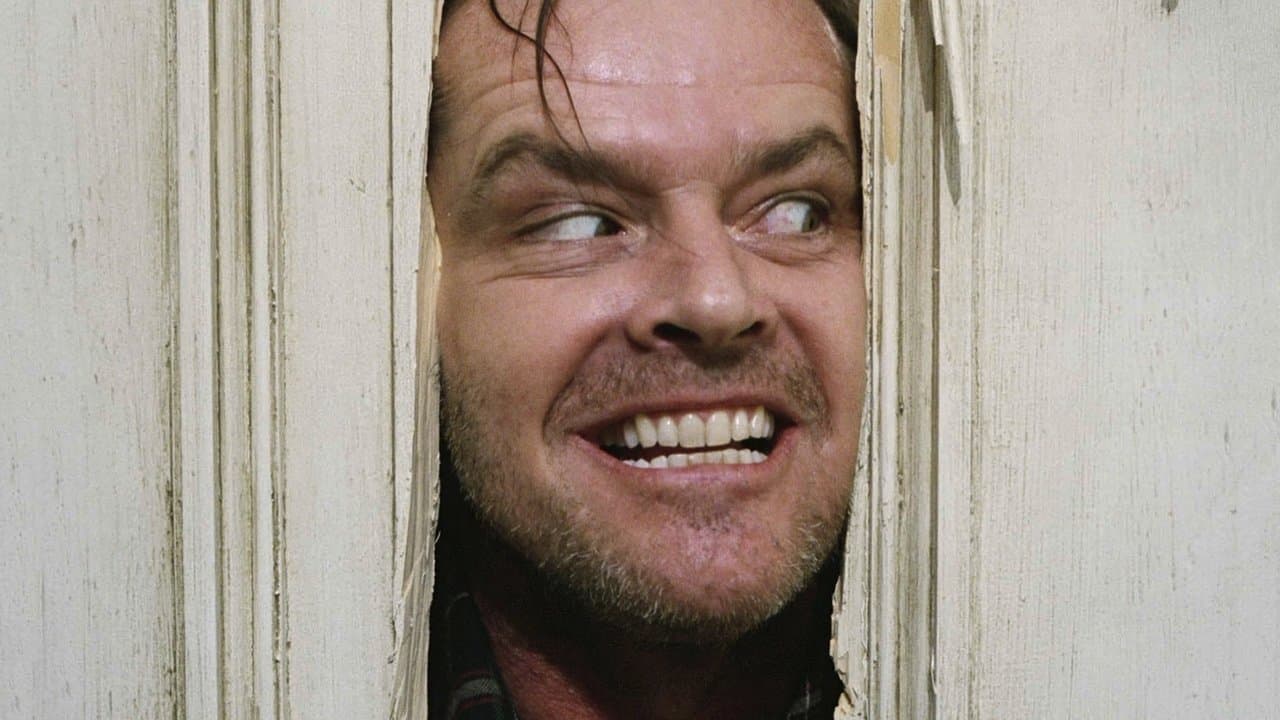
Jack Nicholson ad-libbed "Heeeere's Johnny!" through the splintered bathroom door, riffing on Ed McMahon's nightly introduction of Johnny Carson on The Tonight Show. Kubrick, who had lived in England for years and didn't know the catchphrase, was baffled and seriously considered using a different take. The line stayed, and in 2005 it ranked #68 on AFI's 100 Years...100 Movie Quotes. The scene around it was its own ordeal: by Shelley Duvall's account, the door-axing sequence took three days and burned through roughly sixty doors.
16
The Final Photo Is Real — From the Wrong Party
Hidden DetailBehind the Scenes✓ ConfirmedSecond Watch
WHERE TO LOOK · The slow dolly into the framed photo on the lobby wall, the film's final shot.
The last shot tracks into a lobby photograph captioned "Overlook Hotel — July 4th Ball, 1921," with Jack grinning front and center, decades before his birth. Kubrick told Michel Ciment it "suggests the reincarnation of Jack." The image itself is a real archival photograph: after staged versions with extras disappointed him, Kubrick found a period print in a picture library and had Nicholson photographed to match its angle, lighting, and film grain, then airbrushed in. Decades later, researchers identified the original: it was taken on February 14, 1921 at a St. Valentine's Day dance in the Empress Rooms of London's Royal Palace Hotel — not a July 4th ball, and not in Colorado.
Spoiler — tap to reveal
17
Kubrick Cut the Real Ending Days After Opening Night
Behind the Scenes✓ ConfirmedWhite Whale
WHERE TO LOOK · Originally placed between Jack frozen in the hedge maze and the final dolly to the photograph.
Audiences at the first Los Angeles and New York screenings saw a two-minute epilogue between Jack's death in the maze and the 1921 photograph: Ullman visits Wendy in the hospital, reassures her, and — chillingly — tosses Danny the yellow tennis ball that lured him into Room 237. Days into release, Kubrick decided the scene deflated the climax ("I decided the scene was unnecessary," he said in a phone statement) and dispatched assistants to physically snip it out of prints in theaters. All known copies were reportedly destroyed; only script pages, continuity Polaroids, and trims in the Stanley Kubrick Archive survive, making it one of horror's most famous pieces of lost media.
Spoiler — tap to reveal
18
Stay Through the Credits: The Ball Applauds
Music SecretMeta◆ Community ConsensusWhite Whale
WHERE TO LOOK · The very end of the closing credits — audio only, after the ballroom song finishes.
Kubrick scores the end credits with the same 1930s recording heard in the Gold Room — Al Bowlly-era ballroom music drifting through the empty lobby. Listen past the final note: after "Midnight, the Stars and You" ends, an audience can be heard applauding and murmuring among themselves before fading away. The implication lands like a post-credits scene decades before they existed — the Overlook's party is still going, and it always will be. IMDb catalogs it on the film's Crazy Credits page, and it's the reason Shining devotees never cut the credits short.
Is there a post-credit scene in The Shining?
No — The Shining has no post-credit scene. No post-credits scene — but don't mute the credits. After the ballroom song "Midnight, the Stars and You" finishes over the end titles, you can hear the Gold Room crowd applaud and chat before fading out, as if the Overlook's party never stopped. Historical footnote: 1980 opening-week audiences saw a two-minute hospital epilogue before the final photo, which Kubrick cut from prints days into release.
Frequently asked
+How many easter eggs are in The Shining?
We've documented 18 verified easter eggs and hidden details in The Shining, 8 of them confirmed by official sources like Kubrick's Michel Ciment interviews, crew statements, and archive material. They range from plain-sight moments (the improvised "Here's Johnny!") to white-whale finds like the four-language "All work and no play" inserts and the ghostly applause hidden after the end credits. Counts labeled as theories — like the Apollo 11 moon-landing reading — are marked separately.
+What does Room 237 mean in The Shining?
In Stephen King's novel the haunted room is 217, but Timberline Lodge — the Oregon hotel used for exteriors — asked Kubrick to change it, fearing guests would avoid the real Room 217. Kubrick chose 237 because no such room exists at the lodge. The switch backfired: Room 217 is now Timberline's most-requested room. Theorists have since piled meanings onto 237, from 2×3×7=42 numerology to the Earth-Moon distance, none of them confirmed.
+Why is Jack in the photo at the end of The Shining?
Kubrick answered this directly in his interview with critic Michel Ciment: the 1921 ballroom photograph "suggests the reincarnation of Jack." Jack is part of an evil cycle the hotel keeps replaying — as Grady tells him, "You've always been the caretaker." The photo itself is a real 1921 print from a London hotel dance; Nicholson's face was photographed to match its grain and lighting, then airbrushed in.
+Is the Overlook Hotel's layout in The Shining really impossible?
Yes, and on purpose. Ullman's office has a sunlit exterior window despite a corridor running directly behind it, hallways loop in ways no floor plan supports, and the Colorado Lounge is too large for the building containing it. Executive producer Jan Harlan confirmed the sets were "very deliberately built to be offbeat and off the track" so audiences never quite know where they are — subliminal spatial wrongness as a horror device.
+Did Jack Nicholson improvise "Here's Johnny!" in The Shining?
Yes. Nicholson ad-libbed the line while axing through the bathroom door, parodying Ed McMahon's nightly Tonight Show introduction of Johnny Carson. Kubrick, who had lived in England for years, didn't recognize the catchphrase and nearly used a different take. The line stayed and ranked #68 on AFI's 100 Movie Quotes list in 2005. Per Shelley Duvall, the sequence took three days to shoot and used around sixty doors.
Last updated 2026-07-08 · Spotted something we missed? Tell us.