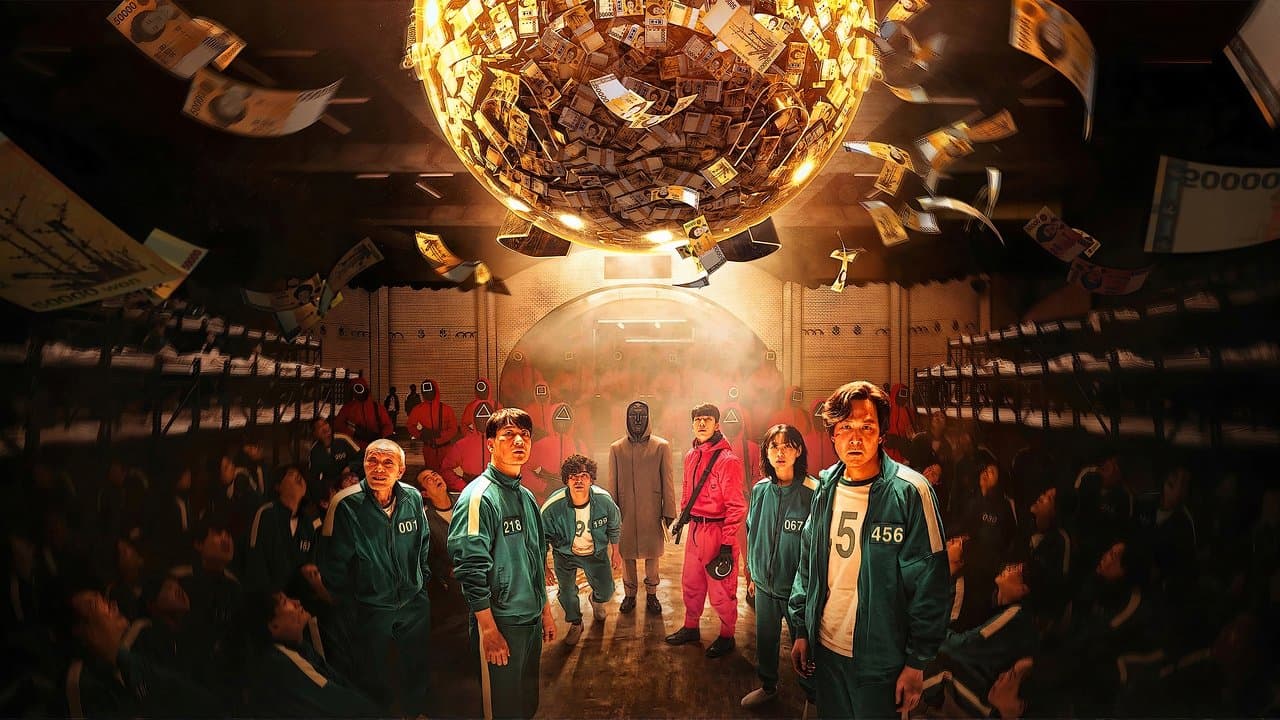
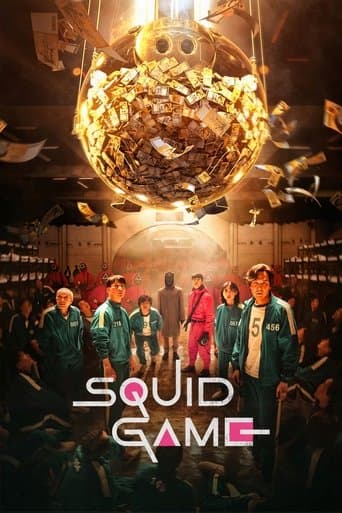
The answer key was hanging over the players' beds the entire time. Squid Game's season 1 dormitory hides faint murals of all six games — from Red Light, Green Light to the squid court itself — behind the stacked bunks, and the artwork only emerges as players die and their beds are hauled away. Creator Hwang Dong-hyuk has confirmed the cruelty was deliberate: the solution was always in the room, but the contestants were too busy turning on each other to look up.
That's the thing about this show — Hwang wrote and directed every episode himself, so the foreshadowing runs unusually deep. Episode 2 quietly rehearses every major character's death out in the real world, and the killer doll's targeting scanner treats Player 001 differently in the very first game, hours of screen time before the Host twist lands. Even the invitation card Gi-hun receives in the subway diagrams the island's entire command structure in three shapes.
Seasons 2 and 3 escalate the game: a Latin epitaph replaces the murals on the dorm walls, the franchise's only post-credits scene introduces a second killer doll, and the 2025 finale stacks a hidden cameo by Hwang himself next to one of the most talked-about surprise appearances in Netflix history. Below, 18 documented eggs in story order — verification labels tell you which ones are creator-confirmed and which are community finds.
The full catalog
Type
Status
Difficulty
01
The Invitation Card's Shapes Map the Island's Hierarchy
S1E1
Hidden DetailForeshadowing◆ Community ConsensusDeep Cut
WHERE TO LOOK · The recruiter hands Gi-hun the card in the subway station after the ddakji match
The business card the ddakji recruiter hands Gi-hun carries a circle, a triangle, and a square — the exact symbols worn on the masks of the island's staff, where circles mark workers, triangles mark armed soldiers, and squares mark managers. In other words, the invitation quietly diagrams the games' entire command structure before Gi-hun ever boards the van. Fans have layered a second reading on top: the three shapes resemble the Korean letters ㅇ, ㅈ, and ㅁ — the initials of 'Ojingeo Geim,' the show's Korean title, literally 'Squid Game.'
02
The Card's Phone Number Was Real — Netflix Had to Edit It Out
S1E1
Behind the ScenesMeta✓ ConfirmedDeep Cut
WHERE TO LOOK · Close-up of the business card's reverse side after the subway ddakji match
The eight-digit number printed on the recruiter's card belonged to a real South Korean woman, Kim Gil-young, who used it for her business. After the show premiered in 2021 she was flooded with calls and texts around the clock — she reported deleting more than 4,000 numbers from her phone as curious fans dialed in hoping to join the games. Netflix and production company Siren Pictures announced they were 'editing scenes with phone numbers where necessary,' and the on-screen number was later replaced with the truncated, uncallable 010-034. When the card returns in season 2, the real number is gone for good.
03
'Fly Me to the Moon' Scores the First Massacre
S1E1
Music Secret✓ ConfirmedSecond Watch
WHERE TO LOOK · The Red Light, Green Light massacre montage as players panic and run
As Young-hee's motion sensors gun down half the field in Red Light, Green Light, the soundtrack floats a dreamy Korean-accented cover of 'Fly Me to the Moon,' arranged by composer Jung Jae-il and sung by Joo Won Shin. The singer revealed that Hwang Dong-hyuk wanted the collision between the song's 'romantic and beautiful lyrics and melody' and the on-screen slaughter to embody 'the increasingly polarized capitalist society that we live in today in a very compressed and cynical way.' The standard returns in season 2's replay of the same game, turning one music cue into a franchise-wide death knell.
04
The Doll's Kill-Cam Won't Target Player 001
S1E1
Hidden DetailForeshadowing◆ Community ConsensusFreeze Frame
WHERE TO LOOK · Young-hee's scanner POV shots during Red Light, Green Light
In Young-hee's X-ray-style POV shots during Red Light, Green Light, moving players are picked out with bright white motion-tracking highlights an instant before they're shot. Watch Il-nam: the scanner never flags him the way it flags everyone else, even as he giggles and stumbles his way forward. On a first watch it reads like an old man getting lucky — on a rewatch it's the earliest visual hint that Player 001 was never in danger, because the game's own systems knew exactly who he was.
Spoiler — tap to reveal
05
The Dorm Walls Spoil All Six Games From Night One
S1E2
Hidden DetailForeshadowing✓ ConfirmedFreeze Frame
WHERE TO LOOK · Dormitory walls behind the bunk stacks — increasingly visible after each elimination round
Behind the towers of bunk beds, the season 1 dormitory walls carry pale, childlike drawings of every game on the schedule: Red Light, Green Light; the dalgona shapes; tug of war; marbles; the glass stepping stones; and the squid court itself. The production removes beds as players die, so the full mural only becomes legible near the endgame — by which point it's far too late to be useful. Hwang Dong-hyuk confirmed the placement was intentional: he wanted it to feel like the answers were right there all along if the players had stopped fighting long enough to notice, while clarifying the walls were an easter egg for the audience rather than an in-world rulebook.
06
Episode 2 Quietly Rehearses Every Major Death
S1E2
Foreshadowing◆ Community ConsensusSecond Watch
WHERE TO LOOK · Each main character's real-world storyline during the mid-game recess in Seoul
'Hell,' the episode where the players return to their real lives, doubles as a prophecy reel. Sang-woo attempts suicide in a bathtub with a burning briquette — he later takes his own life so Gi-hun can win. Sae-byeok presses a knife to a broker's throat — Sang-woo kills her with a blade to the throat in episode 8. Ali has his wages stolen by his boss — then has his marbles stolen by Sang-woo. Deok-su leaps off a bridge to escape gangsters — and later plummets from the glass bridge. Even Gi-hun casually swearing on his mother's life pays off with devastating irony when he returns home in the finale.
Spoiler — tap to reveal
07
Haydn Wakes Them, Strauss Marches Them to Their Deaths
Music Secret◆ Community ConsensusSecond Watch
WHERE TO LOOK · The dormitory PA system each morning and before every game across season 1
The island runs on classical music like a genteel office building. Every morning the players are jolted awake by the third movement of Joseph Haydn's Trumpet Concerto in E-flat major, and each new game is announced with Johann Strauss II's 'The Blue Danube' — a waltz most viewers associate with elegance and space ballets, here repurposed as a march to the killing floor. The polite, bureaucratic cheer of the cues against the brutality of the games is the show's soundtrack thesis in miniature: the system smiles while it kills.
08
No Lock on Il-nam's Tug-of-War Cuff
S1E4
Hidden DetailForeshadowing◆ Community ConsensusFreeze Frame
WHERE TO LOOK · As the team is chained up on the tug-of-war platform — compare the players' wrist cuffs
When Gi-hun's team is shackled to the tug-of-war rope, every player's wrist cuff is secured with a visible padlock — except Player 001's. A TikTok freeze-frame made the detail famous, and it slots neatly beside Il-nam's suspiciously expert tug-of-war strategy: the old man who 'played these games as a kid' arrives with a championship-level playbook and a restraint he could slip at any moment. The games were never going to let their own architect get dragged off a ledge.
Spoiler — tap to reveal
09
The Player Files Start at 002
Hidden DetailForeshadowing◆ Community ConsensusDeep Cut
WHERE TO LOOK · Jun-ho searching the player records in the island's archive room
While undercover, detective Jun-ho combs through the island's archive of player dossiers — and the records begin at Player 002. There is simply no file on 001, because the games' owner was never scouted, vetted, or in debt like everyone else. It pairs with a naming joke hiding in plain sight: 'Il-nam' translates roughly to 'first man,' with 'il' meaning one — the show tells you he's number one in every sense from his first scene.
Spoiler — tap to reveal
10
The Marbles Village Is Hwang's Own Childhood Alley
S1E6
Behind the Scenes✓ ConfirmedWhite Whale
WHERE TO LOOK · The sunset alley arena of the marbles game
The twilight neighborhood where the marbles game plays out isn't a generic retro set — production designer Chae Kyoung-sun built it from Hwang Dong-hyuk's memories of playing in the alleys of Ssangmun-dong, at the exact golden hour when his mother would call him home for dinner. Chae studied photographer Kim Ki-chan's images of 1970s–80s Seoul alleyways to get the texture right, and the set deliberately contains only alleys — there are no actual homes behind the facades. The 'Gganbu' set earned Chae an Emmy nomination, and Ssangmun-dong is also Gi-hun and Sang-woo's home neighborhood in the story, folding the creator's nostalgia into his characters'.
11
The VIPs Wear Golden Predators
S1E7
Hidden Detail◆ Community ConsensusSecond Watch
WHERE TO LOOK · The VIP lounge as the guests settle in to watch the glass bridge game
When the foreign billionaires arrive to watch the endgame in person, each hides behind a unique gilded animal mask — lion, tiger, bear, bull, deer among them. The gold telegraphs wealth, but the menagerie is the real message: these are apex predators gathering to watch prey fight, a costume choice that says the quiet part about how they see the players. Fan readings go further, mapping animals to professions — the bull as a nod to stock-market bulls, the deer as a divine messenger figure in Korean tradition — and unlike the anonymized circle-triangle-square staff, every VIP mask is one of a kind, because even their anonymity has to be exclusive.
12
'Oh Young-il' Echoes 'Oh Il-nam'
S2E3
CallbackForeshadowing◆ Community ConsensusDeep Cut
WHERE TO LOOK · In-ho introduces himself to Gi-hun as Player 001, 'Oh Young-il'
When the Front Man infiltrates the season 2 games wearing Player 001's number, his alias is 'Oh Young-il' — sharing the relatively uncommon surname Oh with the original 001, Oh Il-nam, in a country where roughly half the population is a Kim, Lee, or Park. The episode he debuts in is even titled '001.' The name is only half the egg: Young-il claims to be lactose intolerant, echoing Il-nam's season 1 line that his son couldn't drink milk either — a detail that launched the still-unconfirmed fan theory that In-ho is Il-nam's son. At minimum, it's the show admitting history is repeating: a plant wearing 001 befriends Gi-hun all over again.
Spoiler — tap to reveal
13
The Franchise's Only Post-Credits Scene: Young-hee Gets a Boyfriend
S2E7
ForeshadowingMeta✓ ConfirmedSecond Watch
WHERE TO LOOK · After the credits of the season 2 finale
Sit through the season 2 finale's credits and you get the series' single true post-credits scene: surviving players are marched into a new arena at sunset and stare up at Young-hee — now joined by Cheol-su, a giant boy doll in a green cap. Hwang Dong-hyuk confirmed Cheol-su was the tease for what he called season 3's most exciting game, the deadly jump rope challenge, and he had actually name-dropped 'Young-hee's boyfriend, Cheol-su' as far back as 2022. Both dolls are named after the lead characters of the Korean elementary school textbooks used nationwide from 1948 to 1987 — the country's equivalent of Dick and Jane, weaponized.
14
The Latin on the New Dorm Walls: 'Me Today, You Tomorrow'
Hidden DetailForeshadowing✓ ConfirmedDeep Cut
WHERE TO LOOK · Painted across the dormitory walls throughout seasons 2 and 3
The seasons 2 and 3 dormitory swaps the game murals for something bleaker: the Latin phrase 'Hodie mihi, cras tibi' painted across the walls — a traditional cemetery epitaph meaning 'today it's me, tomorrow it's you.' Hwang Dong-hyuk explained the intent as 'I'm the one inside the coffin today, and it will be you tomorrow' — death in the games belongs to everyone eventually. The production design team layered the theme throughout the room: figures of hanging bodies reflecting the players' psychological state, and a checkerboard pattern of crosses deliberately designed to resemble a graveyard.
15
A Killer Hums iKON's 'Love Scenario' During Hide-and-Seek
Music SecretReference◆ Community ConsensusDeep Cut
WHERE TO LOOK · During the hide-and-seek game, as Nam-gyu taunts Myung-gi
In season 3's hide-and-seek game, the unhinged Nam-gyu sings 'Love Scenario' — iKON's massive 2018 K-pop hit — while menacing fellow player Myung-gi. The song choice is a pitch-black joke for Korean viewers: 'Love Scenario' was so catchy that elementary schoolers sang it constantly (some schools reportedly discouraged it), making it roughly the least threatening song in the country. Hearing it repurposed as a hunter's taunt in a kill-or-be-killed children's game is exactly the kind of innocence-turned-menace the whole franchise is built on.
16
The Creator Paints Himself Into the Finale
S3E6 · 0:31:55
CameoMeta✓ ConfirmedWhite Whale
WHERE TO LOOK · Among the street portrait painters — check behind the artists' desks for a white shirt and grey hat
Before season 3 dropped, Hwang Dong-hyuk announced he'd hidden a cameo in the season and challenged fans to find him. The answer: roughly 32 minutes into the series finale, he's sitting behind one of the portrait artists' desks in a white shirt and grey bucket-style hat, quietly sketching while the story moves past him. It's a fitting sign-off — the man who drew up every game in the franchise appears one last time as, literally, an artist at work. Blink and you'll scroll right past the most authoritative easter egg in the show.
17
Cate Blanchett Is Playing Ddakji in a Los Angeles Alley
S3E6
CameoCallback✓ ConfirmedPlain Sight
WHERE TO LOOK · The very last scene: an LA alley seen from the Front Man's car
The final scene of the entire series hands the recruiter's ddakji tiles to Cate Blanchett. As the Front Man rides through Los Angeles, he hears the familiar slap of folded paper and spots her in a back alley, running Gong Yoo's exact subway routine on a desperate American — then trading a knowing look with him before returning to her mark. Hwang Dong-hyuk said he wanted a female recruiter because it would be 'more dramatic and intriguing,' and cast Blanchett because 'she's just the best, with unmatched charisma': 'If Gong Yoo is the Korean Recruiter, I thought she would be the perfect fit as the American Recruiter.' One image confirms the games are a global franchise — and that the story never really ends.
Spoiler — tap to reveal
18
The Child Actors Kept Their Roles for Four Years
S3E6
Behind the ScenesCallback◆ Community ConsensusDeep Cut
WHERE TO LOOK · Ga-yeong in the Los Angeles epilogue; Cheol in the season's Seoul scenes
Season 3 quietly reunites two faces from 2021: Jo Ah-in returns as Ga-yeong, Gi-hun's daughter, and Park Si-wan as Cheol, Sae-byeok's little brother — the same performers from season 1, now visibly older because the story's timeline aged alongside them. It pays off hardest in the finale, when the money and the responsibility Gi-hun and Sae-byeok fought for finally reach the children they were fighting for. In an era where long-gap productions routinely recast kids, keeping both actors is a continuity flex most viewers never clock.
Spoiler — tap to reveal
Is there a post-credit scene in Squid Game?
Yes — Squid Game has 1 post-credit scene. Across all three seasons there is exactly one post-credits scene: after the season 2 finale (S2E7), surviving players face Young-hee and a brand-new boy doll, Cheol-su — creator-confirmed as the tease for season 3's jump rope game. Seasons 1 and 3 have nothing after the credits; season 3's Cate Blanchett scene plays before they roll.
Frequently asked
+How many easter eggs are in Squid Game?
We've catalogued 18 significant easter eggs across Squid Game's three seasons, from the dorm-wall murals that spoil all six games to Hwang Dong-hyuk's hidden cameo as a portrait painter in the finale. Eight of the 18 are officially confirmed by the creator, production designer Chae Kyoung-sun, or Netflix; the rest are well-documented community finds like the missing padlock on Il-nam's tug-of-war cuff.
+What do the drawings on the walls in Squid Game mean?
In season 1, the dormitory walls carry faint murals of all six games — Red Light Green Light, dalgona, tug of war, marbles, glass bridge, and the squid game — hidden behind bunk beds and revealed as players die. Hwang Dong-hyuk confirmed this was deliberate foreshadowing for viewers. In seasons 2 and 3, the walls instead read 'Hodie mihi, cras tibi,' a Latin epitaph meaning 'me today, you tomorrow.'
+Is the phone number on the Squid Game business card real?
It was. The eight-digit number on the recruiter's card belonged to a real South Korean woman who was flooded with thousands of calls and texts after the 2021 premiere — she reported deleting over 4,000 numbers from her phone. Netflix confirmed it was editing the scenes, and the number was replaced on-screen with the truncated, uncallable 010-034.
+Does Squid Game have a post-credit scene?
Only once in the whole series: the season 2 finale hides a post-credits scene in which players are marched before Young-hee and a new giant doll, Cheol-su, teasing season 3's jump rope game. Hwang Dong-hyuk confirmed the tease himself. Seasons 1 and 3 have no post-credits scenes — season 3's final Cate Blanchett moment plays before the credits roll.
+Who is the American recruiter at the end of Squid Game season 3?
Cate Blanchett. In the series' final scene, she plays ddakji with a down-on-his-luck man in a Los Angeles alley, mirroring Gong Yoo's Korean recruiter from episode one. Hwang Dong-hyuk said a female recruiter felt 'more dramatic and intriguing' and called Blanchett 'the best, with unmatched charisma.' Her appearance signals that the games operate worldwide — and are still running.
Last updated 2026-07-08 · Spotted something we missed? Tell us.