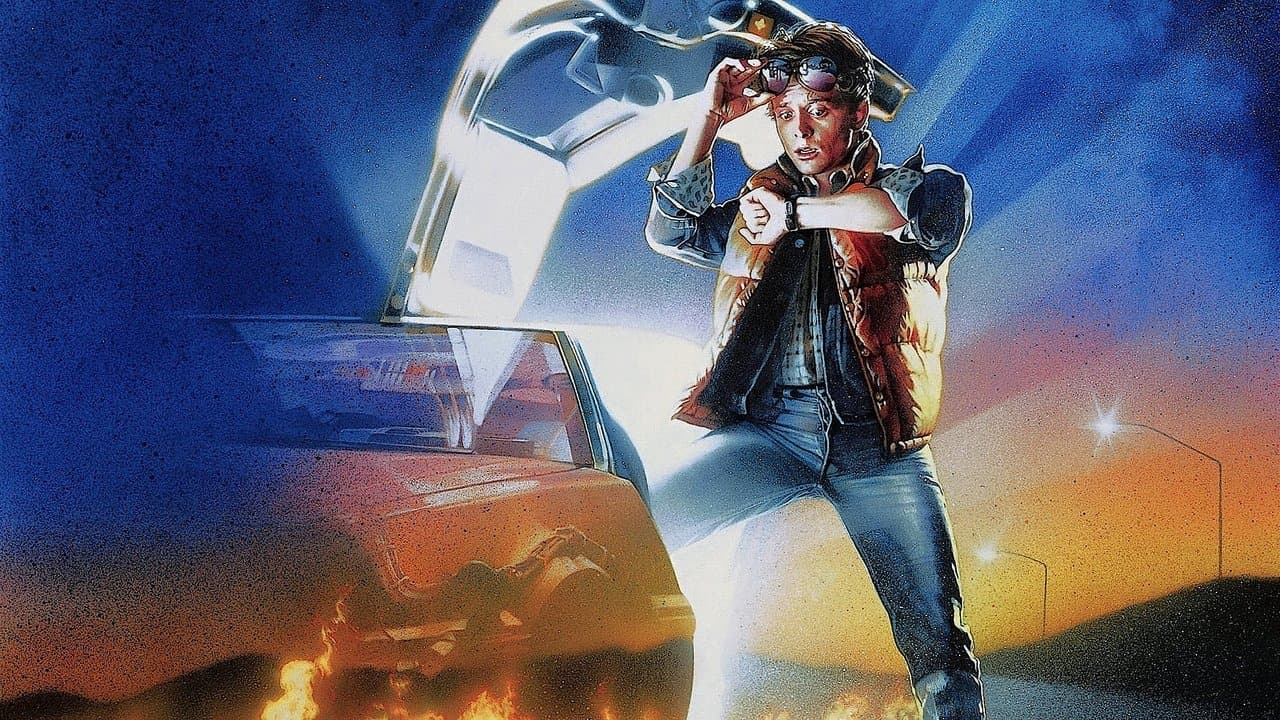
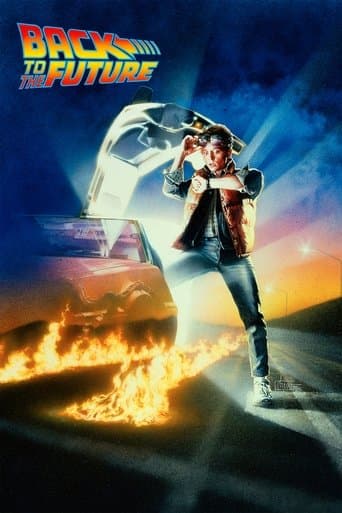
A single pine tree is doing more narrative work in Back to the Future than entire acts of other blockbusters. When Marty McFly flees the Libyans at Twin Pines Mall and flattens one of Old Man Peabody's saplings in 1955, the sign quietly reads Lone Pine Mall on his return — no dialogue, no camera push-in, just the tidiest demonstration of cause-and-effect in time-travel cinema. Robert Zemeckis and Bob Gale built the whole film this way: nearly every gag in the first act is a loaded gun that fires in the third.
That discipline is why the movie keeps giving up new secrets four decades on. The opening pan across Doc's clock collection sneaks in a tiny Harold Lloyd dangling from a clock face, telegraphing the clock-tower climax before a single line is spoken. A cassette labeled Edward Van Halen hides a real, uncredited guitar contribution the man himself only copped to decades later. Even the theater marquees are talking — one of them is the last surviving trace of a completely different, atomic-bomb-powered version of the script.
Universal's 40th-anniversary IMAX and 4DX re-release in October 2025 sent a new generation frame-hunting through Hill Valley. This guide collects the details that are actually documented — from plain-sight jokes to commentary-track deep cuts — in roughly the order the film serves them up.
The full catalog
Type
Status
Difficulty
01
Harold Lloyd hangs from a clock before Doc does
Hidden DetailForeshadowing✓ ConfirmedDeep Cut
WHERE TO LOOK · Opening credits pan across Doc's garage, on a shelf among the ticking clocks
The famous opening pan across Doc's garage — every clock synchronized 25 minutes slow — includes a novelty clock with silent-film star Harold Lloyd dangling from its hands, recreating the skyscraper stunt from Safety Last! (1923). It is a planted image of exactly how the movie ends: Doc hanging off the Hill Valley clock tower to reconnect the lightning cable. Co-writer Bob Gale has said the team knew they had to feature the Lloyd homage, and the clock-tower face even uses the non-standard 'IV' numeral seen on the clock in Lloyd's film instead of the traditional 'IIII'.
02
Marty's jacket badge is from a 1971 Soviet art exhibition
Hidden DetailBehind the Scenes◆ Community ConsensusWhite Whale
WHERE TO LOOK · Marty's denim jacket, worn through most of the 1985 scenes — clearest in close-ups
Pinned to Marty's denim jacket is a badge reading 'Art in Revolution' — merchandise from a real 1971 exhibition of Soviet revolutionary art and design at London's Hayward Gallery. Nobody has ever fully explained how a Hill Valley teenager ended up wearing Cold War-era gallery swag in 1985, which is exactly what makes it a costume-department white whale: it took decades of freeze-framing for fans to even identify what the badge says.
03
The giant amp is labeled CRM-114 — a Kubrick code
ReferenceHidden Detail◆ Community ConsensusDeep Cut
WHERE TO LOOK · Doc's garage, opening scene — stenciled on the huge speaker cabinet Marty plugs into
The oversized speaker rig that blasts Marty across Doc's garage carries the model number CRM-114. That's Stanley Kubrick's recurring in-joke: the CRM-114 is the B-52's radio discriminator in Dr. Strangelove, and variations of the code resurface in A Clockwork Orange (the 'Serum 114' injection) and elsewhere in his filmography. Zemeckis and Gale borrowing it for Doc's absurdly overpowered amplifier is a film-nerd handshake hiding in the very first scene.
04
The Statler dealership sells whatever the era drives
Hidden DetailCallbackBehind the Scenes◆ Community ConsensusFreeze Frame
WHERE TO LOOK · Heard in a 1985 radio ad; seen as Statler Studebaker on the 1955 Hill Valley town square
A radio ad in the 1985 scenes plugs Statler Toyota — and when Marty lands in 1955, the dealership on the town square is Statler Studebaker. The gag keeps compounding across the trilogy: by 2015 in Back to the Future Part II it's Statler Pontiac, and in 1885 it's Honest Joe Statler's fine horses. One family business, four eras, and a world-building joke you only assemble by watching the background of every square scene.
05
Huey Lewis rejects his own song at the band audition
CameoMusic SecretMeta✓ ConfirmedSecond Watch
WHERE TO LOOK · The school gym audition scene, early in the film — the judge at the center table with the megaphone
The bespectacled audition judge who tells Marty's band, the Pinheads, that they're 'just too darn loud' is Huey Lewis — and the song the Pinheads are butchering is a hard-rock instrumental of Lewis's own 'The Power of Love', the film's chart-topping theme. Lewis has said the stone-faced character was inspired by a Chrysalis Records executive. It's a double-layered cameo: the man who wrote the movie's anthem coolly rejecting it as high-school noise.
06
The number 1.21 haunts the Twin Pines Mall experiment
Hidden DetailForeshadowing◆ Community ConsensusFreeze Frame
WHERE TO LOOK · Twin Pines Mall parking lot — watch Einstein's stopwatch and the DeLorean's time readouts
The DeLorean needs 1.21 gigawatts to travel through time — and the movie seeds that number before Doc ever says it. Einstein's stopwatch during the first temporal experiment ticks from 1:20 to 1:21 of elapsed time, and the mall experiment itself unfolds in the 1:15-1:30 a.m. window, with the dog completing his one-minute jump into the future as the readouts land on the magic figure. It's the kind of numeric rhyme Zemeckis and Gale threaded through the film for viewers with a pause button.
07
The first time traveler is a dog — a Disney in-joke
ReferenceBehind the Scenes✓ ConfirmedWhite Whale
WHERE TO LOOK · The Twin Pines Mall experiment — Einstein in the DeLorean's driver's seat
Doc sending Einstein one minute into the future in a remote-controlled car isn't just a proof of concept; per co-writer Bob Gale, the world's first canine time traveler is a nod to Disney's 1959 comedy The Shaggy Dog, about a boy who transforms into a sheepdog. It fits the film's pattern of smuggling in the sci-fi and family movies that shaped its writers — the kind of detail that only surfaced through crew interviews and commentary coverage.
08
Twin Pines Mall becomes Lone Pine Mall
Hidden DetailCallback✓ ConfirmedSecond Watch
WHERE TO LOOK · Compare the mall sign in the first act's experiment scene with the sign when Marty returns at the end
The canonical hidden detail in all of time-travel cinema. The mall where Doc unveils the DeLorean is Twin Pines Mall — named, as Old Man Peabody's 1955 dialogue establishes, for the two pines on his ranch, where he was breeding pine trees. Fleeing Peabody's shotgun, Marty mows one sapling down. When he skids back into the parking lot at the end of the film, the sign now reads Lone Pine Mall. No one comments on it; the timeline just quietly absorbs the change. The detail went viral all over again in 2021 when a TikTok breakdown racked up over 32 million views from viewers who had never clocked it, and Back to the Future Part III later paid it off with a Lone Pine tombstone gag Bob Gale has discussed.
09
Sherman Peabody and the EC-style alien comic
ReferenceHidden Detail◆ Community ConsensusDeep Cut
WHERE TO LOOK · The Peabody farm, right after Marty arrives in 1955 — check the comic cover and the end credits
The farm the DeLorean crashes into belongs to the Peabody family, and the son clutching the comic book is credited as Sherman — making the pair 'Peabody and Sherman', the time-traveling dog-and-boy duo from Rocky and Bullwinkle's WABAC machine segments. The comic Sherman brandishes as proof of aliens, Tales from Space, is its own layered gag: the production mock-up apes the logo and cover styling of EC Comics, the notorious 1950s publisher of Tales from the Crypt. A farm scene built entirely out of 1950s pop-culture sediment.
10
Ronald Reagan is playing at the Essex Theater
Hidden DetailForeshadowingBehind the Scenes◆ Community ConsensusSecond Watch
WHERE TO LOOK · Essex Theater marquee as Marty enters the 1955 town square
When Marty first walks the 1955 town square, the Essex Theater marquee advertises Cattle Queen of Montana, a real 1954 Western 'starring Barbara Stanwyck and Ronald Reagan'. The set-up pays off minutes later when Marty tells 1955 Doc that Reagan is president in 1985 and Doc erupts: 'Ronald Reagan? The actor?!' The marquee makes the joke a two-parter — the future president is literally on a B-movie poster behind Marty's head. Reagan himself loved the gag enough to quote the film in his 1986 State of the Union address.
11
Both McFly households watch the same Honeymooners episode
ReferenceForeshadowingCallback◆ Community ConsensusDeep Cut
WHERE TO LOOK · The 1985 McFly dinner and the 1955 Baines dinner — same show on both TVs
At the 1985 family dinner, the McFlys have The Honeymooners on. In 1955, the Baines family gathers around their brand-new TV set watching the very same episode — 'The Man from Space', in which Ralph Kramden cobbles together a spaceman costume. Marty even blurts out that he's seen it, baffling everyone in 1955. The episode choice is doing double duty: it directly prefigures Marty's own spaceman act in George's bedroom. Eagle-eyed fans note the episode actually aired December 31, 1955 — over a month after Marty's November visit — a wrinkle the filmmakers have long since owned.
12
The pulp magazine that becomes A Match Made in Space
Hidden DetailForeshadowing◆ Community ConsensusDeep Cut
WHERE TO LOOK · George's bedroom, just before the 'Darth Vader' visitation
Beside a sleeping George McFly sits a genuine copy of Fantastic Story, a real science-fiction pulp magazine (the Fall 1954 issue, cover price 25 cents). It quietly establishes George's sci-fi obsession before Marty exploits it — and its lurid cover style is echoed years later in the artwork of A Match Made in Space, the novel George finally publishes in the improved 1985. The prop is the connective tissue between George the doodling dreamer and George the author, and you need a freeze-frame to even notice it exists.
Spoiler — tap to reveal
13
Darth Vader from the planet Vulcan
ReferenceMeta✓ ConfirmedPlain Sight
WHERE TO LOOK · George's bedroom — Marty in the radiation suit with the hair dryer
Marty's hazmat-suited alien alias mashes up the two sci-fi franchises a 1985 teenager would reach for: 'Darth Vader' from Star Wars and the planet Vulcan, Spock's homeworld from Star Trek — both nonsense to a 1955 George, which is the joke. The bit has since gone full circle: the 2025 Star Wars: Visions volume slipped in an official nod to the gag, forty years later, effectively canonizing Marty's bluff inside the galaxy far, far away. In deleted footage, Marty also threatens George with melting his brain, and earlier drafts piled on even more genre references.
14
The 'Edward Van Halen' tape is really Eddie Van Halen
Music SecretCameoBehind the Scenes✓ ConfirmedDeep Cut
WHERE TO LOOK · George's bedroom — freeze on the cassette label as Marty loads the Walkman
The cassette Marty jams into George's Walkman is labeled 'Edward Van Halen' — and the shrieking guitar assault on it was genuinely recorded by Eddie Van Halen. The band wouldn't sign off on using the Van Halen name, but Eddie personally agreed, so the label uses his legal first name instead. He stayed publicly coy for decades before confirming to TMZ in 2012 that the playing was his. The piece isn't a Van Halen track at all — it's original noise connected to his mid-80s film work, engineered to sound like an alien attack to a sleeping 1955 teenager.
15
Marvin Berry gives cousin Chuck 'that new sound'
Music SecretMeta◆ Community ConsensusPlain Sight
WHERE TO LOOK · Enchantment Under the Sea dance — Marvin at the side of the stage during Johnny B. Goode
As Marty rips into 'Johnny B. Goode' at the Enchantment Under the Sea dance, bandleader Marvin Berry phones his cousin Chuck and holds the receiver up: 'You know that new sound you're looking for? Well, listen to this!' It's a full bootstrap-paradox gag — Chuck Berry apparently learning his own signature song, which wouldn't actually be released until 1958, from a kid who learned it from Chuck Berry records. One line of dialogue, an entire causality loop, and one of the most quoted jokes in the film.
16
Marty's solo is a highlight reel of guitar gods who don't exist yet
Music SecretReference◆ Community ConsensusFreeze Frame
WHERE TO LOOK · The climax of Johnny B. Goode at the Enchantment Under the Sea dance
Once 'Johnny B. Goode' goes off the rails, Marty cycles through the signature stage moves of rock's future: Chuck Berry's duck walk, Pete Townshend's windmills and amp-kicking, Jimi Hendrix playing behind his head, Angus Young's floor-spinning schoolboy freakout, and a burst of Van Halen-style two-hand tapping. To Marty it's a greatest-hits medley; to the frozen 1955 crowd it's an alien transmission. 'I guess you guys aren't ready for that yet... but your kids are gonna love it.'
17
The Atomic Kid marquee is a fossil of the original script
Hidden DetailMetaBehind the Scenes✓ ConfirmedFreeze Frame
WHERE TO LOOK · Town Theater marquee, visible during the clock tower climax as Marty departs 1955
As Marty speeds toward the wire on his return trip to 1985, the Town Theater marquee reads The Atomic Kid — a real 1954 Mickey Rooney comedy about a man who survives an atomic blast. Bob Gale has explained it's the last remnant of the screenplay's earliest drafts, in which the time machine wasn't struck by lightning at all: Marty had to drive it into a nuclear test-site detonation to get home, an idea partly inspired by that very film. In the finished movie, the whole abandoned concept lives on only as a theater listing — and the billboard even flickers back into view for a beat when Marty returns to 1985.
18
'To Be Continued...' was never in theaters
MetaBehind the Scenes✓ ConfirmedDeep Cut
WHERE TO LOOK · The final shot of the flying DeLorean — VHS-era releases only
The 'To Be Continued...' card that generations remember from the ending was never shown in cinemas in 1985. Bob Gale has confirmed no sequel was planned during the theatrical run; the graphic was added to the VHS release after Back to the Future Part II got the green light, purely to advertise it. When the film hit DVD in 2002, Gale and Zemeckis had the card removed to restore the original theatrical experience — turning your childhood memory of the ending into a genuine home-video-era easter egg, and a textbook case of the Mandela effect for anyone who swears they saw it on the big screen.
Is there a post-credit scene in Back to the Future?
No — Back to the Future has no post-credit scene. Nothing plays during or after the credits — the film ends with the DeLorean lifting off and Doc's 'Roads? Where we're going, we don't need roads.' The famous 'To Be Continued...' card was a VHS-only addition made after the sequel was greenlit, and it was removed again for the 2002 DVD and later releases.
Frequently asked
+How many easter eggs are in Back to the Future?
This guide documents 18 verified easter eggs and hidden details in Back to the Future (1985), from the Harold Lloyd clock in the opening pan to the VHS-only 'To Be Continued' card. Eight are confirmed on the record by filmmakers or participants — including Bob Gale's Atomic Kid explanation and Eddie Van Halen's 2012 admission — while the rest are widely documented by fans and film press across decades of freeze-frame analysis.
+Why does the mall change from Twin Pines to Lone Pine?
Old Man Peabody's ranch, where Marty lands in 1955, was named Twin Pines for the two pine trees Peabody was breeding out front. Fleeing Peabody's shotgun, Marty runs one of them over in the DeLorean. When he returns to 1985, the mall built on that land — Twin Pines Mall at the start of the film — is now called Lone Pine Mall. It's the film's cleanest illustration that even tiny changes to the past ripple forward.
+Did Eddie Van Halen really play the guitar on Marty's tape?
Yes. The screeching guitar Marty blasts into sleeping George's headphones was recorded by Eddie Van Halen himself, though the band refused use of the Van Halen name — hence the cassette label reading 'Edward Van Halen', his legal first name. Van Halen stayed coy about it for nearly three decades before confirming to TMZ in 2012 that the playing was his. It's original noise, not a track from any Van Halen album.
+Is there a post-credits scene in Back to the Future?
No. Back to the Future has no mid-credits or post-credits scene — the story ends with the DeLorean taking flight and Doc's 'we don't need roads' line before a standard credit roll. The 'To Be Continued...' card many fans remember was added only to the VHS release to promote Part II after the sequel was greenlit, and it was removed from the 2002 DVD onward to match the original theatrical cut.
+What does the Harold Lloyd clock in the opening scene mean?
Among the dozens of clocks in Doc's garage — all running exactly 25 minutes slow — one shows silent-film comedian Harold Lloyd dangling from a clock face, recreating his famous stunt from Safety Last! (1923). It's deliberate foreshadowing: Doc ends the movie hanging from the Hill Valley clock tower in nearly the same pose. Co-writer Bob Gale has said the filmmakers knew they had to feature the Lloyd homage.
Last updated 2026-07-08 · Spotted something we missed? Tell us.