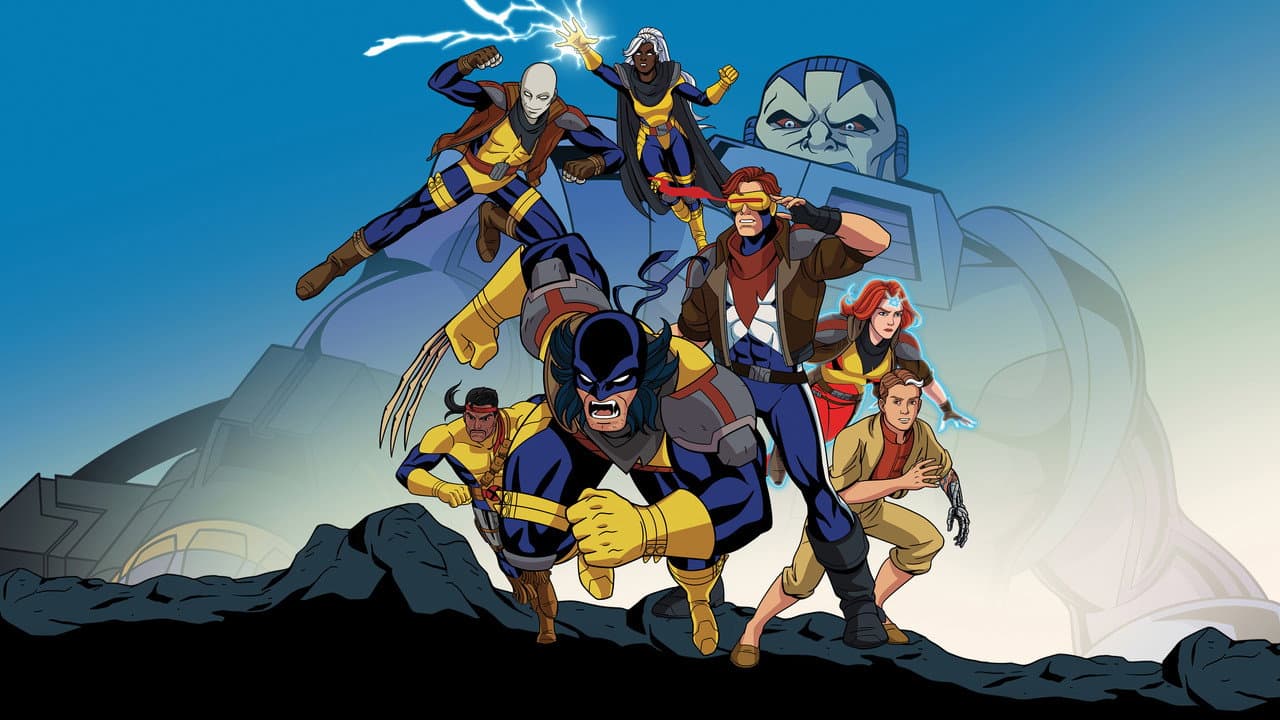
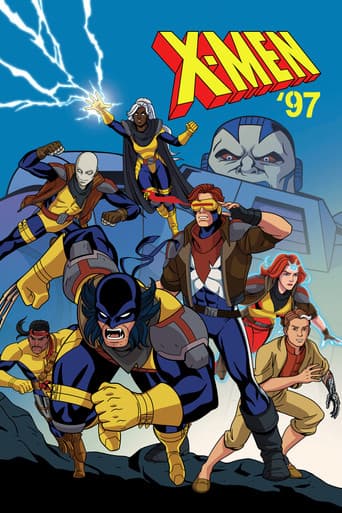
The opening titles are the whole thesis in ninety seconds. Marvel didn't hire someone to imitate the beloved 1992 intro — they brought back Larry Houston, the man who storyboarded and directed the original, and he turned up with his physical boards from thirty years earlier. From there the credits become a living recap that mutates weekly: a character's name card vanishes the episode they die, and Nightcrawler earns his own card the moment he survives Genosha. Miss the titles and you've already missed an easter egg.
Underneath that reverence, showrunner Beau DeMayo and his writers packed almost every frame with comic history and '90s-cartoon deep cuts. Captain America's motorcycle plate reads AVN-A10 — Avengers Annual #10, Rogue's 1981 debut. A silhouette in Genosha's night sky is Uatu the Watcher, quietly filing the show into the same multiverse as Marvel's What If...? And DeMayo has personally confirmed a few of the wildest ones, from the '90s animated Spider-Man swinging past to a villain whose mother first appeared in a 1997 episode.
Below: 20 eggs spanning all ten Season 1 episodes, from the Daily Bugle blowing down Times Square to the finale that strands the X-Men in 3000 BC — where they accidentally rescue their own future worst enemy.
The full catalog
Type
Status
Difficulty
01
The Opening Titles Were Rebuilt From Larry Houston's 30-Year-Old Storyboards
S1E1
Behind the ScenesMetaCallback✓ ConfirmedDeep Cut
WHERE TO LOOK · The opening title sequence; watch the character cards change from episode to episode
The revival's intro isn't a loving imitation — it's the original article, redrawn. Marvel brought back Larry Houston, who storyboarded and directed the 1992 series' iconic title sequence, to oversee the new version, and he showed up with his physical storyboards from three decades earlier. Producer Jake Castorena put it plainly: the team brought "the O.G. man himself" back because "if we don't do that, then we're not the show." Houston worked shot-for-shot with directors Chase Conley and Emi Yonemura, even restoring artwork the 1992 broadcasters had cut. The credits then become a season-long recap: name cards vanish as characters die, and new members like Nightcrawler are quietly added.
02
The Terrified Kid the X-Men Rescue Is a Future New Mutant — Sunspot
S1E1
ReferenceForeshadowing◆ Community ConsensusSecond Watch
WHERE TO LOOK · The cold-open rescue from the Friends of Humanity mob
The premiere opens mid-rescue, with the team saving a panicked teenager named Roberto da Costa from the anti-mutant gang the Friends of Humanity. Casual viewers see a scared kid; comic readers see Sunspot, the solar-powered Brazilian mutant and longtime staple of the New Mutants and X-Force. The show slow-plays his arc across the season — Roberto keeps his powers hidden from his wealthy, status-obsessed mother — but the seed is planted in the first five minutes. Season 2's revamped title sequence later graduates him onto Cable's X-Force team alongside Psylocke and Archangel.
03
The Daily Bugle Blowing Down the Street Has Spider-Man Headlines and a Venom Byline
S1E1
Hidden DetailReference◆ Community ConsensusFreeze Frame
WHERE TO LOOK · The newspaper blowing through the street after the opening city fight
After the opening battle, a newspaper tumbles through the New York streets — freeze it and the whole page is a Marvel in-joke. It's the Daily Bugle, J. Jonah Jameson's tabloid from the '90s Spider-Man cartoon, and one headline asks whether Spider-Man himself might be a mutant while another teases the Hellfire Gala straight out of the comics. The lead article's byline belongs to Eddie Brock — the future Venom — with photos credited to Peter Parker. It's a blink-and-you'll-miss-it stitch quietly binding the '90s Marvel animated shows into one shared universe.
04
The City Skyline Is Papered With MCU Brands: Stark, VistaCorp, WHiH
S1E1
ReferenceHidden Detail◆ Community ConsensusDeep Cut
WHERE TO LOOK · Billboards and signage in the opening act's city backdrops
The New York backdrops are loaded with corporate logos borrowed from the live-action MCU. Eagle-eyed viewers spotted Stark Industries signage, VistaCorp (the company Scott Lang hacked in Ant-Man), and WHiH World News, the in-universe news network that runs through Iron Man, Ant-Man and the Marvel one-shots. They're set dressing rather than plot — and DeMayo has stressed the series is its "own neighboring tree," not literally MCU canon — but the brand cameos keep the cross-universe wink alive.
05
There Are Two Jean Greys — and the Clone Saga Is Straight From the Comics
S1E2
ReferenceForeshadowing◆ Community ConsensusFreeze Frame
WHERE TO LOOK · The reveal that Sinister replaced Jean with a clone
Episode 2 drops a bombshell lifted from one of X-Men's most notorious storylines: the Jean Grey the team has been living with is a clone. Mister Sinister abducted the real Jean and swapped in Madelyne Pryor, a genetic duplicate — the exact engine of the comics' Madelyne Pryor and Inferno sagas. The show even preserves Madelyne's dark destiny as the Goblin Queen. It sets up the season's central tragedy: one Jean carries Scott's baby, the other is manipulated toward villainy, and neither woman knows for certain which of them is the "real" one.
Spoiler — tap to reveal
06
Episode 3 Restages the Dark Phoenix Saga, Down to a Comic Cover
S1E3
ReferenceHidden DetailCallback◆ Community ConsensusDeep Cut
WHERE TO LOOK · Cyclops holding Jean's body; the Marvel Girl costume flashback
"Fire Made Flesh" pours the Dark Phoenix Saga into a single episode, and it recreates specific images from Chris Claremont and John Byrne's landmark run. One shot of Cyclops cradling Jean's limp body directly echoes the cover of Uncanny X-Men #136, and Jean briefly reappears in her original green-and-gold Marvel Girl costume from The Phoenix Saga. The episode also flashes back to the 1990s animated series' own Dark Phoenix arc, stacking cartoon nostalgia on top of the 1980 comics that inspired it in the first place.
Spoiler — tap to reveal
07
Morph's Shapeshifts Are a Rapid-Fire Cameo Reel
S1E3
Hidden DetailReferenceCameo◆ Community ConsensusFreeze Frame
WHERE TO LOOK · Morph's shapeshifting during the mansion sequences
Morph rarely holds one shape for long, and the forms are packed with pulls from X-Men history. In one stretch he becomes Spiral, the six-armed sorceress who debuted in the original series' "Mojovision," and Illyana Rasputina — Colossus's sister Magik — complete with her Soulsword. Across the season his transformations double as sly cameos for characters who never otherwise appear on screen, effectively making a main character's mutant power into a running easter-egg generator.
08
Episode 4 Is a Playable Tribute to the 1992 Konami X-Men Arcade Game
S1E4
ReferenceHidden Detail◆ Community ConsensusFreeze Frame
WHERE TO LOOK · The Mojo video-game levels throughout the episode
"Motendo" traps Jubilee and Sunspot inside a video game built by the reality-warping villain Mojo, and the whole thing is an homage to classic X-Men gaming. The 16-bit levels riff on the beloved 1992 Konami X-Men arcade beat-'em-up, complete with a Days of Future Past "wanted" poster stage and a Savage Land boss fight against the pterodactyl villain Sauron. The climax even has Mojo bursting out of a recreated X-Men arcade cabinet. It's nostalgia aimed squarely at anyone who ever fed quarters into a mall machine.
09
The Game's Hidden Character Is Abscissa — a Tragic Future Jubilee
S1E4
ReferenceBehind the Scenes◆ Community ConsensusDeep Cut
WHERE TO LOOK · Encountered inside the video game as an aged, digital Jubilee
Deep inside Mojo's game, Jubilee meets a grim older version of herself: Abscissa, a deep-cut character from Jubilee's alternate-future comics lore, reimagined here as a surviving beta build stranded in the digital world. It's one of the season's most obscure pulls, rewarding viewers who know Jubilee's variant timelines. Her presence quietly turns a fun arcade episode into a meditation on Jubilee's fear of outliving the friends who raised her.
10
The Song Playing Before Genosha Falls Is a Grimly Chosen Ace of Base Track
S1E5
Music SecretForeshadowing◆ Community ConsensusDeep Cut
WHERE TO LOOK · Magneto and Rogue's dance at the Genosha inaugural gala
In "Remember It," Magneto and Rogue share a slow dance on Genosha to Ace of Base's "Happy Nation" — a needle-drop loaded with meaning. The 1992 single dropped just days after the original X-Men cartoon premiered, anchoring the '90s vibe, but the deeper read is thematic: the song has long carried rumors of far-right subtext, and playing it moments before Genosha's mutant population is massacred layers Magneto's Holocaust history, the coming genocide, and the track's real-world baggage into one devastating scene.
Spoiler — tap to reveal
11
Uatu the Watcher Silently Oversees the Genosha Massacre
S1E5
CameoReference◆ Community ConsensusDeep Cut
WHERE TO LOOK · A figure hovering in the sky over Genosha just before the attack
Just before the Hellfire Gala turns to slaughter, a lone silhouette hangs in Genosha's night sky: Uatu the Watcher, the cosmic observer sworn to witness but never interfere. The cameo does real universe-building — the Watcher is the same figure who narrates Marvel's animated What If...?, so his presence slots X-Men '97 into that wider multiverse. It's a chilling touch: the one being who could halt the coming genocide is contractually bound to simply watch it unfold.
Spoiler — tap to reveal
12
The Fall of Genosha Fuses Three of Marvel's Bleakest Storylines
S1E5
ReferenceCallback◆ Community ConsensusDeep Cut
WHERE TO LOOK · The Sentinel attack on the Genosha gala and its aftermath
The episode-5 massacre isn't one homage — it's three welded together. The Wild Sentinel razing a mutant nation lifts directly from Grant Morrison's "E Is for Extinction," where a rogue Sentinel kills sixteen million mutants on Genosha; the targeting of society's most vulnerable mutants echoes the 1980s "Mutant Massacre"; and a celebratory gala turned bloodbath mirrors the modern "Fall of X" and its Hellfire Gala. "Magneto Was Right" graffiti — a genuine rallying cry from the comics — surfaces as the bodies fall.
Spoiler — tap to reveal
13
Professor X Is Alive in Space — Voiced by a Marvel Impressionist
S1E6
CallbackBehind the Scenes◆ Community ConsensusFreeze Frame
WHERE TO LOOK · Xavier revealed alive with the Shi'ar Empire
"Lifedeath Part 2" confirms Charles Xavier survived, living among the alien Shi'ar as consort to Empress Lilandra — a beat pulled straight from Chris Claremont's comics, where a dying Xavier is healed and romanced in space. There's a casting easter egg too: with original voice actor Cedric Smith not returning full-time, Xavier is voiced by Ross Marquand, the noted impressionist who plays Red Skull and Ultron in the MCU, carefully mimicking Smith's original cadence so the recast is nearly invisible.
Spoiler — tap to reveal
14
Captain America's License Plate Is Rogue's 1981 Comic Debut
S1E7
ReferenceHidden Detail◆ Community ConsensusWhite Whale
WHERE TO LOOK · Captain America's motorcycle at the base; pause on the license plate
When Captain America turns up at a military base in "Bright Eyes," his motorcycle carries a stealth tribute. Freeze on the license plate and it reads AVN-A10 — shorthand for Avengers Annual #10 (1981), the issue that introduced Rogue as a villain who permanently drained Ms. Marvel's powers and psyche. Given the episode is a Rogue showcase, hiding her exact first appearance on Cap's bike is a masterclass in deep-cut referencing. Cap is voiced by Josh Keaton, who also plays Steve Rogers in Marvel's What If...?
15
The Title 'Bright Eyes' Is a Watership Down Song About Death
S1E7
ReferenceMeta◆ Community ConsensusDeep Cut
WHERE TO LOOK · The episode title card
Episode 7's grief-soaked title is a literary pull. "Bright Eyes" is the Art Garfunkel ballad written for the 1978 animated film Watership Down, a song explicitly about the passage from life into death. Dropping it on the episode where the X-Men mourn Gambit and the Genosha dead — with Nightcrawler delivering a eulogy — is a quiet, devastating choice that trusts viewers to know their tearjerker soundtracks. The song itself never plays; the entire reference lives in the title card.
16
That's the '90s Animated Spider-Man Swinging Through Episode 8 — Confirmed
S1E8
CameoReference✓ ConfirmedFreeze Frame
WHERE TO LOOK · The worldwide hero montage as the mutant conflict escalates
During episode 8's globe-spanning montage of heroes reacting to the mutant crisis, a familiar web-slinger swings past — and showrunner Beau DeMayo confirmed it's not just any Spider-Man. Asked directly, DeMayo said "It is indeed that Spider-Man," meaning the Peter Parker from the 1994 Spider-Man: The Animated Series, tying the two flagship '90s Marvel cartoons into one shared animated world. He's part of a crowd — Daredevil, Doctor Strange, Cloak & Dagger and more flash by in the same sequence.
17
Doctor Doom and Baron Zemo Sit on Bastion's Secret Council
S1E8
CameoReference◆ Community ConsensusFreeze Frame
WHERE TO LOOK · Bastion's video conference with his OZT backers
Episode 8 reveals the anti-mutant Operation: Zero Tolerance has powerful backers: a shadowy society that includes Doctor Doom and Baron Zemo, conferring with Bastion by video link. Doom's appearance comes with a twist — he objects to the war crime committed against Genosha, a UN-recognized nation, positioning even Marvel's most infamous villain as a man with a line he won't cross. Valerie Cooper's presence in these scenes fueled a popular fan theory that the real Val had secretly been replaced by the shapeshifter Mystique.
Spoiler — tap to reveal
18
Bastion's Mother First Appeared in the Original Cartoon 27 Years Earlier
S1E8
ForeshadowingBehind the ScenesReference✓ ConfirmedWhite Whale
WHERE TO LOOK · Bastion's childhood origin flashback
Episode 8's origin flashback for the villain Bastion isn't invented for the revival — it's a direct sequel to a 1997 episode of the original series. Showrunner Beau DeMayo confirmed that Bastion's mother appeared in X-Men: The Animated Series' time-travel two-parter "One Man's Worth," and publicly urged fans to rewatch it before the episode aired. It's a reward for continuity die-hards: a villain whose lineage was quietly seeded in the parent show nearly three decades before his X-Men '97 introduction.
Spoiler — tap to reveal
19
Magneto Rips the Adamantium From Wolverine, Recreating X-Men #25
S1E9
ReferenceCallback◆ Community ConsensusDeep Cut
WHERE TO LOOK · The North Pole confrontation between Magneto and the X-Men
Episode 9 stages one of the most infamous sequences in X-Men comics: Magneto, pushed past his breaking point, tears the adamantium clean out of Wolverine's skeleton, leaving him with only his bone claws. The moment adapts 1993's X-Men #25 ("Fatal Attractions") almost beat for beat — and it triggers the comics-accurate fallout, as Xavier retaliates by mind-wiping Magneto, planting the seed for Onslaught, the villain born from their merged psyches. It's the show at its most unapologetically comic-faithful.
Spoiler — tap to reveal
20
The Finale Strands the X-Men in 3000 BC to Raise Apocalypse Himself
S1E10
ForeshadowingReference◆ Community ConsensusFreeze Frame
WHERE TO LOOK · The time-displaced X-Men in ancient Egypt; the post-credits Genosha scene
The season-ending cliffhanger scatters Rogue, Nightcrawler, Beast, Xavier and Magneto through time to ancient Egypt in 3000 BC — where they find and rescue a young, injured En Sabah Nur, the mutant who will grow into the immortal villain Apocalypse. In the finale's post-credits tag, present-day Apocalypse walks the ruins of Genosha and picks up Gambit's scorched playing card, ominously baiting Season 2. It's a cruel double hook: the team unknowingly saves the life of their own future greatest enemy.
Spoiler — tap to reveal
Is there a post-credit scene in X-Men '97?
Yes — X-Men '97 has 1 post-credit scene. Unlike its MCU stablemates, X-Men '97 skips credits stingers for most of Season 1 — the big exception is the finale, "Tolerance Is Extinction, Part 3." After the credits, present-day Apocalypse strides through the smoking ruins of Genosha, laments the dead, and stoops to pick up Gambit's burnt playing card — directly seeding En Sabah Nur's Season 2 arc, which pays off the time-displaced X-Men rescuing his younger self in ancient Egypt.
Frequently asked
+How many easter eggs are in X-Men '97?
We track 20 significant easter eggs across X-Men '97's ten Season 1 episodes, from the Daily Bugle's Spider-Man headlines in the premiere to Apocalypse's post-credits appearance in the finale. Three are confirmed on the record by showrunner Beau DeMayo or the production team — the Larry Houston-rebuilt opening titles, the '90s animated Spider-Man cameo, and Bastion's mother from 1997's "One Man's Worth." The rest are heavily documented community finds like Captain America's Avengers Annual #10 license plate.
+Is X-Men '97 connected to the MCU?
Not directly. Showrunner Beau DeMayo described the show as its "own neighboring tree, not a branch of the multiverse MCU tree." That said, the series is packed with MCU nods — Stark Industries and WHiH World News signage, MCU-popularized terms like "Terran," and a cameo from Uatu the Watcher, the same cosmic observer who narrates Marvel's What If...?, which places X-Men '97 within the broader animated multiverse.
+Who is Madelyne Pryor in X-Men '97?
Madelyne Pryor is a genetic clone of Jean Grey created by Mister Sinister, who abducted the real Jean and swapped in the duplicate. The show adapts her comics arc faithfully: Madelyne ends up on Genosha, is manipulated into becoming the demonic Goblin Queen, and is ultimately the mother of Nathan Summers — the infant sent to the future who returns as the soldier Cable. The twist is seeded in episode 2.
+Does X-Men '97 have a post-credits scene?
Season 1 largely avoids MCU-style stingers, but the finale has one. After the credits of episode 10, a present-day Apocalypse walks the ruins of Genosha and picks up Gambit's burned playing card, setting up Season 2. It pairs with the episode's cliffhanger, in which time-displaced X-Men land in 3000 BC Egypt and rescue the young En Sabah Nur — the boy who becomes Apocalypse.
+What comics inspired the Fall of Genosha in X-Men '97?
Episode 5's massacre fuses three storylines. The Wild Sentinel attack draws from Grant Morrison's "E Is for Extinction," where a Sentinel kills sixteen million mutants on Genosha; the slaughter of vulnerable mutants echoes the 1980s "Mutant Massacre"; and the celebratory gala turned bloodbath mirrors the modern "Fall of X" Hellfire Gala. The "Magneto Was Right" graffiti is a genuine comics rallying cry.
Last updated 2026-07-08 · Spotted something we missed? Tell us.