15 Batman Easter Eggs With Timestamps and Verification Steps
This roundup pulls the highest-value Batman Easter eggs from film, games, and one very famous search-engine gag, and shows you exactly how to verify each one. You’ll get timestamps, director confirmations, and comic-book crosswalks for the film era, plus in-game locations for the Arkham series and Lego Batman: Legacy of the Dark Knight. Thethingsyoumissed keeps a spoiler-safe, timestamped catalog for readers who want to double-check a find before they post it.
TL;DR:
- Several notable Easter eggs, like the Riddler in the window and the Harvey Dent teaser, have been officially confirmed by directors or confirmed sources.
- Fan-sourced references, such as Arkham series background details or in-game mission homages, require cross-verification with independent reports to establish credibility.
- The Batman film draws heavily from comic arcs like Year One, Long Halloween, and Zero Year, with confirmed nods like the Riddler cameo and the Selina-Falcone relationship.
- Search engine Easter eggs, such as Google’s Bat-Signal, are now preserved archives and should be documented with screen recordings rather than static images.
- The credibility of Easter eggs improves with evidence tiering: confirmed with official statements, verified through multiple credible sources, or probable based on a single fan report.
Table of Contents
- The Batman Easter Eggs Fans Still Argue About
- Film Deep Dive: The Batman (2022), Comic Origins, and Confirmations
- Games and Interactive Easter Eggs: Arkham, Lego Batman, and Community Lists
- The Google Bat-Signal: Search-Engine Easter Egg, Explained
- Where the References Come From: Comics and Cinematic Roots
- How to Spot, Verify, and Catalog an Easter Egg
- Easter Eggs Across Batman’s Cinematic Eras
- Easter Eggs in Batman TV Shows and Animated Series
- Fan Theories Built Around Batman Easter Eggs
- Why Batman Easter Eggs Matter to the Fandom
- A Note on Why This Hunt Never Gets Old
- Where to Verify Your Next Batman Find
- Sources
The Batman Easter Eggs Fans Still Argue About
Not every hidden detail carries equal weight. Some are director-confirmed, frame-verified moments; others are fan-sourced patterns that hold up under scrutiny but lack an official nod. Here’s the shortlist worth knowing across every corner of the mythos, ranked by how often fans and critics still bring them up.
- The unseen Riddler in the window (The Batman, 2022). Around the 31:55 mark, a Riddler figure sits visible through a window, a detail Matt Reeves confirmed directly after fans spotted it on streaming. Director-confirmed.
- The Joker cameo in Arkham holding cell. Referenced in write-ups covering the film’s complete DC catalog of nods, tucked into a scene most viewers rush past. Verified via multiple reputable sources.
- The Harvey Dent teaser. Collider’s breakdown flags a district attorney reference that sets up a future Two-Face arc. Verified.
- The welded chest plate on Batman’s suit. A prop choice that visually nods to a still-forming vigilante rather than a finished product. Probable, pending direct interview confirmation.
- The Google Bat-Signal search Easter egg. Typing “Batman” into Google once triggered a stormy Gotham skyline with a swinging Bat cape, an experience still browsable through restored archives. Confirmed, now preserved rather than live.
- The Flugelheim Museum tribute (Lego Batman: Legacy of the Dark Knight). A museum level packed with homages that Polygon mapped mission by mission. Verified.
- The Kevin Conroy voice tribute. Kotaku documented a specific in-game nod to the late voice actor woven into Legacy of the Dark Knight’s dialogue trees. Verified.
- Arkham Knight’s exhaustive community-catalogued references, ranging from Easter-egg side missions to background comic covers, compiled in long-running fan threads. Fan-sourced, use with a second source before citing as fact.
- The Selina-Falcone hint threading through The Batman’s second act, pulling directly from Catwoman’s Year One backstory.
- The black-light poster cipher for The Batman, which reveals a hidden Riddler message only under UV light, tying marketing directly into the film’s puzzle-box structure.
- Detective Comics #27 homage in Lego Batman’s museum wing, a direct visual quote of Batman’s first-ever comic appearance.
- The Gray Ghost cabinet Easter egg, a callback that threads through multiple Lego Batman entries as a nod to Batman: The Animated Series.
- The Nolan trilogy’s recurring Chicago skyline geography, used consistently enough that fans treat it as a soft canon detail.
- The 1989 Burton-era Batmobile silhouette cameo, referenced obliquely in later game environments as a legacy design touch.
- The Zero Year color palette shift, used by multiple adaptations as visual shorthand for Bruce Wayne’s earliest years in the cape.
Pro Tip: When a claim only has one fan-forum source, treat it as “probable” until a second outlet or a direct developer statement backs it up. That single distinction separates a real find from wishful pattern-matching.
Film Deep Dive: The Batman (2022), Comic Origins, and Confirmations
Matt Reeves built The Batman around a specific stack of source comics, and the film rewards viewers who know the material. The most cited touchstones are Batman: Year One, The Long Halloween, and Zero Year, three stories that shaped everything from Bruce Wayne’s detective instincts to the film’s noir lighting scheme, according to Den of Geek’s scene-by-scene mapping.
The standout confirmed detail remains the Riddler window cameo. Reeves acknowledged the moment publicly after fans paused the streaming release, turning a blink-and-miss frame into one of the most talked-about hidden details of the film’s run. That single confirmation matters because it shows the difference between a planted reference and a fan-imagined coincidence.
Other notable threads worth tracking:
- The Selina Kyle and Carmine Falcone dynamic lifts directly from Year One’s treatment of Gotham’s underworld hierarchy.
- Harvey Dent’s district attorney scenes plant seeds Collider connects to a future Two-Face storyline, alongside a Thomas Elliot nod that hints at Hush.
- The Batmobile’s stripped-down, muscle-car design breaks from prior films’ military aesthetics, echoing the analog grit of Zero Year.
- ScreenRant describes the film’s reference density as a deliberate layered structure meant for repeat viewing, not a single watch.
Beyond comics, the film borrows cinematographic DNA from Se7en and Taxi Driver, evident in its rain-soaked color grading and Bruce Wayne’s detached voiceover. These aren’t comic callbacks so much as tonal homages, and treating them as separate categories keeps your verification honest.
Games and Interactive Easter Eggs: Arkham, Lego Batman, and Community Lists
Games hide references differently than film. A movie plants a detail in a single frame; a game can bury it in an optional side room, a museum wall, or a line of dialogue triggered only by backtracking. That difference is why community-compiled lists matter so much for this medium.
The Arkham series remains the deepest well. Long-running fan threads catalog everything from background news tickers referencing comic arcs to unlockable Batsuits tied to specific eras of the character’s history. These lists are genuinely useful for discovery, but they’re crowdsourced, which means accuracy varies. Cross-check a find before you repeat it as fact.
Lego Batman: Legacy of the Dark Knight takes a different approach, leaning into affectionate tribute over hidden trivia. Kotaku found multiple mission-specific homages that remix shots from earlier Batman films, and Polygon’s museum-level breakdown documented direct visual quotes of Detective Comics #27 and the 1989 Batmobile.
To verify an in-game find yourself:
- Capture a screenshot or clip with an in-game timestamp visible, not just a cropped image.
- Note the exact mission, chapter, or unlockable condition required to trigger it.
- Search for a second, independent report of the same detail before treating it as confirmed.
The Google Bat-Signal: Search-Engine Easter Egg, Explained
Searching “Batman” once turned Google’s results page into a stormy Gotham skyline, with a Bat-Signal you could tap to trigger a caped figure swinging across the screen. The gag launched around February 2022 to tie into The Batman’s release and was later pulled from live search.
- Restored, playable versions still exist through archive sites like elgooG.
- Test it across devices; mobile and desktop originally rendered the animation and sound cues slightly differently.
- Document the interaction with a screen recording rather than a static screenshot, since the audio cue and cape animation are the actual payoff.
Where the References Come From: Comics and Cinematic Roots
Every strong Easter egg traces back to something. Here’s the shorthand for the sources that show up most often across film and games:
- Batman: Year One shapes the ground-level, detective-focused tone in The Batman, especially Selina Kyle’s introduction and Gordon’s early partnership with Bruce.
- The Long Halloween informs the film’s mob-boss power struggle and its holiday-themed murder structure, referenced obliquely through Falcone’s arc.
- Zero Year contributes the visual palette: analog tech, muted colors, and a Batman who’s still improvising his methods.
- Detective Comics #27, the character’s original 1939 appearance, gets a direct visual quote in Lego Batman’s museum level.
- Non-comic influences like Se7en, Taxi Driver, and John Carpenter’s grimy urban thrillers shape tone and cinematography rather than plot, which is worth flagging when a nod is atmospheric instead of textual.
How to Spot, Verify, and Catalog an Easter Egg
A hidden detail is only as good as your ability to prove it exists. Here’s the workflow worth using every time:
- Capture the exact timestamp or frame, or the precise in-game location and trigger condition.
- Check for director, writer, or developer commentary confirming intent, the gold standard for verification.
- Corroborate with at least one reputable outlet’s independent write-up.
- Log the find with its evidence tier, confirmed, verified, or probable, so future readers know how much weight to give it.
Thethingsyoumissed sorts entries this exact way: confirmed means official statement backing, verified means multiple credible sources plus visual proof, and probable means a single credible fan report awaiting a second source. That tiering, paired with spoiler-safe browsing, is what keeps a catalog trustworthy instead of just exhaustive.
Pro Tip: Never trust a single forum post as your only source, even if it includes a screenshot. Screenshots can be staged or misdated. A second independent report is the minimum bar for calling something “verified.”
Easter Eggs Across Batman’s Cinematic Eras
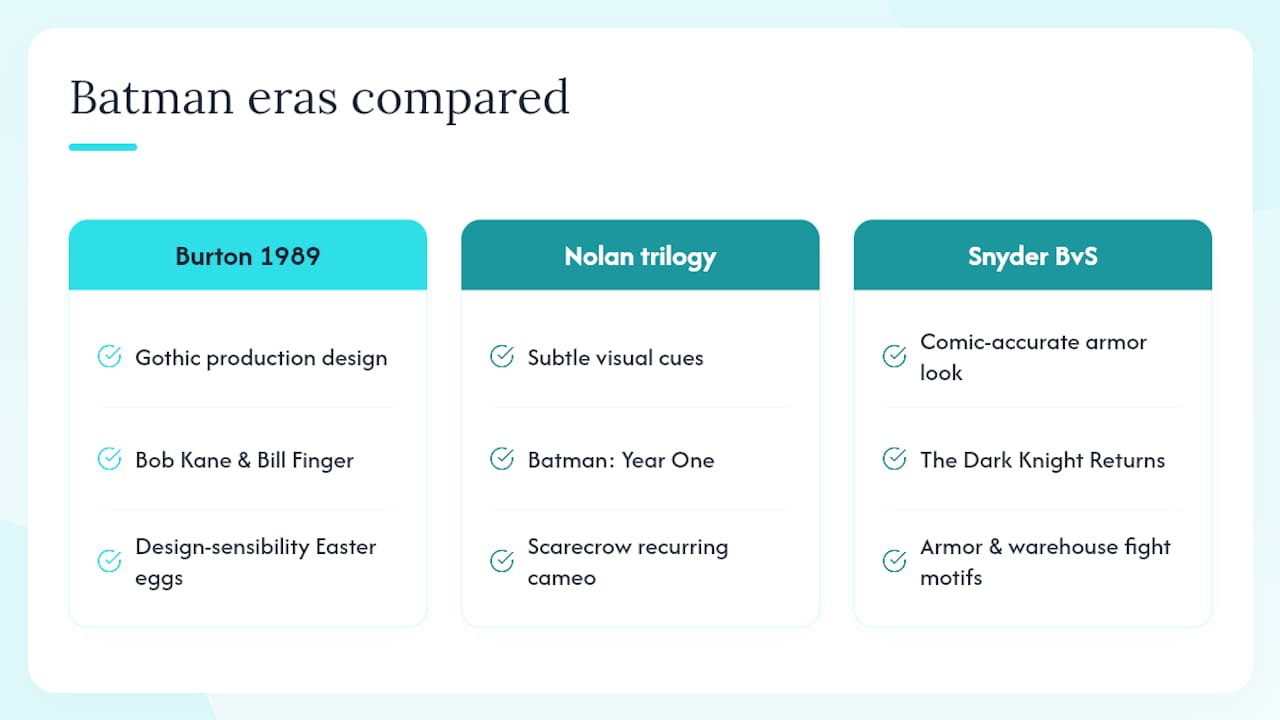
Every director’s Batman era leaves its own fingerprint on the hidden-detail game. Tim Burton’s 1989 Batman buried Bob Kane and Bill Finger’s original design sensibility into its Gothic production design, while Joel Schumacher’s neon-heavy sequels leaned into comic-panel visual gags, freeze-frame kills styled after specific splash pages, and toy-line tie-ins baked directly into set design.
Christopher Nolan’s trilogy took a subtler route. The Scarecrow’s recurring cameo across all three films functions as a connective thread most viewers miss until a rewatch, and Gotham’s geography borrows Chicago’s actual skyline consistently enough that fans treat it as a soft-canon detail. Nolan also folded in visual quotes from Batman: Year One, particularly in Batman Begins, where Bruce Wayne’s early, clumsy vigilante attempts mirror the comic’s ground-level tone almost panel for panel.
Zack Snyder’s Batman v Superman leaned on Frank Miller’s The Dark Knight Returns, lifting specific armor designs and a warehouse fight choreography that echoes the comic’s most famous confrontation. Each era essentially picks a different comic run as its Rosetta Stone, and knowing which one unlocks most of that film’s hidden references before you even start hunting frame by frame.
Easter Eggs in Batman TV Shows and Animated Series
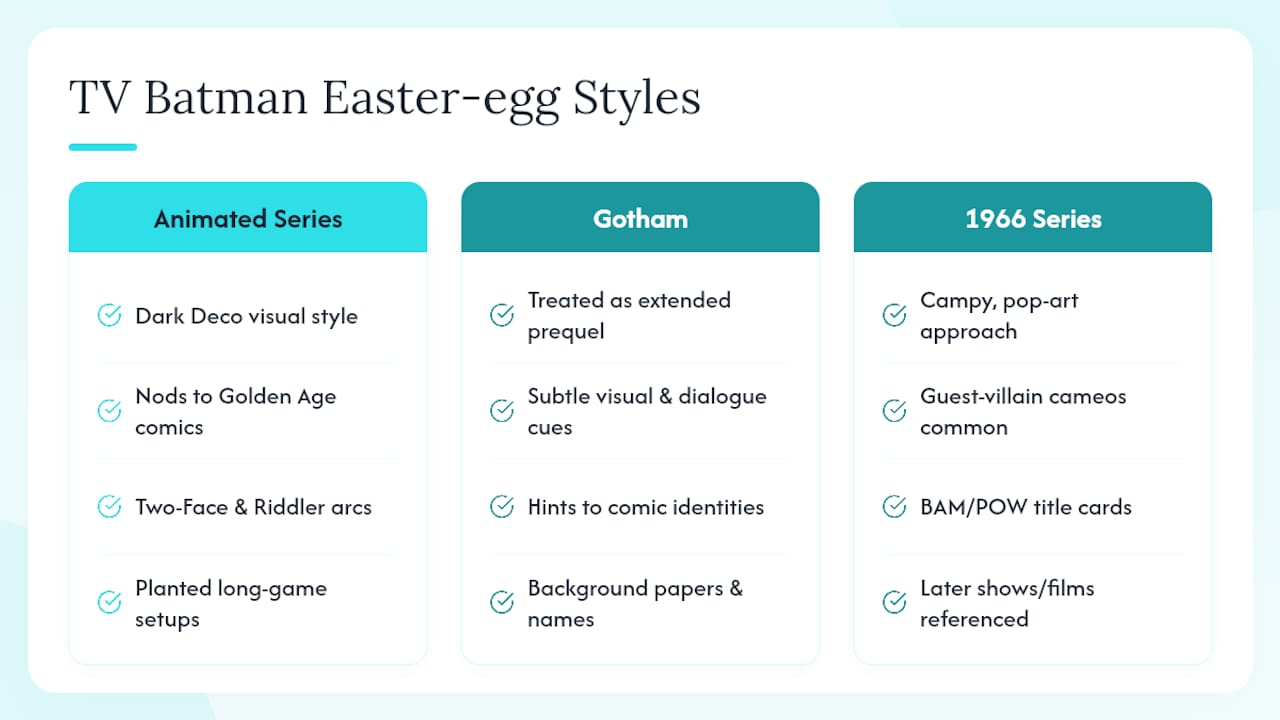
Batman: The Animated Series set the template for animated Easter eggs decades before “Easter egg” was even the common term fans use today. Its Art Deco “Dark Deco” style borrowed visual cues from 1940s film noir, and specific episodes wove in direct nods to Golden Age comic panels, particularly during Two-Face and Riddler arcs. The show’s writers also planted setup material for characters who wouldn’t get full introductions for several seasons, a long-game approach that rewarded dedicated viewers.
Gotham took a different tack, treating its entire run as one extended prequel Easter egg. Characters received subtle visual or dialogue cues pointing toward their eventual comic-accurate identities years before the show confirmed them outright, turning casual viewing into an ongoing scavenger hunt for attentive fans. Background newspapers, minor character names, and even wallpaper patterns in Wayne Manor occasionally referenced specific comic story arcs.
The 1966 Batman series, campy as it was, planted its own tradition: guest-villain cameos and pop-art “BAM” and “POW” title cards that later shows and films have referenced ironically, including winking nods in both Burton’s and Schumacher’s features. Tracing a modern Easter egg back to its animated or TV predecessor often reveals that the “new” reference is actually decades old.
Fan Theories Built Around Batman Easter Eggs
Some Easter eggs generate theories bigger than the detail itself. The Riddler window cameo, for instance, sparked speculation about how much of the Riddler’s plan Batman might have already suspected before the film’s midpoint reveal, a theory that gained traction specifically because Reeves confirmed the detail was intentional rather than coincidental.
The Harvey Dent and Thomas Elliot nods in The Batman fueled extensive fan mapping of a potential future trilogy, with community threads building entire villain-order predictions off a handful of background details. Whether any of that pans out is beside the point. The theorizing itself has become part of how fans engage with the film.
Arkham series players built similarly elaborate theories around background news tickers and environmental storytelling, treating throwaway details as canon confirmation of plot threads the games never directly addressed. Some of these theories later proved accurate when sequels confirmed the connections; many didn’t. That mixed track record is exactly why evidence tiering matters. A fan theory built on a “probable” Easter egg is speculation stacked on speculation, while one built on a director-confirmed detail carries real weight.
Why Batman Easter Eggs Matter to the Fandom
Batman Easter eggs do more than reward attentive viewing. They function as an ongoing dialogue between creators and a fanbase that has spent over eighty years building shared vocabulary around Bob Kane and Bill Finger’s original character. Every confirmed nod to Year One or Detective Comics #27 is a signal that the people making new Batman content actually respect the character’s history rather than treating it as disposable IP.
That respect compounds. Directors and developers increasingly plant layered references specifically for post-release discovery, betting that pausing power and community discussion will surface details a single theatrical viewing never could. The Riddler window cameo is the clearest proof of that strategy working exactly as intended.
Tribute-style Easter eggs carry their own emotional weight, too. The Kevin Conroy references in Lego Batman: Legacy of the Dark Knight aren’t puzzle-box mysteries meant to be solved. They’re memorials, built by a creative team that understood exactly what that voice meant to multiple generations of fans. That’s a different kind of Easter egg entirely, one built on gratitude rather than cleverness, and it’s arguably become one of the most meaningful trends in how modern Batman media treats its own legacy.
A Note on Why This Hunt Never Gets Old
Batman Easter eggs work because Gotham has always been built out of borrowed parts, comic panels, film noir lighting, one very committed voice actor’s legacy. Chasing down a reference and confirming it isn’t trivia for its own sake. It’s tracing the actual lineage of a character that’s been rebuilt by different hands for nearly nine decades, and getting to see exactly which hands left their fingerprints where.
What gets underappreciated is how much verification separates a real find from noise. Anyone can claim they spotted something. Fewer people check whether a director confirmed it, whether a second outlet independently found it, or whether it’s just pattern-matching dressed up as insight. That discipline is what keeps this hobby credible instead of turning into speculation for its own sake.
If you’ve spotted something that isn’t in a catalog yet, submit it here and help build out the next verified entry.
— Christian
Where to Verify Your Next Batman Find
Thethingsyoumissed exists for exactly the moment you pause a frame and think “wait, was that intentional?” Instead of scrolling through scattered forum threads hoping someone else spotted the same thing, you get a timestamped, spoiler-safe catalog built specifically to separate confirmed detail from fan speculation.

The DC Universe hub covers Batman alongside the rest of the DC catalog with the same evidence-tier approach used throughout this piece, confirmed, verified, or probable, so you always know exactly how solid a reference is before you repeat it. Browsing the full movie breakdowns gets you frame-by-frame timestamps across titles beyond Batman, and if there’s a film or show that hasn’t gotten the treatment yet, you can request it directly and help decide what gets cataloged next.
Sources
Batman’s cultural footprint runs deep enough that references show up in media that has nothing to do with Gotham. Open-world games have hidden Batarang props or Bat-signal graffiti as background set dressing, treating the Caped Crusader as pop-culture wallpaper rather than a plot point. Animated sitcoms have run entire cutaway gags built around Adam West’s 1966 performance, assuming audience familiarity runs deep enough to land the joke without setup.
Other superhero properties occasionally take a friendly jab at Batman’s brooding reputation, a running industry gag that counts as its own subgenre of reference. Crossover comic events have folded in visual quotes from The Dark Knight Returns even in stories that have nothing to do with Batman directly, using his silhouette as instantly recognizable shorthand for “grim vigilante.”
Even non-superhero games occasionally drop a Batman poster, comic cover, or action figure into background set dressing as a quick nod to the character’s ubiquity. These cross-franchise nods rarely get director confirmation, since they’re typically small art-team choices rather than narrative plants, which puts most of them firmly in “probable” territory unless a developer addresses it directly in an interview.
- The Batman: Complete DC Easter Eggs and References | Den of Geek
- ‘The Batman’ Easter Eggs You May Have Missed — Collider
- Google Batman Easter Egg — elgooG (restoration)
- Lego Batman: Legacy Of The Dark Knight: 8 Easter Eggs We Found — Kotaku
- Lego Batman’s Flugelheim museum mission is full of Easter eggs — Polygon