The Best Disney Easter Eggs You've Probably Missed

A Disney or Pixar Easter egg is an intentional hidden reference, cameo, or in-joke placed by filmmakers that rewards attentive viewing. You already know the big ones exist. Here are five you can verify on your next rewatch:
- A113 — the CalArts classroom number used by John Lasseter, Brad Bird, and Andrew Stanton, hidden on license plates, camera models, and signage across nearly every Pixar film
- The Pizza Planet truck — Woody and Buzz’s ride from Toy Story that keeps turning up in background shots across the Pixar catalog
- The Luxo ball — the yellow-and-blue striped ball from Pixar’s 1986 short Luxo Jr., spotted in Toy Story, Up, and beyond
- Totoro — Studio Ghibli’s iconic spirit appears as a plush toy in Toy Story 3 as a nod to the Pixar–Ghibli creative friendship
- Flounder — the Little Mermaid fish briefly surfaces in Moana during the “You’re Welcome” sequence
These aren’t rumors. They’re documented across studio interviews, fan databases, and official sources, and they’re the reason a second viewing of any Disney or Pixar film is never quite the same as the first.
Pro Tip: Before your next rewatch, open a second screen with a timestamped Easter egg catalog. You’ll catch things in real time that would otherwise take a dozen pauses to find.
Key Takeaways
Disney and Pixar Easter eggs are most rewarding when you know exactly what to look for and where to verify what you find.
| Point | Details |
|---|---|
| A113 is everywhere | The CalArts classroom number appears on license plates, signage, and cameras across nearly every Pixar film. |
| Recurring motifs form a pattern | The Pizza Planet truck, Luxo ball, and John Ratzenberger appear across the full Pixar catalog as studio signatures. |
| Verify with timestamps | A credible Easter egg claim needs a timestamped screenshot or studio confirmation, not just a social media post. |
| Cross-film teases are planned | Pixar plants references to future films during earlier productions, sometimes years before release. |
| Thethingsyoumissed catalogs verified eggs | The platform provides timestamped, spoiler-safe entries for Disney and Pixar films, organized by motif and title. |
Table of Contents
- The most memorable Disney and Pixar Easter eggs, cataloged
- Recurring Pixar codes and motifs you can hunt across every film
- Why animators hide Easter eggs in the first place
- How to spot and verify Disney Easter eggs yourself
- How fans and journalists verify Easter-egg claims
- Why the catalog approach is the only honest one
- Thethingsyoumissed has the verified, timestamped catalog you need
- Sources
The most memorable Disney and Pixar Easter eggs, cataloged
This is the freeze-frame list. Each entry gives you the film, where to look, and why the reference exists. Spoiler-safe labels mark entries that touch on plot reveals.
1. Flounder in Moana (2016) During Maui’s “You’re Welcome” number, look at the cave paintings decorating the walls. Flounder from The Little Mermaid appears briefly among the sea creatures. It’s a blink-and-miss cameo, but the V&A’s breakdown confirms the scene-level placement. No plot significance, pure studio love letter.
2. Flik in Toy Story 2 (1999) Scan the toy aisle during the Toy Barn sequence. Flik from A Bug’s Life is packaged on a shelf as a toy product. It’s a cross-film cameo that treats Pixar’s own characters as merchandise within the Toy Story universe, which is a genuinely clever layer of meta-humor.
3. Rapunzel and Flynn in Frozen (2013) During Elsa’s coronation scene, Rapunzel and Flynn Rider from Tangled walk through the crowd. They’re in their signature outfits, easy to spot if you know to look at the gate entrance. The cameo works as a continuity nod: both films are set in roughly the same Nordic-inspired world.
4. Heihei in Raya and the Last Dragon (2021) Moana’s famously dim-witted rooster makes a brief background appearance in Raya. It’s a blink-level cameo, placed as a callback to the Polynesian adventure that preceded this Southeast Asian-inspired story.
5. Totoro in Toy Story 3 (2010) Bonnie’s room contains a Totoro plush. Studio Ghibli and Pixar have a long-standing mutual admiration, and John Lasseter’s friendship with Hayao Miyazaki made this cameo a genuine tribute rather than a licensing stunt. (Spoiler-safe: the cameo has no plot bearing.)
6. Scar’s pelt in Hercules (1997) Hercules briefly wears what appears to be Scar’s lion skin as a trophy. It’s a dark Disney-to-Disney callback that plays as an in-universe joke: the villain of The Lion King reduced to a costume prop in a different film’s world.
7. Buzz Lightyear in Finding Nemo (2003) A Buzz Lightyear action figure sits in the dentist’s waiting room. It’s the kind of background prop that rewards pause-and-scan viewing, and it’s one of the earliest examples of Pixar using its own character merchandise as set dressing across films.
8. Remy in Ratatouille references Keep an eye on shadow silhouettes and background signage in later Pixar films. Remy’s distinctive rat silhouette appears in Brave as a witch’s carving, which is one of the most discussed cross-film references in the Pixar shared universe conversation.
9. Dug in Up (2009) and beyond Before Up released, Dug’s silhouette appeared briefly in Ratatouille as a shadow in a Paris alley. Pixar planted this cross-film tease during Ratatouille’s production, years before Up hit theaters. The studio’s practice of seeding future-film references during earlier productions is one of the most deliberate storytelling traditions in animation.
10. Jack Skellington in The Nightmare Before Christmas cameos Jack Skellington appears in James and the Giant Peach as a pirate captain, and his silhouette or figure turns up in several other Disney properties. Because The Nightmare Before Christmas sits at the intersection of Tim Burton’s aesthetic and Disney’s catalog, Jack functions as a recurring dark-fantasy ambassador across multiple productions.
11. Clownfish in Monsters, Inc. (2001) Before Finding Nemo existed as a released film, a clownfish appears briefly in Monsters, Inc. as a visual tease. This is one of the clearest examples of Pixar planting a future-film reference during an earlier production cycle, a tradition documented across the studio’s history.
12. Hidden Mickeys across Disney Animation Hidden Mickeys — the three-circle silhouette of Mickey Mouse’s head — appear across Disney parks, merchandise, and films. In The Little Mermaid, a Hidden Mickey appears in the priest’s robe during the wedding scene. Good Housekeeping’s breakdown catalogs dozens of film placements. They’re their own subcategory of Disney easter eggs, distinct from cross-film cameos.
13. Pinocchio’s Monstro in Moana The giant whale Monstro from Pinocchio appears to be referenced in the ocean’s behavior during Moana. It’s a subtler visual callback than a direct character cameo, but attentive viewers with knowledge of classic Disney animation will catch the shape.

Recurring Pixar codes and motifs you can hunt across every film
These aren’t one-off cameos. They’re studio traditions, documented across Pixar’s full catalog, and once you know them, you’ll spot them everywhere.
A113 The number refers to the Animation 1 classroom, Room 113, at the California Institute of the Arts, where John Lasseter, Brad Bird, Andrew Stanton, and Pete Docter all studied. It appears on license plates (Toy Story, Finding Nemo), camera models (WALL-E), courtroom signage (The Incredibles), and train cars (Brave). It’s the most consistent Pixar motif throughout the entire catalog.
The Luxo ball The yellow-and-blue striped ball from Pixar’s 1986 short Luxo Jr. became the studio’s first recurring prop. It appears in Toy Story, Up, and several other productions. Think of it as Pixar’s visual signature, the equivalent of a director’s cameo but rendered as a prop.
The Pizza Planet truck The battered yellow pickup from Toy Story reappears in nearly every Pixar film. It’s in A Bug’s Life, Monsters, Inc., Finding Nemo, Cars, and many others. One notable exception: Brad Bird confirmed the truck simply wasn’t included in The Incredibles due to production constraints, not as a deliberate omission or secret reference.
John Ratzenberger The actor who voiced Hamm in Toy Story has appeared in every Pixar feature. He’s the Pixar talisman: Hamm (Toy Story), P.T. Flea (A Bug’s Life), the Abominable Snowman (Monsters, Inc.), the school of fish (Finding Nemo), the Underminer (The Incredibles), Mack the truck (Cars), Mustafa (Ratatouille), Tom (WALL-E), and so on. His streak is part of Pixar’s documented studio history.
Why animators hide Easter eggs in the first place
The short answer: studio culture, alumni loyalty, and a genuine love of the craft. The longer answer involves decades of tradition.
Early Disney and Pixar eggs were pure in-jokes, references that animators slipped in for colleagues to find during production screenings. A113 is the clearest example: it’s a tribute to a shared classroom, meaningful to the people who spent years in it and invisible to everyone else. That’s the original spirit of the Easter egg, a private joke that made it into the final cut.
The practice evolved as home video arrived, then accelerated with streaming. Modern filmmakers often design Easter eggs to be discoverable and shareable, knowing that frame-by-frame scrubbing is now a standard fan behavior. What started as an animator’s private joke became a deliberate tool for fan engagement and viral sharing.
Cross-film teases add another layer. Pixar plants visual references to future films during earlier productions, sometimes years before the referenced film enters wide production. The clownfish in Monsters, Inc. predates Finding Nemo’s release by two years. The best Easter eggs often connect films released decades apart, functioning as long-range callbacks that reward viewers with deep knowledge of a studio’s full filmography.
Pro Tip: When you spot a suspected cross-film tease, check the production dates. If the referenced film was already in development when the earlier film was made, the tease was almost certainly intentional.
How to spot and verify Disney Easter eggs yourself
The tools are simpler than you think. The discipline is the hard part.
- Use streaming frame-step controls. Most streaming platforms let you scrub frame by frame using keyboard shortcuts (the period key on Disney+, for example). Use this on wide shots, crowd scenes, and background-heavy sequences.
- Pause on background props and signage. License plates, posters, toy shelves, and cave paintings are the most common hiding spots. Don’t watch the foreground action exclusively.
- Check the end credits. Some Easter eggs are tucked into credit sequences or post-credit scenes. Watch to the very end.
- Use VLC or a downloaded file for precise frame stepping. VLC’s frame-by-frame advance (the E key) gives you more control than most streaming interfaces.
- Search for timestamped screenshots. When you find a suspected egg, search for a screenshot with a timestamp. If multiple independent sources show the same frame, the claim is credible.
- Cross-reference with official sources. D23’s official Easter egg content and the Pixar Animation Blog are the gold standard for studio-confirmed references. If D23 or a director’s interview acknowledges it, it’s verified.
- Check the Pixar franchise catalog at Thethingsyoumissed for timestamped, verified entries organized by film and motif.
- Focus your first pass on crowd scenes, toy shelves, and background vehicles
- Wide establishing shots are where most prop-level eggs hide
- Zoom in on background art in animated films — resolution on streaming is high enough to reveal detail that was invisible on DVD
How fans and journalists verify Easter-egg claims
Not every rumored Easter egg is real. The verification hierarchy matters.
Primary signals (treat these as confirmed):
- A timestamped frame with a high-resolution screenshot showing the specific detail
- A matching production art piece or concept sketch that includes the reference
- Official studio acknowledgment: a director’s interview, a D23 post, or a Pixar Blog entry naming the egg
Secondary signals (treat these as credible but not definitive):
- Multiple independent fans finding the same frame number across different releases (theatrical and home video)
- Consistent placement across multiple streaming platform versions of the same film
- Corroborating fan-research posts with linked screenshots, not just text descriptions
Red flags (treat these as unverified):
- A claim with no screenshot and no timestamp
- A “confirmed” reference that traces back to a single social media post with no studio source
- Fan theories that require multiple interpretive leaps to connect two films (the Pixar timeline theory, for instance, is a fan construct, not a studio-confirmed narrative)
Brad Bird’s clarification about the Pizza Planet truck in The Incredibles is a useful model: studio statements occasionally debunk fan theories, and a director saying “we just didn’t include it” is more reliable than a fan insisting it’s hidden somewhere.
Pro Tip: When sharing an Easter egg find, always include the timestamp and a screenshot. A claim without visual evidence is just a rumor, and the community consensus shifts fast when someone posts the actual frame.
Why the catalog approach is the only honest one
The Easter egg space has a misinformation problem that most fan sites don’t acknowledge. Rumored connections spread faster than corrections. The Pixar shared universe theory, the idea that all Pixar films exist in a single connected timeline, is a compelling fan framework, but Pixar has never officially endorsed it as a production intent. It’s a reading, not a blueprint.
What’s actually verifiable is narrower and more interesting: specific, documented cameos placed by specific animators in specific frames. A113 is real. The Pizza Planet truck is real. The clownfish in Monsters, Inc. is real. These aren’t interpretations; they’re frame-level facts with studio confirmation behind them.
The problem with the broader “Pixar connected universe” framing is that it flattens the distinction between a deliberate Easter egg and a thematic coincidence. When every similarity becomes “evidence,” the catalog loses its credibility. The more rigorous approach is to treat each egg as its own claim, verify it against a timestamped source, and resist the pull of the grand unified theory.
That’s the standard worth holding. Not because it’s less fun, but because the verified eggs are genuinely more impressive than the speculative ones.
Thethingsyoumissed has the verified, timestamped catalog you need
If you’ve been pausing, rewinding, and squinting at background props, there’s a faster route. Thethingsyoumissed catalogs Disney and Pixar Easter eggs with exact timestamps, verified sourcing, and spoiler-safe browsing so you can hunt without accidentally reading ahead.
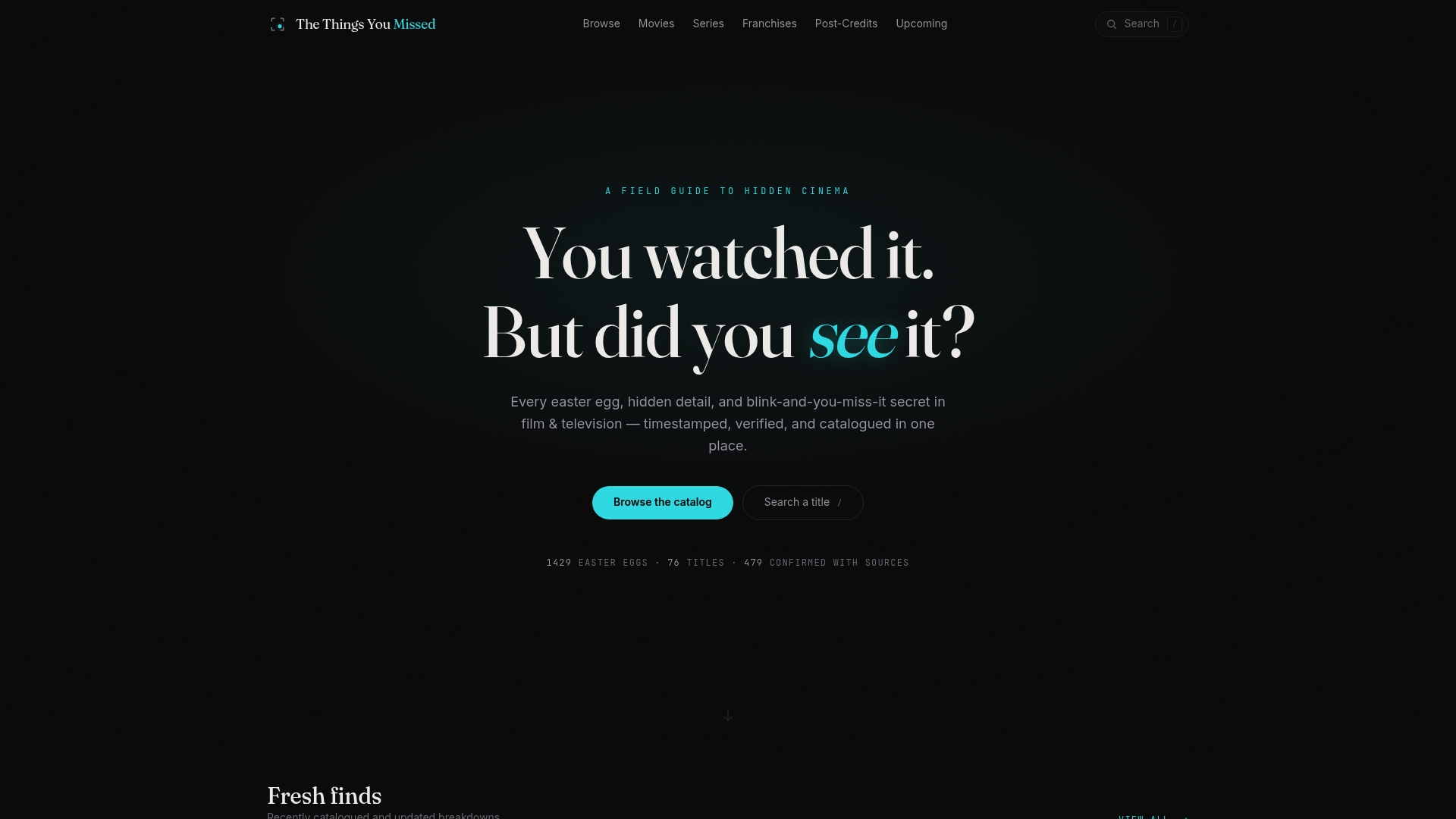
Every entry is tied to a specific frame, not a vague scene description. The recurring motifs hub tracks A113, the Luxo ball, the Pizza Planet truck, and John Ratzenberger appearances across the full catalog in one place. And if a film you’re watching isn’t covered yet, the request page lets you submit it directly.
Browse the full movie catalog and start your next rewatch with a verified list in hand.
Sources
- 41 Disney Easter Eggs and Hidden Features in Disney Movies You Definitely Missed
- List of Pixar film references
- The most clever Disney Easter eggs you probably missed
- Unveiling some of the best Easter eggs in Disney and Pixar films
- A brief history of Pixar in 18 Easter eggs
Recommended
- Disney Animation Easter Eggs — 37 Hidden Details Across 2 Titles — The Things You Missed
- Pixar Easter Eggs — 20 Hidden Details Across 1 Titles — The Things You Missed
- Toy Story 5 Easter Eggs: All 20 Hidden Details & References Explained (2026) — The Things You Missed
- Zootopia Easter Eggs: All 19 Hidden Details & References Explained (2016) — The Things You Missed