Three Defensible Readings of Inception's Ending Backed by Nolan
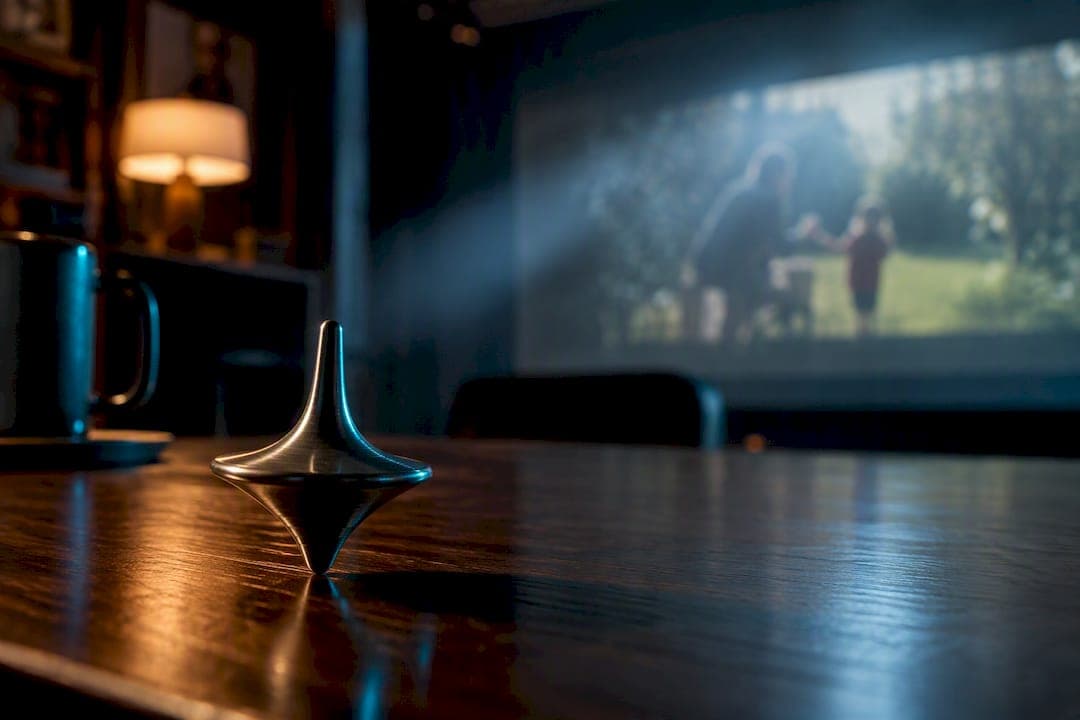
Cobb’s final scene reads as emotional closure, not a puzzle with a provable solution. He walks toward his children without checking the top, which is the point: he has stopped needing proof. The top itself keeps spinning, wobbling, or falling depending entirely on which frame you freeze, and that ambiguity is deliberate, not sloppy.
TL;DR:
- The final scene’s ambiguity is supported by subtle clues, including the children’s changed appearance and the absence of a definitive wobble in the top.
- The layered dream structure explains Saito’s aging in limbo and Cobb’s seamless transition back to reality after the series of synchronized “kicks.”
- The spinning top belonged to Mal and is unreliable as a personal totem, meaning its behavior does not confirm Cobb’s awake or dreaming state.
- Nolan emphasizes the ending’s focus on Cobb’s emotional resolution, not a literal test for reality, leaving the question intentionally unresolved.
- Rewatching with attention to the top’s spin speed and Miles’s appearances can offer support for either interpretation, but neither provides a definitive answer.
Table of Contents
- Inception Ending Explained: The Evidence For and Against Cobb Being Awake
- How the Final Act Actually Works: Dream Layers, Limbo, and the Kicks
- What the Top, the Ring, and the Children Actually Symbolize
- What Nolan and the Cast Have Actually Said About It
- The Most Defensible Way to Read Inception’s Ending
- Sources
- FAQ
Inception Ending Explained: The Evidence For and Against Cobb Being Awake
The final scene gives you exactly enough visual information to argue either side, which is precisely why the debate never dies. Cobb walks past his totem on the table, greets Miles at the door, and reunites with his children in the backyard without a single reality check. Every camera choice after that point is a clue, and none of them close the case.
Here’s what close viewers actually point to:
- The top’s wobble: In the last shot, the top spins for several seconds before the frame cuts to black, and some viewers swear they see the beginning of a wobble that would signal a fall back into reality.
- Earlier top behavior: Cobb tests the top once earlier in the film, and it topples cleanly, giving audiences a baseline for comparison that the ending never quite repeats.
- The wedding ring pattern: Cobb wears his ring in dream sequences involving Mal, and it’s notably absent in scenes fans code as “real,” which some read as a silent visual signal from Nolan.
- The children’s appearance: The kids in the final scene are played by different, slightly older actors wearing different clothes than the ones in Cobb’s memory flashbacks, a detail Primetimer and other outlets treat as strong evidence for a real-world reading.
- Cobb’s customs scene: Cobb clears customs and walks freely through the airport, a sequence that would be an odd detail to fabricate if the film wanted you doubting every frame.
None of these clues functions as a smoking gun on its own. Critics spend far more energy dissecting the top’s final spin than they do quote what Christopher Nolan actually said about it, even though Nolan has been on record for years that the shot is about Cobb’s emotional state, not a literal test.
How the Final Act Actually Works: Dream Layers, Limbo, and the Kicks
The ending only makes sense once you track the stacked dream architecture Nolan builds across the Fischer job. Here’s the chain, step by step:
- The van (Layer 1): Yusuf drives the sedated team through the city while Arthur, Cobb, and the others enter Fischer’s mind. This layer’s “kick” is the van hitting water, which needs to hit every sleeper simultaneously for the wake sequence to work.
- The hotel (Layer 2): Arthur runs the fight sequence in zero gravity, a direct result of the van tumbling in Layer 1. His kick is a controlled explosion timed to the van’s impact.
- The snow fortress (Layer 3): Eames and Fischer storm the fortress. Saito is fatally shot here, which is the event that pulls him into limbo instead of waking normally.
- Limbo: Because Saito dies inside a dream stacked three layers deep, his mind falls into raw, unconstructed subconscious space, where time runs far slower than in any layer above it. Primetimer’s breakdown of the mechanics explains why Saito ages decades there while Cobb, who follows him in deliberately, experiences the same stretch differently, since Cobb has already spent years in limbo with Mal and treats the space with more control.
- The wake sequence: Each kick fires in reverse order, snow fortress to hotel to van, pulling everyone back up through the layers toward the plane. Cobb finds Saito in limbo, reminds him of the deal they made, and both wake on the flight.
The home scene with the children plausibly sits immediately after that flight lands, which is exactly why it carries no clean marker separating it from every other “real” scene in the film.
What the Top, the Ring, and the Children Actually Symbolize
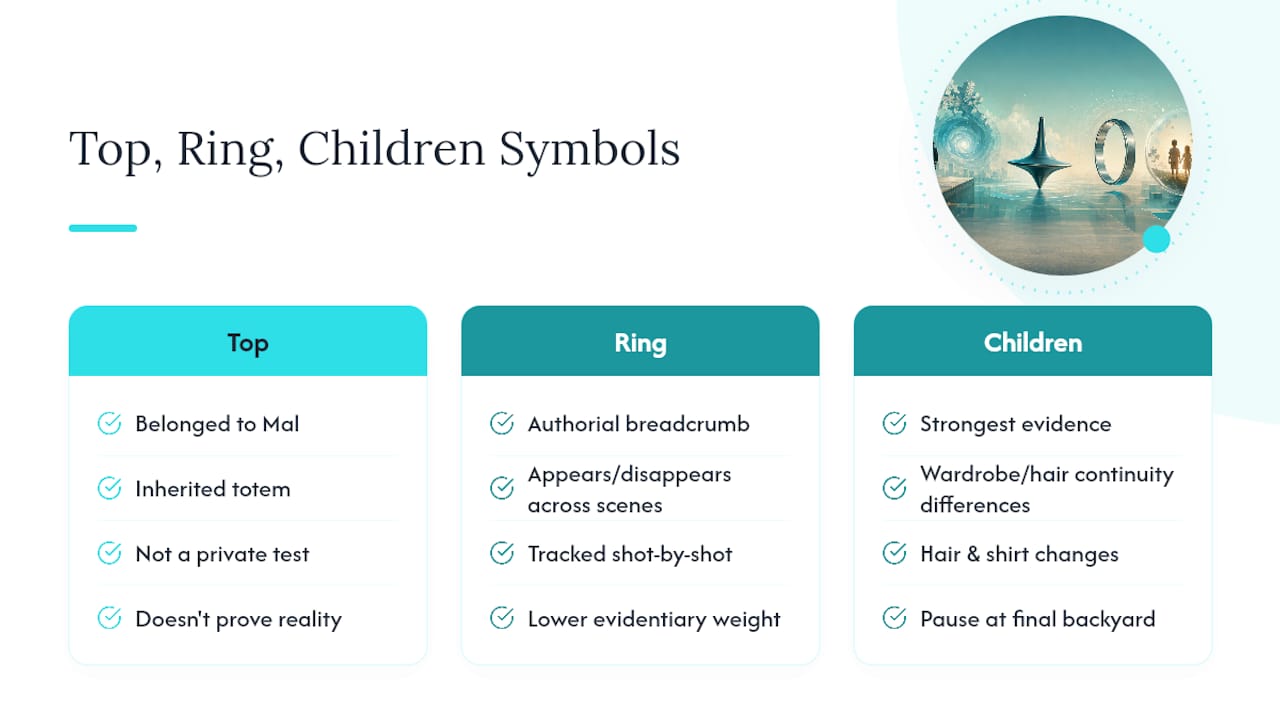
Treating the spinning top as a lie detector misreads what it is. The top belonged to Mal, not Cobb, which makes it an inherited totem rather than a personal one. Totems are only supposed to work because their owner alone knows their exact weight and balance in reality. Since Cobb has watched Mal spin that top for years and has openly discussed its behavior with other people, its reliability as a private test collapses. Philosophical readings of the totem system go further, arguing totems only ever prove you’re not trapped in someone else’s dream, never that you’ve reached objective reality.
The ring functions more as an authorial breadcrumb than a totem, appearing and vanishing across scenes in a pattern some viewers track shot by shot. The children’s changed appearance carries more evidentiary weight than either object, since actor and wardrobe continuity errors of that scale rarely happen by accident in a Nolan production.
Pro Tip: On a rewatch, pause at the backyard reunion around the film’s final two minutes and compare the children’s hair length and shirt colors against Cobb’s earlier flashback of them playing in the same yard. The differences are small but consistent, and they’re the kind of detail a frame-by-frame breakdown is built to catch.
What Nolan and the Cast Have Actually Said About It
Nolan told interviewers the ending’s point is that Cobb “reunites with his children” and stops needing to verify anything, adding that perhaps all levels of reality in the film are valid on their own terms. He has also said an internal, “true interpretation” exists in his own head, but he refuses to state it publicly, preserving the ambiguity as intentional design rather than an oversight.
Michael Caine offers the counterpoint fans love to quote: Nolan reportedly told him that whenever Caine’s character Miles appears, “it’s reality”, since Caine only plays scenes set in the waking world. That single remark has fueled an entire strand of “Cobb is awake” arguments, even though Nolan has never confirmed it applies to the film’s very last shot.
The Most Defensible Way to Read Inception’s Ending
Three readings hold up under scrutiny: Cobb is fully awake, Cobb is still dreaming, or reality itself has become subjective to him, meaning the distinction stops mattering. The third reading is the strongest, because it’s the one Nolan himself has endorsed in his own comments about the ending’s purpose.
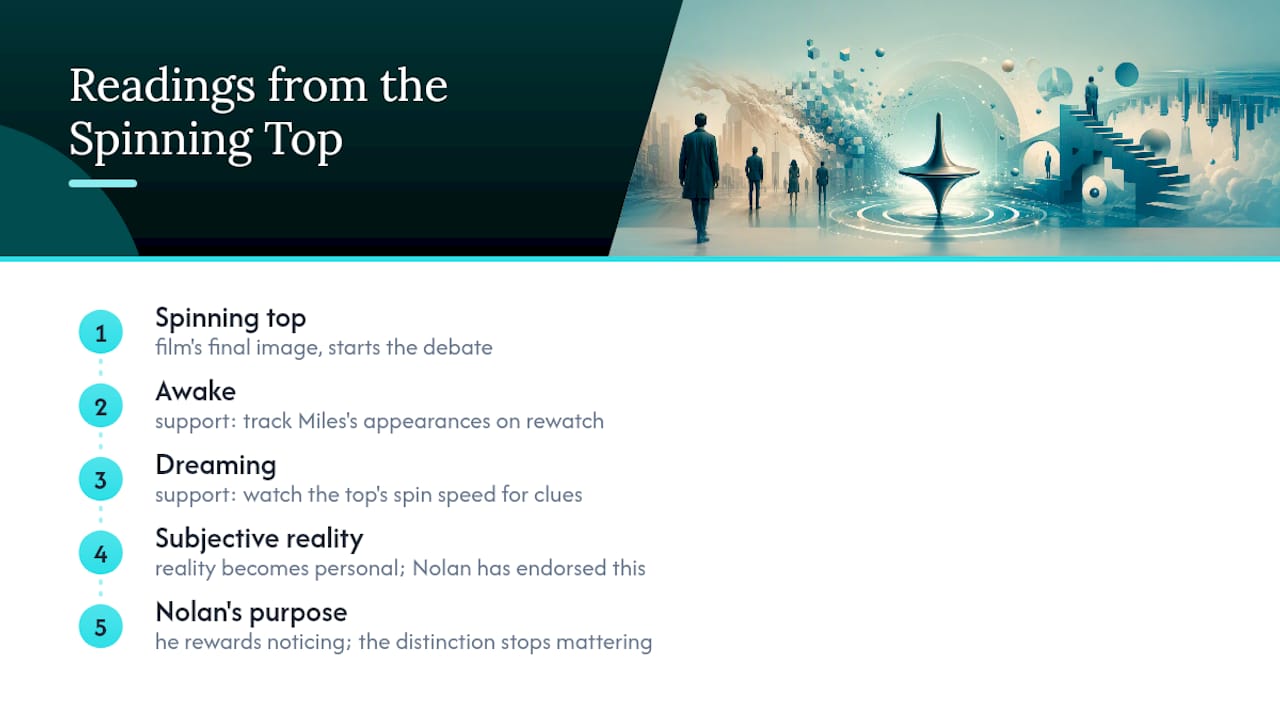
On rewatch, look for the top’s spin speed if you want ammunition for the “dreaming” camp, or track Miles’s appearances if you want support for “awake.” Either hunt is worthwhile, but neither settles anything the film wasn’t designed to settle. Nolan built an ending that rewards obsession with detail while punishing the assumption that detail alone can produce a verdict. What he wants you chasing isn’t the answer. It’s the noticing.
Why This Reading Holds Up on Rewatch
Verifying claims like these means going back to the actual footage instead of trusting secondhand summaries, which is the whole discipline behind how Thethingsyoumissed catalogs a film. Entries get timestamped, checked against sourced references, and tagged for spoiler-safe browsing so readers can confirm a detail themselves before repeating it. For frame-by-frame evidence on the ring, the top, and the children, the full Inception breakdown walks through each contested shot in sequence.
Want to Verify These Frames Yourself?
Some online resources offer entries tied to specific timestamps and sources for contested scenes instead of relying on viewer speculation.

The movies section catalogs Inception frame by frame alongside hundreds of other titles, and a few things make it worth bookmarking before your next rewatch:
- Timestamped entries so you can jump straight to the ring, the top, or the children’s scene without scrubbing the whole runtime.
- Sourced references behind every claim, graded by how visible or difficult the detail actually is to spot.
- Spoiler-safe browsing, so you can dig into a franchise breakdown without a twist getting ruined mid-scroll.
If a detail from this piece isn’t in the database yet, you can request it directly and get notified through the newsletter once the next batch of entries goes live.
Where This Analysis Comes From
This piece draws on Christopher Nolan’s own remarks in The Guardian, cast commentary compiled by RadioTimes, scene mechanics detailed by Primetimer, and totem analysis from Den of Geek. For a broader look at how directors use deliberate ambiguity as a storytelling device, Omnivance Media’s breakdown of Nolan’s techniques is worth a read.
Sources
- Christopher Nolan explains Inception’s ending: ‘I want you to chase your reality’ | The Guardian
- Inception ending explained | RadioTimes
- Inception ending explained: Is Cobb still dreaming? - PRIMETIMER
- Inception ending explained | Den of Geek
FAQ
Is Cobb Still Dreaming at the End of Inception?
The film never confirms it either way, and that’s intentional. Nolan has said the ending is about Cobb’s emotional choice to stop testing reality, not a literal answer to whether he’s dreaming.
Why Did Saito Age but Cobb Didn’t?
Saito died inside the third dream layer and fell into limbo, where subjective time runs far slower than in the layers above it, aging him decades in what felt like minutes to the team above. Cobb enters limbo deliberately to retrieve him and has prior experience navigating that space from his years there with Mal, which shapes his different experience of the same stretch of time.
Was Cobb in the Real World at the End of Inception?
The visual evidence is split by design. The different child actors and their changed clothing support a real-world reading, while the top’s ambiguous final spin keeps the dream reading alive for viewers who focus on it.
How Did Saito and Cobb Wake Up?
Cobb finds Saito in limbo and reminds him of their original arrangement, prompting Saito to choose to wake. Both surface as the layered “kicks” fire in reverse sequence, snow fortress to hotel to van, returning the team to the plane where the mission began.