8 Step Checklist to Decode Ambiguous Movie Endings With Timestamps

Most confusing movie endings are built to be interpreted, not solved, and that changes how you should watch the last ten minutes. This piece gives you a short, repeatable checklist, three applied case studies, and pointers to timestamped resources like The Things You Missed so you can test your reading against actual frames instead of gut instinct.
TL;DR:
- Most confusing movie endings are designed to be interpreted, with ambiguous signals that require careful analysis of motifs, tone, and context rather than a single definitive answer.
- Classifying the ending as open, closed, twist, or psychological helps determine whether unresolved threads, recurring symbols, or altered perceptions drive the confusion.
- Rewatching the final scene frame-by-frame and comparing it to the opening can reveal clues such as props, color shifts, music cues, or costume changes that clarify the film’s intended meaning.
- Confirming interpretations against timestamped resources or director interviews ensures that personal guesses are supported by concrete evidence.
- Ambiguous endings aim to extend a film’s cultural relevance by encouraging multiple viewings and debates, rather than providing tidy closure on first watch.
Table of Contents
- What separates an open ending from a closed one
- Common ending types and the tricks that create them
- How to read a confusing movie ending: a step-by-step checklist you can use now
- Mini case studies: applying the method to three endings
- How to spot hidden clues and timestamped evidence
- Why ambiguity earns a second watch
- Where to go next after a confusing ending
- Sources
- FAQ
What separates an open ending from a closed one
A closed ending answers its own questions: the plot resolves, the fates are stated, the credits roll on certainty. An open ending does the opposite on purpose, leaving at least one major thread dangling so the audience has to finish the thought. According to No Film School, an open ending deliberately withholds resolution to invite interpretation and emotional resonance, prioritizing participation over tidy closure.

The tell is usually in what kind of closure you get. Plot closure means the story questions are answered. Emotional closure means the character’s arc feels complete even if the plot stays murky. A film can have one without the other, and that mismatch is where confusion usually starts. Image & Narrative frames this as a split between story and discourse endings, arguing that meaning is not fixed by the text alone but shaped by how it is told.
Signals worth flagging on a first watch:
- An unresolved plot thread that the film never circles back to.
- A final image that repeats or distorts something from earlier, rather than introducing something new.
- A character who reaches emotional peace while the surrounding mystery stays intact.
Common ending types and the tricks that create them
Confusing endings tend to fall into a handful of recognizable patterns, and naming the pattern is often half the interpretation. A twist ending recontextualizes everything that came before it. A loop or reset ending resolves conflict by erasing memory of it rather than fixing it, a technique common enough in genre film that some audiences mistake it for a plot hole rather than a design choice. An internal or psychological ending stages the climax inside a character’s head, often with no clean signal that reality has shifted. A reframing or moral-pivot ending keeps its plot literal but changes what the story means in its final moments.
- Twist endings: withhold a key fact, then reveal it to force a rewatch of everything prior.
- Loop or reset endings: reset events so characters do not carry memory of the sacrificed timeline.
- Psychological endings: stage the resolution as a character’s internal state rather than an external event.
- Moral-pivot endings: keep the plot literal but reframe its meaning in the last scene.
One consistent finding across explainer coverage of ambiguous films is that open endings measurably extend a film’s cultural life by pushing viewers into rewatches and debate rather than a single, closed reaction. Inception leans on the first pattern, letting the spinning totem stay ambiguous by design. I’m Thinking of Ending Things leans on the third, and the Los Angeles Times reads its final stretch as a thematic confession, a protagonist’s internalized guilt playing out rather than a literal event. Oppenheimer leans on the fourth, using its closing scene to shift the film’s meaning without changing its facts.
How to read a confusing movie ending: a step-by-step checklist you can use now
Treat the last scene as evidence, not a verdict, and work through it in order rather than jumping straight to a theory.
- Classify the ending first: is it open, closed, a twist, or internal/psychological?
- List every recurring motif you noticed: objects, colors, songs, repeated dialogue.
- Check the narrator’s reliability and the timeline: is this a memory, a dream, or an altered reality?
- Compare the final scene’s tone against the film’s opening scene for deliberate mirroring.
- Note any costume, makeup, or staging shift that might signal a subjective point of view.
- Watch the credits and any stinger for a coda that reframes the ending.
- Cross-check your read against a timestamped breakdown or an interview with the director.
- Sit with more than one interpretation before committing to a single answer.
Rewatch questions worth asking: What does the final image share with the opening image? Which prop or line repeats three or more times? Does the protagonist’s appearance change without explanation? Is there a moment the camera lingers on that adds nothing to plot but everything to mood?
Pro Tip: Search for a film’s ending using its title plus “explained” only after your own rewatch, so your read isn’t preloaded by someone else’s theory.
Mini case studies: applying the method to three endings
- Inception: The totem wobbles, the film cuts to black before it settles, and Cobb walks away without checking it. Applying the checklist, the emotional closure (reunion with his children) is complete regardless of which layer of reality he’s in, which is why No Film School treats deliberate irresolution like this as an invitation rather than a flaw.
- I’m Thinking of Ending Things: The janitor’s fantasy sequence, the aging makeup, and the repeated diner motif all point toward an internal reading rather than a literal one. The Los Angeles Times notes that recurring props and songs often carry the emotional truth of a finale even when the plot mechanics stay opaque.
- Oppenheimer: The literal events of the film do not change in its final minutes, but the meaning does. PrimeTimer reads the closing exchange as a pivot that turns the Trinity test into a moral reckoning rather than a countdown to literal apocalypse.
How to spot hidden clues and timestamped evidence
Freeze-frame the last two minutes of any ambiguous film and you will usually find something the pacing rushed past: a prop from act one repositioned, a line of dialogue echoed with a different inflection, a color palette that shifts from warm to cold. Music cues do the same work quietly, often resolving or refusing to resolve a theme that’s been building the whole runtime.
- Freeze-frame the final scene and compare it against the opening shot.
- Note any prop, costume, or color that reappears from earlier in the film.
- Listen for a musical cue that resolves, distorts, or repeats a theme.
- Check the credits and any post-credit scene for a coda that reframes events.
| Clue type | Where to look | What it usually signals |
|---|---|---|
| Repeated prop or object | Opening and closing scenes | A deliberate callback tying the ending to the setup |
| Costume or makeup shift | Final act | A subjective or internal state, not a literal event |
| Musical motif | Score during the last scene | Emotional resolution independent of plot resolution |
| Post-credit or stinger | After the credits roll | A reframing or literal answer the main cut withheld |
The Things You Missed catalogs these details with timestamps and a request feature for new titles, and its motif hub is built specifically for this kind of prop and color tracking across a filmography. Know when to stop: once you’ve confirmed a reading against two or three independent clues, further digging tends to produce noise rather than certainty.
Why ambiguity earns a second watch
I’ll say the unfashionable thing: an ending that refuses to resolve everything is usually doing its job, not failing at it. Directors and critics have long noted that ambiguity trades a clean immediate reaction for a longer life, the kind that gets a film discussed for years instead of forgotten in a weekend. Test your reading against the timestamped clues, not against how satisfying the answer feels.
— Christian
Where to go next after a confusing ending
Once you’ve worked through the checklist, the fastest way to confirm or challenge your reading is to check the frame-level record instead of a forum thread. Our movies index organizes timestamped, spoiler-safe breakdowns by title, so you can jump straight to the film you just watched without wading into unrelated spoilers.
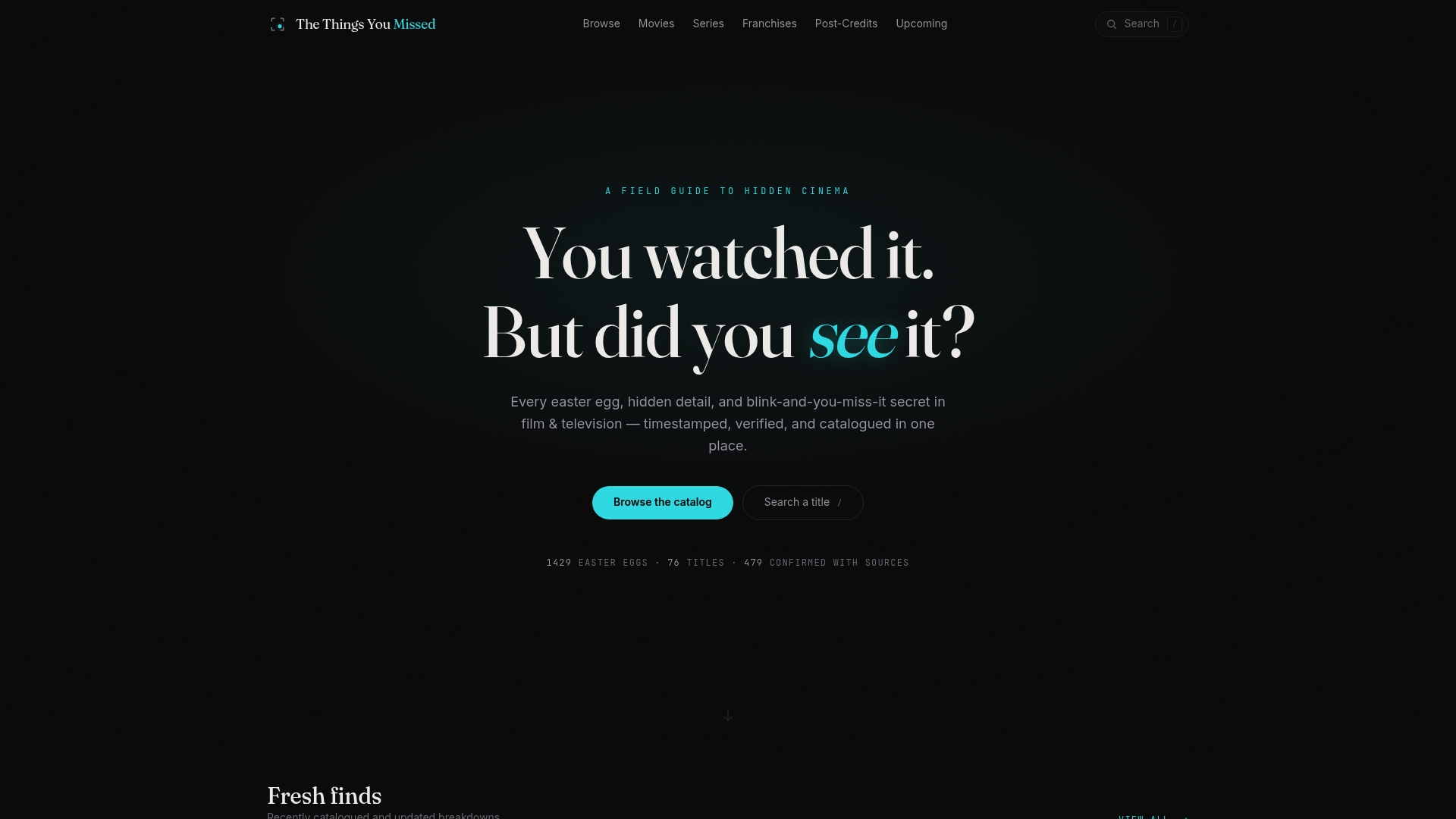
If the ending in question hinges on what happened after the credits, the post-credit scenes page tracks every confirmed stinger by film. And if the title you’re chasing isn’t cataloged yet, you can request the next breakdown and vote it up the queue with your own watchlist.
Sources
Claims above draw on No Film School on open endings, the Los Angeles Times on psychological finales, Image & Narrative on story versus discourse endings, PrimeTimer on moral-pivot endings, and a complementary primer from Nathaniel Connors on open-ending meaning.
- What Is an Open Ending? (And Why Some Films Refuse to Give You Answers) | No Film School
- ‘I’m Thinking of Ending Things’ explained | Los Angeles Times
- How are film endings shaped by their socio-historical context? | Image & Narrative
- Oppenheimer ending explained: Did Oppenheimer’s bomb begin the end of the world? | PrimeTimer
FAQ
Was Susanna cheating on Theo?
The film in question does not give a definitive on-screen confirmation either way, and existing coverage treats it as one of several deliberately unresolved threads rather than a settled fact. Approach it the way you’d approach any open plot point: look for motif and dialogue evidence rather than assuming a single answer.
What movie did Stephen King say not to watch alone?
There is no verified, sourced statement tying a specific film to that exact warning in the materials referenced here. Treat viral claims like this skeptically until you find the original quote from a credible outlet.
Can you explain the ending of the movie “The End”?
Without a sourced breakdown of that specific title’s final scene, the honest answer is that a firm interpretation isn’t available here. Apply the checklist in this guide, classify the ending type first, and cross-check your read against a timestamped resource before settling on one meaning.
What does the “they had” ending in a movie mean?
This phrasing is too vague to map to a specific film’s documented ending without more context. If you mean a particular title, run it through the four-step classification here (open, closed, twist, or psychological) and look for repeated motifs the film uses to signal its intent.
Why do filmmakers choose ambiguous endings over clear ones?
Ambiguous endings trade immediate audience satisfaction for longer cultural relevance, since unresolved questions keep people rewatching and debating. As No Film School puts it, a well-built open ending increases rewatch value precisely because it refuses to hand over a single tidy answer.