Star Wars Watch Order: The Best Sequence for Every Fan
If you want the twists to land the way they did in theaters, start with release order. If you’d rather follow Anakin’s fall and Luke’s rise as one continuous character arc, go chronological. If you’re rewatching and want the best of both worlds, use the Machete Order (IV, V, II, III, VI) or its modified version that folds in the sequel trilogy afterward. Short on time? Skip straight to the nine core saga films.
- New to Star Wars, no spoilers yet: chronological order, starting with The Acolyte
- Rewatching, want maximum drama: Machete Order
- Nostalgic binge, original trilogy energy: release order
- Casual streaming session this weekend: the nine mainline films only, skip the anthology detours
Pro Tip: Whichever order you pick, keep Thethingsyoumissed’s spoiler-safe browsing open in a second tab. You can look up a scene’s hidden detail without anyone accidentally spoiling what happens next.
Key Takeaways
The right Star Wars watch order depends entirely on whether you value preserving the original twist, following Anakin’s arc chronologically, or fitting the saga into limited time.
| Point | Details |
|---|---|
| Pick by priority, not popularity | Release order protects twists; chronological order builds character logic; Machete Order balances both. |
| Anthologies are optional first-watch material | Treat Tales of the Jedi, Tales of the Empire, and similar series as supplemental, not required viewing. |
| Disney+ hosts nearly everything | The main exception is the 2026 theatrical release of The Mandalorian and Grogu, which streams later. |
| Use eras to avoid overwhelm | Chunking the timeline by era (High Republic, Fall of the Jedi) makes a lengthy binge feel manageable. |
| New releases shift placements | Titles like The Acolyte have already pushed the chronological start point back by roughly a century. |
Table of Contents
- Star Wars Watch Order Shortlists You Can Start Tonight
- The Complete Star Wars Timeline in Chronological Order
- How Do You Choose the Right Star Wars Order for You?
- What About Anthology Series and Side Stories?
- Where to Stream Every Star Wars Title in 2026
- How Thethingsyoumissed Helps You Catch What You’d Otherwise Miss
- How Should Newcomers Handle Lore and Spoilers?
- Release Order vs. Chronological vs. Machete: What Actually Changes
- Why New Releases Keep Changing the Ideal Star Wars Order
- Is There Really One Best Way to Watch Star Wars?
- Sources
Star Wars Watch Order Shortlists You Can Start Tonight
Release order (how audiences actually experienced it):
- A New Hope
- The Empire Strikes Back
- Return of the Jedi
- The Phantom Menace
- Attack of the Clones
- Revenge of the Sith
- Sequel trilogy, with Rogue One and Solo slotted in wherever you like as side stories
Chronological order (core films only):
- The Phantom Menace
- Attack of the Clones
- Revenge of the Sith
- Solo: A Star Wars Story
- Rogue One: A Star Wars Story
- A New Hope through Return of the Jedi, then the sequels
Machete Order: watch A New Hope, then The Empire Strikes Back, then jump back to Attack of the Clones and Revenge of the Sith as an extended flashback, then close with Return of the Jedi. It deliberately cuts The Phantom Menace to protect Vader’s reveal. The modified Machete Order keeps that same core but tacks the sequel trilogy on at the end for viewers who want full continuity.
The Complete Star Wars Timeline in Chronological Order
The full chronological viewing guide that StarWars.com maintains anchors every date to the Battle of Yavin, the destruction of the first Death Star at the end of A New Hope. Events before it are labeled BBY (Before the Battle of Yavin) and events after are ABY. That single anchor point is why fans can compare a scene set “19 BBY” to one set “9 ABY” and know instantly which came first.
Here’s the full lineup, oldest to newest:
- The Acolyte (High Republic era, roughly 132 BBY)
- Star Wars: Maul – Shadow Lord (prequel era, bridges The Phantom Menace and Attack of the Clones)
- The Phantom Menace
- Attack of the Clones
- Revenge of the Sith
- Star Wars: The Clone Wars* (spans across the prequel era)
- Tales of the Jedi* (episodic, spans High Republic through the Clone Wars)
- Solo: A Star Wars Story
- Rogue One: A Star Wars Story
- A New Hope
- The Empire Strikes Back
- Return of the Jedi
- The Mandalorian
- The Book of Boba Fett
- Ahsoka
- Star Wars: The Mandalorian and Grogu (2026 theatrical release)
*Marks anthology or episodic entries that span multiple eras rather than sitting at one fixed point.
Andor deserves its own mention here: it runs roughly five years before Rogue One and functions almost like a prequel to a prequel. According to IGN’s chronological breakdown, recent additions like The Acolyte and Maul – Shadow Lord have already reshaped how guides frame the earliest chapters of the saga, pushing the timeline’s starting point back by more than a century.
How Do You Choose the Right Star Wars Order for You?
Four questions settle this fast:
- Do you care more about surprise or character logic? Surprise favors release order. Logic favors chronological.
- How much time do you actually have? A handful of weekends supports the full timeline; a single weekend means core films only.
- Are you spoiler-sensitive about the prequels’ ending? If yes, avoid strict chronological order for your first watch.
- Do you want series or just movies? If you’re movie-only, skip The Clone Wars, Rebels, and Andor entirely for now.
Match those answers to a lane: newcomers who don’t mind knowing where the story ends up should go chronological, since it follows Anakin and later Luke’s arcs without narrative whiplash. First-time rewatchers usually get the most satisfying experience from release order or Machete Order, both of which protect the Vader reveal. Anyone genuinely tight on time should watch the nine core saga films and stop there.
Pro Tip: Group your watch by “era” instead of trying to binge everything at once. StarWars.com’s era framework breaks the saga into chapters like the High Republic and the Fall of the Jedi, which makes a sprawling timeline feel like a handful of manageable stories instead of one giant homework assignment.

What About Anthology Series and Side Stories?
Anthology entries don’t sit at one clean point on the timeline, and treating them like mandatory chapters can wreck your pacing. Series like Tales of the Jedi and Tales of the Empire jump between decades episode to episode, so StarWars.com’s own guide recommends treating them as supplemental viewing rather than a fixed timeline stop.
Practical placement:
- Tales of the Jedi: watch after Attack of the Clones, since most episodes fill in Ahsoka’s and Dooku’s backstories
- Tales of the Empire: watch after Revenge of the Sith, before Rebels
- Tales of the Underworld: slot in around The Mandalorian era
- The Bad Batch: right after Revenge of the Sith
- Rebels: between Revenge of the Sith and A New Hope
- Andor: shortly before Rogue One
If you’re short on time, defer all of these on a first watch. None of them are required to understand the core films.
Where to Stream Every Star Wars Title in 2026
Disney+ has consolidated nearly the entire canon, and its official chronological order covers every film and series discussed above on one platform. The one exception in 2026: Star Wars: The Mandalorian and Grogu hits theaters first, on May 22, before any streaming date is set.
- Build a watchlist in the app before you start, so you’re not hunting titles mid session
- Use a separate profile if household members are at different points in the story, since Disney+ tracks “continue watching” per profile
- Download episodes ahead of travel; the mainline films and most series support offline viewing
- Check our breakdown of the 2026 film’s hidden details once you’ve seen it, since it covers what’s easy to miss on a first watch
How Thethingsyoumissed Helps You Catch What You’d Otherwise Miss
Watching in the “right” order only gets you halfway. The other half is noticing what’s actually on screen, and that’s where a timestamped, spoiler-safe database changes the experience. Thethingsyoumissed catalogs verified entries by exact moment, so you’re never scrubbing back through a 40 minute episode hunting for a blink-and-miss detail.
A few examples of what’s cataloged without spoiling plot:
- Background signage referencing Legends-era planet names
- Costume callbacks that echo a character’s earlier design across decades of timeline
- Recurring visual motifs, like specific shot compositions restaged across multiple films
Once you’ve picked your order, browse the Star Wars hub for title-by-title breakdowns, or use the request feature to vote on which entry gets covered next.
A good watch order tells you what to watch and when. A good easter-egg database tells you what you almost walked right past.
How Should Newcomers Handle Lore and Spoilers?
The single biggest mistake newcomers make is trying to absorb 40+ years of Legends and canon lore before watching a single frame. Don’t. The films and shows are built to teach you the universe as you go; you don’t need a wiki open on your lap for The Phantom Menace to make sense.
If you’re spoiler-sensitive, the danger zone isn’t the movies themselves, it’s searching “Star Wars watch order” and landing on a forum thread that casually reveals who Luke’s father is in the first paragraph. Stick to guides that structure information by order rather than by “best moments” or “biggest twists” lists, which are almost designed to spoil you.
A practical rule: pick your order first, then avoid any content discussing titles you haven’t reached yet. That includes trailers for later seasons and cast interviews, both of which routinely drop context clues about where a story is headed. If you’re watching chronologically, resist the urge to look up “what happens in the sequel trilogy” while you’re still in the prequel era. Half the payoff of Revenge of the Sith depends on not knowing exactly how the fallout unfolds later.
Lore density also varies wildly by entry. Andor rewards close attention to political dialogue; The Mandalorian is far more plug-and-play. If a series feels overwhelming, that’s usually a sign you’ve hit a deep-lore entry meant for viewers already invested, not a sign you’re doing something wrong.
Release Order vs. Chronological vs. Machete: What Actually Changes
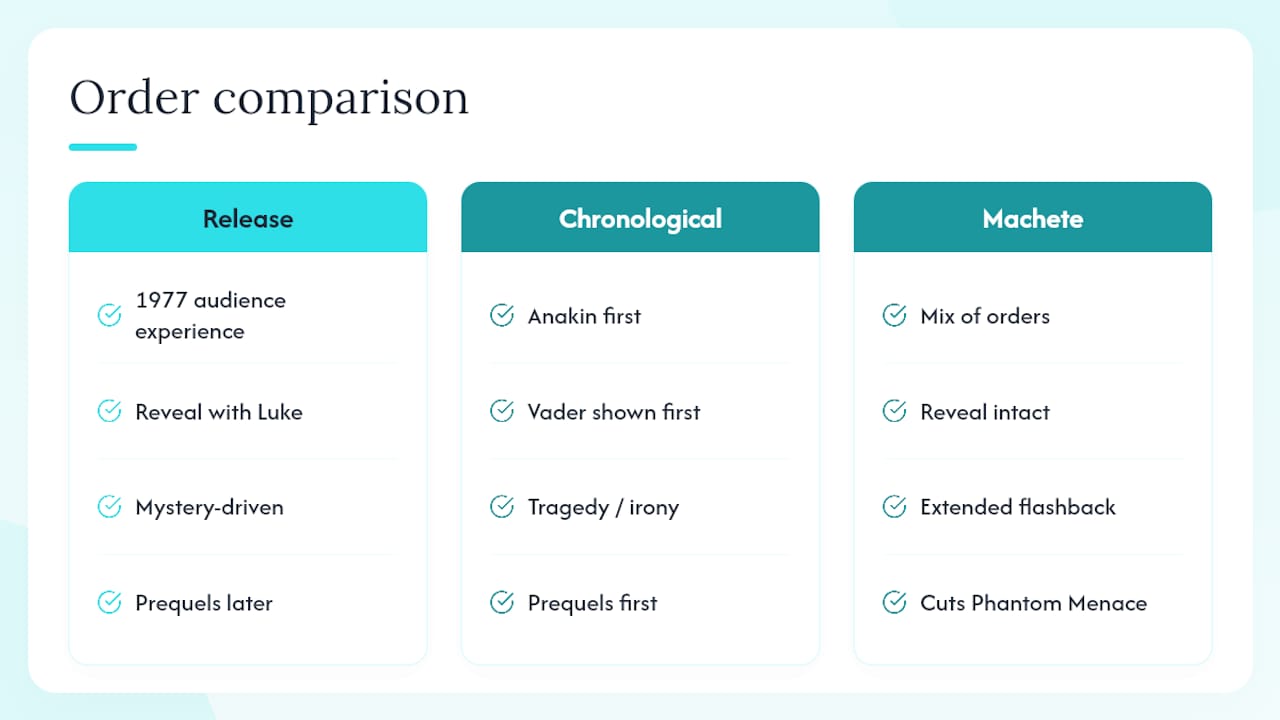
Each order isn’t just a different sequence, it’s a different story. Release order preserves the exact experience 1977 audiences had: you meet Vader as a mysterious villain and only learn his identity when Luke does. That reveal is the entire emotional engine of the original trilogy, and watching the prequels first defuses it completely.
Chronological order flips the story into a tragedy. You watch Anakin become Vader before you ever see him as a masked threat, which changes A New Hope from a mystery into dramatic irony. According to ScreenRant’s analysis, this structure helps newcomers track character motivation more smoothly, since cause and effect run in the order they actually happened.
Machete Order splits the difference. It keeps the Vader reveal intact by watching A New Hope and Empire first, then treats the prequels as an extended flashback triggered by Yoda’s line about facing Vader again. The trade off: it cuts The Phantom Menace entirely, which means you skip young Anakin’s introduction and Padmé and Obi-Wan’s first appearances. Modified versions that restore the full prequel trilogy or append the sequels change that pacing again, trading narrative tightness for completeness.
None of these orders is objectively correct. They’re different tools built for different first impressions.
Why New Releases Keep Changing the Ideal Star Wars Order
Every new canon release forces a small recalibration of “the” watch order, and that’s not a flaw, it’s just how an active franchise works. When The Acolyte premiered, it pushed the earliest chronological entry back by roughly a century, into the High Republic era. Andor did something similar for the era just before Rogue One, adding texture that older guides simply didn’t account for.
The 2026 theatrical release of The Mandalorian and Grogu is the latest example. It adds a new title to the end of a list and is currently a theatrical-only release prior to any streaming availability.
This is exactly why a static, one-size-fits-all order goes stale fast. A guide written even a year earlier could miss an entire era of placements. The practical fix isn’t memorizing a fixed list, it’s understanding the placement logic (era framing, BBY/ABY anchoring, anthology non-linearity) so you can slot new releases in yourself as they land.
Is There Really One Best Way to Watch Star Wars?
No, and most guides that insist otherwise are overselling certainty they don’t have. The honest answer is that release order and chronological order optimize for opposite experiences, surprise versus clarity, and neither is wrong. What conventional advice gets wrong is treating the Machete Order as a solved formula rather than what it actually is: a specific fix for a specific problem, preserving one reveal in The Empire Strikes Back, that stops working cleanly the moment you bolt the sequel trilogy onto the end.
What the research here actually supports is prioritizing your own spoiler tolerance and time budget over any “definitive” ranking. A viewer with three free weekends and zero spoiler exposure should chase the chronological experience StarWars.com’s own era framework is built for. A viewer rewatching for the fifth time should chase craft, and that’s where Machete Order still earns its reputation.
If there’s one thing worth doing differently than most guides suggest, it’s this: stop treating the watch order as the whole plan. The order gets you through the story. A spoiler-safe, timestamped resource is what actually lets you catch the details that make a rewatch worth doing at all.
— Christian
Sources
- Star Wars movies in order | Explore Disney+
- Starwars
- How to Watch Every Star Wars Movie and Series in Order | IGN
- How To Watch Every Star Wars Movie and Series in Order | ScreenRant