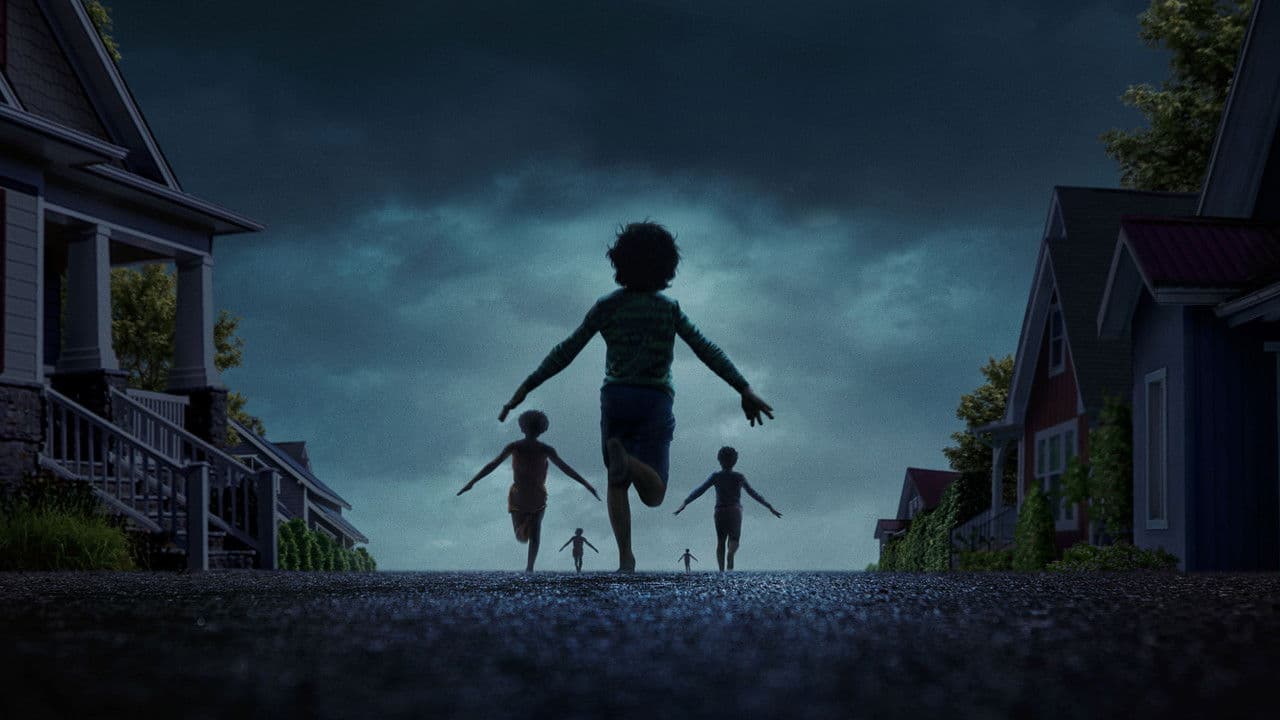
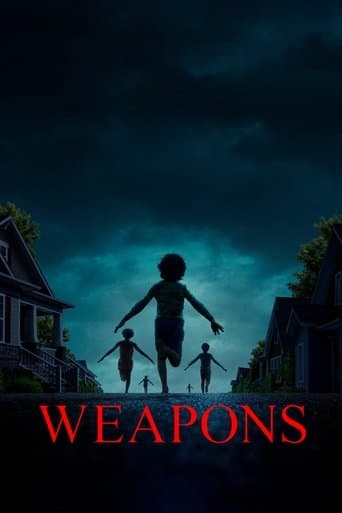
At exactly 2:17 a.m., seventeen kids from Justine Gandy's third-grade class sprint out of their front doors — arms out in that unnerving downward V — and vanish into the dark. Weapons became one of 2025's most obsessively re-watched films because Zach Cregger plays fair: almost every answer about Aunt Gladys is planted on screen long before the movie hands it to you, from a classroom whiteboard that literally says "parasites" to a bell engraved with occult symbols.
Cregger has said he wrote the script Magnolia-style without an outline, discovering Gladys around fifty pages in, and the finished film rewards that same kind of discovery. The 2:17 timestamp is a confirmed homage to Room 217 of The Shining, the kids' running pose was written into the script as a reference to the 1972 "napalm girl" photograph, and the title card hides an Alcoholics Anonymous triangle inside its "O" — a quiet key to the whole movie, since Cregger has been open about the story doubling as an allegory for growing up with an alcoholic parent.
There's also a second, sadder layer: Cregger wrote Weapons while grieving his Whitest Kids U'Know co-founder Trevor Moore, and fans have found tributes hiding in everything from a plate of seven mustard-covered hot dogs to the release date itself. Below, every egg is sorted by how it's verified — director-confirmed, community-documented, or clearly labeled theory.
The full catalog
Type
Status
Difficulty
01
George Harrison Warns You in the First Minute
Music SecretForeshadowing◆ Community ConsensusSecond Watch
WHERE TO LOOK · Opening montage of the children running from their homes, before the title card
The film opens with George Harrison's "Beware of Darkness" from All Things Must Pass (1970) playing under the child narrator's account of the 2:17 disappearances. It's not just an eerie needle drop: the lyrics warn against darkness that 'can hit you' and creep into your life unnoticed — a near-literal thesis statement for Gladys, who enters the Lilly home as a harmless houseguest and hollows out everyone around her. Music outlets flagged the choice immediately when the film opened at number one; the song essentially tells you the ending, if you listen.
02
The Run Is Straight Out of a Vietnam War Photo
Hidden DetailReferenceBehind the Scenes✓ ConfirmedDeep Cut
WHERE TO LOOK · Every shot of the missing kids running, starting with the 2:17 opening
The children's signature sprint — body erect, arms locked in a downward V — isn't random creepiness. Cregger's screenplay describes it explicitly: every child runs 'with the same CURIOUS POSTURE — body erect, ARMS OUTSTRETCHED in a downward V like someone holding heavy bags,' adding that 'they run like the naked Vietnamese girl covered in napalm from that iconic photo.' That's Nick Ut's Pulitzer-winning 1972 photograph of nine-year-old Phan Thi Kim Phuc, an image of children fleeing violence adults inflicted on them — which is the entire movie in one visual.
03
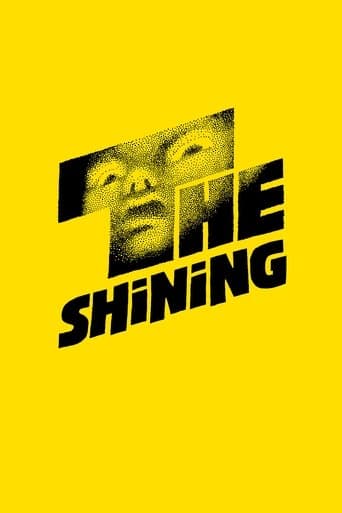
2:17 a.m. Is Stephen King's Room 217
ReferenceBehind the Scenes✓ ConfirmedDeep Cut
WHERE TO LOOK · Established in the opening narration; recurs on clocks throughout and in Archer's dream
The exact minute the children vanish is a confirmed nod to Room 217 of the Overlook Hotel in Stephen King's The Shining novel — the room where the worst horror lives. Cregger told CinemaBlend the influence started subconsciously, and although he's 'a Kubrick guy' (the film famously changed it to 237), he considered switching to 2:37 and decided his first impulse had to stand — siding with King over Kubrick. Fans have stacked extra readings on top: 17 missing kids, the U.S. House passing a 2022 assault-weapons ban with 217 votes, even the Bible verse Matthew 2:17 about mourning lost children. Cregger has only ever confirmed the King homage.
04
An Alcoholics Anonymous Triangle Hides in the Title Card
Hidden DetailMeta◆ Community ConsensusFreeze Frame
WHERE TO LOOK · The 'O' of the WEAPONS title card
Watch the 'O' in the WEAPONS title card: a triangle forms inside the circle, producing the exact circle-and-triangle emblem of Alcoholics Anonymous. It's the first of the film's recovery-culture breadcrumbs, and it reframes Gladys as addiction personified — a presence that moves into a house, leaves the parents glassy-eyed and unresponsive, and makes a child the caretaker. Cregger hasn't confirmed the logo itself, but he's on record that the alcoholism reading is rooted in his own life, while insisting he won't dictate one interpretation.
05
The Whiteboard Diagnoses Gladys Before Anyone Else
ForeshadowingHidden Detail◆ Community ConsensusSecond Watch
WHERE TO LOOK · Justine's classroom whiteboard early in her chapter; the nature documentary on the TV in Marcus's chapter
In Justine's chapter, the word "parasites" is written on her classroom whiteboard, and she asks the kids, 'Who else can think of a parasite?' — a throwaway beat that's actually the movie's answer key. The motif returns in Marcus's chapter, where a TV documentary describes the cordyceps fungus that hijacks ants' bodies, playing right before Gladys shows up at his house. Both moments frame Gladys as a parasite feeding on hosts: she drains the children's life force in the Lillys' basement and puppets the possessed like the fungus puppets ants.
Spoiler — tap to reveal
06
The Doorbell-Camera Couple Are Barbarian Alumni
CameoCallback✓ ConfirmedDeep Cut
WHERE TO LOOK · Archer's chapter — the house where he pleads for doorbell-camera footage
When Archer canvasses the neighborhood for Ring-camera footage, the couple who answer — chilly wife Erica and accommodating husband Gary — are Sara Paxton and Justin Long, both from Cregger's Barbarian. Long played AJ, that film's secretly monstrous actor, and Paxton (Cregger's wife) was Megan, heard only over the phone, which makes this her on-screen debut in his universe. Paxton confirmed the 'sneaky cameo' to ScreenRant before release. For Barbarian fans it's a loaded gag: the harmless suburban husband is played by the last Cregger character you should trust.
07
The Floating Rifle Even Cregger Can't Explain
Hidden DetailMeta✓ ConfirmedPlain Sight
WHERE TO LOOK · The end of Archer's dream sequence in his chapter
Archer's nightmare ends on the film's most argued-about image: a giant assault rifle hovering above a house with an alarm clock embedded in it, frozen at 2:17. Cregger has openly said he doesn't have the answer — calling it 'a very important moment for me in this movie' precisely because 'I don't understand it,' and saying he wants every viewer to build their own relationship with the image. Popular readings range from grief made literal (the title's 'weapon' hanging over every home in Maybrook) to a nod to the 217-vote assault-weapons ban, though Cregger has said the film isn't a school-shooting metaphor.
08
Seven Hot Dogs for Trevor Moore
ReferenceMeta◆ Community ConsensusDeep Cut
WHERE TO LOOK · Marcus's chapter — Terry lays out the lunch spread at their home
In Marcus's chapter, his husband Terry serves a lunch platter of exactly seven mustard-topped hot dogs — an oddly specific number that Whitest Kids U'Know fans immediately recognized. In the sketch 'Hot Dog Timmy,' Trevor Moore plays a doctor whose patient admits to eating seven hot dogs a day. Moore, Cregger's co-founder in the troupe and closest creative partner, died in August 2021, and Cregger has said writing Weapons was part of processing that loss. He hasn't confirmed the hot-dog count on the record, but as fan-found tributes go, this one is practically signed.
09
Count the Newspapers to Read the Timeline
Hidden DetailBehind the Scenes◆ Community ConsensusFreeze Frame
WHERE TO LOOK · The Lillys' driveway across multiple chapters — easiest to clock when James approaches the house
The rolled-up newspapers piling on the Lilly family's driveway are Cregger's hidden calendar. Frame-counters mapped the stack — roughly three papers on day three, four on day four, up to nine by the final Sunday — revealing that the whole film spans a tight eight days, Sunday to Sunday, even though the interlocking chapters scramble your sense of time. There's one deliberate wobble: when James sneaks up to rob the house, the count doesn't quite line up, which the No Scoops Club breakdown argues is Cregger intentionally disorienting the audience the way Gladys disorients her victims.
Spoiler — tap to reveal
10
Paul's Mustache Belongs to a Magnolia Cop
ReferenceBehind the Scenes◆ Community ConsensusDeep Cut
WHERE TO LOOK · Alden Ehrenreich's look throughout Paul's chapter
Cregger has repeatedly named Paul Thomas Anderson's Magnolia as the structural blueprint for Weapons' interlocking-chapter mosaic, and the film wears the influence on its upper lip: Alden Ehrenreich's Officer Paul sports a mustache styled after John C. Reilly's Officer Jim Kurring, Magnolia's own compromised cop. It's a costume-level wink at the movie's biggest debt — both films juggle a suburb full of broken characters converging on one inexplicable event. Cregger walked through his influences (Magnolia among them) in a Letterboxd Journal interview.
11
'Consumption' Dates Gladys by a Century or Two
Behind the ScenesForeshadowing? TheoryDeep Cut
WHERE TO LOOK · Gladys's arrival at the Lilly house, explaining her illness
When Gladys explains why she's staying with the Lillys, she describes illness using the word "consumption" — the 19th-century term for tuberculosis that no modern great-aunt would reach for. Theorists read the archaic vocabulary as a deliberate tell that Gladys is far older than she looks, possibly an ancient witch wearing a borrowed identity (and, per one popular reading, a borrowed body). Cregger cut a whole Gladys backstory chapter from the script, so the word choice is one of the only clues to her true age the finished film leaves standing. Labeled a theory: the film never confirms it.
Spoiler — tap to reveal
12
The Bell Is Engraved With a Triangle and a Six
Hidden DetailBehind the Scenes◆ Community ConsensusFreeze Frame
WHERE TO LOOK · Gladys's ritual bell at the Lilly house; the symbol returns in the end credits
Gladys's control ritual runs on personal objects, her own blood, and a small bell carved with an inverted triangle above the number 6 — a symbol the film never explains. Occult readings note the triangle as a feminine/Crone-goddess mark and six as a number tied to witchcraft and devilry, especially tripled. Eagle-eyed viewers also caught that the symbol appears inverted on the bell but flips right-side-up when it resurfaces in the end credits, a detail that has fueled everything from broken-spell theories to sequel setup. ScreenRant ranks it among the film's biggest unsolved mysteries.
Spoiler — tap to reveal
13
Gladys's Flower Brooch Doubles as a Power Meter
Hidden DetailForeshadowing? TheoryFreeze Frame
WHERE TO LOOK · Gladys's costume in every appearance — compare her arrival, her weakened states, and the finale
A fan theory popularized by content creator DawsOnScreen holds that the floral brooch pinned to Gladys's chest tracks her strength scene to scene: the flower sits closed when she's weak or sick, half-open when she needs to 'feed,' and in full bloom when she's at maximum power. Track it across her appearances and the pattern holds disturbingly well, effectively giving rewatchers a threat gauge for every scene she's in. Cregger hasn't addressed it, so it stays a theory — but it's the kind of costume-department detail Weapons keeps rewarding people for hunting.
Spoiler — tap to reveal
14
Alex's Chapter Is Cregger's Own Childhood
MetaBehind the Scenes✓ ConfirmedDeep Cut
WHERE TO LOOK · The final chapter — Alex caring for his unresponsive parents under Gladys's control
The final chapter — Alex quietly keeping house for parents who sit entranced and unreachable while Gladys rules the home — is the film's confession. Cregger has said flatly: 'The final chapter of this movie with Alex and the parents, that's autobiographical. I'm an alcoholic. I'm sober 10 years; my father died of cirrhosis.' The 'inversion of the family dynamic,' where the child becomes the caretaker, is lifted from his own life with an alcoholic parent. It's why the AA triangle in the title card and Gladys-as-addiction readings land so hard: the metaphor was load-bearing from the start.
Spoiler — tap to reveal
15
Gladys Had Her Own Chapter — Cregger Cut It
Behind the ScenesMeta✓ ConfirmedWhite Whale
WHERE TO LOOK · Not on screen — cut from an early draft and discussed in interviews
The film's chapter structure originally went one name further: an early draft included a Gladys POV chapter explaining who she is and where she came from. Cregger cut it, choosing mystery over lore — which is why the finished film offers only fragments like the 'consumption' line and the bell sigil. The excised material didn't die, though: by late 2025 Cregger was openly discussing a Gladys-centric follow-up film with New Line, telling Deadline about the 'Gladys' project directly. In other words, the movie's biggest deleted easter egg is becoming its own feature.
Spoiler — tap to reveal
16
A Release Date One Day After a Painful Anniversary
MetaBehind the Scenes◆ Community ConsensusWhite Whale
WHERE TO LOOK · The theatrical release itself — August 8, 2025
Weapons hit theaters on August 8, 2025 — one day after the fourth anniversary of Trevor Moore's death on August 7, 2021. Cregger has confirmed the film grew out of grieving Moore, his Whitest Kids U'Know co-founder, and fans read the date as a final tribute wrapped around the whole release. Whether the studio scheduled it deliberately has never been stated, so this stays a community find — but between the timing, the hot-dog scene, and Cregger's interviews about writing through loss, the film functions as a memorial from its first frame to its marketing calendar.
17
The Maybrook News Site Quietly Links Weapons to Barbarian
MetaReference✓ ConfirmedWhite Whale
WHERE TO LOOK · Off-screen — the official Maybrook viral marketing website, pre-release
Before release, the studio's viral marketing hub — an in-universe local paper covering the Maybrook disappearances — buried a story headlined 'Underground Prison Discovered in Rental Home.' It describes a Detroit Brightmoor rental where 'a local woman escaped the home under shocking circumstances and an actor was found dead nearby,' name-checks Tess Marshall, and even uses a still from Barbarian. That's the plot of Cregger's 2022 film, planted as a news item in Weapons' world. Nothing in the movie itself connects them, so most outlets read it as an official wink rather than shared-universe canon.
Is there a post-credit scene in Weapons?
No — Weapons has no post-credit scene. Nothing plays during or after the credits. Cregger has said he wanted Weapons to be a self-contained experience whose final images linger without a teaser — though a Gladys-focused follow-up film is in development at New Line, it isn't set up after the credits.
Frequently asked
+How many easter eggs are in Weapons?
We've cataloged 17 easter eggs and hidden details in Weapons — fittingly, one for each missing child. Seven are confirmed on the record by Zach Cregger or official sources, including the 2:17 homage to The Shining's Room 217 and the napalm-girl running pose written into the script. The rest are widely documented community finds or clearly labeled theories, like the AA triangle in the title card and Gladys's flower-brooch power meter.
+Does Weapons have a post-credits scene?
No. Weapons has zero mid- or post-credits scenes. Zach Cregger deliberately kept the film self-contained so its disturbing final images would linger without a franchise teaser undercutting them. You can leave when the credits start. A Gladys-focused follow-up film is in development at New Line, but it was announced through interviews and trade reports — not a stinger.
+What does 2:17 mean in Weapons?
Cregger confirmed the time is an homage to Room 217 of the Overlook Hotel in Stephen King's novel The Shining — he considered Kubrick's 237 but stuck with his first instinct. Fans have layered on additional readings the director hasn't endorsed: 17 missing children, the 217 votes that passed a 2022 US House assault-weapons ban, and the mourning verse Matthew 2:17. Only the King reference is on the record.
+Is Weapons connected to Barbarian?
Not canonically, but Cregger winks at it twice. The official Maybrook News marketing site ran an article about an 'underground prison' in a Detroit rental home, name-dropping Barbarian's heroine Tess Marshall with a still from that film. And Barbarian alumni Justin Long and Sara Paxton cameo as a couple Archer visits for doorbell-camera footage. Nothing in the actual movie links the two stories.
+What does the floating gun in Weapons mean?
Even Cregger won't say definitively — he calls the giant rifle with the 2:17 alarm clock 'a very important moment' precisely because he doesn't fully understand it himself, and wants viewers to form their own reading. Popular interpretations treat it as Archer's grief made literal or a comment on the violence hanging over American homes, though Cregger has said the film isn't a school-shooting metaphor.
Last updated 2026-07-08 · Spotted something we missed? Tell us.