Watch Breaking Bad Differently: 10 Timestamped Easter Eggs From Better Call Saul
The highest-value Easter eggs in Better Call Saul aren’t cameos for their own sake. They’re deliberate callbacks that reframe character motivation and force you to reread scenes you thought you understood. The superlab burial under Howard and Lalo, the Cinnabon payoff behind Gene Takovic, Walter and Jesse’s own appearances, and Kim Wexler’s calculated absence all sit at the top of that list, and each one carries real narrative weight once you know what to look for.
TL;DR:
- The discovery that Howard and Lalo are buried beneath the superlab rewrites the original series, making scenes in the lab feel like desecration.
- The Cinnabon framing device is a slow-burn Easter egg that connects Jimmy’s black-and-white life to courtroom imagery from his past, adding depth to his character arc.
- Walter White and Jesse Pinkman’s appearances in Season 6 serve as character evidence that influence Gene’s reckless behavior, not mere fan service.
- Props like the Zafiro Añejo stopper and the Best Quality Vacuum Repair card are verified continuity elements that reveal shared tastes and link different story threads across timelines.
- Careful verification — including specific timestamps, prop consistency, and creator confirmation — is essential to distinguish confirmed Easter eggs from fan theories.
Table of Contents
- The Better Call Saul Easter Eggs Worth Rewatching For
- How to Spot, Verify, and Catalog an Easter Egg
- What These Callbacks Actually Reveal
- How Thethingsyoumissed Verifies Every Entry
- Easter Eggs Hiding in the Score and Soundtrack
- Why Careful Easter Eggs Make Better Call Saul a Stronger Prequel
- Get the Full, Timestamped Better Call Saul Catalog
- Sources
- FAQ
The Better Call Saul Easter Eggs Worth Rewatching For
Some of these details were confirmed by the creators themselves. Others are prop-level continuity that rewards a frame-by-frame rewatch. Here’s the ranked shortlist, with locators so you can pull them up yourself.
1. Howard and Lalo buried under the superlab (Season 6, “Waterworks” and “Fun and Games”). This is the single detail that recolors the entire original series. Peter Gould has said flatly that once you know Gus’s superlab sits on top of two bodies, you can’t watch Breaking Bad the same way again. Every scene where Walt and Jesse cook meth in that basement now plays over a literal grave.
2. The Cinnabon frame story (Season 2 through the series finale). Gene Takovic’s black-and-white life in an Omaha mall was never a throwaway framing device. It’s the slowest-burn Easter egg in the show, and the finale montage ties his Cinnabon scoop directly back to courtroom imagery from Jimmy’s past, according to Rolling Stone’s finale recap.
3. Walter White and Jesse Pinkman’s Season 6 appearances (“Breaking Bad” episode). Their scenes function as character evidence, not fan service. Watching Walt manipulate Saul into laundering money, and Jesse recoil from him, directly informs Gene’s increasingly reckless behavior in the black-and-white timeline.
4. The Zafiro Añejo stopper. First seen in Jimmy and Kim’s con on a wealthy mark, this prop resurfaces later as a quiet signal of the couple’s shared taste for high-stakes grifting. Slashfilm’s continuity catalog tracks how the object outlives the relationship it once symbolized.

5. The inflatable Statue of Liberty. Jimmy’s sidewalk mascot gig in the cold open of the pilot isn’t just a joke about his low point. It becomes visual shorthand the show returns to whenever Jimmy’s dignity is on the line.
6. The Best Quality Vacuum Repair card. This is the connective tissue linking Saul’s “disappearer” network to events fans only see resolved in Breaking Bad. The card physically travels between eras, which is exactly the kind of prop Slashfilm flags as a layered payoff object.
7. Loyola’s diner. The same location gets reused across timelines with subtle set redressing, a detail the Hollywood Reporter’s Easter-egg breakdown singles out as one of the show’s quieter continuity flexes.
8. The dented metal trash cans. A minor visual motif, but one that recurs near desert locations tied to cartel violence, reinforcing the show’s habit of letting production design carry thematic weight without a single line of dialogue.
9. Mike Ehrmantraut’s private-investigator work. Tom Schnauz has explained that Mike’s early PI cases aren’t filler. They quietly seed the surveillance skills and criminal contacts that pay off in Breaking Bad’s later seasons.
10. The Season 6 title episode, “Breaking Bad.” ScreenRant’s season-6 rundown catalogs how this single episode retcons several minor Breaking Bad moments by showing what Saul was doing off-screen the whole time.
How to Spot, Verify, and Catalog an Easter Egg
Not every coincidence is a callback. Before you claim an Easter egg is real, run it through a simple filter.
Entries can be sorted into types such as dialogue callback, returning prop, reused location, visual motif, or production-confirmed detail. That labeling matters because a fan theory and a confirmed detail carry very different weight, and Hollywood Reporter’s own coverage makes the same distinction when cataloging props and locations.
Before you call something confirmed, check for:
- A specific timestamp you can point to and rewatch
- A repeat appearance across at least two episodes or timelines
- A creator or production source (interview, DVD commentary, official social post)
- Prop continuity (same object, same wear pattern, same design)
- A corroborating screengrab from someone else who caught it independently
The most common false-positive trap is mistaking visual style for intent. A recurring color palette or camera angle can just be the director’s habit, not a planted clue. Pro Tip: Keep a running note of the exact episode and minute mark the moment you spot something. Spoiler-safe rewatching only works if you can verify a detail without scrubbing through an episode and accidentally seeing what happens next.
What These Callbacks Actually Reveal
The superlab reveal isn’t just a shock twist. It retroactively turns Walt and Jesse’s cooking scenes into something closer to desecration, and that’s precisely the reaction Peter Gould was aiming for.
“I don’t think you can watch those scenes in the lab in Breaking Bad the same way again,” Gould said of the decision to place Howard and Lalo’s bodies beneath the superlab.
Kim Wexler’s total absence from Breaking Bad isn’t a plot hole. It’s a deliberate narrative choice that tells you Jimmy buried that relationship as completely as he buried his own name. Her silence in the years between the two shows says more about his guilt than any flashback could. Mike’s PI work operates the same way, quietly building the skillset and contacts that later let him operate as Gus Fring’s fixer without the show ever needing to explain how he got there. And the Cinnabon payoff works because it inverts the usual formula: instead of building toward a big revelation, it lets a mundane job carry years of unspoken shame.
How Thethingsyoumissed Verifies Every Entry
Cataloging a detail as canon takes more than a screenshot and a hunch. Thethingsyoumissed applies the same verification pass to every entry before it goes live:
- Confirm the exact episode, season, and timestamp
- Cross-check the claim against a creator interview or production note when one exists
- Label the entry by type (dialogue callback, prop, location, motif, or production-confirmed)
- Tag a confidence level (confirmed, probable, or disputed) so readers know what they’re looking at
- Preserve spoiler-safe navigation so nothing downstream gets revealed early
A typical entry reads something like this: episode and timestamp, a one-line description of the egg, its type, a source quote from the relevant interview, and a reference image. That structure is what separates a verified catalog from a forum thread full of guesses, and it’s the same method used across the site’s full library of TV series catalogs.
Easter Eggs Hiding in the Score and Soundtrack
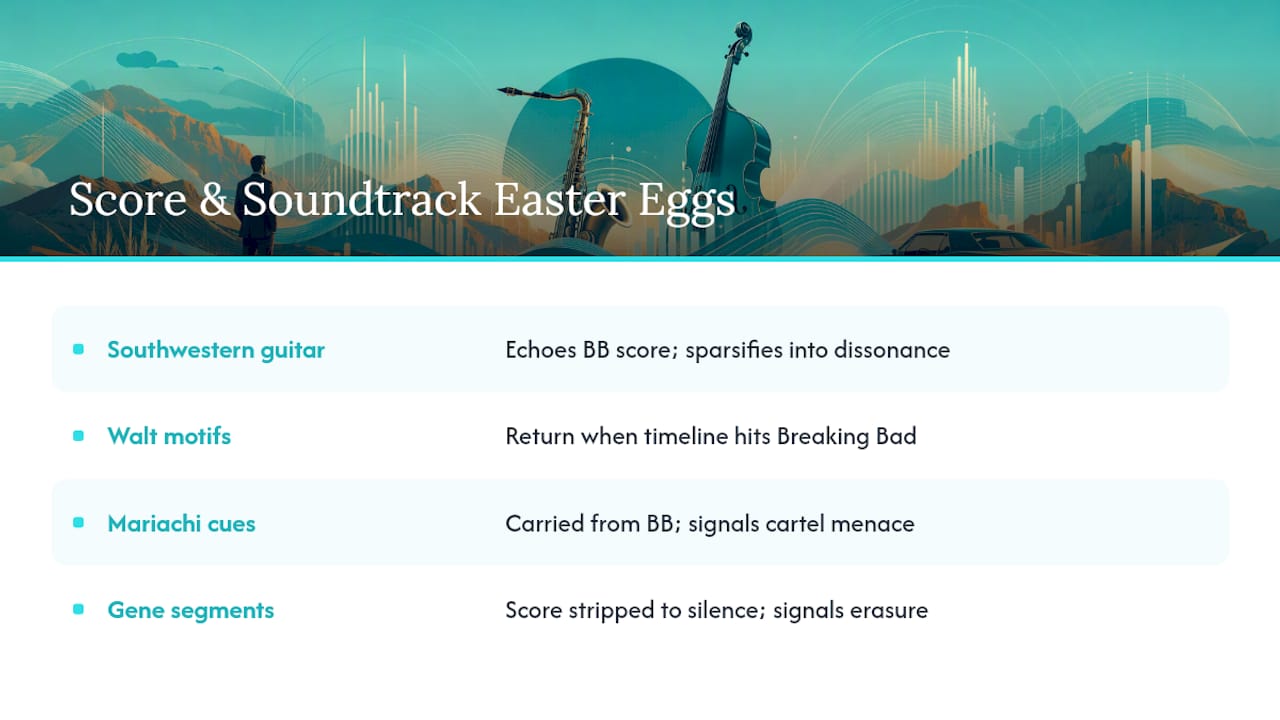
Better Call Saul’s music does quieter work than its props, but it’s just as deliberate. The show frequently leans on Southwestern-flavored guitar cues that echo Dave Porter’s original Breaking Bad score, especially in scenes involving the cartel or the desert. Listen for how those cues get sparser and more dissonant as Jimmy drifts closer to becoming Saul, then return to something closer to Walt’s ominous cooking-scene motifs once the timeline catches up to Breaking Bad territory.
The mariachi and Latin-tinged cues that mark Salamanca family scenes carry over almost unchanged, a musical shorthand the original series established for cartel menace long before Better Call Saul existed. When those same string arrangements show up under Lalo’s scenes, they’re not new. They’re a direct sonic callback that primes longtime viewers for danger before a single line of dialogue confirms it.
Gene Takovic’s black-and-white segments use silence differently than the rest of the show, stripping the score down almost entirely. That absence is its own Easter egg. It signals a man who has muted everything about his former life, including the music that once scored his biggest scams.
Why Careful Easter Eggs Make Better Call Saul a Stronger Prequel
A well-placed callback does more analytical work than a dozen theory videos. What separates Better Call Saul from a typical prequel cash-grab is that its Easter eggs carry emotional consequence: the superlab burial doesn’t just reward attentive fans, it retroactively indicts a scene you already loved. That’s a harder trick to pull off than most shows even attempt, and it’s why this series rewards a second, slower watch more than almost any other prequel on television.
— Christian
Get the Full, Timestamped Better Call Saul Catalog
Thethingsyoumissed is the alternative to scrolling forum threads and half-remembered fan theories. Every entry on the Better Call Saul catalog page comes timestamped, sourced against creator interviews or production notes, and tagged by confidence level, so you know exactly what’s confirmed and what’s still a theory.

If you want the complete episode-by-episode breakdown, including entries not covered here, the full Better Call Saul catalog has every prop, callback, and cameo verified and labeled. Want to see how these connect to the original series? The Breaking Bad catalog and the broader Breaking Bad universe franchise page map the continuity across both shows. Continuity-minded viewers working on their own breakdowns might also find Iguanify’s guide to continuity workflows useful for tracking recurring details systematically. Browse the full TV series index to start your next spoiler-safe rewatch.
Sources
These are the primary interviews and recaps behind the claims in this guide:
- Better Call Saul’s Peter Gould breaks down the series finale | AMC
- Better Call Saul series finale recap | Rolling Stone
- Better Call Saul Easter eggs | Hollywood Reporter
- Every Breaking Bad reference in Better Call Saul so far | Slashfilm
FAQ
Why did Jimmy take an 86-year sentence instead of 7?
Jimmy initially negotiated a 7-year deal, but he tore it up once he realized confessing fully and implicating himself in Chuck’s death and Kim’s trauma mattered more than freedom. Peter Gould has framed that choice as Jimmy reclaiming his own identity rather than a legal miscalculation.
Why is Kim Wexler never mentioned in Breaking Bad?
Her absence is a deliberate storytelling choice, not an oversight. It signals that Jimmy buried that chapter of his life as thoroughly as he buried his real name, and her silence carries more narrative weight than a cameo ever could.
What is the saddest episode of Better Call Saul?
Fan and critic consensus points to “Waterworks” and the finale, “Saul Gone,” as the emotional peaks, largely because of how they resolve Kim’s guilt and Jimmy’s confession. Both episodes lean on visual callbacks discussed throughout this guide, including the superlab reveal.
Is there any mention of Walter White in Better Call Saul?
Yes. Walter White and Jesse Pinkman both appear directly in Season 6’s “Breaking Bad” episode, and their scenes are treated as character evidence rather than a simple cameo. For the full episode-by-episode breakdown of where they show up, the Better Call Saul catalog lists every confirmed appearance.