20 Verified Breaking Bad Hidden Details Fans Missed, All Timestamped

Yes, Breaking Bad is deliberately full of hidden details, and we have pulled together the clearest, most verifiable examples for you. Below is a curated list of easter eggs tied to specific episodes and scenes, backed wherever possible by creator and crew confirmations rather than fan speculation. We also separate what Vince Gilligan built on purpose from what the show discovered along the way.
TL;DR:
- The pink teddy bear foreshadows the Season 2 plane crash resulting from Walt’s actions, while the final episode title “Felina” is confirmed as an anagram of “finale” rather than a chemical reference.
- Visual symbols like Heisenberg’s hat, blue meth’s color, and orange attire encode themes of instability, purity, danger, and death, aligning with character arcs and story motifs.
- Many clues, such as Lydia’s stevia habit, the ricin cigarette, and background props like the Roomba, are deliberately planted early and rewarded on rewatch for more context.
- The series’ cinematography uses camera angles, symmetry, and color schemes to visually mirror characters’ moral decline and control loss, especially in key scenes.
- Verified statements from the creators clarify that many details are intentional symbols, with “Ozymandias” being the series’ pivotal episode and recurring motifs escalating in significance.
Table of Contents
- 1. The pink teddy bear and the plane crash
- 2. “Felina” is an anagram, not a chemistry joke
- 3. Heisenberg’s name, hat, and logo everywhere
- 4. Blue meth as a purity marker
- 5. Orange as a death omen
- 6. Marie’s purple obsession
- 7. Lydia’s stevia packets
- 8. The Saul Goodman billboard and “LWYRUP”
- 9. Gale’s karaoke and “Major Tom”
- 10. The Roomba and the ricin callback
- 11. GPS coordinates as real filming locations
- 12. “Baby Blue” plays Walt’s eulogy
- 13. Recurring clothing as a loyalty tracker
- 14. The confession scene in “Ozymandias”
- 15. Better Call Saul’s quiet tie-ins
- 16. The reused shirt Gilligan didn’t plan
- 17. The “ABQ” title as structural payoff
- 18. Walt’s glasses as a mask
- 19. Skyler’s wardrobe tracking her complicity
- 20. The confession tape as a narrative loop
- Color theory, episode titles, and musical clues worth studying
- What the people who made the show actually confirmed
- Reading the clues: what separates meaning from coincidence
- Cultural and literary allusions hiding in plain sight
- The clues hiding inside scenes you’ve already watched
- How the camera itself tells part of the story
- A small detail that still gets us
- Where to find every confirmed Breaking Bad easter egg
- FAQ
- Sources
1. The pink teddy bear and the plane crash
The scorched pink teddy bear that haunts Season 2’s black-and-white cold opens is not a random prop. It is foreshadowing for the mid-air collision that closes the season, a disaster triggered indirectly by Walt’s choices. Watch for it starting in “Seven Thirty-Seven” and tracked through “ABQ,” where the crash finally lands.
2. “Felina” is an anagram, not a chemistry joke
Fans spent years insisting the finale’s title spelled out Fe, Li, and Na, the chemical symbols for iron, lithium, and sodium, tying it to blood, meth, and tears. Vince Gilligan confirmed on the Breaking Bad Insider podcast that “Felina” is simply an anagram of “finale.” The chemistry reading is a fun coincidence the writers never planned.
3. Heisenberg’s name, hat, and logo everywhere
Walt’s alter ego seeds itself visually long before the porkpie hat becomes iconic. The name nods to Werner Heisenberg’s uncertainty principle, a fitting emblem for a man whose identity keeps destabilizing. Once the hat appears in “Cornered,” its silhouette starts showing up in shadows and reflections across later seasons.
4. Blue meth as a purity marker
The product’s signature color was not an aesthetic accident. Gilligan has described wanting a visual shorthand for Walt’s chemistry skill, something no other dealer could replicate, in his AMC Q&A with fans. The blue tint becomes a stand-in for Walt’s ego as much as his product.
5. Orange as a death omen
Characters who wear orange tend to be marked for danger or demise, a pattern cataloged by outlets tracking the show’s recurring visual language. Walt’s hazmat suit, certain hostage scenes, and key confrontations all lean on the color as a quiet warning sign.
6. Marie’s purple obsession
Marie Schrader’s wardrobe and home decor run almost entirely purple, a color historically associated with royalty, denial, and performative comfort. It is a visual joke about her need to control her surroundings while everything around her falls apart.
7. Lydia’s stevia packets
Lydia Rodarte-Quayle never drinks tea without her own stevia, a tic that seems like harmless characterization until it becomes a plot device. The habit reinforces her controlling, detail-obsessed nature long before it pays off narratively.
8. The Saul Goodman billboard and “LWYRUP”
Saul’s garish highway billboard and his vanity plate reading “LWYRUP” are broad jokes that double as character shorthand. They telegraph exactly the kind of lawyer Walt and Jesse are about to hire, before he says a single word on screen.
9. Gale’s karaoke and “Major Tom”
Gale Boetticher’s rendition of a space-themed ballad during his one real moment of levity makes his eventual fate sting harder. The song choice plays like dramatic irony once you know what happens to him in “Full Measure.”
10. The Roomba and the ricin callback
A seemingly throwaway detail, a Roomba bumping into furniture in the Whites’ house, becomes a clue fans used to track the hidden ricin cigarette. The show rewards viewers who treat background objects as evidence, not decoration.
11. GPS coordinates as real filming locations
Several props display GPS coordinates that, when checked, point to actual filming locations around Albuquerque, a detail documented in reference guides to the show’s cultural touchstones. It is a wink from the crew to anyone willing to pause and zoom in.
12. “Baby Blue” plays Walt’s eulogy
Badfinger’s “Baby Blue” scores the finale’s final minutes in “Felina,” its lyrics about a blue-eyed love reframed as Walt’s goodbye to his chemistry, his legacy, and himself. The needle drop works as the emotional thesis statement for the whole series.
13. Recurring clothing as a loyalty tracker
Jesse and Walt’s wardrobes shift in tandem with their power dynamic. Watch how often Jesse wears muted, oversized clothes early on, then sharper, darker layers as he hardens, a visual echo of Walt’s own transformation from cardigans to black hats.
14. The confession scene in “Ozymandias”
Walt’s raw, broken confession to Jesse was shot under real-world pressure, illustrating the complex contributions of film production departments behind the scenes. Director Rian Johnson has said the crew was racing fading daylight to capture the scene, and that urgency shaped the performance Bryan Cranston delivered in just a few takes. The scramble on set gave the moment its unscripted rawness.
15. Better Call Saul’s quiet tie-ins
Several props and phrases that feel like throwaway lines in Breaking Bad get full backstories once Better Call Saul arrives. Watching both series back to back turns minor details into payoffs years in the making.
16. The reused shirt Gilligan didn’t plan
Not every connection was intentional. Gilligan later noticed, and admitted he had missed, a shirt worn by Jesse that reappears on Todd, a visual thread linking the two characters’ arcs that the creator himself discovered only after the fact.
17. The “ABQ” title as structural payoff
Episode titles across the series function like puzzle pieces. “ABQ” closes Season 2’s long foreshadowing arc by finally delivering the plane crash the cold opens had been hinting at for weeks.
18. Walt’s glasses as a mask
Walt’s eyeglasses, a mundane prop in Season 1, become part of his visual armor once Heisenberg takes over. Compare early classroom scenes to later cook sequences and the glasses start reading less like vision correction and more like a disguise.
19. Skyler’s wardrobe tracking her complicity
Skyler’s clothing shifts from soft, domestic tones to sharper, more businesslike pieces as she becomes entangled in the family’s criminal enterprise, a quiet costuming choice that mirrors her moral slide.
20. The confession tape as a narrative loop
Walt’s early “confession” video to Hank, meant as a cover story, becomes a structural echo of his later, real confession in “Ozymandias.” The show plants the device once as a lie, then detonates it later as a half-truth.
For the complete, timestamped version of this catalog, our Breaking Bad easter egg page breaks down every entry episode by episode.
Color theory, episode titles, and musical clues worth studying
Breaking Bad’s visual language rewards close viewing more than almost any prestige drama of its era, and three patterns do most of the work.
Color. Blue signals purity and Walt’s obsessive craftsmanship. Orange marks characters or moments headed toward death or danger. Purple belongs to Marie, a quiet joke about control dressed up as a favorite color.
Structure. The black-and-white flash-forwards that open Season 2 are not stylistic flourishes. They are a slow-motion countdown to the mid-air collision, and the show trusts you to connect scattered fragments, a burnt teddy bear, a shoe in a pool, into one event by the finale of that arc.
Music and literature. The episode “Ozymandias” borrows its title from Percy Shelley’s poem about the inevitable collapse of empire and ego, a fitting frame for Walt’s downfall. “Felina” closes the loop musically, with “Baby Blue” functioning as the show’s emotional last word.
- Blue tracks purity and pride in the product.
- Orange tracks danger or impending death.
- Purple tracks denial and controlled comfort.
- Black-and-white cold opens track a countdown to disaster.
The finale’s title is an anagram, not a chemical code: Vince Gilligan confirmed on the Breaking Bad Insider podcast that “Felina” stands for “finale,” debunking the popular Fe/Li/Na theory fans had built around it.
What the people who made the show actually confirmed
Separating intentional symbolism from happy accident matters, and the clearest line comes straight from the people who built the series.
“Felina” is an anagram of “finale.” The Fe, Li, Na chemistry reading is likely coincidental.
That confirmation comes from Gilligan’s own account on the Breaking Bad Insider podcast, where he also described the writers’ room debating and ultimately rejecting an early draft that gave Skyler a suicide arc.
- Gilligan called the series a “sociological experiment” testing how long audiences would stay loyal to Walt, detailed in his AMC fan Q&A.
- Rian Johnson said the “Ozymandias” confession was shot in a rush against fading light, a constraint that shaped Cranston’s performance.
- Long-form reporting treats “Ozymandias” as the series’ defining episode, documented in an oral history from The Ringer.
- Gilligan admitted he missed his own callback linking Jesse’s and Todd’s shirts until after the show aired.
Reading the clues: what separates meaning from coincidence
Not every recurring image is a planted clue, and the difference matters for how you watch. A thematic easter egg, like the color patterns above, advances character meaning across many scenes. A playful callback, like a reused shirt, might just be wardrobe continuity that later reads as symbolic.
The most reliable tell is repetition with escalation: a motif that recurs and intensifies as a character changes is deliberate. A detail that appears once and never resurfaces is probably coincidence dressed up by hindsight.

Pro Tip: On your next rewatch, pause during the credits and note whatever color dominates the final shot of each episode. It is one of the fastest ways to spot the show’s visual rhythm.
Cultural and literary allusions hiding in plain sight
Beyond “Ozymandias,” the series leans on outside texts to deepen its own stakes. Walt’s transformation echoes Scarface-style crime sagas, a parallel that outlets tracking the show’s film influences have mapped scene by scene, from his rise in the drug trade to his increasingly theatrical sense of self-importance.
Smaller nods pile up around the edges. Dialogue references to classic literature and film recur in ways that reward viewers who already know the source material, turning a single line into a wink rather than a plot point. These allusions rarely explain themselves. They sit quietly in dialogue or framing, waiting for a rewatch to click.
The show’s confidence in its audience is part of what makes these references work. Nothing is footnoted on screen, and nothing needs to be. If you catch the Shelley poem behind “Ozymandias” or the Scarface shadow behind Walt’s arc, the show rewards you with a slightly different read on everything that follows.
The clues hiding inside scenes you’ve already watched
Some of the show’s biggest reveals are planted long before they pay off, visible only once you know where the story is headed. The Season 2 flash-forwards are the clearest example: a burnt teddy bear, debris in a swimming pool, and a severed eye floating in chlorinated water all read as abstract dread on a first watch, then snap into focus once “ABQ” delivers the mid-air collision they were always pointing toward.
Smaller puzzles work the same way. The ricin cigarette hidden in a cigarette pack, tracked partly through a background Roomba bump, sets up a plot thread that pays off episodes later in a completely different context. Lydia’s stevia habit looks like a character tic until her caution around what she ingests becomes directly relevant to her fate.
These are not twists dropped on you without warning. They are clues planted early enough that a second viewing feels like watching a different, more deliberate show.
How the camera itself tells part of the story
Breaking Bad’s cinematography does narrative work that dialogue never touches. Low, ground-level shots, often from inside a pool, a floor, or a car trunk, recur whenever the show wants to suggest a character has lost control of their own story. Overhead shots looking straight down on Walt during key cooks visually box him in, turning the frame itself into a cage.
Symmetry matters too. Scenes of domestic normalcy are often shot with careful, centered compositions, while scenes involving the drug trade tilt slightly off-axis, a subtle visual cue that something is skewed even when the dialogue stays calm. Once you notice the pattern, it is hard to unsee it, and it turns ordinary blocking choices into part of the show’s argument about how far Walt has drifted from the life he started in.
A small detail that still gets us
One of our favorite discoveries is how casually the show plants its ricin and Roomba clue, a detail easy to miss entirely on a first watch and nearly impossible to forget once you catch it. That is the thrill we chase: the moment a background prop turns out to matter. Our catalog exists to make that moment available to everyone, with spoiler-safe browsing so you can explore at your own pace.
- Timestamped entries tied to specific scenes
- Verified sourcing behind every claim
- Spoiler-safe browsing by design
— Christian
Where to find every confirmed Breaking Bad easter egg
We built our full Breaking Bad catalog for exactly this kind of rewatch: every entry is timestamped, sourced, and graded by how hard it is to spot, so you are never guessing whether a detail is real or fan theory.
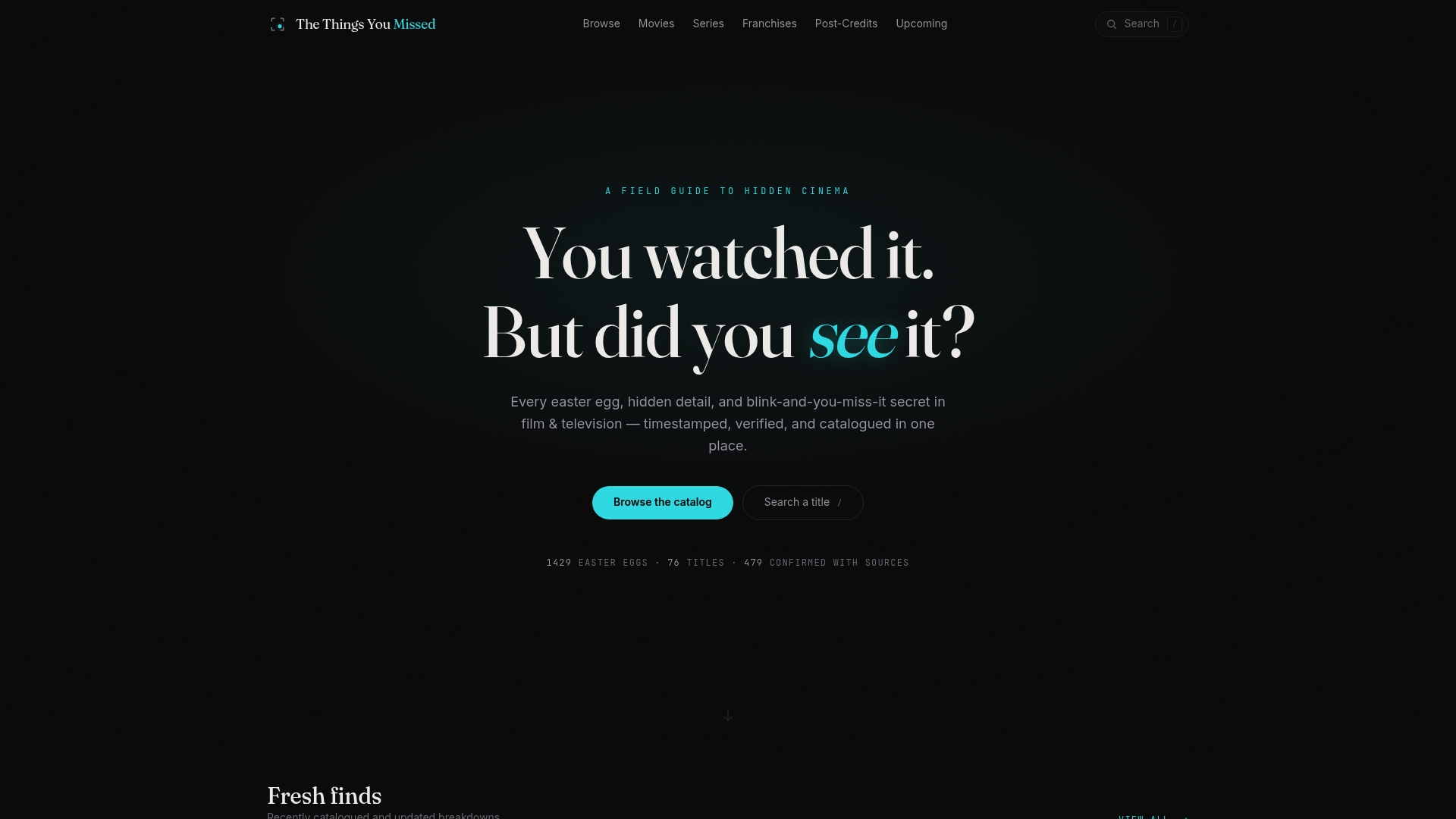
If you want the wider picture, our Breaking Bad universe breakdown connects callbacks across both Breaking Bad and Better Call Saul, and our TV series hub covers dozens of other shows the same way. Subscribe for updates and we will keep adding new entries as they get verified.
- Searchable, timestamped entries for every episode
- Spoiler-safe browsing so you control what you see
- Franchise-level breakdowns connecting Breaking Bad and Better Call Saul
FAQ
What’s the most controversial episode of Breaking Bad?
“Ozymandias” is widely treated as the series’ most devastating and debated episode, largely because of Hank’s death and the family’s collapse, a reading supported by long-form oral history reporting. Its production was also unusually tense, with a key confession scene nearly lost to fading daylight.
What are some cool facts about Breaking Bad?
The finale’s title “Felina” is confirmed by Gilligan as an anagram of “finale,” not the Fe/Li/Na chemistry reading fans popularized, according to the Breaking Bad Insider podcast. Gilligan also described the entire series as a sociological experiment testing audience loyalty to a morally compromised protagonist.
What is Walt’s biggest mistake?
Fans and critics generally point to Walt’s refusal to quit once he and Skyler had enough money, a choice driven by ego rather than necessity. That refusal sets off the chain of events that culminates in the family’s destruction in “Ozymandias.”
Who turned down the role of Walter White in Breaking Bad?
This detail is not documented in verified production interviews or creator statements we rely on, so we are not going to guess at a name that isn’t publicly confirmed. What is confirmed is that Bryan Cranston’s casting came directly from Vince Gilligan’s vision for the character.
Sources
- Breaking Bad Insider Podcast finale: Listen to Vince Gilligan explain the final episode.
- Breaking Bad Creator Vince Gilligan Answers Fan Questions - Part I | AMC
- The Pivotal Breaking Bad Scene That Almost Didn’t Happen, According To Rian Johnson | Cinemablend
- Vince Gilligan missed a Breaking Bad Easter egg — and loved it | Time