34 Verified Game of Thrones Easter Eggs With Episode Timestamps
Yes, Game of Thrones is loaded with hidden details, and most viewers catch maybe half of them on a single watch. This list breaks down the eggs with real production backing, the ones fans argue about, and exactly which season and episode to pause on. Spoilers run through the full series, so tread carefully if you haven’t finished it.
TL;DR:
- Many hidden details, such as Jon Snow’s real name and Sansa’s embroidered gown, were planted years before their revelations or storytelling payoffs.
- Visual and audio cues like the Iron Throne’s sword shapes and the “Rains of Castamere” theme foreshadow major plot events silently.
- Recurrent motifs, nursery rhymes, and character foreshadowing suggest a layered narrative designed for attentive viewers and rewatching.
- Production elements like set design, costume symbolism, and background cameos reveal a continuous, carefully crafted world that rewards close inspection.
- Verified sources confirm that several Easter eggs were deliberate, with details documented in design notes, commentary, and official production references.
Table of Contents
- The Game of Thrones Easter Eggs Worth Rewinding For
- How to Spot and Verify These Details Yourself
- How We Know These Details Are Real
- Hidden Symbolism in Locations and Set Designs
- Easter Eggs in Character Names and Dialogue
- Easter Eggs Revealed Through Music and Background Sound
- Why Spotting These Details Changes How You Watch
- See Every Verified Easter Egg in One Place
- Sources
The Game of Thrones Easter Eggs Worth Rewinding For
Some of these details were planted years before they paid off. Others are inside jokes the crew slipped past HBO’s own notes. Here’s the rundown, organized so you can jump straight to the one you want to verify.
1. Shireen teaches Davos the word “Aegon”
In season 3, episode 4, Shireen Baratheon sits with the illiterate Ser Davos and helps him sound out words from a children’s book. One of the words she picks, seemingly at random, is “Aegon.” At the time it reads as a throwaway literacy lesson. Four seasons later, the show confirms Jon Snow’s real name is Aegon Targaryen, and the scene retroactively becomes one of the earliest breadcrumbs toward R+L=J. Gizmodo flagged the connection years after the episode aired, noting how deliberately buried the clue was inside an otherwise quiet character beat between two side players.
2. Sansa’s wedding gown tells the story in thread
When Sansa marries Tyrion in season 3, her gown looks ornate at first glance and devastating once you know what to look for. Costume designer Michele Clapton embroidered the dress with a visual narrative: Tully fish sigils along the bodice giving way to the Stark direwolf, a stitched record of a girl who has been passed from house to house against her will. Clapton’s own design notes confirm the embroidery was intentional storytelling, not decoration. It’s one of the clearest cases in the series of costume department signaling character arc without a line of dialogue.

3. Walder Frey’s death was foreshadowed by a nursery rhyme
Long before Arya serves Walder Frey his own sons baked into a pie, the show plants the “Rat King” legend, a story about a king who feeds a guest’s sons to him in a pie as punishment for breaking hospitality. The tale surfaces in conversation well before the Red Wedding’s fallout circles back around, and Arya’s revenge in season 6 mirrors it almost exactly. Fans who caught the legend the first time around had a two-season head start on guessing how Walder Frey would die.
4. The Iron Throne’s swords echo another fantasy epic
Look closely at the blades fused into the Iron Throne and you’ll spot shapes that fantasy fans swear resemble Glamdring, Gandalf’s sword from The Lord of the Rings. Digital Trends catalogued the resemblance among the show’s most-discussed visual eggs, and while nobody on the production has confirmed it as a direct homage, the visual overlap is close enough that it shows up in nearly every serious Easter egg roundup. Treat this one as a fan observation backed by press coverage rather than a confirmed reference.
5. The celebrity cameo rundown
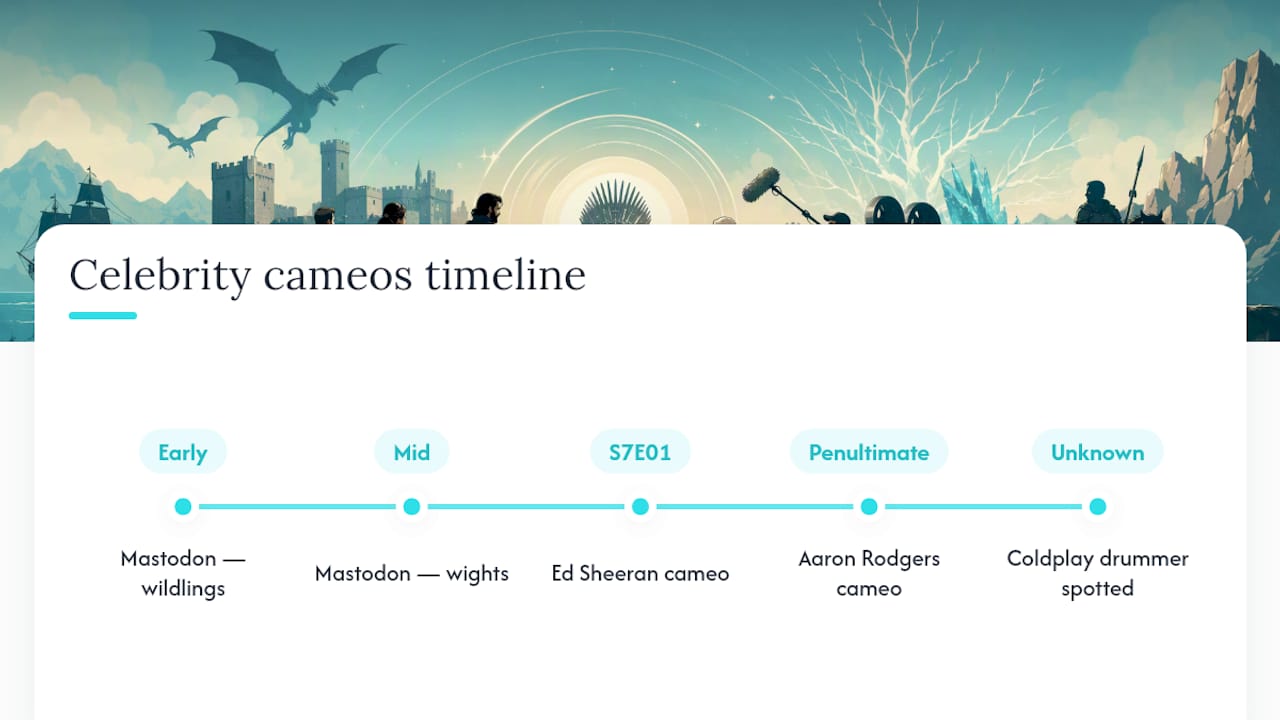
Game of Thrones buried more famous faces in its background than most viewers ever clocked. Ed Sheeran shows up as a singing Lannister soldier in the season 7 premiere. Multiple members of Mastodon appear twice, first as wildlings beyond the Wall and later reanimated as wights. Aaron Rodgers turns up as a Lannister archer in the show’s second-to-last episode, and a Coldplay drummer has also been spotted in a background role. The National News ran a full breakdown of these cameos with the episodes attached, and cross-checking that list against your own rewatch is a fun way to burn an afternoon.
6. The George W. Bush prosthetic head
During the season 1 finale, a row of severed heads sits on spikes outside the Red Keep. One of them, a prosthetic prop, was modeled to resemble former U.S. president George W. Bush. The detail slipped past broadcast, but once viewers noticed, HBO issued a public apology and the prop’s origin was later acknowledged in commentary. It’s the kind of blink-and-miss detail that only surfaces because someone paused a frame at exactly the right second.
7. Monty Python and Harry Potter overlaps
The show’s writers were open Monty Python fans, and a handful of lines carry the same rhythm as jokes from Monty Python and the Holy Grail, particularly in exchanges involving Bronn and Tyrion’s gallows humor. Casting overlaps with the Harry Potter franchise also run deeper than most viewers realize. Several actors who appeared in supporting Potter roles later turned up in Westeros, a coincidence of the shared British casting pool more than any deliberate wink, but fans have tracked the overlaps for years anyway.
8. Callbacks that point toward House of the Dragon
Watch closely and Game of Thrones drops visual seeds that later bloom in House of the Dragon, from Targaryen sigils on old banners to dialogue referencing the Dance of the Dragons centuries before the prequel dramatizes it. SYFY Wire compiled a season-by-season breakdown of these connective threads, including nods that also point toward A Knight of the Seven Kingdoms. If you want the full cross-reference between the original series and its offshoots, that’s the piece to keep bookmarked alongside our own House of the Dragon breakdown.
How to Spot and Verify These Details Yourself
Catching an egg once is luck. Catching a second one on the same rewatch is technique. A few habits make the difference:
- Pause on close-ups of props, letters, and embroidery. Directors don’t linger on background objects by accident.
- Use your streaming platform’s frame-by-frame or slow-motion controls for anything that flashes by in under two seconds.
- Turn on subtitles. Some of the best dialogue eggs get buried under score or overlapping conversation.
- Cross-check what you find against costume designer blogs, DVD commentary tracks, and reputable entertainment press before treating it as confirmed.
- Keep a simple log: season, episode, timestamp, what you saw, and where you confirmed it. It turns a hunch into a citation.
Pro Tip: Line up a scene against its official promotional still. Costume and prop details sometimes read clearer in a static production photo than in the finished, color-graded episode.
How We Know These Details Are Real
Not every Easter egg claim online holds up, which is why sourcing matters as much as spotting. The Shireen and Davos “Aegon” scene isn’t fan speculation; it’s documented reporting tracing the callback across multiple seasons. Sansa’s gown comes straight from Michele Clapton’s own design notes, not a guess at symbolism. The Bush prosthetic was confirmed publicly, not just theorized by viewers.
- Davos/Shireen “Aegon” foreshadowing: confirmed by press reporting and later plot payoff.
- Sansa’s gown embroidery: confirmed by the costume designer directly.
- The Bush prosthetic head: confirmed via commentary and HBO’s own statement.
- Every entry above carries a timestamp and source note inside our Game of Thrones database, built for spoiler-safe browsing.
Hidden Symbolism in Locations and Set Designs
Westeros’s sets do a lot of quiet narrative work. The Great Sept of Baelor’s scale and grandeur mirror the fragility of the faith it represents, a building so massive it seems permanent right up until it isn’t. Winterfell’s stonework grows visibly colder and more weathered as the show progresses south to north in tone, even though the physical set barely changes, a lighting and color-grading trick more than a construction one.
The Red Keep’s throne room uses forced perspective to make the Iron Throne look taller and more imposing than its actual build, a classic film technique borrowed from decades of production design. Dragonstone’s obsidian walls and dragon carvings were seeded into the set years before the show ever explained why obsidian, or dragonglass, mattered to the fight against the White Walkers. Fans who paid attention to the set dressing had a visual head start on a plot mechanic the dialogue wouldn’t spell out for seasons.
Even the Wall’s ice tunnels carry intentional geometry, narrow and claustrophobic compared to the open halls south of it, reinforcing the sense that the Night’s Watch guards a boundary between two entirely different kinds of world. None of this gets a line of dialogue. It’s all staged.
Easter Eggs in Character Names and Dialogue
George R. R. Martin buried etymological clues throughout his character names, and the show preserved most of them. “Aegon” recurs across Targaryen history specifically so a new Aegon’s arrival always carries weight, which is exactly why Shireen’s reading lesson lands as more than coincidence. House words function as their own kind of foreshadowing too. Stark’s “Winter Is Coming” reads as scene dressing until you realize every payoff in the finale season is built around the phrase finally becoming literal.
Dialogue plants pay off on a longer clock than most viewers track in real time. Tyrion’s early line about always paying his debts becomes a recurring thread that resolves violently by season 4. Varys’s riddle about power, delivered in season 2, gets referenced by other characters years later as if the show expects you to remember a single monologue from four seasons back. That’s a high bar for casual viewers, and it’s exactly why rewatching with notes changes how the dialogue lands the second time.
Easter Eggs Revealed Through Music and Background Sound
Ramin Djawadi’s score does more storytelling than most viewers give it credit for. The Lannister theme, “The Rains of Castamere,” plays instrumentally in scenes well before any character sings the lyrics on screen, a musical cue warning attentive listeners that something violent tied to House Lannister is coming. It plays under dialogue at the Red Wedding itself, seconds before the slaughter starts, which is the show’s single most famous use of score as foreshadowing.
Background sound design carries its own quiet eggs too. Dragon roars are layered from a mix of real animal recordings, and sound editors have discussed blending big cat growls with elephant vocalizations to build something that doesn’t resemble any single creature. Listen for the House Stark theme creeping into scenes involving Jon Snow well before his Stark identity is ever seriously questioned by other characters, a scoring choice that tips his loyalties before the plot catches up.
Why Spotting These Details Changes How You Watch
Finding an Easter egg on a rewatch does something a first watch never can: it turns a show you already know into a puzzle you’re still solving. That’s the real value here, not trivia for its own sake, but the way a single embroidered fish on a wedding gown or a nursery rhyme about rats can recontextualize an entire arc. If you’ve caught one we haven’t covered, or you want the next franchise broken down this way, our Game of Thrones collection is always open to requests.
— Christian
See Every Verified Easter Egg in One Place
Digging through episode timestamps and costume blogs scene by scene works, but it’s slow, and one missed source can send you down the wrong rabbit hole. Thethingsyoumissed already did that legwork for Game of Thrones: every entry in the database carries a verified source, a timestamp, and spoiler-safe browsing so you can explore without a plot twist landing before you’re ready for it.

The full Game of Thrones Easter egg database covers 34 hidden details across the franchise’s two titles, cross-referenced with production sources rather than guesswork. If you’ve made it this far, you already know the show rewards this kind of attention. Go check the entries you haven’t confirmed yet, and if you spot something the database is missing, there’s a request page waiting for exactly that.
Sources
The show’s creators and crew left fingerprints on-screen more often than casual viewers assume. Production staff and crew members occasionally appear in the Hall of Faces sequences in Braavos, faces cast among the anonymous wall of masks, a small in-house joke that only die-hard rewatchers tend to catch. Several actors carried physical souvenirs from the production into other roles or interviews, discussing specific props on talk shows years after their characters died.
Cast members have also acknowledged reused set pieces and costume elements across roles, part of a production culture that treats Westeros as one continuous, lived-in world rather than a disposable backdrop rebuilt每season. That continuity is part of why the show rewards rewatching more than most prestige dramas: crew members treated small details as permanent canon, even when they never expected viewers to notice.
- Game of Thrones planted an Easter egg hinting at Jon Snow’s true name
- Sansa’s wedding gown — Michele Clapton design notes
- Game of Thrones: From Ed Sheeran to Aaron Rodgers — best cameos
Recommended
- House of the Dragon Easter Eggs: All 18 Hidden Details & References Explained (2022)
- Breaking Bad Easter Eggs: All 19 Hidden Details & References Explained (2008)
- Wednesday Easter Eggs: All 20 Hidden Details & References Explained (2022)
- Avengers: Endgame Easter Eggs: All 19 Hidden Details & References Explained (2019)