The Best Harry Potter Easter Eggs Hiding in Plain Sight

Newt Scamander’s name flickering across the Marauder’s Map, McGonagall’s Quidditch trophy tucked in a Philosopher’s Stone display case, the meta-joke buried on page 394, and the bezoar Snape mocks Harry over in year one all pay off later, and that’s just the start of this hunt. This guide walks through the highest-value harry potter easter eggs across the films and books, tells you exactly where to look, and shows how to verify a find before you swear it’s canon. Expect:
- Frame-by-frame movie details (Sherbet Lemon, Cheeri-Owls, Chocolate Frog cameos)
- Book and chapter pointers for planted foreshadowing
- The number-seven motif and other recurring patterns
- A verification method for telling “confirmed” from “fan theory”
Thethingsyoumissed catalogs entries like these with timestamps and spoiler-safe descriptions, so you can check a claim without ruining the next chapter for yourself.
Key Takeaways
Verified Easter eggs hold up under scrutiny because they’re tied to a specific frame, page, or confirmed statement, not just repeated online claims.
| Point | Details |
|---|---|
| Movie eggs reward pausing | Details like the Marauder’s Map cameo and Cheeri-Owls box only register on a paused, rewatched frame. |
| Book eggs set up real payoffs | The bezoar in book one directly resolves a life-or-death moment five books later. |
| Seven is structural, not accidental | The number recurs across books, Horcruxes, and Quidditch rules as a deliberate motif. |
| Verify before you repeat a claim | Confirm against official franchise sources or direct interviews before calling something canon. |
| Thethingsyoumissed logs it all | The site timestamps and confidence-rates film Easter eggs so fans can check claims spoiler-safe. |
Table of Contents
- Harry Potter Easter Eggs That Reward a Frame-by-Frame Rewatch
- Book Easter Eggs That Set Up Payoffs Chapters or Years Later
- Why the Number Seven Keeps Showing Up
- How Thethingsyoumissed Verifies and Timestamps Every Egg
- Easter Eggs in Harry Potter Video Games and Other Media
- Where Rowling’s Own Life Shows Up in the Text
- Trivia the Cast and Crew Planted on Purpose
- The Debates Fans Still Argue Over
- Sources
Harry Potter Easter Eggs That Reward a Frame-by-Frame Rewatch
The films are stuffed with details that fly by in under two seconds, which is exactly why they’re worth hunting on a second or third viewing. These are the ones worth pausing for.
- Newt Scamander’s name on the Marauder’s Map (Prisoner of Azkaban): During the map-reveal sequence, a careful eye can catch “Newt Scamander” listed among the map’s creators, decades before he’d get his own franchise. It’s confirmed by Wizarding World’s own Easter-egg feature as an intentional nod planted for the world-building nerds in the audience.
- McGonagall’s Quidditch trophy (Philosopher’s Stone): The trophy case Harry studies in the halls includes a plaque for “M. McGonagall,” seeker for Gryffindor, quietly establishing that the strict Transfiguration professor was once a broom-flying prodigy herself.
- Sherbet Lemon as Dumbledore’s password (Philosopher’s Stone): The Muggle candy reference isn’t just a throwaway line. It signals early that Dumbledore keeps one foot in the non-magical world, a detail Collider’s ranking of top film Easter eggs singles out for how naturally it slides past first-time viewers.
- Cheeri-Owls in the Weasley kitchen (Chamber of Secrets): A cereal box on the counter, styled after Cheerios but starring owls, is the kind of production-design joke that only survives on a paused frame.
- Chocolate Frog card cameos: Cards for Dumbledore, Agrippa, and Ptolemy appear across multiple films, and eagle-eyed fans have spotted background cards referencing wizards mentioned nowhere else in the movies.
- The dragon safety disclaimer: Blink and you’ll miss the in-universe warning label on dragon-related packaging in later films, a wink at British product-safety conventions transplanted into the wizarding world.
- Marauder’s Map footprints in the end credits: Several films let map-style footprints wander across the closing credits, a small stylistic callback that ties the credits sequence to the map’s own magic.
- Background portraits reacting to scenes: Watch the portraits lining hallway walls during tense moments. Several react, whisper, or shift position in ways that have nothing to do with the main dialogue.
Pro Tip: Take a screenshot at the exact frame and note the runtime timestamp before you post a claim anywhere. A blurry description (“somewhere in the trophy scene”) gets disputed; “0:47:12 in the theatrical cut” gets confirmed.
Book Easter Eggs That Set Up Payoffs Chapters or Years Later
Rowling planted callbacks into the text itself, not just the films, and these hold up better under scrutiny because you can point to an exact page.
- The bezoar in “The Potion Master” (Philosopher’s Stone, chapter 8): Snape quizzes Harry on what a bezoar is and gets silence in return. Five books later, Harry cures a poisoning in Half-Blood Prince using exactly that stone, a payoff book-easter-egg research traces directly back to that first, easily forgotten classroom scene.
- Page 394: A frequently cited meta-reference tied to Prisoner of Azkaban, where the specific page carries weight beyond the plot itself. J.K. Rowling reportedly flagged its significance directly to Alan Rickman ahead of the film adaptation, a detail that circulates as production trivia more than a single documented public source, so treat it as well-corroborated color rather than an airtight citation.
- Trelawney’s real prophecy (Order of the Phoenix): After two books of mocking her as a fraud, Trelawney delivers one authentic prediction, and Rowling seeds enough ambiguity earlier in the series that a careful reader can flag it as different in tone from her usual theatrics.
- The Parseltongue hint in “The Vanishing Glass” (Philosopher’s Stone, chapter 2): Harry’s zoo conversation with a boa constrictor reads like a throwaway gag on first read. It’s actually the first evidence of a magical ability that becomes central to the plot’s biggest twist.
- The Hand of Glory foreshadowing (Chamber of Secrets): A minor object mentioned in Borgin and Burkes resurfaces with real narrative weight later in the series, a classic Rowling move of introducing an object once, quietly, before it matters.
- Repeated lines across books: Certain phrases (warnings from Dumbledore, specific turns of phrase from Hagrid) recur almost verbatim in later books, which longtime readers have flagged as deliberate rhythm rather than accidental repetition.
- Edition differences worth knowing: Page numbers shift between UK and US editions, and even between hardcover and paperback printings. If you’re citing “page 394,” specify which edition, because the same scene can land on a different page entirely in another printing.
Why the Number Seven Keeps Showing Up
Seven books. Seven Horcruxes. Seven players on a Quidditch team. Harry’s seven years at Hogwarts. The number recurs so often across the franchise that Wizarding World itself has flagged it as one of the series’ most consistent structural choices, tied to seven’s long history as a “magically powerful” number in folklore.
Watch for these patterns on your next read-through:
- The “power of three” shows up in trios (Harry, Ron, Hermione) and triple-repeated warnings or spells.
- Objects introduced once tend to resurface exactly when the plot needs them, rarely earlier.
- Names and titles echo across generations (the Potters, the Blacks), reinforcing lineage as a running motif.
How Thethingsyoumissed Verifies and Timestamps Every Egg
Before we call anything “confirmed,” it goes through a short process:
- Capture the exact frame or timecode for film details, or the chapter and page for book details.
- Cross-check against official sources like Wizarding World features, director commentary, or direct author interviews.
- Flag the entry as confirmed, likely, or unverified, so nobody mistakes a fan theory for studio-confirmed canon.
- Present it spoiler-safe, meaning the timestamp tells you where to look without giving away what happens next in the scene.
Pro Tip: Whenever possible, reference the original theatrical release timestamp or a first-edition page number. Director’s cuts and later printings shift both, and that’s usually where “well actually” arguments start online.
Found something we haven’t logged yet? You can submit it through our request page and we’ll run it through the same verification steps.
Easter Eggs in Harry Potter Video Games and Other Media
The franchise’s reach beyond the films opened up an entirely separate category of hidden detail. Early LEGO Harry Potter games hid unlockable characters and levels tied to book-only scenes that never made it to film, rewarding players who’d read the source material closely. Hogwarts Legacy leans even harder into this, scattering portraits, dialogue lines, and background objects that reference specific book chapters rather than just film moments, since its story takes place a century before Harry’s arrival and has more narrative room to play in.
The Harry Potter and the Order of the Phoenix video game notably included a Marauder’s Map mechanic that let players track NPCs in real time, essentially turning a book-only object into a functional gameplay tool years before later games refined the idea further. Mobile spin-offs and trivia apps have followed suit, often quietly slipping in references to deleted scenes, alternate chapter titles from international editions, or props that appeared only in early production concept art. None of these carry the same documentation trail as the films or books, so treat video-game Easter eggs as a looser category: fun to spot, harder to verify against a single authoritative source, and best cross-checked against community wikis with a healthy dose of skepticism before you repeat a claim as fact.
Where Rowling’s Own Life Shows Up in the Text
Several details in the books trace back to Rowling’s own history and public statements rather than pure invention. Long-form scholarship on the series’ influences and analogues documents her acknowledged debts to authors like Jane Austen and to The Little White Horse, a childhood favorite whose structural fingerprints show up in how Rowling paces mystery and reveal.
Names in the series lean heavily on Rowling’s interest in etymology and mythology, something she’s discussed in interviews as a deliberate practice rather than coincidence: Remus Lupin’s name doubles down on werewolf mythology twice over, and Sirius Black’s name ties directly to the Dog Star. Rowling has also spoken publicly about drawing on personal experience with grief and loss for Harry’s own arc as an orphan navigating a world that constantly reminds him of what he lost. None of this reaches the reader as an explicit “Easter egg” in the traditional sense. It’s closer to authorial fingerprint, the kind of detail that rewards readers who go looking for the person behind the pen rather than just the next plot beat.
Trivia the Cast and Crew Planted on Purpose
Some of the richest harry potter hidden details come straight from behind-the-camera choices, not just the script. Production designers reportedly embedded background jokes into set dressing that only reveal themselves on a paused, zoomed frame, the Cheeri-Owls box being a prime example of art department humor that never appears in dialogue.
Directors across the eight films made small callbacks to each other’s work as the series changed hands, weaving visual rhymes between early, whimsical entries and the darker later films even though different people sat in the director’s chair for each installment. Alan Rickman, notably, was given information about his character’s arc years before the books revealing it were published, which is why some of his line deliveries in earlier films read entirely differently once you know how the series ends. That’s the kind of intentional Easter egg that only becomes visible in hindsight, on a second full rewatch of the franchise once you already know where Snape’s story goes.
The Debates Fans Still Argue Over
Not every claimed Easter egg survives scrutiny, and that’s part of what keeps the fandom engaged years after the last book’s release. Community wikis and forums catalog an enormous number of alleged references and cross-media nods, but fan-compiled lists vary wildly in reliability, and plenty of “confirmed” claims circulating online trace back to nothing more than a Reddit thread with no primary source behind it.
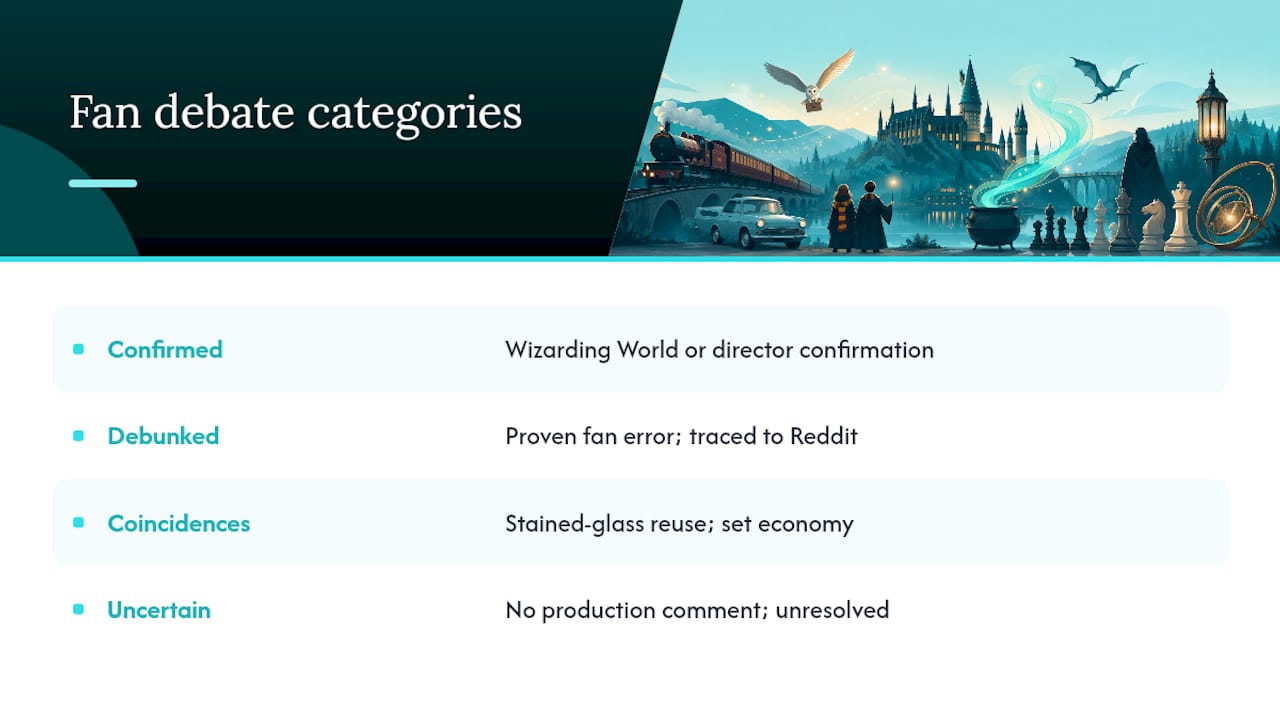
Some of the most persistent debates involve whether specific background extras were meant as deliberate callbacks or simple coincidence, whether certain prop choices in early films were planned with later books in mind (production timelines make several of these unlikely, since some films were shot before certain books were even written), and whether repeated visual motifs, like recurring stained-glass window patterns in Hogwarts scenes, carry symbolic intent or are just efficient reuse of expensive set pieces. The honest answer is that some of these will never get a definitive yes or no, since nobody involved in production has spoken on the record about every single detail. Treat unverified claims exactly that way, interesting, worth discussing, but not the same tier of certainty as a detail Wizarding World or a director has confirmed outright.
Why Hunting These Details Still Feels Worth It
The first time you catch the bezoar callback linking Snape’s classroom scene to Harry saving Ron’s life five books later, something clicks that a plot summary never gives you. That’s the whole appeal of chasing harry potter lore details: the series rewards patience, and Rowling built it to be reread. If you’ve spotted something we haven’t logged, tell us about it here, and we’ll run it through verification for the next breakdown.
— Christian
Get the Full Timestamped Breakdown at Thethingsyoumissed
Spotting one Easter egg on a rewatch is fun. Having every confirmed detail already timestamped, sourced, and organized by film is faster, and it means you’re not pausing and rewinding the same scene five times trying to catch what everyone else already found.

Thethingsyoumissed keeps a searchable, frame-by-frame database of film Easter eggs across the Harry Potter series and dozens of other franchises, with spoiler-safe entries so you can check a detail without learning what happens next. Want to see how deep the cataloging goes for a single universe? Browse the recurring motifs collection to see how patterns like number symbolism get tracked across an entire franchise, not just one film. Found something we haven’t logged yet? Submit it through the request page and help shape the next breakdown we publish.
Sources
- Harry Potter | Did you spot these Easter eggs in Harry Potter? | Wizarding World
- 10 Best Easter Eggs in the Harry Potter Movies, Ranked
- 25 Harry Potter Book Easter Eggs You Missed
Recommended
- IT Easter Eggs: All 20 Hidden Details & References Explained (2017) — The Things You Missed
- Backrooms Easter Eggs: All 20 Hidden Details & References Explained (2026) — The Things You Missed
- Severance Easter Eggs: All 18 Hidden Details & References Explained (2022) — The Things You Missed
- Ready Player One Easter Eggs: All 18 Hidden Details & References Explained (2018) — The Things You Missed