The Things You Missed

BackroomsEaster Eggs & Hidden Details

Steering wheels sunk into the ceiling, a cardboard caveman playing NASA's Voyager record, and a fax number that really answered.

2026 · Film · 111 min · Kane Parsons

20 eggs catalogued5 confirmed? 1 theoriespost-credits vary by cutupdated 2026-08-05

The short version

Backrooms (2026) hides 20 catalogued easter eggs and hidden details, 5 of them confirmed by official sources. Standouts include the score is made out of the rooms themselves, the real blueprint is mr. robot, one hour photo and portal and 30,000 square feet, 50 wallpaper tests, and a blender file that killed a computer. Every entry below includes where to look, a spotting difficulty, and sources.

Every egg on this page

  1. The Cold Open Is a Kane Pixels Short, Dubbed Through a Real VCR
  2. June 19, 1990 Places the Film Weeks After Peter Tench
  3. One Room Is the 2019 4chan Photograph, Rebuilt
  4. Clark Marks the Doorway in Blue Tape — So Did a Girl on YouTube
  5. Reverchon Ventures Is Demolishing More Than Mary's House
  6. Ship's Wheels in the Walls — Parsons Won't Explain the Pirates
  7. A Stuffed Parrot and a Lopsided Throne, Long Before the Costume
  8. Clark's Bedtime T-Shirt Dates His Failure to 1970
  9. Mary's Self-Help Book Spoils Two Later Scenes
  10. Read the Signs Backwards — the Complex Is Remembering Wrong
  11. The Cardboard Caveman Is Playing NASA's Voyager Golden Record
  12. An Async Family Is Watching The NeverEnding Story
  13. "The Handwriting Looks Like Mine" — the Mural That Predicts the Ending
  14. Bobby and Kat Get Missing-Person Posters — A Whole Short Film's Worth
  15. Cap'n Clark's Commercial Aired Once on Pluto TV — and the Fax Number Worked
  16. The Bonus Footage Hides a Fourth "Everything Must Go" Sign in the Panelling
  17. The Killing Blow Is Framed Like a Goya Painting
  18. The Score Is Made Out of the Rooms Themselves
  19. The Real Blueprint Is Mr. Robot, One Hour Photo and Portal
  20. 30,000 Square Feet, 50 Wallpaper Tests, and a Blender File That Killed a Computer

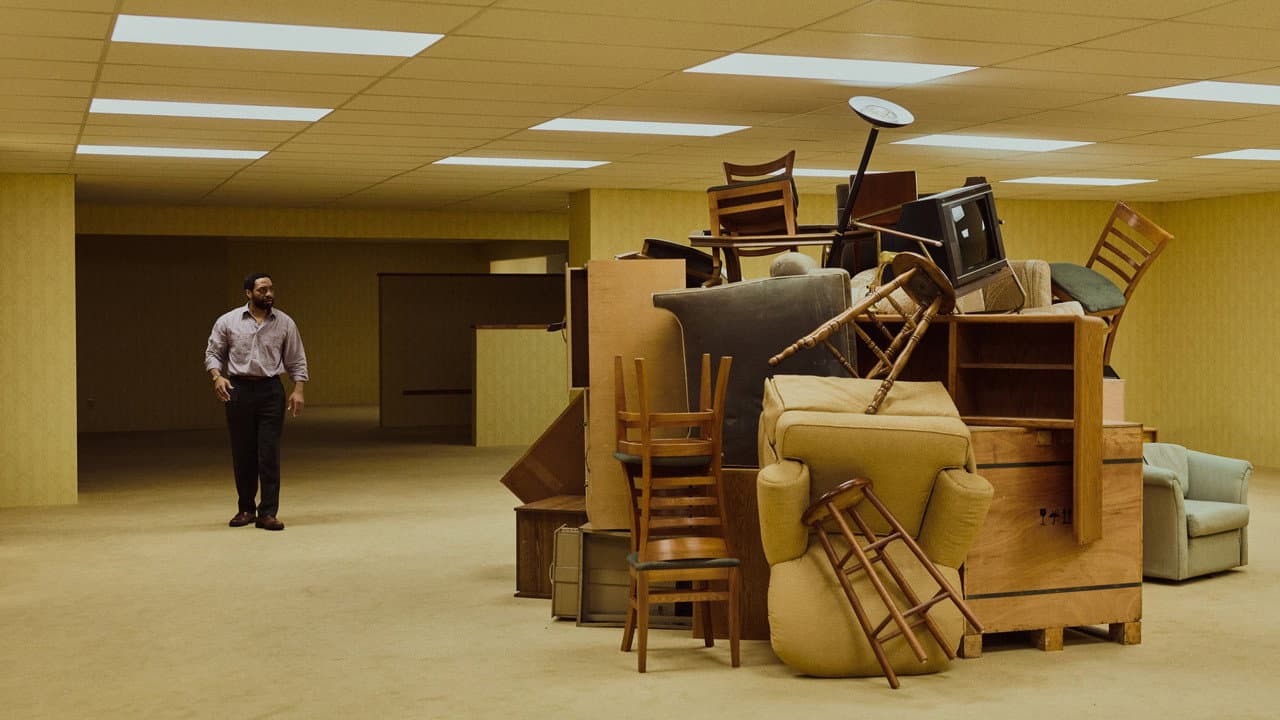
Somewhere in the yellow, a life-size cardboard caveman stands in an empty corridor with a speaker bolted to it, playing NASA's Voyager Golden Record on a loop — the real 1977 disc of greetings in 55 languages that includes a child saying "Hello from the children of planet Earth." Clark walks past it thinking it's a person. It isn't. Async put it there, and nobody in the film ever tells you why. That single prop is the best argument for rewatching Backrooms: Kane Parsons fills 111 minutes of buzzing fluorescent nothing with objects that are doing specific, unexplained work.

Parsons was 20 when A24 handed him his first feature, and he built it out of the same instincts that made his Kane Pixels YouTube shorts a phenomenon — but with an editorial rule he's talked about openly: no lorebloat. Deep-cut continuity is planted where longtime viewers will trip over it, never where a newcomer needs it. The result is a film where the production design carries the plot. Danny Vermette's team built close to 30,000 square feet of practical rooms across four sound stages, ran 50 wallpaper tests chasing the exact wrong shade of beige-yellow, and raised the sets on platforms so the floors tilt under the actors. The found-footage passages were shot digitally and then physically dubbed through a VCR rather than filtered in post. Crew members genuinely got lost in there. Parsons has said his biggest visual and tonal reference wasn't a horror film at all — it was Mr. Robot, which he'd watched end to end eight or nine times — alongside One Hour Photo, Punishment Park, Paranoia Agent and Valve's Portal.

The deepest layer belongs to the internet. The film is period-set at the tail of Async's 1990 operations, and a date stamp in the opening footage lands it less than a month after Peter Tench's disappearance in the web series — which is why the corporation's cameras are suddenly everywhere. Clark's furniture store, Cap'n Clark's Ottoman Empire, was real enough to air a single retro commercial on Pluto TV two months before release, complete with a fax number that answered anyone who dialled it. Below, everything is sorted by how solid it is: what Parsons and his department heads have confirmed on the record, what the community has documented and agreed on, and what is still, honestly, just a good reading.

The full catalog

Your hunt

Tick off what you spotted

0 / 20 spotted

Tap the circle on a card when you catch one.

Type
Status
Difficulty

The Cold Open Is a Kane Pixels Short, Dubbed Through a Real VCR

MetaReferenceBehind the Scenes ConfirmedPlain Sight

WHERE TO LOOK · The pre-title sequence, and again whenever Clark's own tapes are played back

Before the title card, Backrooms isn't a movie — it's a 1990 camcorder tape: shaky first-person handheld, blown-out fluorescents, audible breathing, VHS tracking glitches. It's a straight recreation of the format that made Parsons famous on YouTube, and it's the film's handshake with the people who got it made. The technique is genuinely analogue: Parsons confirmed the found-footage material was shot digitally and then authentically run through a VCR rather than given a digital VHS filter, which is why the artefacting behaves like real tape damage instead of a plugin. Once the title lands, the film snaps to conventional coverage and never fully goes back.
June 19, 1990 Places the Film Weeks After Peter Tench

Behind the ScenesCallback Community ConsensusDeep Cut

WHERE TO LOOK · Burned-in timecode on the opening found footage, and again on Async's CCTV monitors

Freeze the corner of the opening tape and the burned-in date reads June 19, 1990. For anyone who only knows the movie, it's set dressing. For anyone who watched the web series, it's a timeline lock: it puts the film less than a month after Dr. Peter Tench, the Async camera operator who was separated from his team, lost months to the Backrooms' broken clock and came out unwell — an incident Async covered up with a faked death. That's the missing explanation for why the corporation has CCTV strung through the yellow by the time Clark noclips in. They aren't watching for Clark. They're watching so they never have another Tench.

One Room Is the 2019 4chan Photograph, Rebuilt

ReferenceHidden Detail Community ConsensusFreeze Frame

WHERE TO LOOK · Clark's camera pass through the Complex after he starts documenting it

The whole mythology started with a single anonymous image posted to 4chan in 2019 — a mono-yellow room with damp carpet and a low ceiling, which turned out to be a Wisconsin hobby store mid-renovation. Parsons puts it in the movie. As Clark works deeper into the Complex with his camera, he passes through a space staged to match that original photograph: the same proportions, the same doorway placement, the same sickly wall colour. It's the film's most literal act of preservation, and it doubles as a joke about the whole phenomenon — the most famous haunted room on the internet was a furniture-adjacent retail unit being redecorated.

Clark Marks the Doorway in Blue Tape — So Did a Girl on YouTube

CallbackHidden Detail Community ConsensusDeep Cut

WHERE TO LOOK · The basement of Cap'n Clark's Ottoman Empire, when Clark first marks the entry point

When Clark finds the slit in his showroom basement, he outlines it in blue painter's tape so he can find it again. Web-series viewers have seen that exact gesture before: one of Parsons' shorts follows a girl who tapes off a null zone on her garage floor for the same reason — to keep track of a hole in reality that doesn't stay put. It doesn't help her. The tape expands with the anomaly and then pulls her through. Parsons doesn't flag the echo, and the film never mentions it, which is exactly the register he says he's aiming for: continuity for the people who'll catch it, invisible to everyone else.

Reverchon Ventures Is Demolishing More Than Mary's House

ReferenceHidden Detail Community ConsensusDeep Cut

WHERE TO LOOK · The demolition of Mary's childhood home, and again in the final act

The contractor's board outside Mary's childhood home, as the machines take it apart, reads Reverchon Ventures. That name belongs to Parsons' other series, The Oldest View, whose antagonist — the Rolling Giant — is modelled on a real 12-foot wheeled puppet of French botanist Julien Reverchon, built for a 2012 Dallas parade and later folded into the buried-mall mythology of Valley View Center. The sign returns in the film's closing stretch, which is why it reads as a plant rather than a stray prop. Treat it as a signature, not a crossover: Parsons has been clear the two projects don't share continuity.

Ship's Wheels in the Walls — Parsons Won't Explain the Pirates

Hidden DetailForeshadowingMeta ConfirmedSecond Watch

WHERE TO LOOK · Wall and ceiling dressing throughout the Complex; heaviest in the final tropical-backdrop room

Long before you understand why, the architecture starts going nautical: ship's steering wheels sunk into walls and ceilings, coat racks and lawn furniture arranged like a showroom, and in the final room the tropical backdrop from Clark's own TV commercial wrapped across all four walls until there's no horizon left. The Backrooms are regurgitating Cap'n Clark's Ottoman Empire back at its owner. Parsons has confirmed the pirate and ocean imagery is deliberate and threaded through the whole film — and then refused to say more, telling interviewers only, "I won't say more, but I think people will dig into it." The seagull that turns up where no bird should be is part of the same weather system.

A Stuffed Parrot and a Lopsided Throne, Long Before the Costume

ForeshadowingHidden Detail Community ConsensusFreeze Frame

WHERE TO LOOK · Clark's first solo push deeper into the Complex — the throne room with the carpeted shoes

Spoiler:

Early in Clark's exploration he finds a room with a crooked throne, shoes fused into the carpet, and a stuffed toy parrot — pure nonsense on a first watch. On a second one it's a costume list. The parrot, the throne, the buccaneer staging: the Backrooms have already digested the Cap'n Clark commercial and started assembling the thing that will eventually wear it. The room is the earliest hard evidence that the space is building its monster out of Clark's own marketing rather than out of anything native to the Complex, and it lands well before the film ever shows you the advert it's copying.

Clark's Bedtime T-Shirt Dates His Failure to 1970

Hidden DetailBehind the Scenes Community ConsensusDeep Cut

WHERE TO LOOK · Clark's bedroom, before he goes back down to the showroom basement

The faded shirt Clark wears to bed reads Modernist Design Forum 1970 — a conference tee from the architecture career he never had, still in rotation two decades later. It's a costume-department detail credited to Mica Kayde, and it quietly sets the film's clock: Clark has been sleeping in the merchandise of his abandoned ambition for twenty years. Pair it with the hand-drawn building elevations pinned around his office and the reason the Backrooms take the shape they do stops being mysterious. The Complex builds him ramps, impossible vanishing-point doorways and vaulted voids because that is the only architecture he ever got to design.

Mary's Self-Help Book Spoils Two Later Scenes

ForeshadowingHidden DetailMusic Secret Community ConsensusDeep Cut

WHERE TO LOOK · Mary's promotional spot early on; pays off at Kat's window and in Clark's final voicemail

Spoiler:

Mary's own paperback, glimpsed in a commercial for her practice, is titled *The Window Within, sold on a line about breaking through the pane. The film then cashes it twice. Kat's worst moment arrives through a window — she sees what's standing behind Clark through glass rather than face to face. And Clark's last voicemail, the one that finally sounds unwell, talks about opening the window. Parsons and Edo van Breemen even named a score cue "Open the Window"* for Mary's search sequence. A therapist's marketing slogan turns out to be the film's operating instruction for getting somewhere you cannot come back from.

Read the Signs Backwards — the Complex Is Remembering Wrong

Hidden DetailForeshadowing Community ConsensusFreeze Frame

WHERE TO LOOK · Signage in the first Backrooms excursions; compare against the storefronts in the later, deeper rooms

Stop signs, banners and shopfront lettering in the early Backrooms sequences are mirror-flipped, as though copied by something that saw them once and reproduced them from the wrong side. It's the film's cleanest visual statement of its own thesis: the space replicates reality out of borrowed memory, and memory degrades. Track it across the runtime and the transcription visibly improves — later spaces get signage that reads correctly, including a restaurant board rendered in plausible Cyrillic — which implies the Complex is learning from every new mind that falls into it. Several critics read the whole motif as a sideways joke about generative image models.

The Cardboard Caveman Is Playing NASA's Voyager Golden Record

ReferenceHidden DetailBehind the Scenes Community ConsensusFreeze Frame

WHERE TO LOOK · Corridors of the Complex; the spare-cutout storage room seen from Mary's transport at the Async facility

Spoiler:

The shirtless, bearded, walking-stick figure Clark mistakes for another survivor is a cardboard standee with a speaker attached, and what it broadcasts is real: the greetings-in-55-languages segment from NASA's 1977 Voyager Golden Record, including the child's voice saying "Hello from the children of planet Earth." Mary knocks one over while running. Later, through glass at the Async facility, she passes a storage room stacked with spare cutouts — confirming the corporation manufactured and planted them. Whether they're bait for the Still Lifes or a first-contact protocol aimed at something that isn't human, the film never says. The redacted CCTV still Phil slides across the table during her interrogation suggests Async would rather it stayed that way.

An Async Family Is Watching The NeverEnding Story

ReferenceHidden Detail Community ConsensusFreeze Frame

WHERE TO LOOK · The Async employee's living room, television in the background

In one of the film's few scenes of ordinary domestic life, an Async employee's family has the television on, and what's playing is **The NeverEnding Story (1984)** — a children's fantasy about a realm that survives only as long as somebody keeps imagining it, being consumed from the inside by a spreading Nothing. Set that against a corporation quietly cataloguing an infinite building that grows out of human memory and the joke stops being cute. It's also a period-correct choice for a film obsessive about not putting anything on screen that didn't exist yet, and one of the only warm images in the movie.

"The Handwriting Looks Like Mine" — the Mural That Predicts the Ending

ForeshadowingHidden Detail Community ConsensusFreeze Frame

WHERE TO LOOK · Mary's search of the deeper rooms, on a painted wall with handwritten text beside it

Spoiler:

Mary finds a painted mural deep in the Complex showing Captain Clark lifting a figure toward a window — an image of something that hasn't happened yet. Scrawled beside it: "The floor plan changed again. Roof is wrong, roof is wrong. I don't know who signed the plans but the handwriting looks like mine." It's the film's most unnerving artefact because there is no comfortable answer for who made it. Clark, painting during his collapse and unknowingly drafting his own end? Or the Backrooms, sketching intentions in advance, in the hand of the man they're copying? Parsons leaves it open, and it is the loudest hint that the space doesn't only remember — it plans.

Bobby and Kat Get Missing-Person Posters — A Whole Short Film's Worth

CallbackHidden Detail Community ConsensusDeep Cut

WHERE TO LOOK · The final montage — the room of spiralling posts covered in notices

Spoiler:

The closing montage lands on a room of spiralling electrical posts papered with missing-person notices, two of which are Bobby Franklin and Kat Taylor. It's a callback to Parsons' own short Backrooms – Missing Persons, and it makes explicit the horror the web series only implied: everyone the Complex takes stays statistically missing forever, because there is no body and no scene to search. It also quietly indicts Clark. He recruited two employees with a camera and a hunch, and the film's final accounting of that is a laminated photograph stapled to a pole inside the thing that ate them.

Cap'n Clark's Commercial Aired Once on Pluto TV — and the Fax Number Worked

MetaBehind the Scenes Community ConsensusWhite Whale

WHERE TO LOOK · Off-screen — the Backrooms ARG marketing campaign, spring 2026

Two months before release, a genuine-looking retro furniture advert for Cap'n Clark's Ottoman Empire aired exactly once on Pluto TV on 3 April 2026, and was pulled apart by fans within hours. Printed on screen was a fax number — (408) 357-2875 per the community's records — and it answered. Send a fax and a reply came back within five to ten minutes: originally a flyer for the store's sale, then, once a Cap'n Clark T-shirt appeared on 20 April, a different document altogether for a fictional South Bay bulletin board. The store's pirate mascot commercial is the film's engine, so A24 broadcast it into the world first and let people find it.

The Bonus Footage Hides a Fourth "Everything Must Go" Sign in the Panelling

CallbackBehind the ScenesHidden Detail Community ConsensusWhite Whale

WHERE TO LOOK · The Everything Must Go bonus footage — the panelled corridor before the mannequin room

Spoiler:

The 16 minutes attached to the Everything Must Go Edition are a standalone 1990 survey tape, and their best detail is a counting game. The Async team finds three identical signs reading "Everything Must Go — Entire Store on Sale", the exact clearance banner from Clark's showroom, standing in a space that has no store attached to it. Then they find a fourth, half-swallowed inside wood panelling, alongside a hand jutting out of a beam that turns out to belong to a mannequin. It means the Complex was already chewing on Cap'n Clark's Ottoman Empire in June 1990 — years of screen time before Clark himself walks in.

The Killing Blow Is Framed Like a Goya Painting

ReferenceHidden Detail? TheoryWhite Whale

WHERE TO LOOK · The final confrontation, in the room lined with the commercial's tropical backdrop

Spoiler:

The composition of the film's central death — the towering pirate figure bent over a much smaller man, mouth first — reads to a number of critics as *Francisco Goya's Saturn Devouring His Son*** (c. 1820–23), the black painting of a father eating his child to stop being replaced by him. It fits the film's argument uncomfortably well: the creature attacks at the precise moment Clark demands to be told he doesn't have to change, so the thing that consumes him is the version of himself that refused to grow. Parsons hasn't cited Goya anywhere on the record, so this stays a reading rather than a confirmed reference — but it's the most persuasive one going.

The Score Is Made Out of the Rooms Themselves

Music SecretBehind the Scenes ConfirmedWhite Whale

WHERE TO LOOK · Throughout — most audible in the long wordless corridor stretches

Parsons co-composed with Vancouver's Edo van Breemen (The Monkey, Keeper), and their method was to build cues out of the set's own room tones — fluorescent ballast hum, HVAC drone, the specific dead acoustic of carpet under a dropped ceiling — rather than write conventional themes. Parsons, who has no formal training, put it bluntly: "I mostly function more as a caveman, banging rocks together, since I don't have formal training and can't play an instrument." His touchstones are Aphex Twin, Boards of Canada and Burial, which is why cues like "Quiet Wall in a Dark Room" sit closer to degraded ambient tape than to horror scoring.

The Real Blueprint Is Mr. Robot, One Hour Photo and Portal

ReferenceBehind the Scenes ConfirmedWhite Whale

WHERE TO LOOK · Structural — clearest in the Async interrogation staging and Clark's showroom scenes

Asked what he was actually copying, Parsons names almost no horror. Mr. Robot is the big one — he has said he watched it end to end eight or nine times and calls it his single biggest visual and tonal reference. One Hour Photo shaped the film's real-world material, the flat fluorescent retail sadness of Clark's life outside the basement. Portal and Valve's design language sit under the Complex's logic of clean, hostile, obviously-authored space. He also cites Punishment Park (1971) and Paranoia Agent (2004). Watch the office and showroom scenes with Robin Williams' photo-lab technician in mind and the framing choices stop looking accidental.

30,000 Square Feet, 50 Wallpaper Tests, and a Blender File That Killed a Computer

Behind the ScenesHidden Detail ConfirmedWhite Whale

WHERE TO LOOK · Every practical Backrooms interior — the noclip portals were two real portals, one for the actor and one for the camera

Almost none of the Complex is CGI. Parsons sent production designer Danny Vermette a Blender file of the world he wanted built — roughly 100,000 square feet of it — and it crashed Vermette's machine on open. What got built was close to 30,000 square feet across four sound stages in Vancouver, under the working title Effigy, with about 37,000 square feet of wallpaper and 29,000 of carpet, raised on platforms so floors slope and the actors are never level. It took 50 wallpaper tests to land the wrong yellow; Vermette's note is that the original photo "wasn't yellow — it's a white-balance issue." Walls were struck and re-arranged mid-shoot, leaving half-finished rooms visible in backgrounds, and objects were deliberately built clipping through floors and beams to mimic a rendering error. Crew genuinely got lost. Parsons has said he would "never lean in a generative AI direction." The build was bankrolled by a producing group that includes Shawn Levy's 21 Laps Entertainment, the shingle behind Stranger Things, alongside James Wan's Atomic Monster.

Post-credit scenes in Backrooms

It depends on the version — some cuts of Backrooms carry a post-credit scene and some carry none. The full answer — what plays, where it falls in the roll and what it sets up — has a page of its own.

Full post-credit breakdown →

Frequently asked

+How many easter eggs are in the Backrooms movie?

We've catalogued 20 easter eggs, hidden details and references in Backrooms. Five are confirmed on the record by Kane Parsons or his department heads — including the found-footage passages being physically dubbed through a real VCR, the score built out of the sets' own room tones, and Parsons admitting the pirate and ocean imagery is deliberate while refusing to explain it. Fourteen are documented community finds, like the cardboard caveman broadcasting NASA's Voyager Golden Record, the mirror-flipped signage, and the Reverchon Ventures demolition sign. One, the Goya framing of the final kill, is clearly labelled a theory.

+Does Backrooms have a post-credits scene?

Only in one version. The standard theatrical cut and the digital release have no credits scenes of any kind — nothing mid-credits, nothing after. The Everything Must Go Edition, which played in theatres from 3 July 2026, adds roughly sixteen minutes of bonus footage after the credits finish: a 1990 Async survey tape shot by explorer Naren Warne, dated the day before the film's own opening footage. That footage is also included on the 4K and Blu-ray editions, but not on the digital rental or purchase.

+What is the monster in Backrooms, and what does the ending mean?

The creature is Captain Clark — a Still Life, one of the hollow human copies the Backrooms build out of borrowed memory, wearing the pirate costume from Clark's own furniture-store commercial. Parsons describes the space as an echo chamber, "a feedback loop of his interior world, vomited out onto the walls." It kills Clark at the exact moment he demands to be told he never needed to change. Mary escapes with Async's help and is immediately detained — and the closing montage reveals a Still Life of her already standing in a copied room, which is why the ending reads as a trap rather than a rescue.

+How does the Backrooms movie connect to Kane Parsons' YouTube series?

It's strict continuity, not a reboot. The film sits inside the same 1990 Async timeline as the Kane Pixels shorts: a date stamp of 19 June 1990 places it under a month after Dr. Peter Tench's disappearance, which explains the CCTV cameras suddenly threaded through the Complex. Async's origin as an MRI manufacturer that pivoted to its Low-Proximity Magnetic Distortion research is straight from the series, as are the hazmat suits, the noclipping vocabulary and the objects clipping through walls. Parsons has been careful about what he calls lorebloat, so none of it is required reading.

+Is Backrooms connected to The Oldest View?

Only as a signature. The demolition contractor tearing down Mary's childhood home is called Reverchon Ventures, and the name returns near the end of the film — a nod to The Oldest View, Parsons' other web series, whose Rolling Giant is modelled on a real 12-foot wheeled puppet of the botanist Julien Reverchon built for a 2012 Dallas parade. That series recreated Dallas's shuttered Valley View Center mall, the abandoned space that shaped Parsons' whole aesthetic. There's no shared continuity between the two projects — the connection begins and ends with that sign.

+Was the Backrooms set real or CGI?

Overwhelmingly real. Production designer Danny Vermette built close to 30,000 square feet of interconnected rooms across four Vancouver sound stages, using around 37,000 square feet of wallpaper and 29,000 of carpet, and raised much of it on platforms so the floors slope under the actors. Parsons' original Blender file asked for roughly 100,000 square feet and crashed Vermette's computer. It took 50 wallpaper tests to find the right wrong yellow. Even the noclip portals were practical — two real openings, one for the actor and one for the camera — with VFX reserved for seams and impossible volumes.

Last updated 2026-08-05 · Spotted something we missed? Tell us.