15 Horror Movie Easter Eggs That Prove Directors Never Stop Winking
This is a verified, timestamped roundup of the horror genre’s best-hidden details, from the evidence locker in Bride of Chucky to the tapestry foreshadowing in Midsommar. Every entry below flags spoiler level and explains what the reference means, so you can rewatch smarter or catch what you missed the first time, all cross-checked against Thethingsyoumissed’ verified catalog.
TL;DR:
- Many horror Easter eggs appear in plain sight as background props, requiring pause and slow scrubbing to spot details like franchise logos or foreshadowing clues.
- The evidence locker in Bride of Chucky features a dense collection of iconic horror masks and weapons, explicitly acknowledging shared universe connections.
- Production design elements, such as the tapestry in Midsommar or recurring background extras in Hereditary, encode plot outcomes or reveal ongoing surveillance.
- Cross-franchise references, like Predator’s Xenomorph skull or Freddy Krueger’s glove in Evil Dead II, are confirmed through frame-by-frame verification and remain hidden without careful inspection.
- Verified databases and cross-referenced sources ensure that each Easter egg is an intentional, officially documented detail rather than a fan fabrication.
Table of Contents
- What Are Horror Movie Easter Eggs, Exactly?
- The Definitive List of Horror Movie Easter Eggs Worth Hunting
- How to Catch Horror Movie Easter Eggs Without Spoiling Yourself
- How Thethingsyoumissed Verifies Every Easter Egg on This List
- Why I Keep Chasing These Details
- Find Every Verified Detail in Thethingsyoumissed’ Catalog
- Sources
What Are Horror Movie Easter Eggs, Exactly?
Horror movie Easter eggs are deliberate hidden details, props, or references that reward close viewers without derailing the plot for everyone else. They range from a single frame of a Xenomorph skull on a trophy wall to a director stepping in front of his own camera for three seconds. The term borrowed its name from the same hunt logic as an actual egg hunt: something is placed intentionally, in plain sight, for the person paying attention.
The habit predates modern franchise culture by decades. Horror directors have always used background details to reward patient audiences, but the genre’s obsession with shared universes (Freddy, Jason, Chucky, and friends all crossing paths eventually) turned prop placement into a sport. Fans now treat frame-by-frame scanning as its own form of horror film trivia, and high-resolution streaming and 4K remasters have made previously invisible details suddenly legible. A 23-years-later crossover discovery is proof that better formats keep resurrecting old secrets.
The Definitive List of Horror Movie Easter Eggs Worth Hunting
Some of these are famous enough to be horror film trivia night staples. Others hide in a single background shot you’d blink past on a first watch. All of them reward the rewatch.
1. Bride of Chucky’s Evidence Locker (1998)
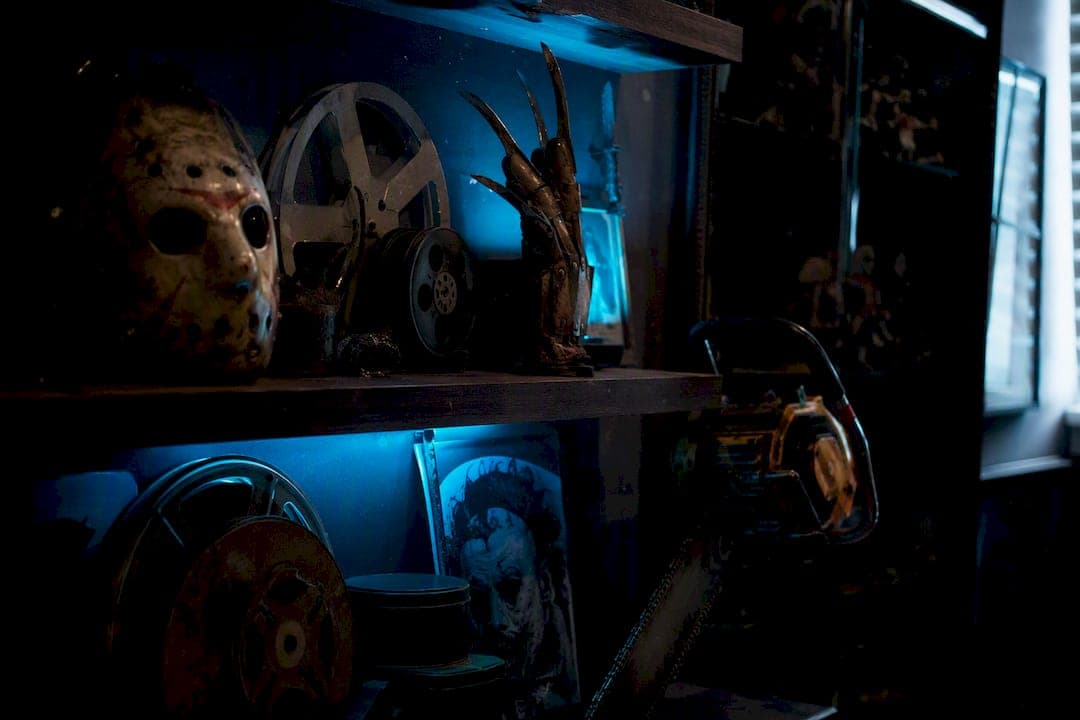
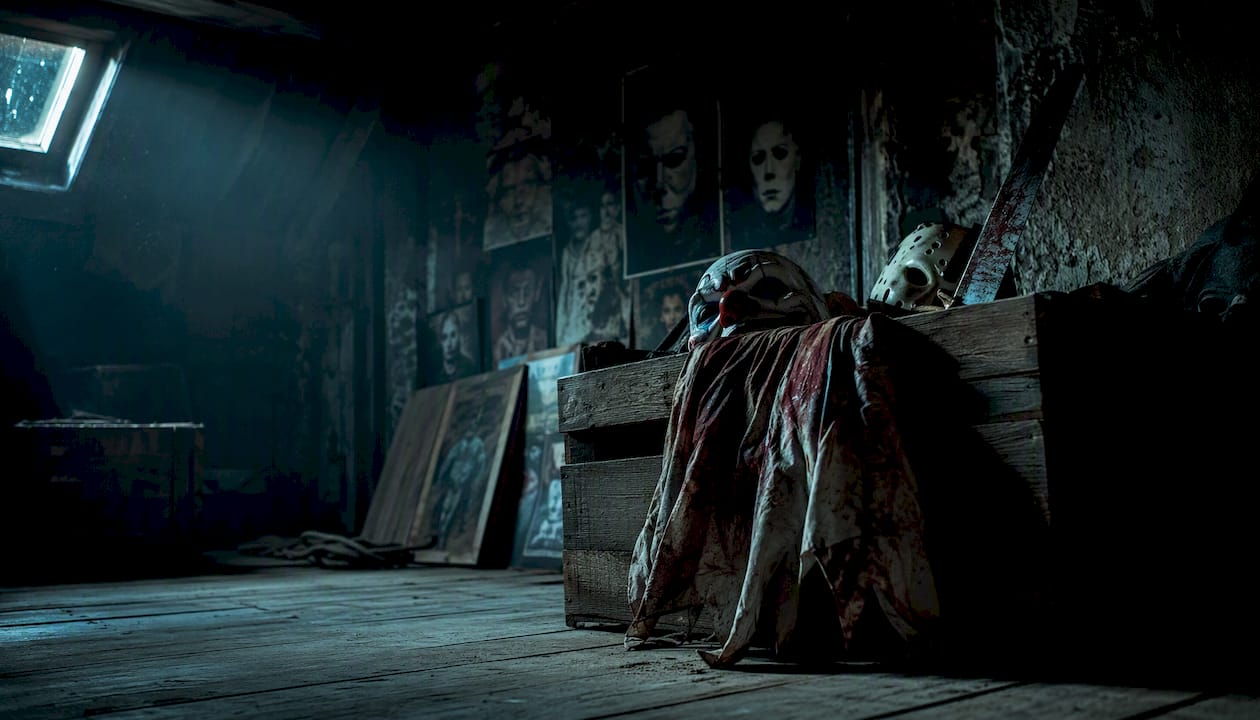
Detective Warren Kincaid’s evidence room in Bride of Chucky stacks Jason Voorhees’ hockey mask, Freddy Krueger’s clawed glove, Michael Myers’ William Shatner mask, and Leatherface’s chainsaw into a single frame. It’s one of the densest cross-franchise collections ever assembled in a horror film, and it’s not subtle: the camera lingers just long enough for you to catalog every icon. Spoiler level: none. It’s pure fan service, a director’s wink acknowledging that Chucky now shares a universe with horror’s other legends, even without a literal crossover plot.
2. Midsommar’s Tapestry Foreshadowing (2019)
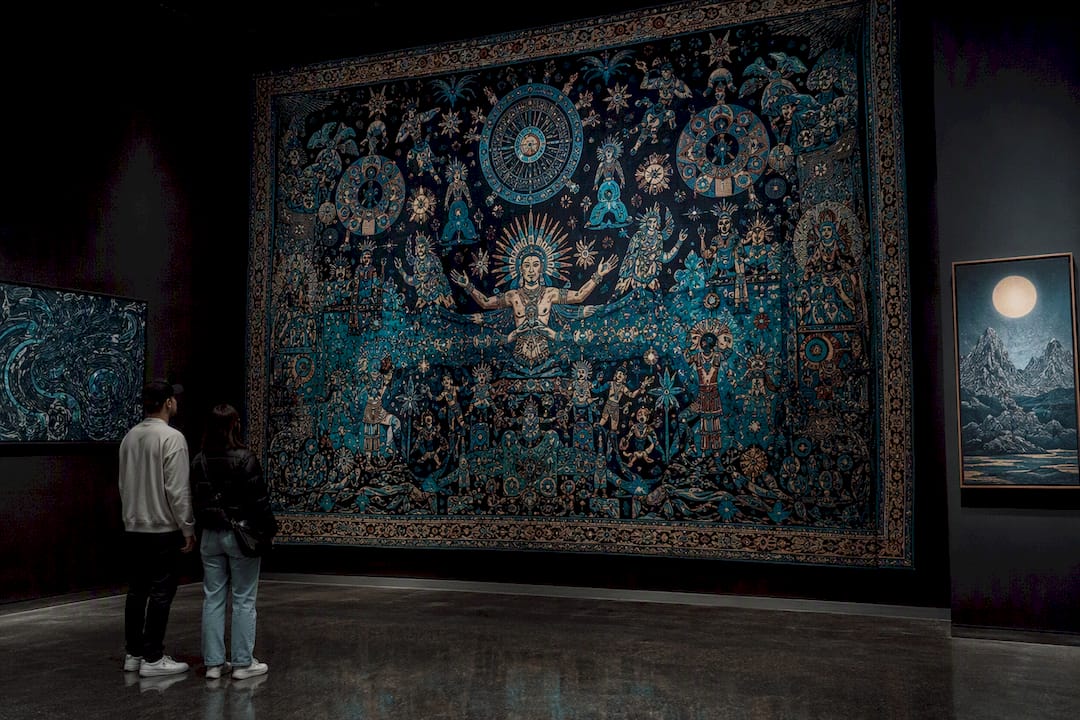
Ari Aster hides the entire back half of Midsommar in a tapestry glimpsed early in the film, depicting the May Queen ritual and the bear sacrifice before either happens on screen. The TheaterEars breakdown singles this out as a defining example of production design doing narrative work. Spoiler level: heavy if you clock it early. Aster doesn’t use Easter eggs for winks. He uses them to encode plot outcomes directly into set dressing, which turns every rewatch into a decoding exercise.
3. The Freddy Glove in Evil Dead II (1987)
Blink and you’ll miss it: a Freddy Krueger glove sits in Ash’s cabin toolshed for roughly a second and a half. Sam Raimi and Wes Craven were friends and mutual admirers, and this cameo prop is the horror genre’s version of a professional handshake. Spoiler level: none. It means nothing for the plot, but it tells you two of horror’s most influential filmmakers were paying attention to each other’s work in real time.
4. Valak’s Name Drop in The Conjuring 2 (2016)
The demon nun Valak isn’t a Wan invention. The name comes from the Lesser Key of Solomon, a real occult grimoire cataloging demonic hierarchies, and the film uses that grounding to make the entity feel like it belongs to something older and larger than the Warrens’ immediate case file. Thethingsyoumissed’ Conjuring franchise breakdown tracks how later entries keep threading Valak-adjacent imagery back into the frame. Spoiler level: moderate, since the name itself is a reveal.
5. Scream’s Janitor Cameo (1996)
Wes Craven appears briefly as a school janitor in a Freddy Krueger sweater, a joke so layered it requires you to already know Craven directed A Nightmare on Elm Street. Spoiler level: none. It’s the purest form of director cameo: an in-joke that only pays off if the audience already did its homework, and it set a template every self-aware slasher since has tried to copy.
6. Us and the Hands Across America Backdrop (2019)
Jordan Peele plants a Hands Across America television broadcast early in Us, a real 1986 charity event, then builds the entire film’s thesis around the literal image of people holding hands across the country. Spoiler level: heavy. It’s not decoration. The broadcast is the mechanism the plot pays off, making it one of the rare Easter eggs that functions as the whole movie’s structural spine rather than a side detail.
7. Hereditary’s Background Cult Members (2018)
Rewatch Hereditary and you’ll spot the same background extras recurring in scenes that have no reason to share cast members, a deliberate tell that Annie’s family has been under surveillance the entire runtime. Spoiler level: heavy. Aster used the same background-planting trick here that he’d refine further in Midsommar, proving it wasn’t a one-off trick but a signature.
8. The Xenomorph Skull in Predator (1987)
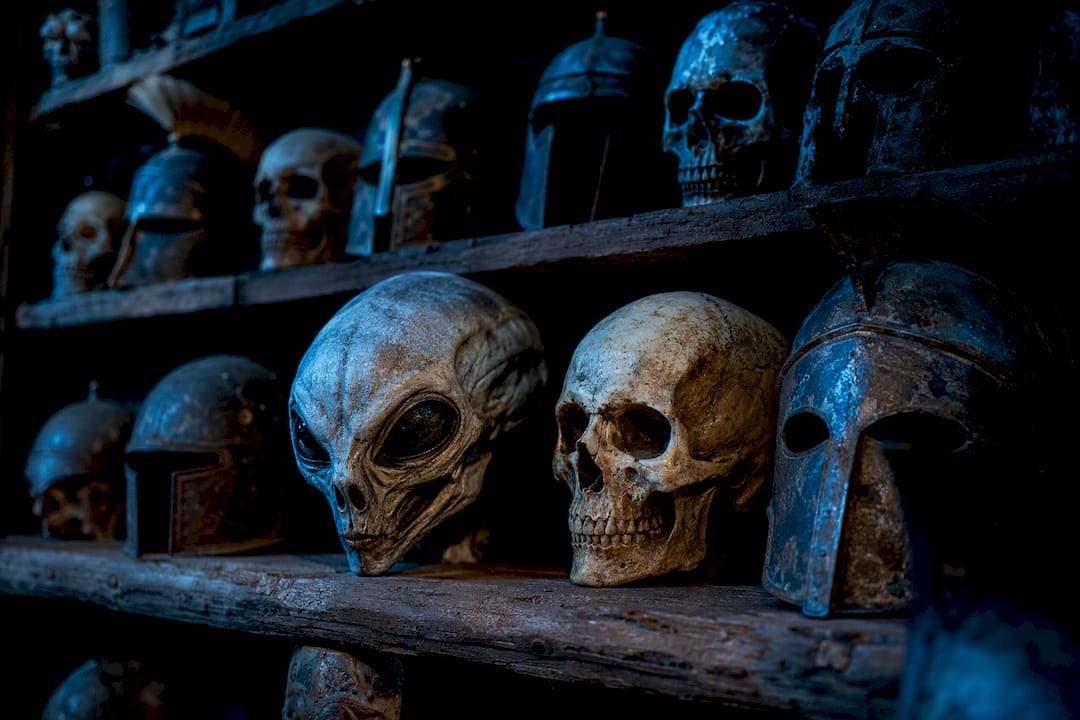
A human skull mounted among Predator’s trophy collection was confirmed years later to belong to a Xenomorph, retroactively tying the Alien and Predator franchises into shared continuity before AVP made it official. JoBlo’s crossover roundup calls this the template for how visual crossover clues work: a single static prop, no dialogue, and decades of fan theorizing. Spoiler level: none, though it reshapes how you read the entire franchise. Thethingsyoumissed’s Predator: Badlands breakdown keeps tracking how later entries reuse the gag.
9. Jason Goes to Hell’s Necronomicon Cross-Reference (1993)
The final shot of Jason Goes to Hell has Freddy’s glove dragging Jason’s mask into the ground, a direct setup for Freddy vs. Jason years before it existed. Some prints of the Evil Dead franchise’s Necronomicon also make cameo appearances across Raimi and Sam Raimi adjacent horror productions of that era, reinforcing how tightly this small circle of filmmakers cross-pollinated their prop closets. Spoiler level: moderate, since it spoils a crossover that took nearly a decade to actually deliver.
10. Get Out’s Skeleton Key Parallel (2017)
Peele plants a literal key motif throughout Get Out that mirrors the “keys to the mind” hypnosis mechanism driving the plot, turning a household object into a visual shorthand for control. Spoiler level: heavy. It rewards a second viewing more than almost any other detail on this list, since the first watch reads it as set dressing rather than mechanism.
11. Halloween Ends’ The Thing Homage (2026)
A character in Halloween Ends watches The Thing (1982) on television, and the choice isn’t random. John Carpenter directed both films, and Screen Rant’s franchise breakdown frames the moment as a layered tribute: a diegetic reference nested inside a franchise Carpenter himself launched in 1978. Spoiler level: light. This is the diegetic-media trick at its cleanest: horror characters watching other horror films as a wink to the audience.
12. The Cabin in the Woods’ Monster Vault
Drew Goddard’s film stacks its underground facility with silhouettes referencing dozens of other horror monsters, an intentional visual index of the genre itself rather than a single crossover gag. It functions less as a specific reference and more as a genre love letter, cataloging horror’s shared iconography in one wide shot.
13. Predator’s Skull Callback in Later Sequels
Later Predator installments keep returning to trophy-wall imagery as connective tissue, letting new films acknowledge the Alien connection without ever forcing a literal crossover into the plot. It’s a good example of a franchise reusing one Easter egg’s DNA across decades instead of retiring the joke.
14. Rocky Horror’s Literal Egg
Not every entry on a list of Easter eggs is symbolic. During production of The Rocky Horror Picture Show, crew members staged an actual scavenger hunt and left a real egg on set, a detail confirmed in JustWatch’s anecdote roundup. Spoiler level: none. It’s a reminder that the phrase “Easter egg” started as a literal object before it became shorthand for hidden meaning.
15. Cracked’s Background Detail Grab Bag
Several smaller, blink-and-miss details compiled by Cracked confirm a pattern running through nearly every entry above: most horror Easter eggs are single-frame background choices, not full scenes, which is exactly why frame-by-frame rewatching remains the only reliable way to catch them all.
How to Catch Horror Movie Easter Eggs Without Spoiling Yourself
Most hidden references hide in plain sight, but plain sight moves fast at normal playback speed. A five-step approach catches nearly everything without needing a second career as a film editor.
- Pause and scan backgrounds during any static or slow-panning shot, especially interiors with shelves, trophy cases, or wall art.
- Track repeated motifs across scenes: the same extra, the same color, the same object reappearing is rarely coincidence.
- Scrub at 0.25x to 0.5x speed through scenes flagged in fan discussions, since single-frame gags disappear at normal speed.
- Check props and closing credits for prop-house or special-thanks acknowledgments that hint at franchise borrowing.
- Cross-check against a timestamped database like Thethingsyoumissed’ movie catalog before trusting a theory you spotted yourself.
| Technique | Best For | Spoiler Risk |
|---|---|---|
| Frame-by-frame scrubbing | Background props, crossover clues | Low |
| Motif tracking across rewatches | Foreshadowing, symbolic design | Medium |
| Subtitle/dialogue search | Diegetic media references | Low |
| Verified database cross-check | Confirming theories, avoiding false positives | None |
How Thethingsyoumissed Verifies Every Easter Egg on This List
Every entry above gets checked against multiple frame passes before it’s published, not a single rewatch and a guess. That means confirming a prop’s presence at a specific timestamp, then cross-referencing trade coverage or franchise records before calling it canon rather than fan speculation.
- The Bride of Chucky evidence locker was confirmed against Screen Rant’s behind-the-scenes reporting before inclusion.
- The Conjuring’s Valak references are tracked across entries in Thethingsyoumissed’ Conjuring breakdown.
- Predator’s crossover skull is catalogued alongside newer franchise entries in the Predator: Badlands page.
Christian built this catalog around one rule: nothing gets listed as an Easter egg until it’s been verified frame by frame.
Why I Keep Chasing These Details
Cataloging horror movie easter eggs isn’t about trivia for its own sake. Every verified prop or callback tells you something about how a director thinks, whether it’s Ari Aster hiding an ending in a tapestry or Wes Craven winking at his own filmography. That’s the part casual viewing skips past entirely.
If there’s a film you think deserves this treatment next, request the next breakdown and help decide what gets cataloged.
— Christian
Find Every Verified Detail in Thethingsyoumissed’ Catalog
Scrolling Reddit threads for horror film trivia means sorting real finds from wishful thinking. Thethingsyoumissed skips that step: every entry in the movie catalog is timestamped, cross-checked, and organized by film, franchise, or motif, so you’re never guessing whether a detail is confirmed or just a fan theory that gained traction.
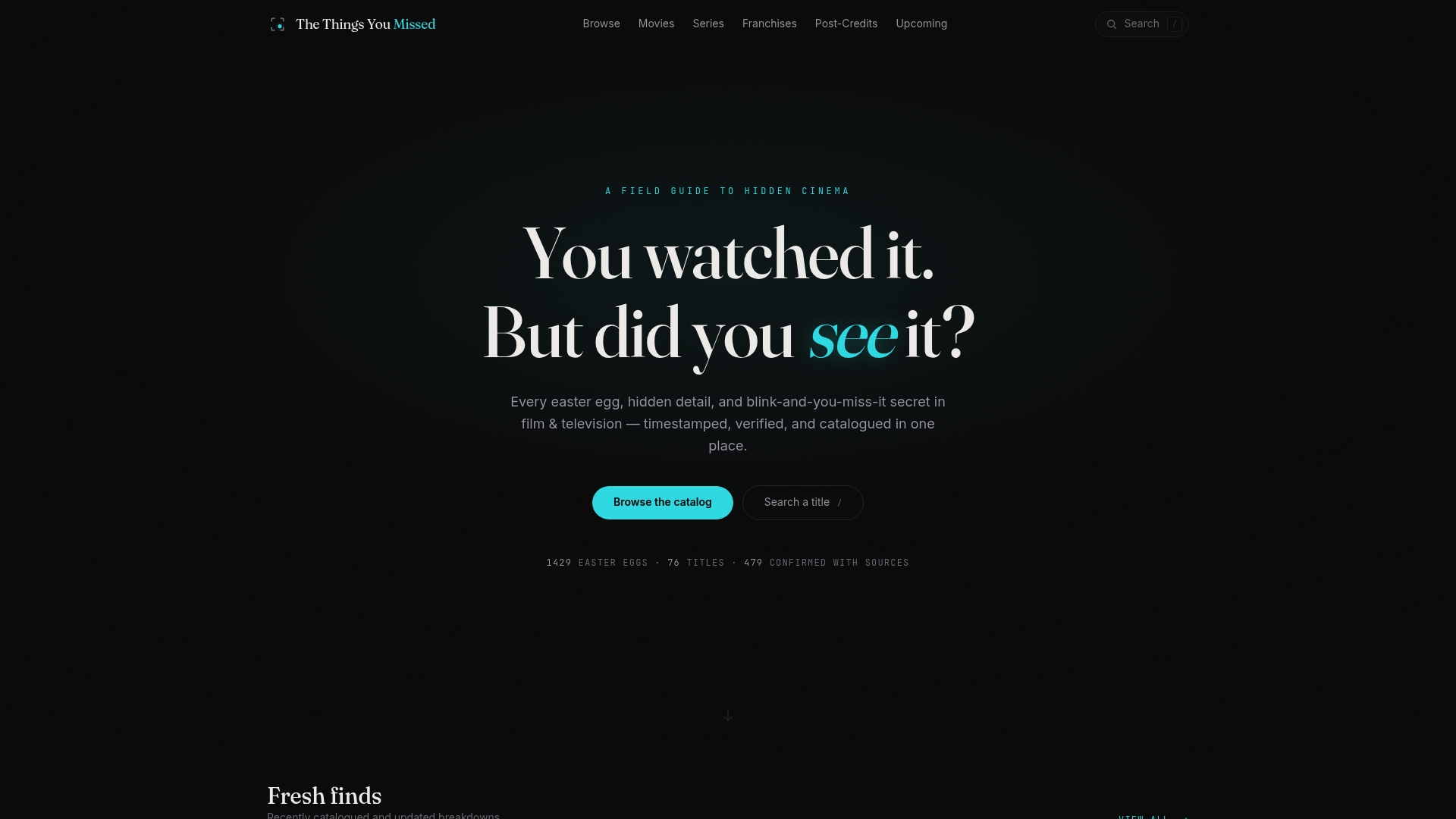
Browse breakdowns by franchise, search a specific title, or dig into recurring motifs like blink-and-miss signage across dozens of films. Spoiler-safe browsing means you can check whether a detail’s been cataloged before you finish a movie, not after. If your favorite horror film hasn’t been fully broken down yet, submit a request and help shape what gets verified next.
Sources
This list drew on Screen Rant’s prop-level reporting on Bride of Chucky, TheaterEars’ ranked canon list, JoBlo’s crossover-specific breakdown, Cracked’s background-detail compilation, SlashFilm’s coverage of shared-universe sci-fi eggs, and ComicBook.com’s reporting on frame-level rediscoveries.
- Bride of Chucky behind-the-scenes, facts and trivia | Screen Rant
- The 10 Best Horror Movie Easter Eggs of All Time | TheaterEars
- Top 10 crossover horror movie Easter eggs | JoBlo