Match Cut Examples That Reveal How Editors Bend Time

A match cut joins two shots by lining up a shape, a motion, or a sound, and it’s one of the sharpest tools in a film editor’s kit. Three types dominate: graphic matches (visual shapes or colors), match-on-action (aligned movement), and audio matches (sound bridges). The most famous is still the bone flung skyward in 2001: A Space Odyssey, which becomes an orbiting satellite mid-flight and compresses millions of years of human evolution into a single cut.
- Graphic: shapes, colors, or composition align across the cut
- Match-on-action: motion continues seamlessly across two different scenes
- Audio: sound carries over the cut to link two moments emotionally or thematically
Match cuts exist for one reason above all others: narrative economy. They condense time, forge thematic parallels, and let an edit stay invisible or hit like a punch, depending on what the scene needs.
Key Takeaways
Match cuts succeed when a shared shape, motion phase, or sound is planned before the camera rolls and aligned precisely in the edit, not discovered by accident afterward.
| Point | Details |
|---|---|
| Three core types | Graphic, match-on-action, and audio (sound bridge) each rely on a different shared element across the cut. |
| Mid-motion timing wins | Editors typically cut at the middle of a gesture, not its start or end, to sell continuity. |
| True match cuts are hard cuts | Dissolves, jump cuts, and symbolic gags get mislabeled as match cuts constantly; only a clean cut counts. |
| Canon examples anchor study | 2001, Lawrence of Arabia, Psycho, Citizen Kane, The Graduate, and North by Northwest remain the reference points every editor learns from. |
| Verified timestamps speed learning | Thethingsyoumissed catalogs frame-accurate, spoiler-safe entries so you can study these cuts directly rather than guessing at timing. |
Table of Contents
- What Are the Different Types of Match Cuts?
- Iconic Match Cut Examples Every Editor Should Study
- How Do You Plan and Shoot a Match Cut?
- How Does the Things You Missed Verify Match Cut Examples?
- What Goes Wrong When Editors Attempt a Match Cut?
- Why Does the 2001 Bone-to-Satellite Cut Still Work Six Decades Later?
- Christian’s Take: What Film Students Get Wrong About Match Cuts
- Study These Cuts Frame by Frame on The Things You Missed
- Frequently Asked Questions
- Sources
What Are the Different Types of Match Cuts?
Professional editors and colorists generally sort match cuts into three buckets: graphic, action, and audio, and knowing which one you’re building changes everything about how you shoot and cut it, according to Adobe’s breakdown of cut types.
- Graphic match. Two shots share a visual trait, shared shape, color, or screen position, so the eye reads continuity even though the setting has changed entirely. A round moon dissolving into a round clock face is graphic; so is a red balloon in one shot answered by a red umbrella in the next. The cut works because the brain fills in the connection before it consciously registers the jump.
- Match-on-action. The subject’s movement continues across the cut, usually aligned to the same phase of a gesture rather than its start or finish. If a hand is rising in shot one, it should still be rising, not just resting, when shot two begins.
- Audio match / sound bridge. A sound (dialogue, music, or ambient noise) carries across the cut, often starting in the first scene and finishing in the second, or vice versa, to bind two moments emotionally even when nothing visual matches at all.
StudioBinder’s guide to match cuts notes that graphic matches lean hardest on color and shape planning, while action and audio matches depend on precise shooting so the footage actually lines up in the edit bay.
Here’s where a lot of “best match cut” lists go wrong: they lump in dissolves, composite shots, and symbolic gags as if they were the same technique. A true match cut is a hard cut, no fade, no blend, according to FilmDaft’s survey of the genre. A dissolve overlaps two images gradually; a jump cut skips time within the same scene and deliberately breaks continuity; a symbolic gag (like a train entering a tunnel) leans on innuendo, not editorial technique. Confuse these and you’ll misread a film’s craft.
Pro Tip: Watch a suspected match cut frame by frame. If there’s any crossfade or overlap, it’s a dissolve wearing a match cut’s clothes.
Iconic Match Cut Examples Every Editor Should Study
These six are the canon, the scenes every editing class eventually circles back to, and a handful of modern films that prove the technique never went out of style.
- 2001: A Space Odyssey (1968). A hominid’s thrown bone cuts directly to an orbiting satellite. Same trajectory, same silhouette against the sky, and roughly four million years collapse into a single frame. It’s the textbook graphic match, cited constantly by FilmDaft as the genre’s high-water mark.
- Lawrence of Arabia (1962). Lawrence blows out a match; the flame cuts straight to a blazing desert sunrise. Color and shape carry the cut, and the tonal shift signals a leap forward in both time and mood.
- Psycho (1960). After Marion Crane’s murder, the shower drain spirals into her lifeless eye. The graphic rhyme between drain and pupil turns a violent moment into something almost hypnotic.
- Citizen Kane (1941). Welles builds his opening montage on matched light sources and aligned compositions, using dissolves and cuts together to compress Kane’s rise into a few economical minutes.
- The Graduate (1967). Benjamin flops onto a pool raft, then the same motion lands him on a bedroom mattress. The match-on-action cut collapses an entire aimless summer into one gesture.
- North by Northwest (1959). Roger Thornhill’s desperate pull up the face of Mount Rushmore cuts to him pulling himself into a train sleeping bunk, motion completed, relationship (and danger) instantly reset.
Modern filmmakers still lean on the technique constantly. Scott Pilgrim vs. the World and Baby Driver use match-on-action and audio bridges to keep their soundtrack-driven momentum from ever stalling, while Shaun of the Dead uses graphic and rhythmic matches as a running visual joke about repetition and routine.
How Do You Plan and Shoot a Match Cut?
Match cuts that feel effortless almost always started as a plan, not an accident. Practical editing guidance consistently stresses that the alignment has to exist in the footage before an editor can do anything with it.
- Preproduction. Storyboard the match point specifically: which shape, gesture, or sound connects shot A to shot B? Decide which phase of the motion (start, middle, or end) will carry the cut, and build match-frame thumbnails so the whole crew is chasing the same target.
- On set. Hold your camera axis steady between setups, mark actor positions with tape, and keep focal length and framing consistent unless the script calls for a deliberate scale shift. Shoot a clean plate of each setup too. It gives you a fallback if fill light or scale needs fixing later.
- Editing. Find the identical motion phase in both clips and cut mid-action rather than at the start or end. Editors generally lock the timing to that middle beat because it sells continuity far better than an edit at rest, a pattern confirmed by production guides like Soundstripe’s. Use frame-by-frame trims and small nudges (a frame or two either way) until the motion reads as one continuous gesture.
- Audio. Decide whether a sound should bridge the cut outright or whether you’ll use J-cuts and L-cuts to let dialogue or score lead into the new scene before the picture catches up.
- Test the cut. Run an offline pass, then step through it frame by frame comparing color, position, and scale between the two halves.
Pro Tip: Grade the two shots together, not separately. A perfect motion match still reads as a mistake if the color temperature jumps between frames.
How Does the Things You Missed Verify Match Cut Examples?
Every example named above gets cross-checked against the actual film before it earns a spot in our catalog, not lifted from someone else’s list and repeated on faith.
- Recurring visual patterns, including restaged shots and shared match techniques across decades of film, sit in our motif database.
- Films that deliberately restage or reference a famous match cut get logged in our restaged famous shot collection.
Christian handles most of the frame-level analysis behind these entries. Spot a match cut we haven’t logged yet, or think a timestamp is off by a beat? The request form on each film page routes straight to our editorial queue.
What Goes Wrong When Editors Attempt a Match Cut?
The most common failure is timing: cutting at the start or end of a motion instead of the middle, which breaks the illusion the technique depends on. Editors and directors studying the craft repeatedly point to mid-action alignment as the difference between a cut that reads as continuous and one that reads as a splice.
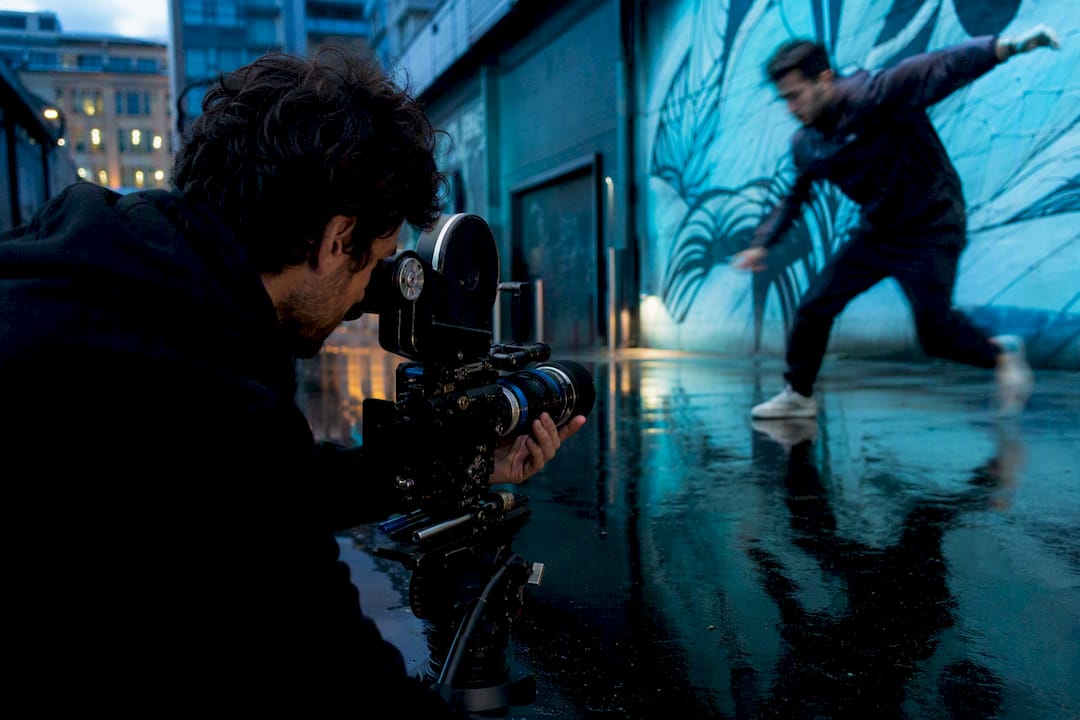
Scale mismatches cause the second most common problem. If a subject’s size in frame shifts too much between shots, even a perfectly timed motion match will look like a jump. Shooting clean reference plates at each setup, as mentioned above, gives you the material to fix this in post rather than reshoot.
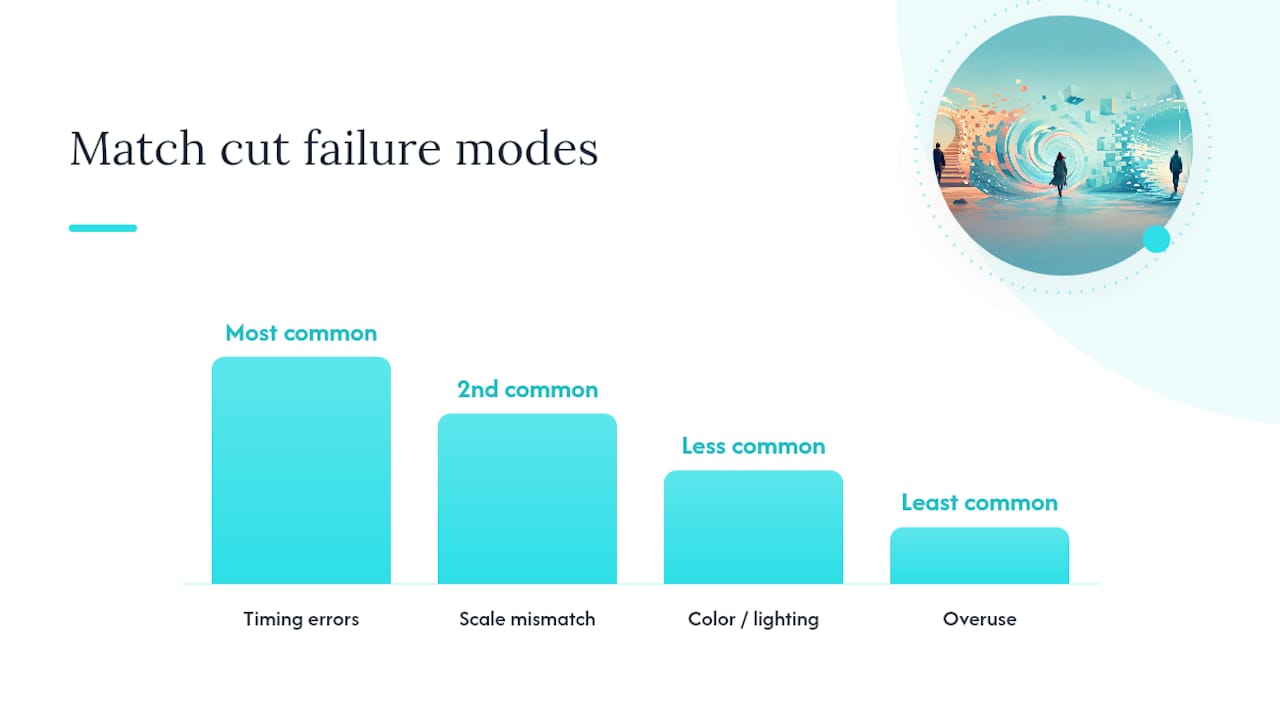
Color and lighting inconsistency undo a lot of otherwise solid graphic matches. A red object cutting to another red object only works if the reds actually match under the final grade, not just on set. That’s why colorists get looped into match cut planning early on productions that lean on the technique heavily.
Finally, overuse kills the effect. A match cut works because it’s a break from ordinary continuity editing. String too many together and the audience stops noticing any single one, which defeats the narrative economy the whole technique is built on.
Why Does the 2001 Bone-to-Satellite Cut Still Work Six Decades Later?
Break the sequence into its components and the craft becomes obvious. A hominid smashes a bone against the ground, realizes its use as a tool, then hurls it skyward in triumph. Kubrick holds on the bone at the apex of its arc, spinning against open sky, then cuts to a satellite occupying nearly identical screen position and rotation.
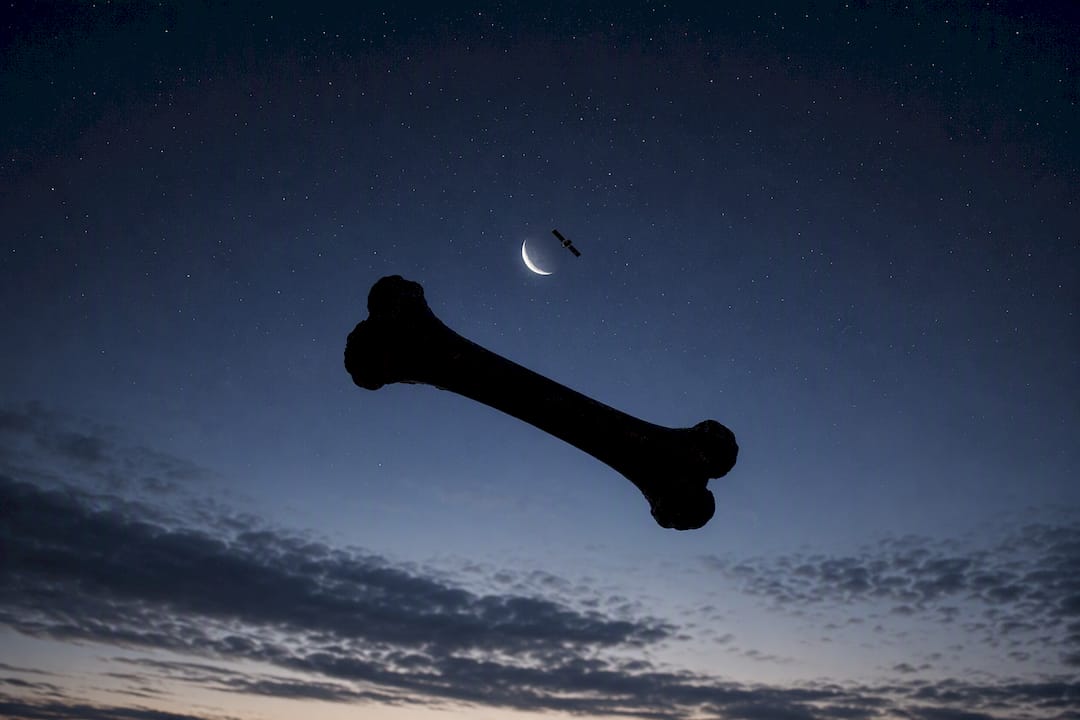
The graphic match does the heavy lifting: same silhouette, same trajectory, same negative space around the object. But the deeper trick is conceptual. The cut isn’t just visually clean, it’s an argument. Tool becomes weapon becomes technology becomes orbital hardware, and the entire arc of human tool-making collapses into a splice that lasts a fraction of a second.
Compare that to The Graduate’s pool-to-bed cut. Same technique, entirely different function. Benjamin’s dive isn’t making an argument about civilization; it’s compressing a summer of drift and boredom into one unbroken motion. The raft splash becomes a bed, and the audience understands instantly that nothing meaningful happened in between; that’s the joke and the tragedy of the scene at once.
Both cuts succeed for the same underlying reason: they trust the audience to make the leap. Neither over-explains. That restraint, more than any technical alignment trick, is what separates a match cut that lands from one that just looks clever on a shot list.
Christian’s Take: What Film Students Get Wrong About Match Cuts
Most explanations of match cuts treat them as a purely visual trick, a party move for editors who want to show off. That undersells what’s actually happening. The best match cuts in film history function as arguments, not decorations. The bone-to-satellite cut in 2001 isn’t there because Kubrick liked the shapes; it’s there because it’s the fastest possible way to state a thesis about human violence and progress in under two seconds.
Where I’d push back on conventional editing advice: too many young editors chase the graphic match because it’s the flashiest to identify and reproduce. Match-on-action and audio bridges get less classroom attention, yet they’re often more useful in contemporary work, especially in genre films that need momentum more than metaphor. If you’re studying this technique, don’t just catalog which shapes rhyme. Ask what argument the cut is making, and whether a subtler motion or sound match might make that argument more honestly than a showy visual rhyme would.
Study These Cuts Frame by Frame on The Things You Missed
Reading about a match cut only gets you halfway there. The real education happens when you scrub back and forth across the actual frame where the bone becomes a satellite, or where the pool raft resolves into a mattress, and see exactly which pixel the editor was chasing.
That’s the gap Thethingsyoumissed exists to close. Instead of hunting through a film hoping to land on the right timestamp, you get verified, timestamped entries built specifically for that kind of frame-level study. Our movie catalog breaks down films scene by scene, and our franchise pages group recurring techniques and callbacks across entire universes, so if a director reuses a match cut trick across a trilogy, you’ll see the pattern instead of missing it. Every entry runs spoiler-safe, so you can browse a title you haven’t finished without risking the ending. If you spot a match cut we haven’t logged, the request tool on any film page sends it straight to our editorial queue. Start with the movie catalog and search the title you’re studying right now.
Frequently Asked Questions
What is a match cut in simple terms? It’s a hard cut between two shots that share a visual shape, a motion, or a sound, creating an instant, often symbolic connection between two otherwise unrelated moments.
What’s the most famous match cut example in film history? The bone-to-satellite cut in 2001: A Space Odyssey is the one most cited across editing guides and film courses alike.
How is a match cut different from a jump cut? A match cut connects two different scenes through a shared visual or audio element; a jump cut skips forward in time within the same continuous scene, deliberately breaking smoothness rather than disguising it.
Are match cuts only used in graphic or artsy films? No. Action films like Baby Driver and comedies like Shaun of the Dead use match-on-action and audio matches constantly to keep pacing tight.
Can a match cut include sound instead of an image? Yes. An audio match, or sound bridge, carries a noise or line of dialogue across the cut, and it’s just as valid a category as a graphic or motion match.
Sources
- Match cut — Adobe Creative Cloud
- Match Cuts & Creative Transitions with Examples — StudioBinder
- The art of the match cut — The Conversation
- The best match cut examples in film — FilmDaft
Recommended
- Recurring Motifs — Easter Eggs That Show Up Everywhere — The Things You Missed
- The Things You Missed — Movie & TV Easter Eggs, Catalogued
- Peacemaker Easter Eggs: All 19 Hidden Details & References Explained (2022) — The Things You Missed
- Backrooms Easter Eggs: All 20 Hidden Details & References Explained (2026) — The Things You Missed