Why Oranges Signal Doom in The Godfather Trilogy
Oranges in The Godfather work as a recurring visual omen. When that fruit shows up, somebody is about to get betrayed, shot, or both. Vito Corleone is buying oranges from a street cart seconds before gunmen open fire on him. A bowl of oranges sits on Jack Woltz’s breakfast table the morning before he wakes up next to a severed horse head. Johnny Ola hands Michael an orange in Part II, and the gesture reads like a countdown clock. This piece breaks down how the motif actually works, catalogs every major appearance across all three films, and weighs whether Francis Ford Coppola and his crew planned it that way or stumbled into cinema’s most famous fruit bowl.
Key Takeaways
Oranges function as the Godfather trilogy’s most consistent visual omen, warning of death or betrayal through repetition, color contrast, and deliberate placement rather than through a single scripted symbol.
| Point | Details |
|---|---|
| Core symbolism | Oranges most often precede death, betrayal, or violence across all three films, though not exclusively. |
| Mechanism | Color contrast against a muted palette, plus repeated placement, trains viewers to read the fruit as a warning sign. |
| Origin debate | Evidence suggests an accidental, color-driven start in 1972 that became a conscious motif by Part II and Part III. |
| Cultural layer | Oranges carry existing associations with hospitality and prosperity in Sicilian and Italian tradition, deepening the irony. |
| Explore further | Thethingsyoumissed catalogues this motif and dozens of others with timestamped, verified scene entries. |
Table of Contents
- What Makes the Godfather Oranges Symbolism Actually Work?
- Every Notable Orange Scene Across the Godfather Trilogy
- Were the Oranges Planned or Just Set Dressing?
- How the Godfather Orange Motif Shaped Later Crime Dramas
- What Do Oranges Symbolize Beyond Death in The Godfather?
- Do Oranges Have Deeper Roots in Sicilian and Italian Culture?
- How Does This Motif Compare to Fruit Symbolism in Other Stories?
- Find Every Godfather Easter Egg and Recurring Motif
- Sources
What Makes the Godfather Oranges Symbolism Actually Work?
The mechanism is simple: repetition trains an audience to flinch. The first time an orange appears near violence, it’s a coincidence. The second time, viewers start connecting dots. By the third or fourth appearance, the fruit itself becomes a warning light, and Coppola knew exactly how to exploit that learned response.
Color does the heavy lifting here. The Godfather trilogy leans on a deliberately muted, sepia-heavy palette full of browns, dark woods, and shadowed interiors. Against that backdrop, a bright orange practically vibrates on screen. Production designer Dean Tavoularis reportedly started using the fruit for color contrast, a practical choice to keep somber sets from going visually flat. Contrast alone doesn’t make a motif, though. Placement does. Oranges keep showing up on tables right before ambushes, in hands right before betrayals, and in bowls right before bad news. That pattern, not any single appearance, is what converts a piece of set dressing into a warning.
Once you notice it, suspense builds even in scenes that seem calm on the surface. A quiet dinner scene with a fruit bowl in the frame suddenly carries dread that dialogue alone wouldn’t generate.
A few formal triggers turn an ordinary prop into a recognized motif:
- Repetition across multiple scenes and multiple films, not just one memorable instance.
- Color contrast against a deliberately desaturated production design.
- Timing, with placement clustered right before or during violent turns.
Pro Tip: Once you’ve spotted the obvious orange, start tracking secondary cues in the same frame: orange-colored neckties, orange juice glasses, or fruit rolling loose on the ground. The trilogy uses these smaller echoes to reinforce the same warning without repeating the exact same shot.
Every Notable Orange Scene Across the Godfather Trilogy
Here’s a scene-by-scene catalogue of where the fruit shows up and what follows it, checked against the films directly and cross-referenced with Collider’s scene list and the Medium essay on the motif.
- Vito Corleone’s shopping trip. Vito stops at a fruit stand to buy oranges on a New York street, and gunmen ambush him moments later, hitting him multiple times. This is the scene most viewers point to first, and it directly precedes an assassination attempt.
- Jack Woltz’s breakfast table. A bowl of oranges sits prominently on the table where Woltz eats breakfast the morning he discovers his prized horse’s severed head in his bed. The fruit precedes a violent, threatening message rather than a death, an early sign the motif covers more than literal killing.
- Sonny’s death setup. Orange imagery appears in the sequence building toward Sonny Corleone’s ambush at the causeway tollbooth, part of the same visual pattern that flags major violence before it lands.
- Michael and Kay’s wedding-era scenes. Oranges appear in domestic settings during The Godfather’s quieter family moments, functioning as ironic contrast rather than direct foreshadowing, a reminder that not every appearance signals imminent death.
- Johnny Ola’s gift in Part II. Hyman Roth’s emissary hands Michael an orange during their meeting in Havana. Michael’s inner circle unravels shortly after, with Fredo’s betrayal coming into full view.
- Fredo’s fishing trip. The build toward Fredo’s death on Lake Tahoe carries the same visual DNA established earlier in the franchise, even without the fruit appearing in the exact frame of the killing. Analysts at Thegodfathertrilogy treat this sequence as a thematic echo of the established pattern rather than a literal repeat.
- Michael’s business meetings, Part II. Orange bowls and orange-toned decor recur across boardroom and negotiation scenes, reinforcing that corruption and violence travel together throughout Michael’s rise.
- The helicopter ambush, Part III. An orange visibly rolls during the chaos of the assassination attempt at the mafia commission meeting, one of the most literal, unmistakable uses of the prop in the entire trilogy.
- Michael’s fatal collapse. The closing sequence of Part III, where Michael dies alone, echoes the visual isolation and fruit-adjacent imagery that opened the saga, closing the loop on the motif rather than introducing a new instance.
- Mary Corleone’s death on the opera steps. The ambush that kills Michael’s daughter carries the same tonal signature as earlier orange-flagged violence, even where the fruit itself is used more sparingly by Part III.
Cross-referencing these entries against Looper’s analysis confirms the pattern holds across multiple instances spanning all three films, with the majority clustering immediately before death or attempted murder rather than after.
Were the Oranges Planned or Just Set Dressing?
The evidence points to an origin that started practical and became intentional. Dean Tavoularis has been credited with introducing oranges primarily as a color-contrast device, something to brighten frames that otherwise leaned heavily brown and gray. That’s a production decision, not a screenwriting one, and it suggests the earliest instances in the 1972 film may not have been scripted symbolism at all.
But the pattern doesn’t stay accidental for long. By Part II and Part III, orange placement clusters so consistently around betrayal and violence that it reads as a deliberate callback to what audiences had already learned to expect.
Explainers cite production commentary suggesting oranges “began as a color-contrast device” on set, only to be recognized and reinforced as the trilogy continued, per ScreenRant’s breakdown.
Fan communities picked up on the pattern early, too. A long-running Movies Stack Exchange thread collects viewer observations dating back years, debating intentionality without a definitive on-record quote from Coppola himself confirming it as planned symbolism from day one. No primary-source interview settles the question outright. What’s clear is that intent matters less than effect: whether Coppola sketched it out in the margins of Mario Puzo’s novel or discovered it in the edit bay, the motif works exactly the same way for audiences either way.
How the Godfather Orange Motif Shaped Later Crime Dramas
The trick Coppola’s team stumbled into, or engineered, became standard vocabulary for visual storytellers who came after. A repeating background object that signals danger without a single line of dialogue is efficient in a way scripts rarely are.
- The Sopranos leans on recurring visual cues in similar fashion, using specific colors and objects to flag tension before violence breaks out.
- The Wire and other prestige crime dramas borrowed the same idea: let a prop do narrative work that would otherwise require exposition.
- Breaking Bad has drawn comparisons from critics for its own color-coded foreshadowing, an approach traced back to the Godfather playbook by several film analysts.
Every sequel The Godfather produced leaned harder into the device than the last, which is exactly why later shows had a clear template to copy.
What Do Oranges Symbolize Beyond Death in The Godfather?
Reading oranges purely as a death flag flattens what the motif actually does across nearly nine hours of film. Death is the most visible reading, but not the only one worth making.
The fruit also tracks corruption eating into something that started out clean. Early in the saga, oranges appear in domestic, almost innocent settings: family tables, casual conversation, ordinary meals. As the Corleone family’s business deepens and Michael’s choices grow darker, the same fruit starts appearing in boardrooms, ambush settings, and moments of betrayal. The shift in context, not the fruit itself, tracks the family’s moral slide.

There’s also an argument for oranges as a marker of transaction and exchange. Johnny Ola handing Michael an orange isn’t just a death cue, it’s a gesture loaded with the same false hospitality that defines mafia business dealings throughout the trilogy, where gifts and favors always carry a price. Read that way, the fruit signals obligation and debt as much as it signals violence.
None of these readings cancel each other out. A single prop carrying multiple, layered meanings is exactly what makes the motif durable enough to study decades later, rather than a one-note gimmick that wears out on a second viewing.
Do Oranges Have Deeper Roots in Sicilian and Italian Culture?
Citrus fruit carries real weight in Sicilian and broader Italian history, which gives the motif a cultural foundation beyond Coppola’s editing choices. Sicily has grown citrus for centuries, and oranges specifically became tied to prosperity, hospitality, and status in southern Italian households, often appearing at celebrations and as gifts between families.
That context adds texture to how The Godfather deploys the fruit. Oranges at a family table aren’t neutral background objects to an audience steeped in that cultural shorthand. They signal warmth, abundance, and old-world hospitality, the exact values the Corleone family claims to protect even as their business corrupts everything around it. Placing the fruit at moments of betrayal creates a pointed contrast: a symbol of generosity and family repurposed as a warning sign.
Mario Puzo’s original novel draws heavily on Italian-American immigrant experience, and the film’s production design carries that texture into its visual choices, whether or not every citrus placement was scripted with folklore in mind. The fruit didn’t need an invented meaning grafted onto it. It already carried cultural associations with celebration and family loyalty that made its ironic reuse as an omen land harder for audiences who recognized that context, even subconsciously.
How Does This Motif Compare to Fruit Symbolism in Other Stories?
Fruit carrying symbolic weight is nothing new in storytelling. The apple in Genesis marks temptation and fall. Pomegranates in Greek myth tie Persephone to the underworld. What makes The Godfather’s approach distinct is how it strips away mythological or religious framing and works purely through cinematic repetition.
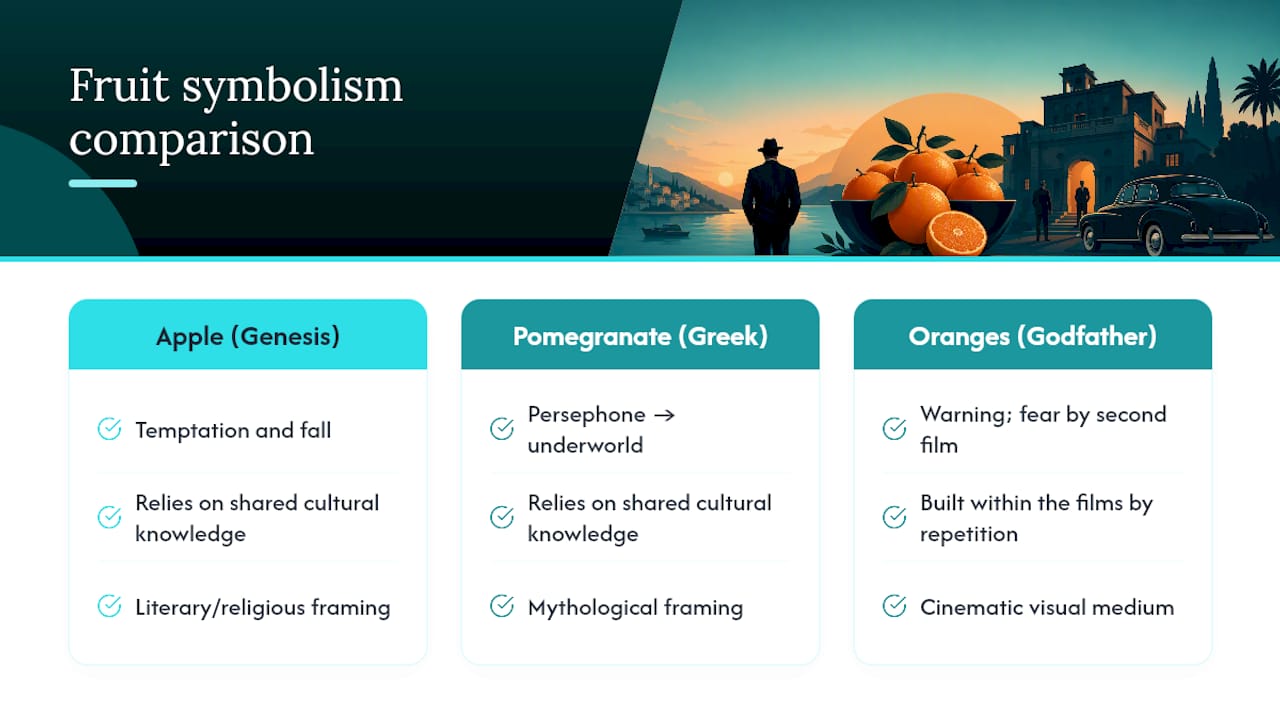
Where older literary fruit symbols rely on shared cultural knowledge readers bring with them, Coppola’s oranges build their meaning entirely within the text itself, scene by scene, across nearly nine hours of film. A first-time viewer with zero background in Sicilian citrus history still learns to fear the fruit by the second film, purely from pattern exposure.
That’s closer to how television and film use recurring colors or objects today than to how classical literature uses fruit. Compare it to something like the green light in The Great Gatsby, a single, sustained symbol tied to one character’s longing. The orange motif functions more like a Chekhov’s gun repeated a dozen times across three films: a warning that gets recalibrated and reinforced with each new placement rather than delivering one grand payoff. It’s a technique built for a visual medium, not a literary one, which may explain why it echoes so clearly in the crime dramas that followed rather than in novels.
Why cataloguing motifs like this actually matters
I think the value in tracking something like the orange motif isn’t proving Coppola planned every frame. It’s giving viewers language for something they already sensed on a first watch. Cataloguing these patterns turns a gut feeling into evidence you can point to on a rewatch.
Find Every Godfather Easter Egg and Recurring Motif
If cross-referencing a dozen orange appearances across three films sounds like exactly the kind of rabbit hole you enjoy, that’s the entire premise behind Thethingsyoumissed. Every scene mentioned in this catalogue, along with the smaller details that didn’t make the cut, gets logged with timestamps and verified against the actual film rather than secondhand memory.

Thethingsyoumissed’s recurring motifs catalogue groups visual devices like this one across different franchises, so you can see how filmmakers reuse the same tricks from one production to the next. If you want the full breakdown of Godfather-specific details beyond the fruit, the movie Easter egg catalogue is where those entries live, spoiler-tagged and timestamped for exactly this kind of deep dive. Every entry gets checked against the source film directly before it’s published. Start with the motifs page and see what other recurring props you’ve been walking past without noticing.
Sources
- The Godfather: Why The Oranges Are So Important — ScreenRant
- The Fruit of the Gangster — Medium (New Literary Society)
- 10 Times Oranges Served as Foreshadowing in ‘The Godfather’ Movies — Collider
- Why The Oranges In The Godfather Mean More Than You Think — Looper
- Thegodfathertrilogy
Recommended
- Recurring Motifs — Easter Eggs That Show Up Everywhere — The Things You Missed
- Movie Easter Eggs — Every Film, Frame by Frame — The Things You Missed
- Is There a Post-Credit Scene in The Super Mario Bros. Movie? Yes, and Here’s What Both Set Up — The Things You Missed
- Star Wars Easter Eggs — 38 Hidden Details Across 2 Titles — The Things You Missed