8 Verified Star Trek Easter Eggs With Scene Timestamps for Rewatchers

This is a verified, cross-era list of notable Star Trek Easter eggs, each with a short explanation of what it means and where to find it. Entries run from the Original Series through Strange New Worlds and the Kelvin timeline films, with scene-level pointers so you can jump straight to the frame. For deeper verification and full timestamped breakdowns, some sites keep searchable databases built exactly for this kind of hunt.
TL;DR:
- The number 47 appears frequently in Star Trek, originating as an inside joke among writers and now serving as a recurring motif across multiple series.
- Modern productions, especially on Paramount+, incorporate detailed background props and set elements that reference classic Trek canon, rewarding attentive viewers.
- Hidden references such as the TARDIS in Strange New Worlds and R2-D2 in the 2009 film are subtle, requiring frame-by-frame pauses and high-resolution scrutiny to catch.
- Star Trek’s Easter eggs extend beyond props to include character names, dialogue echoes, and ship registry numbers, emphasizing continuity and inside knowledge.
- Verified discovery of Easter eggs can be achieved through timestamped scene captures using dedicated databases that help fans confirm sightings without spoilers.
Table of Contents
- Top Star Trek easter eggs, explained
- Recurring motifs and inside jokes
- How to spot and verify Star Trek Easter eggs
- Why our verification matters: The Things You Missed’s timestamped database
- Deep-cut set design details worth a second look
- Historical context and significance of major Easter eggs
- Influence of Easter eggs on Star Trek fan culture and fandom engagement
- Notable creators or writers known for including Easter eggs
- The evolution of Easter egg complexity throughout Star Trek’s production history
- Why finding these still feels like discovery
- Verify your next find with dedicated Easter egg databases
- Sources
Top Star Trek easter eggs, explained
Some of these references have been catalogued for decades. Others surfaced within the last year. All of them reward a rewatch with the pause button close at hand.
1. Lorca’s lab of horrors (Discovery, Season 1). Captain Lorca’s private quarters aboard the Discovery hide a small museum of franchise nightmares: a Gorn skeleton, a dissected Tribble, and a tank of Cardassian voles. The deep-cut Discovery props tie directly into Lorca’s later reveal as a Mirror Universe transplant, since voles specifically call back to Deep Space Nine’s “Empok Nor.” Look for the wide shot as Lorca crosses the room in early season one episode; the shelf reads like a trophy case for franchise villains.
2. The Chateau Picard bottle. A wine label bearing the Picard family vineyard shows up tucked into background shots across Discovery and Picard, a quiet nod that Jean-Luc’s family estate exists in the same visual universe fans later got to walk through in Star Trek: Picard. It is easy to miss because it never gets a close-up. It rewards viewers who already know the Picard family lore.
3. R2-D2’s cameo in the 2009 film. During the Kelvin timeline reboot, a small droid resembling Star Wars’ R2-D2 appears among the wreckage on Delta Vega. J.J. Abrams directed both franchises around the same period, and the gag has become one of the most-cited crossover winks in modern blockbuster filmmaking. If you catalog crossover references for a living, this one belongs next to any Star Wars Easter egg breakdown as a case study in directors signing their own work.
4. The TARDIS in Strange New Worlds. Season three’s episode “The Sehlat Who Ate Its Tail” hides a Doctor Who TARDIS in a brief bridge shot, part of a wider set of classic callbacks packed into that same episode. It is blink-and-you-miss-it fast. Frame-by-frame review is the only reliable way to catch it, which makes it a favorite test case for verification tools.
5. Every “47” you can find. Registry numbers, stardates, coordinates, room numbers. The digits 47 show up so often across every Trek series that it has become the franchise’s longest-running inside joke, discussed at length below.
6. Classic-era props reused in new productions. Paramount+ era shows regularly dress sets with equipment, uniforms, or graphics lifted straight from Original Series or Next Generation aesthetics. Analysis of these modern callbacks treats them as a deliberate conversation with longtime viewers rather than accidental overlap. Watch for background consoles in Strange New Worlds engineering scenes; several use control layouts that mirror 1960s set photography almost exactly.
7. Starfleet Academy’s opening batch of nods. The newest series arrived loaded with references in its first two episodes alone, from cadet roster names to background dialogue that name-drops earlier missions. Episode-specific recaps of Starfleet Academy’s Easter eggs are your fastest route to catching them before spoilers spread across social feeds.
8. StarTrek.com’s own curated canon. The franchise’s official site maintains a running gallery of dozens of confirmed eggs across every series and film, a useful cross-check against any fan-compiled list, including this one. If an entry you spot isn’t already logged somewhere official, that is often your signal you have found something genuinely obscure.
Recurring motifs and inside jokes
The number 47 is the franchise’s most famous running gag, and it has an origin story: writer Joe Menosky introduced it during Next Generation in 1990, and colleagues including Ronald D. Moore and Brannon Braga kept the habit alive across later shows. It spread the way inside jokes spread in any writers’ room: new staff copy the convention because it is already baked into the scripts they are studying. Eventually the joke got so pervasive that the writing staff consciously dialed it back to keep it from distracting from plot.
Beyond 47, watch for:
- Ship registry numbers that echo earlier vessels in the same class lineage.
- Background lab equipment and prop reuse signaling homage rather than budget-saving.
- Character names or callsigns lifted from earlier, unrelated episodes.
- Dialogue lines that mirror a line spoken decades earlier in a different series.
How to spot and verify Star Trek Easter eggs
- Pause on any background shot longer than two seconds; that is usually where set dressers hide the good stuff.
- Use an HD stream and frame-grab the shot; detailed set labels only become legible at higher resolution.
- Note the exact timestamp to the second, not just the scene.
- Cross-check production credits and episode notes to confirm intent versus coincidence.
- Log your find with a screenshot and timestamp before sharing it, so you can verify it later.
Pro Tip: Zoom in on console labels and lab signage specifically. Prop designers treat those small text elements as their personal signature space, and that is where the densest reference density tends to live.
Keep your notes spoiler-free when posting publicly. A timestamp without plot context lets other fans verify the find without ruining the episode for themselves.
Why our verification matters: The Things You Missed’s timestamped database
Every entry in The Things You Missed’ catalog carries a timestamp and a spoiler-safe summary, so you can jump straight to the frame without wading through recap text. Author Christian built the site’s Star Trek coverage around exactly this kind of scene-level precision. For deeper dives, browse the TV series database or the film catalog for follow-up breakdowns.
Deep-cut set design details worth a second look
Set decorators on Star Trek productions have always treated background details as their own private canvas, and that habit has only intensified with modern production budgets. Lab displays are the richest hunting ground. Lorca’s aforementioned shelf of horrors is the standout example, but nearly every science-fiction set on the franchise carries some version of it: specimen jars, hand-lettered warning labels, or diagrams borrowed from earlier canon.
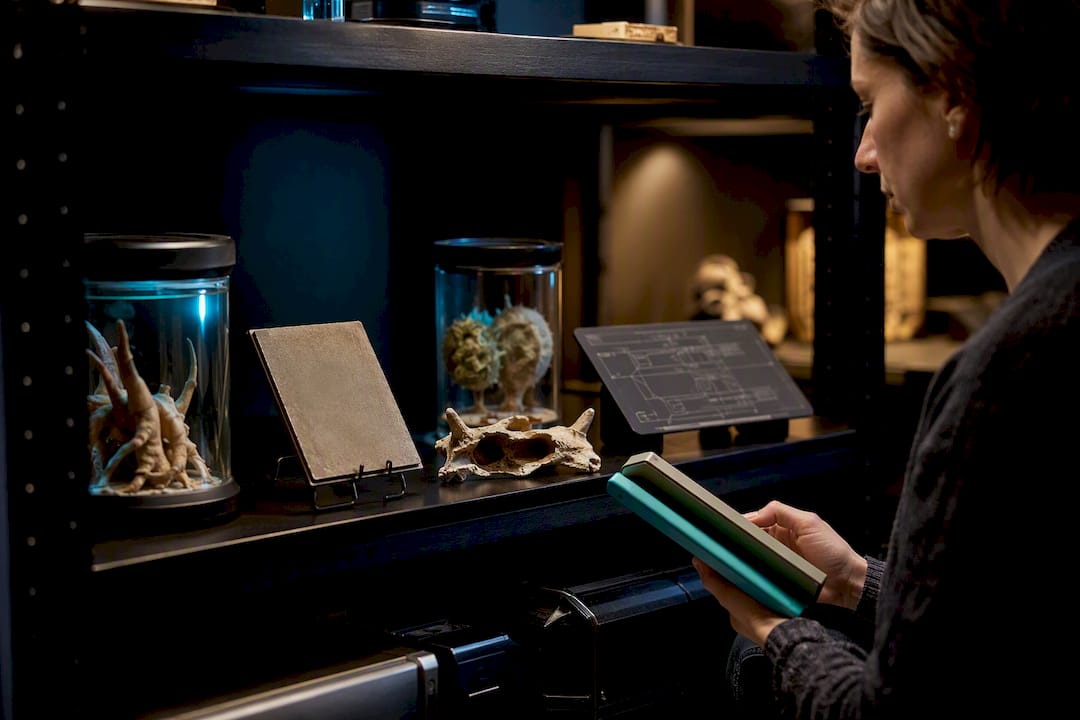
Background labels matter almost as much as hero props. A padd screen glimpsed for half a second might display a star chart referencing a planet from a decades-old episode. Corridor signage sometimes lists deck numbers or department names that only make sense if you already know the ship’s internal geography from a previous series. None of this changes the plot. It changes how the universe feels lived-in.
Credits sequences and production plaques deserve attention too. Engineering consoles occasionally carry small manufacturer plaques referencing in-universe companies established in earlier Trek media, a level of continuity that only a production team already fluent in franchise lore would bother maintaining. That fluency is exactly what separates a show respecting fifty-plus years of canon from one merely borrowing the name.
Historical context and significance of major Easter eggs
Star Trek’s Easter egg tradition did not start as a marketing strategy. It started as writers and set decorators quietly rewarding their own colleagues and the most attentive viewers, long before “Easter egg” was common vocabulary for hidden media details. The number 47 is the clearest proof: it began as a private joke among writers in 1990, not a planned franchise feature, and it only became a documented phenomenon after fans started tallying its appearances themselves.
That grassroots origin gives these references staying power that manufactured viral moments rarely achieve. PBS has documented Star Trek’s decades-long cultural footprint, and trivia resources tracing that history consistently point back to the franchise’s density of internal reference as part of what makes it feel like a coherent universe rather than a string of separate shows. Modern productions inherited that expectation. When Strange New Worlds hides a TARDIS or Discovery dresses a lab with Gorn bones, the production team is participating in a tradition older than most of its own cast members.
Influence of Easter eggs on Star Trek fan culture and fandom engagement
Star Trek fandom has organized itself around detail-hunting since long before streaming made frame-by-frame review easy. Convention panels, fanzines, and later message boards all built rituals around cataloging references, and that instinct only intensified once HD releases made previously invisible set details legible to the average viewer at home.
Easter eggs give fans a second layer of the show to engage with beyond plot. A viewer who spots the Chateau Picard bottle or catches a registry number callback gets a small, private confirmation that the writers are speaking directly to people who already know the universe deeply. That recognition builds loyalty in a way plot alone cannot. It also generates community activity: recap threads, timestamp lists, and comparison charts between series are now a standard part of how episodes get discussed the morning after release, turning a single scene into days of ongoing conversation.
Notable creators or writers known for including Easter eggs
Joe Menosky holds a specific place in this history as the writer credited with originating the number 47 gag during his time on The Next Generation. The habit did not stay contained to his own scripts. Ronald D. Moore and Brannon Braga, both prolific Trek writers across multiple series, picked up the convention and carried it into their own work, which is how a single writer’s private joke became a franchise-wide fixture spanning five decades of production.
Beyond that specific gag, the modern Paramount+ writing and production teams have earned a reputation for treating classic-era references as deliberate craft rather than incidental homage. Analysis of recent seasons’ classic callbacks frames this as an ongoing dialogue between current showrunners and longtime viewers, using props, episode titles, and specific shot compositions to acknowledge audiences who have followed the franchise since the 1960s. That is a different kind of authorship than a single writer’s inside joke. It is closer to an entire production culture agreeing that continuity itself is worth celebrating on-screen.
The evolution of Easter egg complexity throughout Star Trek’s production history
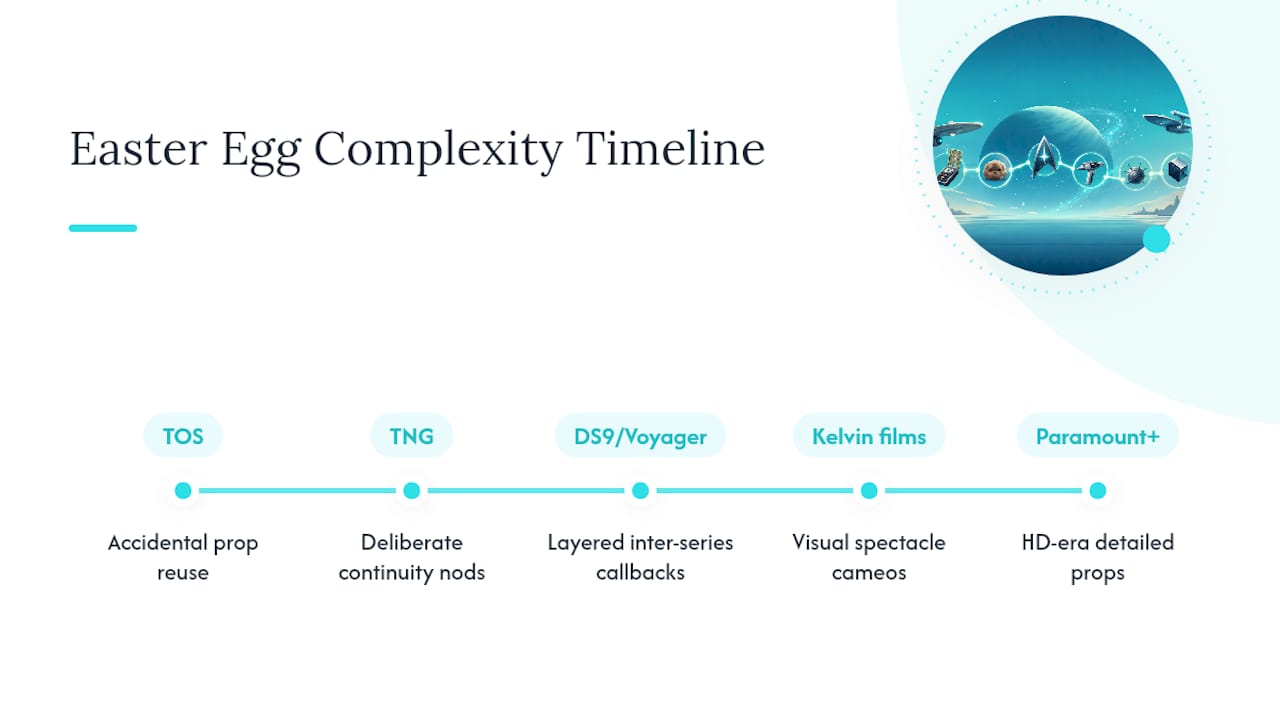
Original Series Easter eggs were largely accidental or born of budget constraints: reused props, recycled sound effects, the same alien mask painted a different color. There was no coordinated strategy, just a small production team working fast under tight schedules.
By The Next Generation, that changed. Writers began seeding intentional continuity nods and private jokes like Menosky’s 47, marking a shift from accidental reuse to deliberate craft. Deep Space Nine and Voyager expanded that further with layered callbacks between sister series, referencing each other’s episodes directly.
The Kelvin timeline films pushed complexity into visual spectacle, hiding references like the R2-D2 cameo inside high-budget action sequences rather than quiet dialogue exchanges. The current Paramount+ era represents the most complex phase yet: HD production values mean set decorators can hide legible text and detailed props that only reveal themselves on a large screen or a frame grab, exactly the kind of density that makes shows like Discovery and Strange New Worlds so rewarding to pause and study scene by scene.
Why finding these still feels like discovery
Spotting a reference nobody pointed out to you first still carries a real charge, even decades into this franchise’s run. Streaming and high-definition transfers changed the hobby more than any single show did: details that used to require a fan convention rumor or a magazine tip now sit there waiting for anyone willing to pause and zoom. The Chateau Picard bottle is the entry that sticks with me most, precisely because nobody built a scene around it. It is just there, quietly confirming the writers trust you to already know the family history.
— Christian
Verify your next find with dedicated Easter egg databases
You have the list. Now go confirm it yourself, or skip the frame-by-frame guesswork and let a database built for exactly this job do the heavy lifting. Some sites catalog Star Trek references with timestamped, spoiler-safe entries organized by episode and film, so you can jump straight to the second a reference appears instead of scrubbing through an entire runtime.

Browse the TV series catalog for episode-by-episode Star Trek breakdowns, or check the movie database for film-specific finds across the Kelvin timeline. If you have spotted something not yet logged, submit it through the request page and help build out the next verified entry.
Sources
- Star Trek: Discovery’s Coolest, Deepest-Cut Easter Eggs
- The inside joke of the number 47 in Star Trek
- Trekmovie
- Modern Star Trek’s greatest classic-era Easter eggs