24 Anime Easter Eggs You Never Noticed (Even on a Rewatch)

An anime Easter egg is any intentional detail a creator hides for attentive viewers to find: a cameo, a callback, a signature, a joke that only lands if you’re paying close attention to the background of a frame). Some pay off the plot later. Most are just gifts from animators to the audience that’s rewatching frame by frame at 2 a.m.
Here are five to get you oriented before we go series by series:
- One Piece hides up to 35 rapid-fire cameos and throwbacks in a single opening sequence, gone in a blink if you’re not scrubbing frame by frame.
- Attack on Titan’s finale drops a red object into an otherwise gray, desaturated frame. A direct nod to Schindler’s List.
- Mob Psycho 100 and One Punch Man trade visual winks between studios, including recurring nods to Saitama.
- Death Parade slips in a cameo appearance from Light Yagami of Death Note, blink and you’ll miss it.
- Attack on Titan episode 78 buries franchise references and foreshadowing that only click once you know how the story ends.
A quick spoiler note before you go further: entries below are flagged when they touch plot outcomes. If you’re mid-series on any of these, skip the flagged items and come back after you’ve caught up. Nothing here is worth ruining your first watch.
Key Takeaways
The most reliable anime Easter eggs are the ones confirmed by a primary source, a timestamp, an artbook, or a staff interview, not the ones repeated across forums without citation.
| Point | Details |
|---|---|
| Know the egg type | Cameos, background gags, and foreshadowing behave differently. Confirm which one you’re seeing before drawing conclusions. |
| Slow down openings | Dense sequences like One Piece’s openings hide up to 35 references in seconds. Frame-scrub to catch them. |
| Separate foreshadowing from jokes | Foreshadowing changes plot causality. Most Easter eggs are meta nods that don’t. |
| Verify before you trust it | Confirm claims through interviews, artbooks, or official studio posts, not screenshots alone. |
| Respect spoiler flags | Skip flagged entries, like Attack on Titan’s finale details, until you’ve finished the series. |
| Use a sourced catalog | Thethingsyoumissed maintains timestamped, spoiler-safe breakdowns for series like Attack on Titan and One Piece for exactly this kind of verification. |
Table of Contents
- What Counts as an Anime Easter Egg? A Quick Taxonomy
- Notable Anime Easter Eggs, Series by Series
- How to Spot and Verify an Easter Egg Yourself
- Why Creators Bury These Details in the First Place
- What Actually Separates a Great Anime Easter Egg From a Gimmick
- Find Every Verified Detail in Thethingsyoumissed’s Catalog
- Where to Verify These Details Yourself
- Sources
- FAQ
What Counts as an Anime Easter Egg? A Quick Taxonomy
Not every hidden detail works the same way, and lumping them together is how casual viewers miss half of what’s actually there. Anime hidden details generally sort into seven buckets, and knowing which one you’re looking at changes how you should read it.
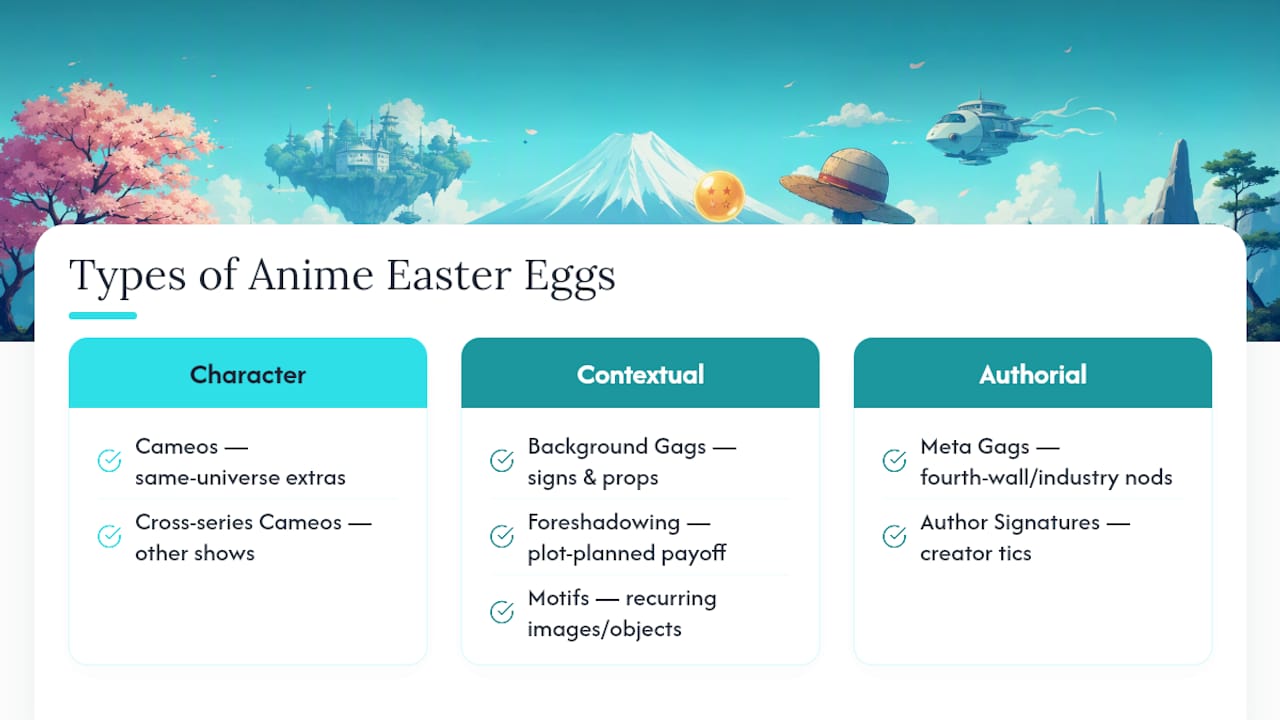
Cameos are characters from the same universe popping up somewhere they technically don’t belong, like a background extra at a train station. Cross-series cameos go further, borrowing a character or visual signature from an entirely different show. Roundups of anime inside jokes point to the Mob Psycho 100 and One Punch Man overlap as a textbook case: both shows share visual nods to Saitama despite being produced with different core teams, a wink between studios rather than an official crossover.
Background gags are jokes stashed in signage, posters, or incidental objects that never get commented on by any character. Foreshadowing looks similar on the surface, but it’s structurally different: a detail placed early that the plot later depends on, not just references. Meta gags break the fourth wall a little, referencing the anime industry itself, a studio’s other work, or a real production event. Author signatures are a mangaka’s personal tics, recurring numbers, colors, or even literal self-portraits slipped into a panel that made it to animation. Motifs are objects or images that recur across a season or series to build a theme, like a repeated color scheme signaling danger before anyone says a word.
Here’s the distinction that trips people up: an Easter egg is usually a wink that doesn’t touch the plot’s causality. Foreshadowing is narrative-planned payoff baked into the story’s architecture. Treat the two differently when you’re trying to “solve” a series, because chasing every visual gag as if it’s a clue will send you down a lot of dead ends.
Notable Anime Easter Eggs, Series by Series
This is the part you came for. Every entry below has a location you can go check yourself, and a flag if it edges into spoiler territory.
One Piece. The series’ newer opening sequences are dense with throwbacks. Fans have counted up to 35 distinct Easter eggs packed into a single new opening, from silhouettes of future arcs to blink-and-miss cameos of side characters. Beyond the openings, keep an eye out for Pandaman, a background character the animation team hides in nearly every episode as a running gag documented across the One Piece Wiki. No spoiler risk here; Pandaman-spotting is pure fan sport.

Attack on Titan. This is the series with the deepest well of verified references. The finale’s visual homage to Schindler’s List uses a single red object in an otherwise monochrome frame, mirroring Spielberg’s famous red coat. Episode 78 carries additional foreshadowing and franchise nods that only resolve once you’ve seen how the war storyline ends. Broader pop-culture references, including callbacks to Terminator, have been cataloged extensively by fans on X, with those tracking projects pulling in roughly 17.7 million views. Spoiler flag: the Schindler’s List homage and episode 78 details both touch major plot beats. For a full episode-by-episode breakdown, Thethingsyoumissed keeps a timestamped Attack on Titan catalog built for exactly this kind of hunt.
Mob Psycho 100 / One Punch Man. Beyond the Saitama nods mentioned above, both series share a director in ONE, whose art style connects them even when the animation studios differ. It’s less a hidden clue than a friendly signature stamped across two unrelated stories.
Death Note. The series shows up as the source material for one of anime’s better-known cross-show cameos rather than hiding eggs of its own within its runtime; Light Yagami appears in Death Parade, a documented cameo that rewards viewers who’ve seen both shows without spoiling either one.
Assassination Classroom. The series leans on background sight gags in classroom scenes, chalkboard doodles and posters that reference other Studio Lerche projects, a subtler version of the industry in-joke you see elsewhere on this list.
FLCL. Character names and visual motifs throughout the series double as references to Western rock music and film, part of what made the show a cult favorite for viewers who caught the layered homages beneath its surface chaos.
Hunter x Hunter. Yoshihiro Togashi’s manga is known for author signatures, recurring numeric motifs and small personal details that longtime readers track across arcs, functioning less like jokes and more like a fingerprint you learn to recognize.
How to Spot and Verify an Easter Egg Yourself
Finding these on your own gets a lot easier once you build a system instead of hoping something jumps out. Here’s the workflow that actually works:
- Slow the opening down. Openings and credit sequences are the densest hiding spots in anime because so many cameos and throwbacks appear for a fraction of a second. Frame-scrub or use a video player’s frame-step function rather than watching at normal speed.
- Compare key frames across episodes. Repeating props, signs, or background characters (like Pandaman) only become obvious once you’ve seen the same detail show up two or three times.
- Watch backgrounds during dialogue scenes, not just the characters talking. Background gags are placed specifically where your eyes aren’t supposed to be.
- Cross-reference with fan trackers. Large-scale fan projects on platforms like X have already mapped out huge chunks of a series’ references; checking existing work saves hours of frame-by-frame hunting.
- Confirm before you post. Check the source, an artbook, a staff interview, an official studio social account, or a fandom wiki, before treating a guess as a confirmed reference.
Pro Tip: When you spot a possible reference, search the studio’s official social account alongside the episode number. Staff and directors often confirm intentional Easter eggs directly in replies or interviews within days of an episode airing, and that beats guessing from a screenshot every time.
The verification step matters more than people think. A detail that “looks like” a reference isn’t the same as one a director has confirmed, and treating unconfirmed pattern-matching as fact is how fandom myths get started and never die.
Why Creators Bury These Details in the First Place
Anime is unusually self-referential compared to other animation industries, and there’s a simple reason: a huge share of the people making these shows grew up as fans of the shows that came before them. Easter eggs function less like a puzzle designed to trick you and more like a friendly nod between studios, a way of building community inside an industry where teams often cross paths across multiple productions.

Some eggs exist purely as homage. Attack on Titan’s Schindler’s List reference isn’t decoration, it borrows Spielberg’s specific visual grammar to make an otherwise abstract ending land with more emotional weight, tying a war story to the most recognizable cinematic language about war’s aftermath in the West. Other eggs exist to reward patience: a detail dropped in episode 12 that means nothing until episode 60 recontextualizes it. That’s the delayed-gratification structure that separates a good Easter egg from a throwaway joke, it isn’t just hidden, it’s hidden with a payoff attached.
That payoff is also what turns a one-time viewing into a rewatch. An egg you catch on your third pass through a series works like narrative glue: it retroactively makes the earlier episode feel more intentional than it did the first time, even if the joke itself never advances a single plot point.
What Actually Separates a Great Anime Easter Egg From a Gimmick
The best anime Easter eggs earn a second watch. That’s the filter Thethingsyoumissed applies to everything we catalog, and it’s why some of the entries above get full breakdowns while dozens of “hidden details” floating around fan forums don’t survive our verification process at all.
Here’s an unpopular opinion: most Easter egg lists online are lazy. They repeat the same five examples every other list already ran, they rarely cite a timestamp, and they almost never distinguish between something a director confirmed in an interview and something a Reddit thread decided was true because it sounded plausible. That gap between “confirmed” and “convenient theory” is where most anime trivia goes wrong, and it’s the reason a detail like Attack on Titan’s finale homage gets treated with the same confidence as an unverified fan rumor, when one has a source behind it and the other doesn’t.
What we track for isn’t just cleverness, it’s intent you can actually source. A background gag that a studio confirmed in an artbook is worth more than three “probably references” stacked together with no citation. If you take one thing from this list, take that standard with you the next time you’re scrubbing through an opening looking for cameo number 36.
Find Every Verified Detail in Thethingsyoumissed’s Catalog
Hunting down a single Easter egg across old forum threads and half-sourced YouTube videos eats an entire evening you could spend actually rewatching the show. Thethingsyoumissed built a faster route: a searchable, timestamped catalog where every entry is spoiler-flagged and sourced before it ever gets published.

Here’s what that actually gets you. First, you skip the scavenger hunt entirely, search a series and jump straight to the episode and timestamp where a detail lives. Second, every entry ties back to a verifiable source, an interview, an artbook, an official post, instead of a forum guess dressed up as fact. Third, spoiler-safe browsing means you can explore a series you haven’t finished without a single major beat getting spoiled by accident. The Attack on Titan breakdown alone runs through 20 hidden details episode by episode, and the One Piece catalog does the same for that show’s openings and arcs. If you’re more interested in patterns that repeat across shows entirely, the recurring motifs page tracks those threads across titles instead of within just one. Browse the full series catalog and pick your next rewatch with the details already mapped out for you.
Where to Verify These Details Yourself
Trusting a claim because it sounds right is how anime trivia gets muddled over time. These are the sources worth checking before you repeat one as fact.
| Source | What it verifies | Why it’s reliable |
|---|---|---|
| Official studio social accounts | Confirmed cameos, staff-acknowledged references | Direct statement from the people who made the scene |
| Artbooks and production guides | Author signatures, design intent | Published alongside the original creative team |
| Fandom wikis (e.g., One Piece Wiki) | Recurring background characters, community-tracked sightings | Crowd-verified across thousands of episode viewings |
| Fan reference trackers on X | Cross-media homages, pop-culture nods | Large-scale frame comparisons across an entire series |
| Thethingsyoumissed series pages | Episode-specific, timestamped Easter eggs | Every entry is sourced and spoiler-flagged before publication |
For collectors who want to hold onto a favorite reference beyond the screen, partners like Remerlinds’ Attack on Titan resin model kits turn a memorable moment into something you can actually put on a shelf.
Sources
- 10 easy-to-miss details that went over most anime fans’ heads
- 10 Best Easter Eggs In Anime
- All 35 Easter Eggs Hidden in One Piece’s New Opening Explained
- Attack on Titan: A Steven Spielberg reference in the final episode
FAQ
What is the difference between an anime Easter egg and foreshadowing? An Easter egg is typically a wink, a cameo, a joke, a signature, that doesn’t change how the plot unfolds. Foreshadowing is a detail the story structurally depends on later, meaning removing it would leave a gap in the narrative logic.
Are anime Easter eggs officially confirmed, or are most just fan theories? Some are confirmed directly by studios or creators through interviews and social posts. Others remain fan-documented patterns that haven’t received official confirmation, which is why checking the source matters before treating a claim as fact.
Which anime has the most documented Easter eggs? Attack on Titan and One Piece consistently rank among the most cataloged, thanks to dense opening sequences in One Piece and extensive cinematic homages throughout Attack on Titan’s run.
Do anime Easter eggs ever spoil the plot? Occasionally, yes. Some references, like Attack on Titan’s finale homage, are tied directly to major plot beats. Always check for a spoiler flag before reading a breakdown of a series you haven’t finished.
Where can I request a breakdown for a specific anime? You can submit a request for a series you’d like fully cataloged, and vote with your watchlist on what gets covered next.
Recommended
- One Piece Easter Eggs: All 18 Hidden Details & References Explained (2023) — The Things You Missed
- TV Series Easter Eggs — Every Show, Episode by Episode — The Things You Missed
- Movie Easter Eggs — Every Film, Frame by Frame — The Things You Missed
- Futurama Easter Eggs: All 15 Hidden Details & References Explained (1999) — The Things You Missed