Netflix Watch Order: The 8 Witcher Entries for Easter-Egg Hunters
Watch The Witcher in release order if this is your first trip through the Continent. Season 1’s timelines are already scrambled on purpose, and release order preserves the reveals as showrunner Lauren Schmidt Hissrich intended. Chronological order is a fine second pass for lore purists who want the Conjunction of the Spheres explained before they meet Geralt, but even that path still has to reckon with Season 1’s internal timeline tricks.
TL;DR:
- Watching the franchise in release order preserves the intended narrative reveals, especially the complex timeline intercut in Season 1, which is crucial for understanding the story.
- The chronological viewing order starts with Blood Origin, set 1,200 years before Geralt’s era, but it can spoil Season 1’s mystery if viewed first.
- Spin-offs like Blood Origin and Nightmare of the Wolf offer lore expansion but are optional on a first watch, while the main seasons provide the core plot.
- The series streams exclusively on Netflix, requiring an active subscription, and regional restrictions may affect availability of certain titles.
- The book series and TV adaptations run on separate continuities, and reading the books in proper order is recommended if you want additional context beyond the show.
Table of Contents
- The Chronological Witcher Watch Order (In-Universe Timeline)
- What Order Should You Watch The Witcher In For Release?
- What Is Each Witcher Title Actually About?
- Which Witcher Order Fits Your Viewing Style?
- Where Can You Stream The Witcher Series?
- How Does The TV Order Compare To The Books?
- How We Catalog The Witcher’s Hidden Details
- Why Release Order Beats Chronological For Most Viewers
- Sources
The Chronological Witcher Watch Order (In-Universe Timeline)
If you want events unfolding the way they actually happened on the Continent’s timeline, start roughly 1,200 years before Geralt ever picks up a sword. That’s where Blood Origin plants its flag, and it’s the only entry in the franchise set that far back.
- The Witcher: Blood Origin — the Conjunction of the Spheres, the first prototype witcher, and the origin of monsters crossing into the human world. Four episodes, all deep lore, zero familiar faces from the main cast.
- The Witcher: Nightmare of the Wolf — an animated film set generations later, centered on a young Vesemir before he trains Geralt. It closes with a Geralt cameo that bridges the two eras.
- The Witcher Season 1 — Geralt, Yennefer, and Ciri’s stories begin, though the season itself jumps between three different points in time rather than playing them straight.
- The Witcher Season 2 — the timelines converge, Ciri reaches Kaer Morhen, and the main plot finally moves in a straight line.
- The Witcher Season 3 — the Continent’s politics boil over and the original Cavill era closes out its arc.
- Sirens of the Deep — an animated feature slotting into the main timeline, expanding the world below the waterline.
- The Rats — a spin-off following Ciri’s outlaw allies, sitting alongside the later main-season events.
- The Witcher Season 4 — the next chapter of the main story, with Liam Hemsworth stepping into the role of Geralt.
Going chronological front-loads a lot of unfamiliar mythology before you’ve met the characters you’re supposed to care about. Blood Origin and Nightmare of the Wolf both work better as expansions once you already know who Geralt, Yennefer, and Vesemir are, which is exactly why most guides put chronological order second, not first.
What Order Should You Watch The Witcher In For Release?
For a first watch, follow the order the franchise actually shipped in. Guides tracking the franchise’s rollout consistently land on the same release sequence, and it’s the sequence Netflix itself designed the reveals around.
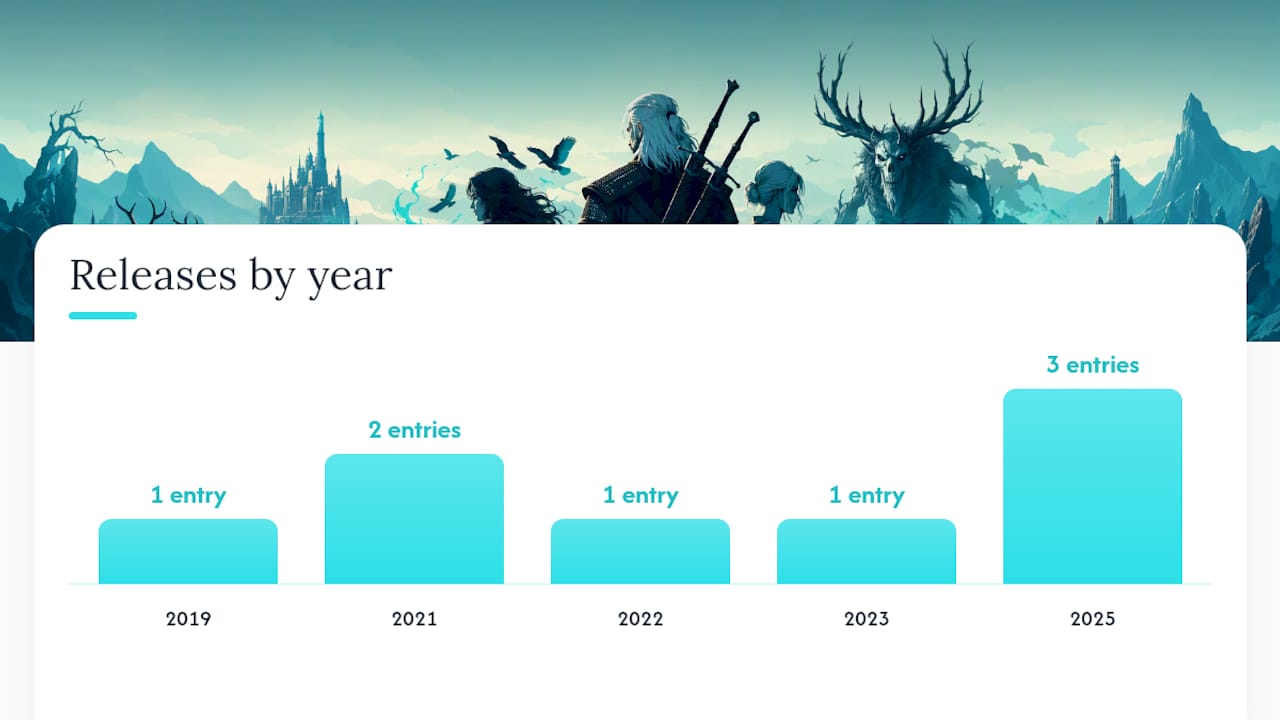
- The Witcher Season 1 (2019)
- The Witcher: Nightmare of the Wolf (2021)
- The Witcher Season 2 (2021)
- The Witcher: Blood Origin (2022)
- The Witcher Season 3 (2023)
- Sirens of the Deep (2025)
- The Rats (2025)
- The Witcher Season 4 (2025)
This order matters because Season 1 wasn’t built to be watched with a chronological cheat sheet in hand. It deliberately intercuts three separate timelines belonging to Geralt, Ciri, and Yennefer, and the season’s biggest twist depends on you not realizing how those timelines connect until the finale. Rearranging that footage chronologically spoils the trick the writers built the entire season around.
Blood Origin and Nightmare of the Wolf are genuinely optional on a first pass. Skip them entirely and the main story still makes complete sense; watch them and you get texture, not plot requirements. Sirens of the Deep and The Rats are the same kind of optional expansion, just released more recently.
Pro Tip: Watch Season 1 once without pausing to map out the timelines yourself. The disorientation is the point. You’ll appreciate the structure a lot more on a rewatch than you would trying to solve it in real time.
What Is Each Witcher Title Actually About?
Here’s the cheat sheet for deciding what to watch tonight versus what to save for later.
- The Witcher: Blood Origin — the deep-lore prequel explaining how the first witcher and the first monster incursion came to be. Best watched after Season 1, not before.
- The Witcher: Nightmare of the Wolf — an animated origin story for Vesemir, Geralt’s mentor, with a young-Geralt cameo that rewards viewers who already know the main cast.
- The Witcher Season 1 — Geralt, Yennefer, and Ciri’s introductions, told across three intercut timelines that converge in the finale.
- The Witcher Season 2 — Ciri arrives at Kaer Morhen and the timelines finally sync up into one linear story.
- The Witcher Season 3 — the political stakes escalate across the Continent, closing out the arc built since Season 1.
- Sirens of the Deep — an animated feature widening the world’s scope beneath the waves.
- The Rats — a spin-off centered on Ciri’s band of outlaw allies, filling in a corner of the story the main seasons only gloss over.
- The Witcher Season 4 — the next main-story chapter, and a genuine turning point: Liam Hemsworth takes over the role of Geralt from Henry Cavill.
Timeline check: Blood Origin sits roughly 1,200 years before the main story, which is why it reads almost like a separate franchise if you watch it cold instead of after Season 1.
Which Witcher Order Fits Your Viewing Style?
Different viewers want different things out of this franchise, so match the order to your goal instead of defaulting to whatever autoplay suggests.
- First-timers: stick with release order. It protects Season 1’s reveals and lets you meet the core cast before the spin-offs throw centuries of lore at you.
- Lore purists: go chronological, starting with Blood Origin. You’ll trade some narrative surprise for a cleaner sense of cause and effect across the Continent’s history.
- Rewatchers: chronological order is genuinely more fun the second time, once you already know how the pieces fit.
- Easter-egg hunters: watch the spin-offs after at least one pass through the main seasons. References to Vesemir’s past or the Conjunction of the Spheres land harder once you’ve met the characters they’re building toward.
- Season 4 newcomers: go in knowing the Cavill to Hemsworth transition is a casting change, not a canon reset. The story picks up where it left off.
Where Can You Stream The Witcher Series?
The full franchise, spin-offs included, streams exclusively on Netflix, and you need an active subscription to watch any of it legally.
- A Netflix account is required. No other platform currently carries the series or its animated films.
- Skip the VPN workarounds. Netflix enforces regional licensing tightly, and VPN access frequently causes playback errors rather than reliable streaming.
- Check regional availability listings before assuming every title is live in your country, since animated entries sometimes roll out on a slight delay.
How Does The TV Order Compare To The Books?
The TV series and Andrzej Sapkowski’s novels run on separate continuities, and the recommended book reading order diverges sharply from anything Netflix released. Most reading guides start with The Last Wish. You don’t need to read a single page to follow the show, but if the source material interests you, a proper book order guide will serve you better than treating the TV sequence as a stand-in.
How We Catalog The Witcher’s Hidden Details
A certain online resource builds timestamped, verified entries for moments a watch order can’t explain on its own, including visual callbacks and lore Easter eggs in the series. Browse the franchise breakdowns once you’ve picked your order, and request an episode we haven’t covered yet if you spot something first.
Why Release Order Beats Chronological For Most Viewers
The internet loves treating chronological order as the “correct” way to watch anything with a timeline, and The Witcher is a case where that instinct actively works against you. Season 1 isn’t confusing by accident. Hissrich built the whole season as a mystery about how Geralt, Ciri, and Yennefer’s stories connect, and watching it in strict chronological order tells you the answer before you’ve even asked the question.
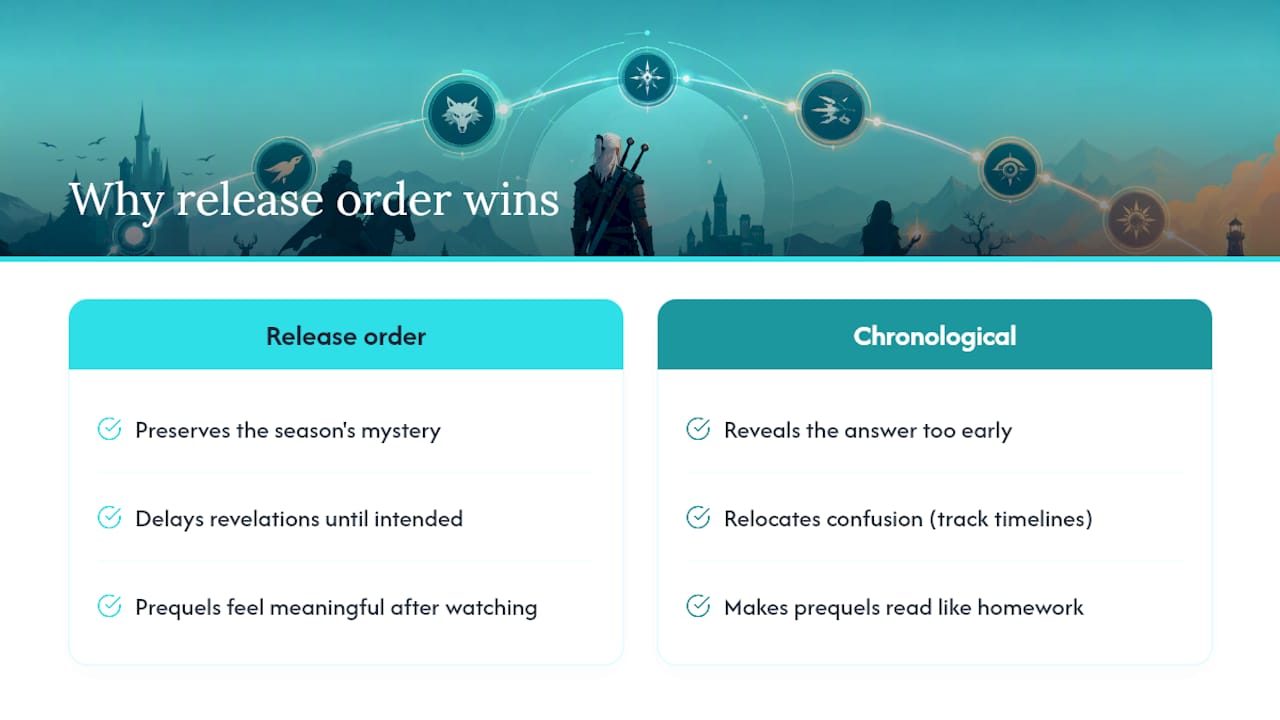
What people underestimate is that chronological order doesn’t actually save you from confusion, it just relocates it. You still have to track which timeline within Season 1 you’re watching once you’ve broken it into chronological chunks, so the “cleaner” order isn’t cleaner at all. It’s just differently confusing, and it costs you the reveal the writers spent an entire season building toward.
My honest read: chronological order is a rewatch tool, not a discovery tool. Save Blood Origin and Nightmare of the Wolf for after you know the characters they’re expanding on. That’s when a thousand years of prehistory actually means something, instead of reading like unrelated homework before the show you came to watch even starts.
— Christian
Sources
- The Witcher Books in Order: A Complete Series Timeline — IGN
- The Witcher Netflix Watch Order (Shows & Films) — BingeRun
- Where to watch The Witcher — EpicStream
- The Witcher season 4 review — Liam Hemsworth takes over as Geralt — Forbes