Nibbler's Shadow in the Very First Scene
WHERE TO LOOK · Applied Cryogenics office — the moment Fry's chair tips backward into the cryo-tube; watch the floor under the desk.

Two decodable alien ciphers, a real math theorem proved for one episode, and a shadow in the pilot that took four seasons to pay off.
1999 · Series · 11 seasons · Matt Groening, David X. Cohen
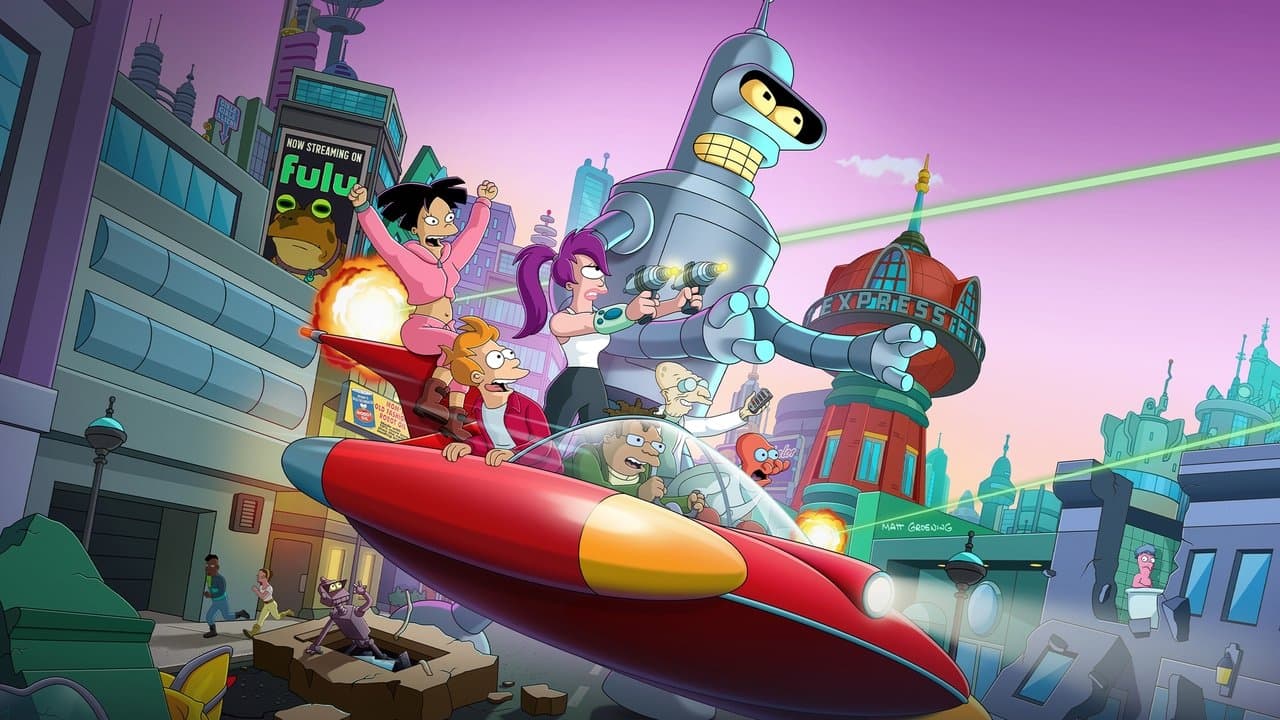
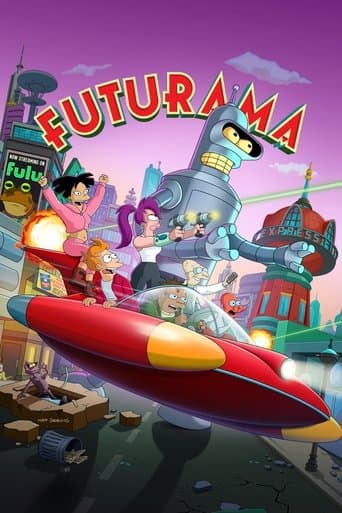
Futurama (1999) hides 15 catalogued easter eggs and hidden details, 8 of them confirmed by official sources. Standouts include alien language 2: the cipher built to beat the fans, the 'drink slurm' rosetta stone and 1729, the show's favorite number. Every entry below includes where to look, a spotting difficulty, and sources.
Futurama treated its audience like a puzzle to be beaten. The writers room was famously stacked with advanced degrees — Ken Keeler holds a PhD in applied mathematics, Jeff Westbrook a PhD in computer science — and they used that firepower to hide jokes most shows couldn't even attempt. The premiere seeded a full alien alphabet (Alienese) into background signs, complete with a deliberate Rosetta Stone: a "Drink Slurm" poster in plain English placed near its alien-script twin. Producer David X. Cohen says fans decoded the entire language within a couple of hours of the 1999 broadcast, so Westbrook built a second, far nastier cipher that took years to crack.
That arms race set the tone for everything else. Bender's apartment number is ASCII for a dollar sign. The Hardy-Ramanujan number 1729 stalks the series from Bender's family Xmas card to the hull of the Nimbus. And in "The Prisoner of Benda," Keeler didn't just write a mind-swap farce — he proved a brand-new group theory theorem to resolve the plot, then put the proof on screen.
The deepest egg of all hides in the very first scene of the very first episode: a small one-eyed shadow flickers behind Fry as he tips into the cryogenic tube, a plant that wouldn't pay off until season 4. Below are 15 of the show's best-documented hidden details — what they say, where to freeze-frame, and which ones the crew has confirmed on the record.
WHERE TO LOOK · Applied Cryogenics office — the moment Fry's chair tips backward into the cryo-tube; watch the floor under the desk.
WHERE TO LOOK · Compare the English Slurm ad early in the episode with the Alienese poster behind the bar where Fry and Bender meet; sewer-wall graffiti later in the episode.
The pilot quietly hands viewers the key to the show's first alien language. An ordinary English "Drink Slurm" ad appears early in the episode; later, when Fry and Bender sit at a bar, the same slogan hangs behind them written in Alienese. Comparing the two posters yields five letters of the substitution cipher — exactly as the writers intended. Producer David X. Cohen said fans "translated all of the alien language within a couple hours" of the premiere airing. Once cracked, the background of New New York became legible: sewer graffiti in the same episode reads "Venusians Go Home," and nearly every Alienese sign across the series decodes to a real gag in English.
WHERE TO LOOK · Leela's fate assignment officer paperwork/ID in the pilot; her apartment door number 1I in later episodes.
When Leela processes Fry at the Head Museum's fate assignment office in the pilot, her officer code reads 1BDI — say it out loud: "one beady eye." The show kept the ocular wordplay going for years: Leela's apartment door in later episodes is numbered 1I. It's a classic Futurama move — a throwaway alphanumeric string in the corner of the frame that turns out to be a fully formed joke about the character standing next to it.
WHERE TO LOOK · Crowd shots from the pilot onward — look for the bald man in a dark tunic with a white number 9.
WHERE TO LOOK · The door plate of Bender's apartment at Robot Arms Apts.
In "I, Roommate," Bender's apartment at Robot Arms Apts is numbered 00100100. Read that as an 8-bit binary ASCII code and you get 36 — the character code for the dollar sign, $. For a robot whose stated life goals are money, theft and more money, it's a perfect address. It also established a running trick the show would reuse: putting machine-readable jokes on screen and trusting that some fraction of the audience would actually sit down and decode them. (Fry's neighboring closet, for the record, gets no such honor.)
WHERE TO LOOK · On the surface of the garbage ball, as Bender scavenges through the trash.
When the crew lands on the giant 20th-century garbage ball threatening Earth in "A Big Piece of Garbage," Bender digs up a Bart Simpson doll that squawks "Eat my shorts!" — and Bender obliges, later belching "Mmm... shorts" in a perfect Homer cadence. It's an official crossover wink from Matt Groening's other universe, made fully canon-adjacent by the casting: Nancy Cartwright, Bart's actual voice actress, cameos to voice the doll. The garbage ball itself is a loving spoof of Armageddon, making this one dense little sequence of stacked references.
WHERE TO LOOK · Bender's card in Xmas Story (S2E4), the Nimbus hull number, Universe 1729 in The Farnsworth Parabox, and the taxicab in Bender's Big Score.
The Hardy-Ramanujan "taxicab" number 1729 — the smallest number expressible as the sum of two cubes in two different ways — haunts the series as a recurring tribute to mathematician Srinivasa Ramanujan. Bender's Xmas card in "Xmas Story" (S2E4) reveals he is son number 1729 of his Mom's robot brood; Zapp Brannigan's ship the Nimbus carries hull registry BP-1729; and "The Farnsworth Parabox" (S4E15) files a parallel reality away as Universe 1729. The bit even scales up: in Bender's Big Score, a taxicab bears the number 87539319 — the smallest number expressible as the sum of two positive cubes in three ways. The writers have openly discussed the gag as their in-house mathematician's calling card.
WHERE TO LOOK · Bender and Flexo compare serial numbers while getting drunk together at Planet Express.
In "The Lesser of Two Evils," Bender and his lookalike Flexo bond over the fact that both of their serial numbers are expressible as the sum of two cubes — and the joke is real math, not gibberish. Flexo's 3370318 equals 119³ + 119³, while Bender's 2716057 equals 952³ + (−951)³. Writer Ken Keeler, the staff's applied-mathematics PhD, worked out the numbers so the nerdiest viewers could verify the gag by hand; Simon Singh later documented it among the geekiest math jokes ever hidden in the show. Fry's baffled "...I don't get it" is the writers laughing at everyone who didn't bring a calculator.
WHERE TO LOOK · The supply closet at Planet Express — two binders on the shelf labeled P and NP.
Blink and you'll miss it in "Put Your Head on My Shoulders": inside a Planet Express closet sit two binders labeled simply P and NP. That's a sight gag about the P versus NP problem — the most famous open question in computer science, asking whether every problem whose answer can be quickly verified can also be quickly solved. The Clay Mathematics Institute has a standing $1,000,000 prize for a proof either way. Shelving the two classes side by side in a janitor's closet, unresolved, is about as dry as a joke can get — which is exactly why the show's computer-science-literate staff loved it.
WHERE TO LOOK · The theater marquee as the crew arrives to see All My Circuits: The Movie.
The cinema where the crew watches All My Circuits: The Movie in "Raging Bender" is signposted Loew's ℵ0-Plex — pronounced "aleph-null-plex." In set theory, ℵ0 (aleph-null) is the smallest infinite cardinal number, the size of the set of all counting numbers. So while a real-world multiplex brags about 16 or 30 screens, New New York's theater literally advertises a countably infinite number of them. It's a one-frame background sign that doubles as a set-theory lecture, and a favorite example when mathematicians write about the show's academic streak.
WHERE TO LOOK · The wall of Bender's inherited castle, then the mirror Bender looks into moments later.
In the Halloween-flavored episode "The Honking," Bender inherits a haunted castle where 0101100101 appears on the wall in blood. Bender scoffs that it's gibberish — then sees its reflection in a mirror, 1010011010, and screams. Decode the mirrored string from binary and you get 666, the Number of the Beast. The whole beat is a robot-native parody of the REDRUM/MURDER mirror reveal from The Shining, and it may be the only TV joke that requires the viewer to mentally reverse a bit string and convert from base 2 to land the punchline. IMDb's trivia page and multiple breakdowns have documented the math.
WHERE TO LOOK · Background signage from The Day the Earth Stood Stupid onward; AL2 glyphs look blockier than standard Alienese.
After fans demolished the show's first alien alphabet in hours, writer Jeff Westbrook — a former Yale computer science professor — engineered a second script (AL2) that debuted in "The Day the Earth Stood Stupid." Instead of a one-to-one substitution, AL2 is a variant autokey cipher: each glyph has a numeric value, and every letter is decoded from a running sum of the values before it, mod 26, so the same symbol means different letters in different positions. As Westbrook put it, "the next letter is given by the summation of all of the previous letters plus the current letter... mod 26." Determined fans still cracked it, a feat Westbrook saluted on DVD commentary, and the complete key was finally hidden as a disc easter egg on Bender's Big Score — whose obelisks Westbrook described as "Rosetta Stones for the two alien languages."
WHERE TO LOOK · The bottles on the table while Fry, Leela and Bender brew and drink beer.
The beer the crew drinks in "The Route of All Evil" is branded Klein's, and the glass container it comes in is shaped like a Klein bottle — the famous non-orientable surface described by mathematician Felix Klein, a closed shape with no distinct inside or outside. A Klein bottle can't actually exist in three dimensions without passing through itself, which raises delightful questions about how one would ever pour from it, let alone keep beer carbonated in a container whose inside is its outside. It's a top-shelf example of Futurama hiding a topology lecture inside a background prop.
WHERE TO LOOK · The nightclub's neon sign as the crew arrives to celebrate their survival.
The nightclub the crew visits in the season 6 opener "Rebirth" is called Studio 1²2¹3³. Do the arithmetic — 1² is 1, 2¹ is 2, 3³ is 27 — multiply them together and you get 54: the club is a 31st-century reincarnation of Studio 54, Manhattan's legendary disco. It's the Futurama formula in miniature: take a pop-culture reference any show could make, then encrypt it behind just enough math that spotting it feels like solving something. The sign is on screen for only a few seconds, which is why this one routinely tops "details you missed" lists.
WHERE TO LOOK · The blackboard proof during the Harlem Globetrotters' climactic body-swap solution.
"The Prisoner of Benda" runs on a mind-swapping machine that can never swap the same two bodies twice — a constraint that threatens to strand everyone's brain permanently. To resolve it, writer Ken Keeler (PhD in applied mathematics, Harvard) proved an actual, novel group theory result: no matter how tangled the swaps get, everyone can be restored using at most two fresh helpers who haven't swapped before. The proof, now known as the Futurama theorem or Keeler's theorem, appears on the blackboard the Globetrotters use in the episode's climax, and it's widely cited as the first mathematical theorem created specifically for a television show. Mathematicians have since published generalizations of it.
We track 15 major documented easter eggs across Futurama, 8 of them confirmed by the creators on commentary tracks or in interviews. They range from the pilot's decodable Alienese signs and Nibbler's hidden shadow to the ASCII joke in Bender's apartment number and the group theory theorem Ken Keeler proved for "The Prisoner of Benda." Counting every background Alienese sign and math gag individually, the true total runs well into the hundreds.
Almost every Alienese sign decodes to a real English gag. The first language is a simple substitution cipher the pilot deliberately taught viewers via matching English and Alienese "Drink Slurm" posters — producer David X. Cohen says fans translated the whole alphabet within a couple of hours of broadcast. Decoded messages include "Venusians Go Home" sewer graffiti in the pilot and hundreds of background jokes across the series.
Yes. The one-eyed shadow that appears as Fry falls into the cryogenic tube was in the original March 28, 1999 broadcast of "Space Pilot 3000" — fans have verified this against original airings after years of debate. David X. Cohen has said the conspiracy behind Fry's freezing was planned from the show's conception, and the plant paid off four seasons later in "The Why of Fry," which reveals Nibbler pushed Fry into the freezer.
Yes. For season 6's "The Prisoner of Benda," staff writer Ken Keeler — who holds a PhD in applied mathematics from Harvard — proved a genuine group theory result showing any tangle of mind swaps can be undone with at most two additional people. Known as the Futurama theorem or Keeler's theorem, the proof appears on screen on the Globetrotters' blackboard and is considered the first theorem created specifically for a TV episode.
1729 is the Hardy-Ramanujan "taxicab" number — the smallest number expressible as the sum of two cubes in two different ways, made famous by an anecdote about mathematician Srinivasa Ramanujan. Futurama's math-PhD writers planted it repeatedly: Bender is his Mom's 1729th son in "Xmas Story," the Nimbus hull reads BP-1729, a parallel universe is labeled 1729, and Bender's Big Score features taxicab 87539319 — a three-way sum of cubes.
Last updated 2026-07-08 · Spotted something we missed? Tell us.