20 Dune Easter Eggs Confirmed by Production and Weta
This article lists the confirmed Easter eggs and subtle references across Denis Villeneuve’s Dune films and recent trailers, sourced from The Art and Soul of Dune: Part Two, designer interviews, and verified craft reporting. Consider this your spoiler-flagged rewatch companion. Every entry below is either confirmed by production sources or clearly labeled as speculation, so you know exactly what you’re looking at, cross-checked against the kind of timestamped verification Thethingsyoumissed builds its whole database around.
TL;DR:
- Chani’s blue scarf signifies her falling in love and serves as a visual cue in the monochrome desert setting, highlighting her emotional state before dialogue.
- The blue eyes of Paul and Chani develop gradually through spice exposure, representing their transformation and increasing prescience across both films.
- The design of Giedi Prime’s black sun and the Giedi Prime’s infrared color grading symbolize the planet’s cruelty and set a stark contrast to Arrakis’s desert environment.
- Key visual motifs, like repeated shots and temple set fingerprints, encode themes of inheritance, prophecy, and the human connection to sacred spaces.
- Trailer visuals hint at Dune Messiah elements such as ghola imagery and blindness, but these remain unconfirmed and speculative until the next film’s release.
Table of Contents
- What Are the Confirmed Dune Easter Eggs Fans Keep Finding?
- What Does the Dune: Part Three Trailer Hint At?
- Why the Book Connections Change How You Read These Easter Eggs
- What Production Choices Created the Film’s Hidden Meanings?
- How We Verified These Easter Eggs
- Are There Hidden Audio Cues in the Dune Soundtrack?
- What Costume and Prop Details Reference the Wider Dune Universe?
- How Do the Films Encode Dune’s Religious and Philosophical Themes?
- Does Dune (2021) Nod to Earlier Adaptations?
- Are There Hidden Symbols Buried in the CGI Sequences?
- What These Easter Eggs Add Up To on a Rewatch
- Where to Catch Every Dune Easter Egg in Full Detail
- Sources
- FAQ
What Are the Confirmed Dune Easter Eggs Fans Keep Finding?
Villeneuve’s Dune films reward the kind of viewer who pauses on a costume seam or catches a repeated camera angle two hours apart. Here are the confirmed, sourced hidden details across Dune (2021) and Dune: Part Two, organized so you can rewatch with a checklist in hand.
1. Chani’s blue nezhoni scarf. In Dune: Part Two, Chani wears a piece of blue fabric knotted at her head. Villeneuve confirmed in The Art and Soul of Dune: Part Two that the blue scarf signals that a Fremen woman has fallen in love. The color choice is not incidental. Arrakis is shot in a punishing, near-monochrome palette of sand and bone, so a single strip of blue reads as a visual flare gun, telling the audience Chani’s feelings before she says a word.
2. The Eyes of Ibad. Both Paul and Chani develop solid blue eyes after prolonged spice exposure, a condition Herbert’s books call the Eyes of Ibad. The film treats this less as a cosmetic detail and more as a slow-burn transformation, tracking Paul’s growing entanglement with prescience and the spice that fuels it. Watch how the blue deepens across both films rather than appearing all at once.
3. Muad’Dib and the desert mouse. Paul takes the Fremen name Muad’Dib, Fremen for the kangaroo mouse native to Arrakis. Stilgar explains the creature “makes his own water” and knows how to survive where nothing should. Naming Paul after an animal built for desert endurance is the film’s shorthand for what he is about to become, and it works whether or not you know the book’s zoology.
4. Irulan’s metallic headpieces. Princess Irulan’s severe, armor-like headdresses were designed with religious authority in mind. Costume designer Jacqueline West said the pieces were built to evoke a Virgin Mary-esque silhouette, drawing on the shape of nun habits without pushing Irulan into full Bene Gesserit black. It positions her as imperial and devotional at once, caught between two power structures.
5. The Cave of Birds “fingerprint” set design. The rock formations inside the Fremen’s sacred cave were sculpted with ridges resembling a fingerprint, a subtle design choice that ties the sietch’s sacred geography to something intimate and human, almost as if the desert itself carries a signature.
6. Giedi Prime’s black sun. The Harkonnen homeworld is shown under a black sun, filmed in infrared to strip out color entirely. It is one of the boldest visual swings in either film, and it reframes House Harkonnen’s world as a photographic negative of Arrakis, cruelty rendered in stark monochrome rather than desert gold.
7. Fireworks like “ink dropped into alcohol.” The fireworks displays over Giedi Prime during Feyd-Rautha’s arena sequence were designed to move like ink spreading through liquid, a detail confirmed in behind-the-scenes production materials. The effect gives the celebration a queasy, spreading menace instead of festive spectacle.
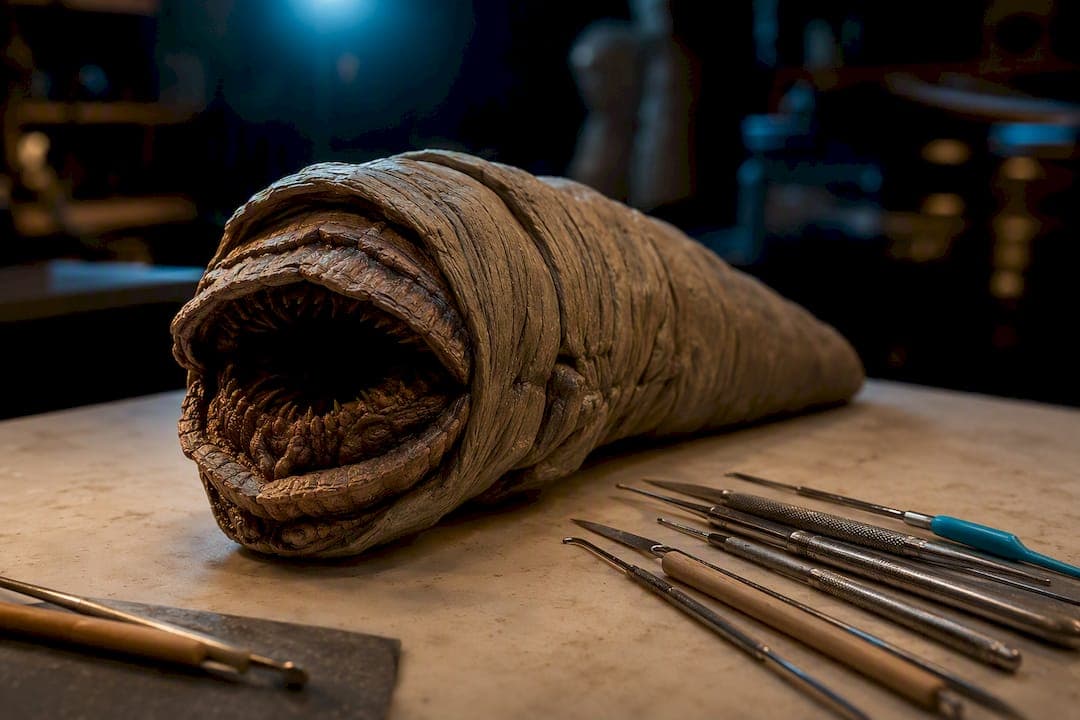
8. The baby sandworm puppet. Inside the Maker’s Temple, the smaller sandworm seen up close was built as a practical puppet rather than a pure CGI creation. Weta Workshop’s project documentation confirms the team built physical puppetry into the creature work, which is why the texture holds up so well in tight shots. It grounds the film’s biggest creature in something a camera could actually touch.
9. Sardaukar sword design. The Emperor’s elite soldiers carry blades styled after Excalibur and Templar-era swords, a deliberate choice from the same Weta Workshop credits behind the sandworm puppetry. It threads a medieval, almost crusading aesthetic through the Sardaukar that separates them visually from every other faction’s weapons.
10. Gurney Halleck’s baliset. Gurney’s stringed instrument, the baliset, is a direct pull from Herbert’s text, where Gurney is as much a troubadour as a warmaster. The films keep this contradiction intact: a man who sings ballads and also trains the Atreides heir in knife work.
11. Duncan and Gurney’s physical gestures. Jason Momoa built a personal beat into Duncan Idaho’s final stand, touching his hand to his heart and then his head. Momoa has said this was a nod to his own son and drew on Kali martial arts techniques passed down in his family, folding a real personal gesture into a scripted death scene.
12. Echo shots between Part One and Part Two. Several compositions repeat deliberately across the two films: a hand entering the Gom Jabbar box, a voice command that controls another person’s body, a close-up on Paul’s face lit the same way in different emotional states. These visual rhymes are Villeneuve’s way of showing how much Paul has changed while framing him identically.
13. Shifting flag and banner imagery. The political symbols carried into Paul’s visions versus what appears on the actual battlefield differ subtly, a choice that underlines the gap between prophecy and lived history. Pay attention to which banners appear only in Paul’s prescient flashes.
14. Water-of-Life vision callbacks. Jessica’s Water-of-Life ordeal in the first film visually rhymes with Paul’s own ordeal in the second, same camera language, same disorienting color shift, reinforcing that mother and son are walking the same terrifying threshold, just years apart.
15. Pyramid framing in the Imperial Tent. The Emperor’s tent interiors are shot with strong pyramidal composition lines, a quiet visual echo of imperial and religious architecture that reinforces Shaddam’s claim to divine authority without a single line of dialogue.
16. The real partial solar eclipse. During production, the crew captured a real partial solar eclipse and composited it with a second synthetic moon to preserve Arrakis’s signature double-moon sky. The Art and Soul of Dune: Part Two documents the crew witnessing this eclipse on October 25, 2022, turning an accidental celestial event into a permanent piece of the film’s visual identity.
17. Anya Taylor-Joy’s Alia cameo. Villeneuve confirmed he deliberately kept Anya Taylor-Joy’s casting a secret, filming her brief appearance with a small special unit to prevent leaks ahead of release. He has described the reveal as a gift to fans who track casting news closely.
18. Jessica’s costume palette shift. Jessica’s wardrobe moves from Atreides earth tones toward the stark black associated with the Bene Gesserit as her allegiance and influence over Paul deepen, a visual cue the production intentionally built into her costume arc across both films.
19. The stillsuit design logic. Every stillsuit variant on screen, Fremen, Atreides, or Imperial, differs slightly in tubing and paneling, signaling technological access and cultural adaptation to the desert rather than just costume variety for its own sake.
20. Feyd-Rautha’s arena entrance. The bald, colorless presentation of Feyd-Rautha’s introduction on Giedi Prime deliberately isolates him from every other character’s color palette in the film, marking House Harkonnen’s heir as something closer to a blade than a person.
What Does the Dune: Part Three Trailer Hint At?
Trailer footage mixes confirmed shots with plenty of room for theory, and the gap between what is visible and what reporting has verified matters here. A few things stand out:
- Hayt/ghola imagery. Early Part Three footage includes visual cues associated with the ghola concept from Dune Messiah, a resurrected servant built from a dead man’s flesh and reconditioned memory. If the trailer is drawing from that book, expect a very different kind of Duncan Idaho.
- Spacing Guild tank visuals. Shots evoking Guild Navigators and Edric’s spice-saturated tank point toward the prescience-clouding mechanics that dominate the political chess of Messiah, where the Guild’s blind spots become a plot weapon.
- Chani with children. Footage suggesting Chani with young children raises real narrative stakes, but which children and under what circumstances remains unconfirmed. Treat this as likely, not settled.
- Blind Paul imagery. Shots implying Paul has lost his sight echo one of the most striking turns in Herbert’s Messiah, though how faithfully the film will follow that beat is still speculative.
- Reporting on the trailer has been careful to separate confirmed frames from theory-driven interpretation, and this article follows the same rule: what you see in the frame is fact, what it means for the plot is still a working theory.
Why the Book Connections Change How You Read These Easter Eggs
Herbert built Dune’s mythology out of real linguistic and cultural fragments, and the films lean on that groundwork rather than inventing their own symbolism from scratch.
- Lisan al Gaib combines Arabic roots: “Lisan” means tongue, and “al Gaib” means the hidden or unseen. Put together, the phrase functions as “the voice from the outer world”, a messianic title the Bene Gesserit planted among the Fremen generations before Paul ever set foot on Arrakis.
- Muad’Dib’s mouse origin isn’t decoration. Herbert chose an animal that survives the desert on its own terms, small, adaptive, and nearly impossible to eradicate, as a symbolic preview of what Paul becomes: someone the Empire cannot simply stamp out.
- House Atreides carries a name lifted straight from Greek myth. Atreides literally translates to son of Atreus, the doomed royal house behind Agamemnon and a family history soaked in prophecy, betrayal, and inherited curses. Herbert wasn’t being subtle; he wanted readers to feel the weight of Greek tragedy sitting on Paul’s shoulders before the story even begins.
- The films compress and reorder several book chronology beats, particularly around how quickly Paul’s prescience develops and how the Harkonnen retaking of Arrakis unfolds, choices made for pacing rather than fidelity.
Pro Tip: Reread the “Lisan al Gaib” chants during Paul’s Fremen integration scenes with the Greek root of Atreides in mind. Villeneuve is stacking two entirely different mythologies, Middle Eastern prophecy and Greek tragedy, onto one character, and once you see both layers, the political maneuvering around Paul reads very differently.
What Production Choices Created the Film’s Hidden Meanings?
Craft decisions on Dune weren’t just aesthetic. Several were built specifically to encode meaning fans could uncover on rewatch.
- The baby sandworm inside the Maker’s Temple was built as a physical puppet, a choice from Weta Workshop’s effects team that gave the creature weight and texture no pure CGI shot could replicate.
- Jacqueline West’s Irulan headdresses were engineered around a nun-habit silhouette specifically to suggest religious gravity without borrowing Bene Gesserit black.
- The Sardaukar’s Excalibur and Templar-inspired swords come from the same prop design lineage as the creature effects, giving the Emperor’s soldiers a crusader-era menace distinct from every other faction.
- The Cave of Birds set carries deliberately sculpted fingerprint ridges, a set decision meant to humanize a sacred, alien space.
- Production designer Patrice Vermette and prop master Doug Harlocker are credited with several of these choices, part of a broader design language documented across Weta Workshop’s Dune: Part Two project pages.
Pro Tip: Pause on any scene inside the Maker’s Temple. The puppet work holds up far better in stillness than in motion, and it’s the clearest place to see practical effects doing work CGI usually claims credit for.
How We Verified These Easter Eggs
Every entry above is checked against primary production sources: The Art and Soul of Dune: Part Two, on-record interviews with Denis Villeneuve, Patrice Vermette, and Jacqueline West, and craft-side documentation from Weta Workshop’s prop and effects credits. Thethingsyoumissed cross-references these against its own timestamped movies database before publishing, flagging anything unconfirmed as speculation rather than fact. This entry was compiled by Christian.
Are There Hidden Audio Cues in the Dune Soundtrack?
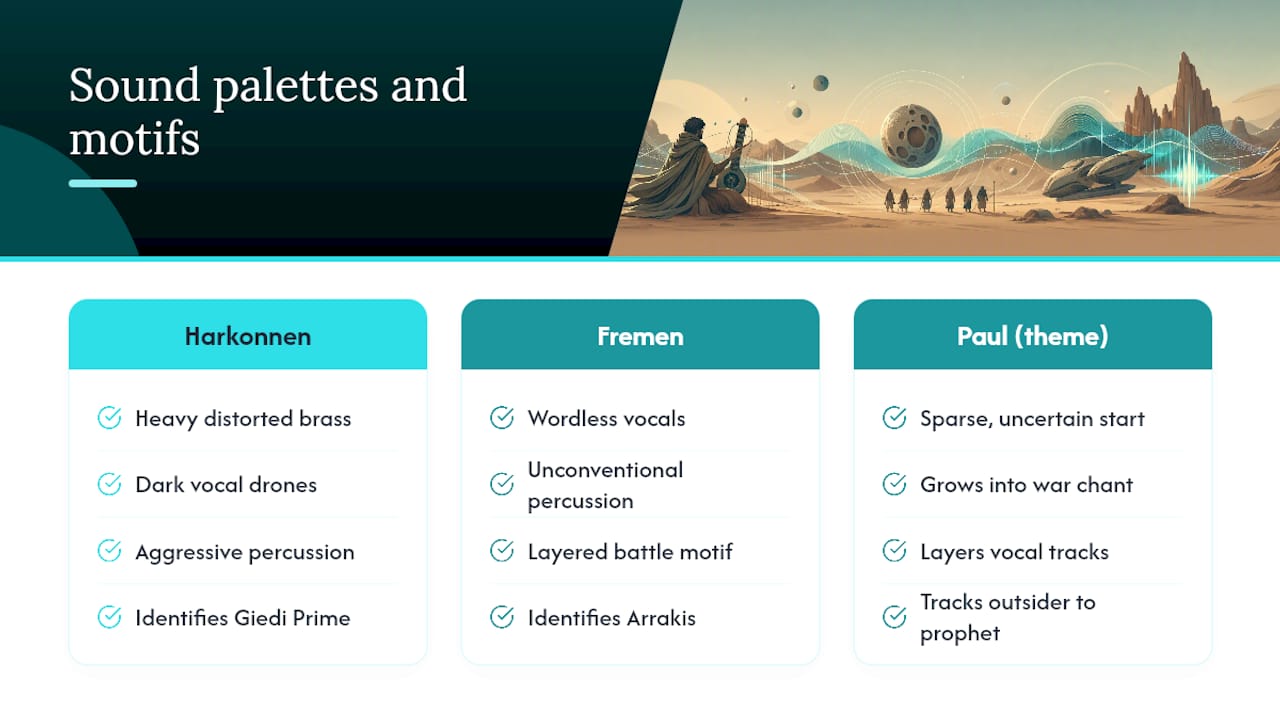
Hans Zimmer’s score works less like background music and more like a character map. Certain vocal drones and instrument choices attach to specific factions rather than scenes, so the Harkonnen sequences carry a heavier, distorted brass presence while Fremen scenes lean on wordless vocals and percussion built from unconventional instruments Zimmer commissioned specifically for this world. Paul’s theme evolves noticeably between the two films, starting sparse and uncertain in Dune (2021) and thickening into something closer to a war chant by the back half of Part Two, tracking his transformation from outsider to prophet in the score alone.
Listen for the moment the Fremen battle cry motif first appears versus how it returns during Paul’s final Lisan al Gaib declaration. The instrumentation swells with layered vocal tracks that weren’t present earlier in the film, a musical cue that mirrors the visual escalation happening on screen. Zimmer has spoken in interviews about designing distinct sonic palettes for Arrakis, Caladan, and Giedi Prime so that even with your eyes closed, you’d know which world a scene belongs to. That’s a soundtrack Easter egg most viewers feel without ever consciously naming it.
What Costume and Prop Details Reference the Wider Dune Universe?
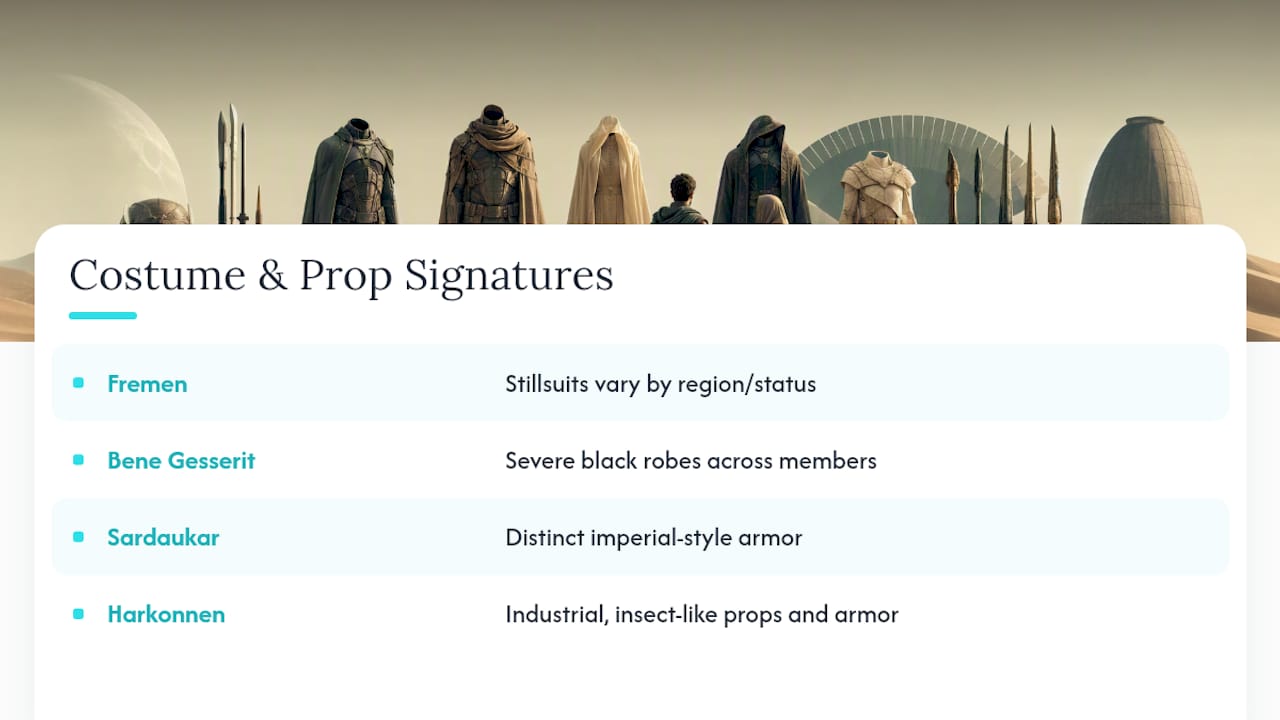
Costume work across both films encodes faction identity down to fabric choice. Fremen stillsuits vary by region and status, with visible differences between Sietch Tabr’s suits and those worn by more remote desert communities, a detail suggesting the extended Fremen culture is not monolithic even though the films can only show a slice of it. Bene Gesserit robes use a severe black silhouette that recurs across Jessica, the Reverend Mother, and eventually Irulan’s transitional wardrobe, a deliberate visual shorthand for encroaching Sisterhood influence.
Sardaukar armor incorporates design elements distinct from both Atreides and Harkonnen aesthetics, built to suggest an imperial military culture that answers to no house, only the throne. Harkonnen prop design, meanwhile, favors industrial, insect-like shapes, visible in everything from Rabban’s armor to the arena structures on Giedi Prime, reinforcing the house’s identity as something mechanized and predatory rather than noble. None of this is spelled out in dialogue. It’s built into the objects characters carry and wear, which is exactly the kind of detail a scene-by-scene rewatch tends to surface.
How Do the Films Encode Dune’s Religious and Philosophical Themes?
Dune’s central tension, between manufactured prophecy and genuine faith, shows up visually as often as it does in dialogue. The recurring motif of eyes, the Eyes of Ibad, the Reverend Mother’s piercing stare, Paul’s growing prescient gaze, ties directly to the story’s obsession with sight versus blindness, seeing the future versus being blinded by it. Water imagery carries a parallel religious weight: on Arrakis, water is currency, sacrament, and mourning ritual all at once, and the films consistently frame Water-of-Life sequences with the visual language of baptism.
The Bene Gesserit’s manipulation of the Lisan al Gaib prophecy is staged so the audience always sees the machinery behind the miracle, crowds chanting a name that was planted among them generations earlier by design. That’s Herbert’s core argument dramatized in a single image: charismatic religious movements can be engineered, and Villeneuve keeps the camera close enough to Paul’s discomfort that you feel the cost of stepping into a prophecy he didn’t choose but chose to use anyway.
Does Dune (2021) Nod to Earlier Adaptations?
Villeneuve has been vocal about respecting David Lynch’s 1984 Dune and the 2000 Sci-Fi Channel miniseries while charting a different visual path entirely. Rather than direct homage shots, the connective tissue is mostly structural: both prior adaptations wrestled with how to visualize the Guild Navigators and prescience, and Villeneuve’s choice to keep Guild imagery abstract and unsettling in Part Three trailer footage reads as an answer to decades of adaptations struggling with the same design problem.
Some fans have pointed to small compositional echoes, a framing choice here, a color choice there, as possible nods to Lynch’s more surreal visual instincts, though none of these are confirmed by production sources as intentional homage. What is confirmed is Villeneuve’s stated respect for the earlier work even while pursuing a grounded, less baroque aesthetic, a philosophy that shapes nearly every design decision across both of his films.
Are There Hidden Symbols Buried in the CGI Sequences?
The sandworm sequences carry more digital craftsmanship than most viewers register on a first watch. Worm skin texture was built to shift subtly depending on the creature’s size and age, with smaller worms carrying rougher, less defined scarring than the massive Shai-Hulud that appears in the climactic ride sequence, a digital continuity detail meant to suggest worms age and scar over centuries. The spice-infused atmospheric effects during vision sequences use a particle system distinct from the film’s other CGI work, giving Paul’s prescient flashes a grainy, almost photographic quality that separates them visually from ordinary scenes.
Giedi Prime’s black-sun cinematography required extensive digital grading to preserve detail in near-total infrared contrast, a technical solution that doubles as a storytelling device: it’s harder to read faces on Giedi Prime, and that visual difficulty mirrors how hard it is to read Harkonnen intentions. None of this is a literal hidden image tucked into a frame, but it’s digital craftsmanship functioning as narrative code, which is arguably a more sophisticated Easter egg than a simple hidden logo.
What These Easter Eggs Add Up To on a Rewatch
The pattern across all of this is consistency: color, sound, and prop design aren’t decoration in these films, they’re argument. Rewatch the Water-of-Life sequences back to back, Jessica’s and Paul’s, and watch how identical camera language turns a family bond into something closer to inheritance and warning. That single comparison tells you more about this saga’s real subject than any single Easter egg on its own.
— Christian
Where to Catch Every Dune Easter Egg in Full Detail
Reading about these details is one thing. Catching them yourself, mid-rewatch, with exact scene context, is another. A searchable catalog offers timestamped entries for hidden details across film and television, sometimes verified against production sources and organized so users can browse spoiler-safe if they’re not ready for certain reveals yet.

The site’s movies landing page covers Dune alongside other franchises with the same scene-by-scene approach, and the franchise-level pages let you jump between entire universes if Dune sends you chasing similar detail-hunting elsewhere. If you want a sense of the format’s depth, the site’s Star Wars franchise coverage shows how far a single universe’s Easter eggs can go when properly cataloged. Sign up for the weekly newsletter to get new verified entries as they’re added, and check the most confirmed Easter eggs page if you want to start with the highest-certainty finds across the whole database.
Sources
- What Does Chani’s Blue Scarf Represent in Dune 2?
- Dune: Part Two — Weta Workshop project page
- Denis Villeneuve Explains Anya Taylor-Joy’s ‘Dune 2’ Casting Secret
- 5 things we learned from ‘The Art and Soul of Dune: Part 2’ | Mashable
FAQ
Why Was Zendaya Reportedly Upset About the Dune 2 Ending?
Reports around the Part Two press cycle suggested Zendaya felt Chani’s arc was underused relative to her prominence in marketing, since Chani spends the film’s final act in opposition to Paul’s messianic rise rather than beside him.
Why Did David Lynch Dislike His Dune Adaptation?
Lynch has said publicly that studio-mandated cuts and a compressed runtime for his 1984 Dune left the final film far from his creative vision, and he has largely disowned the theatrical release as a result.
Is Dune Considered a Politically Charged Film?
Dune engages directly with colonialism, resource extraction, and the danger of manufactured messiah narratives, themes Herbert built into the books decades before “woke” became a modern shorthand; the films dramatize these ideas rather than avoid them.
Why Do the Harkonnens Wear Heavy, Industrial Suits?
Harkonnen costume and armor design leans into cold, insect-like industrial shapes to visually separate the house from the Atreides’ earth tones and the Fremen’s practical stillsuits, reinforcing their identity as mechanized and predatory within the film’s costume language.
Are There Confirmed Easter Eggs in the Dune: Part Three Trailer?
Some trailer imagery, including Guild tank visuals and blind-Paul shots, points toward Dune Messiah elements, but reporting treats these as strong theories rather than fully confirmed plot details until the film’s release.