Rewatch Interstellar with Timestamps: Production Confirmed Easter Eggs

The strongest Interstellar Easter eggs cluster around four systems Christopher Nolan built into the film on purpose: Murph’s coded bookshelf, the robot names, the ticking sound that clocks time dilation, and the tesseract’s watch message. Production interviews confirm none of this was accidental set dressing. This guide gives you the scene cues and sourcing behind each one, so your next rewatch actually lands differently.
TL;DR:
- The bookshelf in Murph’s childhood room contains specific titles like Flatland and Borges volumes that symbolize key film themes of higher dimensions and recursive time.
- The robot names TARS, CASE, and KIPP are designed as functional hardware rather than humanoids, reflecting a deliberate choice aligned with military and engineering principles.
- The ticking sound on Miller’s planet is a synchronized clock that maps Earth’s years to minutes passed on the water world, with each tick roughly 1.25 seconds apart.
- The film’s hidden details, such as Murph’s watch Morse code and the placement of the wormhole near Saturn, are confirmed by sources and intended as thematic and visual clues.
- Practical effects, including real cornfield crops and puppeteered robots, reinforce Nolan’s commitment to tangible visuals rather than CGI trickery.
Table of Contents
- What Are the Best Interstellar Easter Eggs to Catch on Rewatch?
- Murph’s Bookshelf: What the Books Actually Signal
- The Robots’ Names Hide a Design Philosophy
- The Ticking Clock on Miller’s Planet
- The Tesseract, the Watch, and the Loop That Saves Everyone
- Cast and Crew Details Hiding in the Background
- Christian’s Perspective: Why Timestamped Verification Changes How You Watch
- Find the Full Timestamped Breakdown
- Sources
- FAQ
What Are the Best Interstellar Easter Eggs to Catch on Rewatch?
Every one of these rewards a second or third viewing, and most connect to something Nolan or his production team confirmed on record. Here’s the rewatch checklist, ranked by how much they change your read of the film.
-
Murph’s bookshelf spells out the film’s whole thesis. Look closely during Cooper’s farewell scene and later ghost visits. The visible spines (Flatland, apocalyptic fiction, Borges-adjacent volumes) aren’t random production dressing. Wired’s breakdown of the bookshelf documents the specific titles and ties them to the film’s dimensional and time themes.
-
TARS and CASE were never meant to look human. Watch their boxy, articulated movement in the ranger cockpit scenes. Jonathan and Christopher Nolan deliberately avoided humanoid robot design so the machines would feel functional, not decorative.
-
KIPP’s name hides a direct tribute. The lunar rover robot lost in the mission that killed Cooper’s crewmate carries initials that fan communities have long connected to physicist Kip Thorne, the film’s science consultant.
-
The ticking on Miller’s planet is a literal clock. Analysts have timed the faint background tick at roughly 1.25-second intervals, a deliberate audio cue mapping the crew’s minutes to years passing on Earth.
-
There’s no wildlife anywhere in the film’s Earth scenes. No birds, no insects in frame, no livestock beyond the corn. That absence is environmental shorthand for a dying planet, reinforced in the Hollywood Reporter’s roundtable on the film’s Dust Bowl inspiration.
-
Cooper’s name is a quiet reveal, not a coincidence. “Cooper Station,” the space habitat Murph builds decades later, is named for her father before the film confirms why. Rewatch the reveal scene for the exact framing.
-
Flatland isn’t just a book title. It’s the visual key to the tesseract. The 1884 novella about a two-dimensional being perceiving a third dimension mirrors exactly what Cooper experiences inside the tesseract.
-
The wormhole sits next to Saturn on purpose. Stanley Kubrick’s original script for 2001: A Space Odyssey placed the monolith near Saturn before technical limits forced a change to Jupiter. Nolan’s placement of the wormhole restores that original idea, made possible by CGI Kubrick never had.
-
The watch face carries the film’s actual climax. Cooper’s Morse code tapping on the second hand of Murph’s watch, visible in close-up during the tesseract sequence, is the mechanism that saves humanity. Watch her hand trembling as she counts the ticks.
-
The robots you see are physical, not rendered. CNET’s reporting confirms TARS and CASE were built as real puppeteered models on set, which is why their weight and movement read as tangible rather than animated.
-
The cornfields were real crops, grown for the shoot. Nolan planted actual corn for the Kansas-style farm scenes rather than faking it digitally, part of a broader commitment to practical effects documented in the same Hollywood Reporter interview.
-
A throwaway line about “staying” foreshadows the ending. Early dialogue about someone needing to stay behind gets a quiet payoff once you know Cooper’s tesseract fate. It only clicks once you’ve seen the full arc.
Murph’s Bookshelf: What the Books Actually Signal
Nolan didn’t hand set decorators a random pile of hardcovers. The bookshelf in Murph’s childhood bedroom functions as a coded index to the film’s ideas, and Wired’s title-by-title breakdown is the most complete public accounting of what’s actually visible.
- Flatland appears prominently and does the heaviest thematic lifting. Edwin Abbott’s 1884 novella imagines a two-dimensional creature struggling to perceive a third dimension. That’s precisely Cooper’s predicament inside the tesseract, watching a fourth or fifth dimension he can barely process.
- The Stand and other apocalyptic titles underline the ecological collapse driving the plot before a single line of dialogue explains the blight.
- The Wasp Factory, Iain Banks’s unsettling debut novel, sits among the visible spines and adds a darker undertone to the coming-of-age material.
- Borges-adjacent volumes reinforce the idea of infinite libraries and recursive time, themes that echo the tesseract’s “infinite rooms” visual.
The books aren’t Easter eggs in the trivia sense. They’re a reading list for the movie you’re already watching.
The Robots’ Names Hide a Design Philosophy
TARS, CASE, and KIPP aren’t just cute acronyms. Their design reflects a specific choice Nolan made early: robots that function like military hardware rather than science-fiction companions.
- KIPP’s initials track closely to Kip Thorne, the theoretical physicist whose wormhole and black hole research shaped the film’s science.
- TARS and CASE were built as boxy, articulated units rather than anthropomorphic figures, a decision rooted in Mies van der Rohe’s functionalist design principles rather than typical movie-robot aesthetics.
- Bill Irwin puppeteered and voiced TARS on set, feeding lines live to Matthew McConaughey, which is why the banter between them lands with real comic timing instead of post-dubbed flatness.
Pro Tip: Watch TARS’s movement during the docking sequence with Endurance. That tumbling, gymnastic motion was performed by a puppeteer in real time, not animated frame by frame.
The Ticking Clock on Miller’s Planet
The faint ticking sound layered under dialogue on Miller’s planet isn’t ambient noise. It’s a literal countdown. Analysis of the scene has clocked the interval at roughly 1.25 seconds between ticks, a rate that maps directly onto the film’s math: every hour there equals roughly seven years back on Earth.
That’s why the sound design matters more than it seems. Each tick you hear during the crew’s brief water-planet mission symbolizes the passage of extensive time Romilly experiences alone on Endurance.

Pro Tip: Put on headphones for this scene specifically. The tick sits low in the mix and disappears on typical laptop speakers.
The Tesseract, the Watch, and the Loop That Saves Everyone
Cooper’s tesseract sequence is the film’s most confusing stretch on a first watch and its most rewarding on a second one, once you can track the mechanics step by step.
- Cooper enters the tesseract, a five-dimensional construct built by future humans, and initially tries to physically stop Murph’s younger self from leaving the room, an act the film shows fails.
- He shifts strategy and starts manipulating gravity, knocking books off Murph’s shelf in a pattern she later reads as coordinates to NASA.
- He finishes by tapping Morse code into the second hand of the watch he gave her, encoding the exact data (Dr. Brand’s gravity equation) she needs decades later.
Production designer Nathan Crowley built much of the tesseract sequence as a physical set rather than a pure digital environment. In an interview about the film’s design, Crowley described combining large practical structures with projected textures and digital extensions to give McConaughey something tangible to move through.
The loop only works because it’s self-consistent: “they,” the future humans who built the tesseract, are humanity itself after it survives. Cooper isn’t receiving help from aliens. He’s receiving help from the species he’s trying to save, closing the causal loop from the inside.
Cast and Crew Details Hiding in the Background
Beyond the props and dialogue, Interstellar carries a handful of quieter cameo and crew-level details that reward attention on repeat viewings.
Matt Damon’s appearance as Dr. Mann was kept out of marketing and trailers entirely, a deliberate choice that let his character’s reveal function as a genuine twist rather than a known cameo, unusual for an actor of his profile in 2014. William Devane and other veteran character actors fill out the NASA panel scenes with almost no fanfare, giving those sequences a documentary weight that a flashier casting choice would have undercut.
Behind the camera, Hans Zimmer composed the score before seeing a full script, working instead from a single page Nolan handed him describing a father’s relationship with his child. That origin explains why the organ-driven score feels emotionally attached to Cooper and Murph specifically, rather than to the space visuals audiences typically associate with the film’s marketing. The Hollywood Reporter’s production roundtable also notes that several crew members with long-standing ties to Nolan, going back to earlier films, worked on Interstellar’s physical sets, part of a consistent in-house team Nolan has relied on across multiple productions rather than a rotating outsourced crew.
None of these are hidden in the frame the way the bookshelf or the watch are. They’re hidden in the credits and the choices nobody advertised.

Christian’s Perspective: Why Timestamped Verification Changes How You Watch
What surprised me most in tracking these down wasn’t the number of details. It was how many trace back to a named production source rather than fan speculation. That distinction is the whole point of watching with sourced timestamps instead of forum folklore. Next viewing, mute everything but the sound design during the Miller’s planet sequence and just listen for that tick.
— Christian
Find the Full Timestamped Breakdown
Reading about these details is one thing. Catching them yourself on your next watch is another, and that’s what some detailed movie databases aim to help with. Entries in such catalogs are often timestamped and sourced to guide viewers on spotting hidden elements.
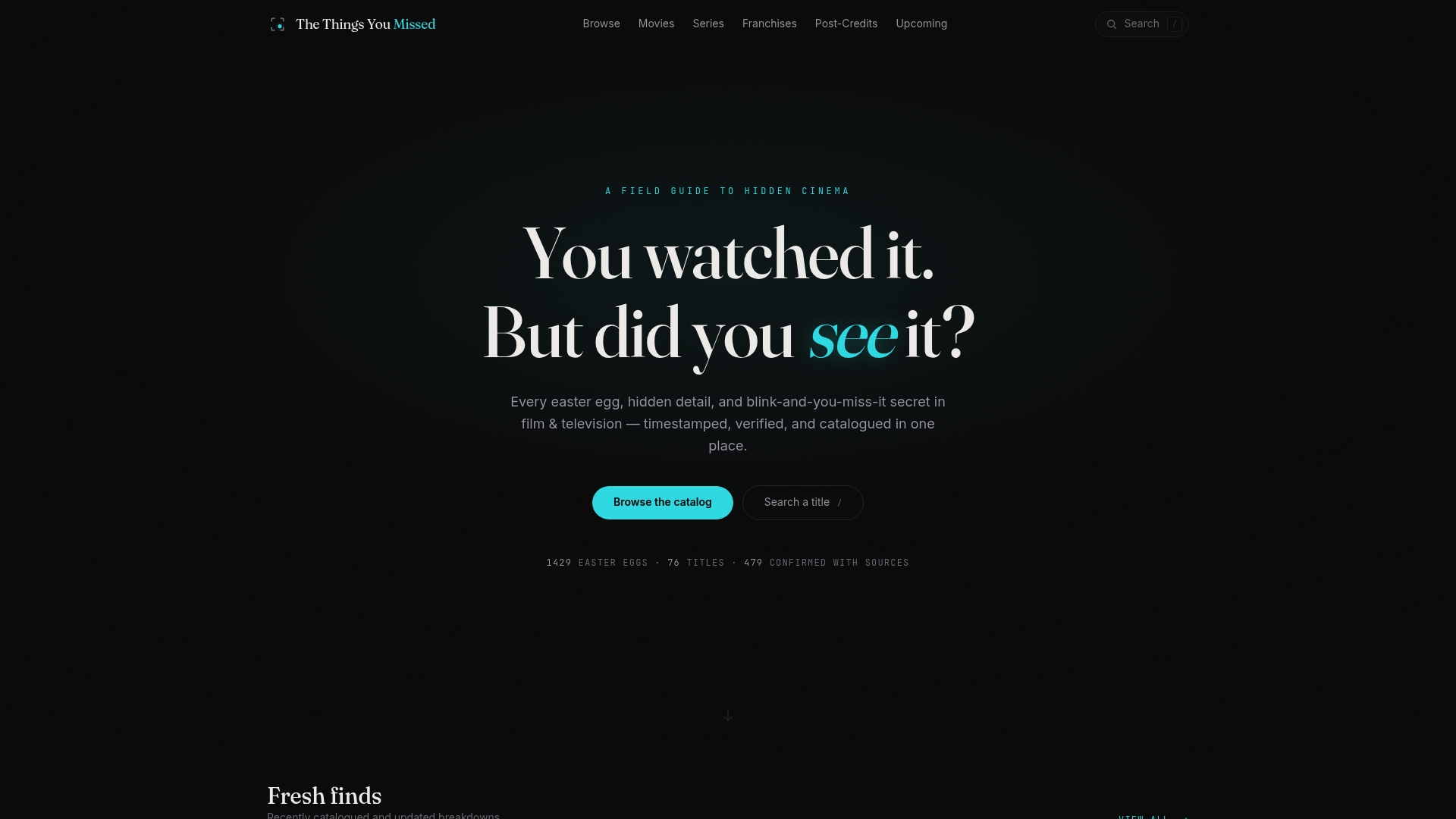
Browsing is spoiler-safe, meaning you can check a detail from a film you haven’t finished without a plot twist getting spoiled in the process. If Interstellar isn’t the only film on your rewatch list, the movies catalog covers dozens of other titles with the same timestamped treatment, and you can request a breakdown for anything missing from the archive. Start with the Interstellar entry, then browse from there.
Sources
- Christopher Nolan’s Interstellar nod to Kubrick’s Saturn placement
- Interstellar robots were real, not CGI (CNET)
- 9 Easter Eggs From the Bookshelf in Interstellar (Wired)
- 5 Small Interstellar Details That You Only Notice On Rewatch (Screen Rant)
FAQ
Did Romilly really wait 23 years?
Yes. While Cooper, Brand, and Doyle spend a brief time on Miller’s planet, many years pass for Romilly aboard Endurance due to the planet’s proximity to Gargantua’s gravity well. The film shows his visibly aged appearance and stir-crazy demeanor when the crew returns.
Why is TARS called TARS?
The film never explicitly explains the acronym on screen, and it functions primarily as a military-style designation rather than a decoded phrase. Its blocky, non-humanoid design reflects Nolan’s stated preference for robots that read as functional hardware rather than companions.
What are some hidden details I missed in Interstellar?
The most commonly missed details include the 1.25-second ticking sound on Miller’s planet, the absence of any wildlife in the Earth scenes, and the Flatland novel on Murph’s bookshelf foreshadowing the tesseract’s dimensional logic. A full scene-by-scene list appears earlier in this guide.
How did Murph realize it was Cooper?
Murph connects the gravity-based Morse code in the dust and the bookshelf, plus the watch’s ticking second hand, back to her father only after decades of studying the anomaly herself. The Morse pattern spells out coordinates and equation data that only Cooper, communicating from inside the tesseract, could have sent.
Does Thethingsyoumissed cover every Easter egg in Interstellar?
Thethingsyoumissed maintains a timestamped, sourced catalog of verified details for Interstellar and other films, with new entries added as they’re confirmed. Check the movies landing page for the current full breakdown.