Verified James Bond Easter Eggs: Production Confirmed, Timestamped
This list rounds up the most notable, verifiable James Bond Easter eggs across the franchise, from prop callbacks and soundtrack cues to cameos that only make sense once you know the history. The richest payoff sits in the Daniel Craig era, especially Spectre, where costume nods and set echoes to earlier films stack up scene after scene. Verification notes follow every entry, and spoilers stay to a minimum.
TL;DR:
- The franchise’s most detailed callbacks occur in the Daniel Craig era, especially in Spectre, with dozens of visual and dialogue references to previous films.
- Iconic props like the Aston Martin DB5 are repeatedly reused, while specific sets and costumes often mirror earlier movies, confirming intentional homages.
- Verified Easter eggs rely on confirmed interviews, matching props with production archives, or credited cameos, rather than fan speculation or visual coincidence.
- Major franchise symbols, such as Blofeld’s cat and the volcano lair, directly reference classic Bond films like You Only Live Twice, often with visual homages.
- The density of callbacks increases in milestone films, with some entries, like Spectre, featuring up to fifteen separate references woven into the story and design.
Table of Contents
- James Bond Easter Eggs: A Film-by-Film Watchlist
- How to Spot and Verify a Bond Easter Egg
- Why Bond Keeps Hiding These Details in Plain Sight
- How a timestamped, sourced easter egg database verifies details like these
- What Annotated Screenshots Reveal That Plain Text Can’t
- A Researcher’s Note on Chasing Bond’s Hidden History
- Find Every Verified Bond Detail on Thethingsyoumissed
- Sources
- FAQ
James Bond Easter Eggs: A Film-by-Film Watchlist
Bond films have hidden references to their own past since the franchise’s earliest days, but the density and cleverness of these callbacks have grown with every era. Below are the standout entries, organized by film, with a note on how solid the confirmation is behind each one.
-
Goldfinger’s laser table, echoed in Skyfall. The scene where Silva threatens Bond while strapped to a chair recalls the infamous laser table from 1964. Bond’s own line (“You expect me to talk?” “No, Mr. Bond, I expect you to die”) gets flipped, and Bond delivers a version of the joke back. Production-confirmed through interviews around the film’s release.
-
The Aston Martin DB5 returns, again and again. From GoldenEye to Skyfall to No Time to Die, the same silver DB5 (or a faithful successor) keeps appearing, often with the same ejector-seat gag referenced verbally even when it isn’t used. This is one of the most consistent visual motifs in the whole franchise.
-
Moneypenny’s return to the field, Skyfall. Naomie Harris plays a field agent for most of the film before a reveal ties her identity to the classic Miss Moneypenny of the desk and doorway. It’s a structural Easter egg more than a visual one, rewarding longtime viewers who know what that name usually means.
-
The Komodo dragon pit, Skyfall. Bond’s fight above the reptile enclosure nods to Live and Let Die’s crocodile farm sequence, another example of the franchise recycling a peril setup decades later.
-
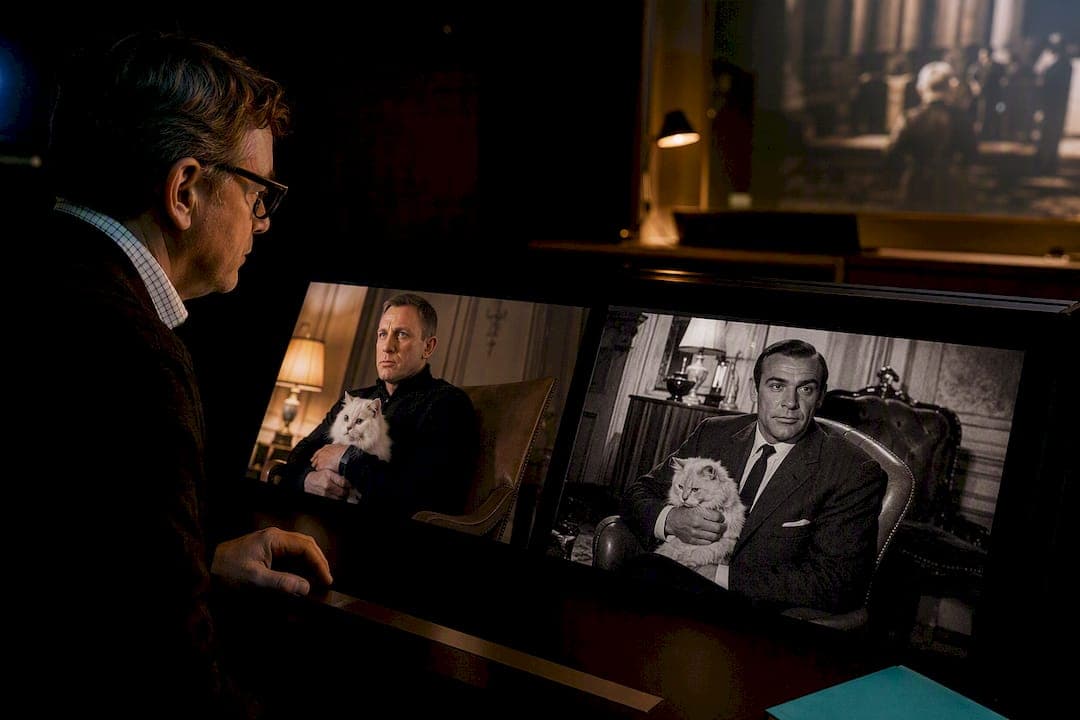
Blofeld’s cat, Spectre. Christoph Waltz’s Franz Oberhauser reveals himself as Ernst Stavro Blofeld while cradling a white Persian cat, a direct visual quote of Donald Pleasence’s Blofeld from You Only Live Twice. ScreenRant catalogs this and several other deliberate homages built into Spectre’s production design.
-
The volcano lair callback, Spectre. Blofeld’s Moroccan base draws heavily from the crater fortress of You Only Live Twice, right down to the industrial scale and the henchman theatrics.
-
Bond’s ring in Spectre. The octopus ring Bond investigates throughout the film ties directly to the SPECTRE organization’s visual branding from the 1960s films, a franchise-wide symbol rather than a one-off prop.
-
Fifteen distinct callbacks in one film. CinemaBlend counted fifteen separate references to earlier Bond entries woven into Spectre alone, spanning costume choices, dialogue echoes, and shot composition. That density is unusual even by Bond standards.
-
The DB5 destroyed, No Time to Die. Bond’s Aston Martin gets blown apart in the pre-title sequence, a moment fans read as the franchise symbolically closing the book on Craig’s era using its most iconic prop.
-
Felix Leiter’s fate. No Time to Die kills off Bond’s CIA ally in a way that echoes the character’s near-death experiences in the Fleming novels, where Leiter suffers gruesome injury more than once.
-
Madeleine Swann’s daughter, Mathilde. The final film’s emotional core leans on a plot thread seeded in Spectre, making the reference plot-relevant rather than a background gag. Modern Bond films increasingly use callbacks as narrative payoff across multiple entries, not just isolated in-jokes.
-
The exploding pen, Die Another Day. Q’s gadget lab includes a wink to GoldenEye’s exploding pen, delivered as a throwaway line that only lands if you remember the earlier gadget.
-
Jinx’s entrance, Die Another Day. Halle Berry emerges from the ocean in an orange bikini, a shot-for-shot recreation of Ursula Andress’s iconic entrance in Dr. No, released exactly forty years earlier.
-
Every gadget in Q’s warehouse, Die Another Day. The film’s twentieth entry stuffs its Q Branch scene with visible props from past films, turning the sequence into a walkable museum for anyone pausing the frame. 007 Magazine’s fact files document this kind of anniversary-driven density, noting that milestone films tend to pack in far more callbacks than their neighbors.
-
The gun barrel sequence itself. Every film opens with a variation on the same iris shot and blood drip, but the framing, timing, and placement (cold open versus pre-title) have shifted enough over six decades that tracking the changes has become its own mini-hobby among fans.
-
GoldenEye’s tank chase homage. The St. Petersburg tank rampage nods to the destructive set-piece tradition established in earlier entries, scaled up for the franchise’s post-Cold War reboot.
-
Michael G. Wilson’s cameos. The longtime producer has appeared in minor background roles across multiple films, a running gag among crew and diehard fans that only pays off once you know to look for him.
-
Prop continuity across decades. Certain gadgets and props get physically reused or rebuilt from the same design specs, something production art books occasionally confirm through matching inventory numbers.
-
007 First Light’s Fleming nods. IO Interactive’s prequel game folds in references to Ian Fleming’s original novels alongside film homages, using collectibles and audio logs to reward players who explore off the main path. Beebom’s breakdown of the game’s Easter eggs points to specific mission-based nods that connect this new medium back to six decades of Bond lore.
-
Casino Royale’s callback to the character’s literary debut. The 2006 reboot draws directly from Fleming’s first novel, including the torture scene and the baccarat-turned-poker card game, grounding the modern era in the source material rather than prior films.
-
On Her Majesty’s Secret Service, referenced structurally. Bond’s brief marriage and the loss of his wife echo forward into later films’ emotional beats, including the Craig era’s handling of loss and grief as recurring themes rather than one-off tragedy.
Some widely shared “fact” lists mix confirmed homages with speculative fan readings, so treat any claim you haven’t cross-checked as provisional rather than settled.
How to Spot and Verify a Bond Easter Egg
Not every repeated image is intentional. Franchises this long develop visual habits, and it’s easy to mistake a director’s stylistic tic for a deliberate callback. Here’s what separates a confirmed reference from a coincidence:
- Interview or making-of confirmation. If a director, composer, or production designer names the reference in an interview or DVD commentary, that’s as solid as verification gets.
- Matching prop details. Identical prop inventory numbers or continuity photos in production art books are strong physical evidence, not just a visual hunch.
- Soundtrack motifs with a paper trail. A repeated musical cue counts as intentional when a composer or music editor discusses it in interviews or liner notes.
- Credited cameos. Appearances like Michael G. Wilson’s are documented in cast records, not just spotted by eagle-eyed viewers.
- Specialist archives over crowd-edited lists. Sources like 007 Magazine’s fact files carry more weight than a random ranked article, since they track production history rather than repeat popular claims.
Pro Tip: Before trusting any “hidden reference” claim, pause the scene and search for the specific frame using a still or timestamp. If three or more independent, production-linked sources describe the same detail, treat it as confirmed. If only one listicle mentions it, treat it as a theory until proven otherwise.
The most common trap is retrospective reading: fans notice a repeated shot type or color palette and assume intent, when it may simply be a cinematographer’s habit across films they didn’t even work on together.
Why Bond Keeps Hiding These Details in Plain Sight
Easter eggs in the Bond franchise serve a few overlapping purposes. They reward long-term viewers, they function as low-cost marketing (a reference clip travels well on social media), and they let filmmakers acknowledge sixty-plus years of continuity without slowing the plot down for exposition.
- Continuity and fan service. Repeating gadgets, cars, and lines gives the series a throughline despite constant recasting and rebooting.
- Anniversary density. Milestone entries like Die Another Day (the fortieth film) and Skyfall (the franchise’s fiftieth-anniversary release) pack in noticeably more references than films released mid-cycle, a pattern 007 Magazine’s trivia archive traces back to the earliest films.
- Recurring production choices. Cameos like Michael G. Wilson’s, prop-archive reuse, and callback casting decisions function as meta-Easter eggs that run underneath the films’ plots, visible mainly to people who’ve watched the whole catalog.
How a timestamped, sourced easter egg database verifies details like these
A specialized platform builds timestamped, sourced entries for exactly this kind of hunt, so you’re not relying on a comment thread to settle whether something was intentional.
- Entries can carry a timestamp tied to the specific frame or line, not a vague “somewhere in act two” description.
- Sources can link back to production notes or interviews where they exist, separating confirmed homages from fan speculation.
- Some interfaces allow checking a single reference without seeing the twist that surrounds it.
- Some sites group related callbacks, like every DB5 appearance, allowing tracing a single thread through decades of releases.
Anyone who has read through the most confirmed Easter eggs on the site knows the difference between a documented callback and a guess is usually a single sourced sentence, buried in an interview nobody bothered to dig up.
What Annotated Screenshots Reveal That Plain Text Can’t
A written description of Blofeld’s cat only goes so far. Seeing the actual frame next to its 1967 counterpart makes the homage instantly obvious in a way that paragraphs of explanation never quite manage. That’s the value of visual, screenshot-based breakdowns for Easter-egg hunting specifically: props, costume details, and set dressing are visual information first, and text is a lossy translation of it.
The strongest annotated guides pair a still frame with a callout box naming the reference, a timestamp for the exact moment, and a short verification note pointing to the source. For something like the fifteen Spectre callbacks CinemaBlend documented, a side-by-side of the octopus ring against its 1960s SPECTRE branding communicates the connection faster than any sentence could. The same goes for prop continuity: two photos of the same gadget model, twenty years apart, make the case better than a paragraph describing “similar design language.”

This is also where fan communities add real value. Frame-grab comparisons that circulate on forums and social threads have surfaced details even dedicated researchers missed, particularly background props and licensed vehicle plates that only become visible on a paused, zoomed-in frame. Community discussion doesn’t replace production confirmation, but it frequently points researchers toward frames worth checking against the archival record. A good visual guide treats those community finds as leads, not conclusions, until a production source or matching prop record backs them up.
A Researcher’s Note on Chasing Bond’s Hidden History
Building out a list like this means watching key scenes frame by frame and cross-referencing them against production notes rather than trusting the first blog post that mentions a detail. The Komodo dragon pit in Skyfall surprised me more than the obvious Blofeld cat reveal, mostly because so few write-ups connect it back to Live and Let Die.
— Christian
Find Every Verified Bond Detail on Thethingsyoumissed
Cross-referencing interviews, prop archives, and fan forums for a single scene takes hours most people don’t have. Thethingsyoumissed does that legwork ahead of time, publishing timestamped, sourced entries so you can jump straight to the frame that matters instead of scrubbing through a two-hour film on your own.
Every entry separates production-confirmed homages from speculative fan theories, and spoiler-safe browsing means you can check a single reference without spoiling the twist around it. Start with the movies catalog to browse verified breakdowns by title, or check how many Easter eggs are confirmed versus speculative across the site’s full database before you dive into your next rewatch.
Sources
- ScreenRant — James Bond easter eggs and references
- 007 Magazine — Fact files and Bond trivia
- CinemaBlend — 15 references to previous Bond films in Spectre
- Beebom — 007 First Light easter eggs
FAQ
Who is rumored to be the next James Bond?
Speculation has circulated around several British actors, but no official casting announcement has confirmed a successor as of this writing. Studio and franchise representatives have kept the process private, so any name currently circulating remains unconfirmed rumor rather than fact.
Does Bond use condoms in the films?
Bond’s on-screen encounters have never explicitly depicted contraception as a plot point, and the franchise’s PG-13-adjacent rating in most markets keeps that detail off-screen. It isn’t a documented Easter egg or franchise motif discussed in production notes.
What are all the Easter eggs in 007 First Light?
The game includes multiple references to both the Bond films and Fleming’s original novels, delivered through collectibles, mission details, and audio logs rather than one single master list. Beebom’s breakdown covers the most notable confirmed examples, though the full scope depends on how thoroughly a player explores each mission.
Why didn’t some fans like Daniel Craig as James Bond?
Some longtime fans felt Craig’s grittier, more emotionally serious take departed too far from the quippier, gadget-forward tone of earlier eras. Others came around once later films, particularly Skyfall and No Time to Die, tied his arc back to classic franchise elements through the callbacks and motifs covered above.
How can I verify a Bond Easter egg myself?
Check for interview or making-of confirmation first, then look for matching props, credited cameos, or documented soundtrack motifs before trusting a claim. Thethingsyoumissed’s catalog of answers walks through this same distinction between documented homages and coincidental similarities.