25 Verified MCU Easter Eggs With Exact Timestamps
An MCU Easter egg is a deliberately hidden visual or audio detail, planted in a frame or a line of dialogue, that rewards viewers who look closer than the plot requires. This guide catalogs the best ones across the Marvel Cinematic Universe, with exact scene guidance, comic origins, and why each one matters, so your next rewatch turns into a real hunt.
TL;DR:
- Most MCU Easter eggs are subtle details like signage, props, or visual references that reward viewers who pause and analyze scenes carefully.
- Recognizable patterns include comic cover recreations, character-coded props, and deliberate callbacks spanning multiple movies and series.
- The most common Easter eggs involve Star Wars references, including toys, ship silhouettes, and planet visuals, which serve as homage but lack narrative significance.
- Nearly all hidden details can be spotted through frame-by-frame scrubbing, especially during wide shots or quick inserts where production intentionally embeds clues.
- Dedicated resources provide timestamps and sourcing to help fans locate and verify Easter eggs without spoilers or unnecessary rewatching.
Table of Contents
- The Best MCU Easter Eggs to Rewatch For
- How MCU Easter Eggs Are Built (and Where to Look)
- Why Star Wars Keeps Showing Up in Marvel Movies
- Why the Props You Never Notice Still Matter
- A Fan’s Case for Slowing Down
- Jump Straight to the Timestamp, Not the Spoilers
- Sources
- FAQ
The Best MCU Easter Eggs to Rewatch For
Marvel has spent many years training its audience to look at the corners of the frame instead of just the center. Some of these details set up entire story arcs. Others exist purely to make a comic reader grin in the dark. Here’s a curated run through the ones worth pausing for, organized loosely by chronology so you can trace how the habit grew more elaborate over time.
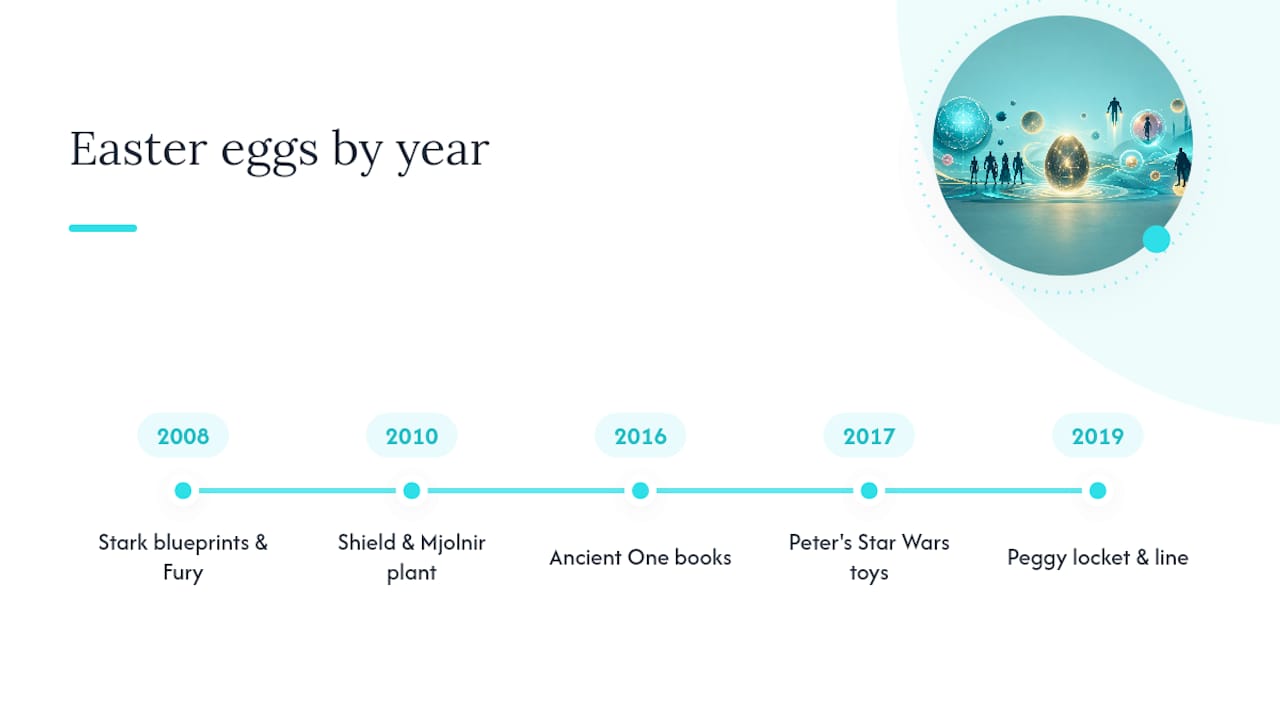
1. Tony Stark’s Arc Reactor Blueprint (Iron Man, 2008). During the workshop scenes, background sketches on Tony’s desk hint at future suit iterations that would not appear on-screen for several films. The detail rewards viewers who freeze the frame during his early tinkering sequences.
2. The First Avengers Initiative File (Iron Man, 2008 post-credits). Nick Fury’s line about “a bigger universe” is the moment the shared-universe model became real for audiences, not just a marketing promise. It is the whole thesis of the franchise delivered in under thirty seconds.
3. Captain America’s Shield Sketch (Iron Man 2, 2010). In Tony’s father’s old workshop reel, a shield-shaped object briefly appears in a Stark Expo prototype display, roughly forty minutes in. It is one of the earliest visual breadcrumbs connecting Howard Stark to the Super Soldier program before The First Avenger explained the relationship on screen.
4. Mjolnir in the S.H.I.E.L.D. Crater Photos (Iron Man 2, 2010). A file photo glimpsed during a Fury briefing shows the hammer’s crash site in New Mexico. It is a direct plant for Thor, released the following year, and one of the cleanest examples of Marvel seeding a future film inside an unrelated one.
5. Peter Parker’s Star Wars Toys (Spider-Man: Homecoming, 2017). Peter’s bedroom shelf includes recognizable Star Wars figures, a detail ScreenRant’s catalog of Star Wars references traces back to the writers’ own fandom rather than any in-universe crossover claim. It shows up again in Far From Home, reinforcing that Peter is a nerd first and a hero second.
6. The Ancient One’s Library Books (Doctor Strange, 2016). Sharp-eyed viewers spotted book spines in Kamar-Taj referencing real occult texts, a small touch that grounds the mysticism in something researched rather than invented wholesale.
7. Peggy Carter’s Locket (Avengers: Endgame, 2019). During the time-heist sequences, Tony’s flashback to Peggy’s photograph closes a loop that started in The First Avenger. ReactorMag’s breakdown of Endgame’s callback structure counts dozens of these deliberate echoes, built specifically so longtime viewers feel the weight of eleven years of continuity in a single close-up.
8. “I Love You 3000” (Avengers: Endgame, 2019). Morgan Stark’s line during the family scene late in the film is not an Easter egg in the classic sense, but it functions as an emotional callback that recontextualizes Tony’s earlier bravado about numbers and math.
9. The Reappearing Captain America Chant (Avengers: Endgame, 2019). “On your left,” first spoken by Sam Wilson in The Winter Soldier, returns during the final battle as a full-circle character beat. It is a callback egg, not a hidden one, but it belongs on any serious list because of how precisely it was tracked across two films released six years apart.
10. Wanda’s Sitcom Timeline Easter Eggs (WandaVision, 2021). Each episode of WandaVision recreates a specific decade of American sitcom style, and the show hides comic references inside the decor of every set, down to product labels in the Westview grocery store. The full episode-by-episode breakdown catalogs which decade maps to which comic-adjacent detail, since the show buries at least one per episode.
11. The Hexagon Motif Throughout WandaVision. Watch for hexagon shapes in wallpaper, jewelry, and even the Halloween candy bowl. It is a visual foreshadowing of the Hex barrier itself, planted long before the show reveals what is happening.
12. Wong’s Cameo Cards (Spider-Man: No Way Home, 2021). Background signage during the Sanctum sequences includes small textual nods to prior Doctor Strange lore that only pay off if you already know the comics.
13. The Multiverse Glimpses in Loki (2021). During the TVA’s pruning sequences, background monitors flash timeline branches that attentive viewers matched to deleted or alternate scenes from earlier MCU films, a rare case of an Easter egg referencing footage that technically does not exist in the main timeline.
14. Mobius’s Jet Ski Obsession. A minor running gag, but the specific jet ski model glimpsed in his office reappears as a visual callback in the character’s season two arc, rewarding viewers who noticed the brand the first time.
15. She-Hulk’s Fourth Wall Break Reels (She-Hulk: Attorney at Law, 2022). The season finale’s meta commentary directly reuses editing techniques from earlier Marvel productions, essentially Easter-egging its own studio’s habits.
16. Kevin Feige’s Cameo Non-Appearance. She-Hulk’s confrontation with “Kevin Feige” plays as parody, but the office set behind him includes production notes visible for a single frame that reference real unreleased Marvel projects at the time of filming.
17. The X-Wing in What If…? (2021). A background ship silhouette in a multiverse battle sequence matches Star Wars fighter design almost frame-for-frame, an homage rather than a crossover claim, since ScreenRant’s full catalog of Star Wars nods treats it as visual tribute, not continuity.
18. A Mustafar-Style World Glimpse in the Multiverse (What If…?, 2021). During a montage of alternate realities, a lava-planet silhouette briefly resembles the iconic Star Wars location. It rewards pausing on a frame most viewers blow right past.
19. Ironheart’s Chicago Signage (Ironheart, 2025). Background storefronts throughout the series carry small textual nods to earlier Stark Industries subsidiaries, a detail ScreenRant’s episode guide traces episode by episode, including a mid-credit tease that connects back to Tony’s old supply chains.
20. The Watcher-Shaped Window (Daredevil: Born Again, 2025). A skylight framing in one interior set forms the unmistakable silhouette of Uatu the Watcher’s head. Fans flagged it almost immediately, and IGN reported that a Marvel Television executive acknowledged the sighting rather than dismissing it as coincidence, one of the rare instances where the studio confirmed a crowd-spotted detail was intentional.
21. Timely Comics Signage in Times Square (The Fantastic Four: First Steps, 2025). A building facade during the Manhattan sequences carries the name “Timely Comics,” a direct nod to Marvel’s own 1939 predecessor company. GamesRadar’s scene-by-scene guide pins the exact block and building angle where it is legible.
22. In-Movie Cartoon Reels (The Fantastic Four: First Steps, 2025). A retro-styled cartoon shown within the film recreates period animation techniques and hides a small character cameo inside its background art, a detail that rewards a second viewing of a scene most audiences treat as a throwaway gag.
23. Amazing Fantasy #15 Recreation (Spider-Man: Brand New Day, 2026). The film stages a shot that visually recreates Spider-Man’s original 1962 comic cover, right down to the framing angle. It is one of the clearest examples of what ScreenRant’s deep-cut analysis calls comic-cover recreation, a technique the MCU has leaned on harder in its later phases.
24. Restaurant and Hotel Names as Comic Aliases. Multiple recent titles hide comic character names inside fictional business signage, a technique cataloged across several entries in ScreenRant’s roundup of details most viewers miss, often requiring a paused frame to read.
25. Community-Flagged Obscure Finds. Fan threads on Reddit continue to surface details mainstream outlets miss entirely, from license plate numbers to background extras dressed as specific comic characters. Discussion threads compiling the most obscure sightings function as a crowd-sourced early warning system that editorial outlets later verify.
How MCU Easter Eggs Are Built (and Where to Look)
Not every hidden detail works the same way. Marvel’s teams draw on a handful of repeatable techniques, and once you recognize the pattern, you start spotting them without needing a list at all.
- Comic cover recreations. A shot is staged to mirror an iconic comic panel or cover, as with Spider-Man: Brand New Day’s recreation of Amazing Fantasy #15.
- Background signage. Storefronts, building names, and posters carry comic-era brand names like Timely Comics, often legible for only a second or two.
- Character-coded props and business names. Hotel names, restaurant brands, or company logos allude to comic aliases without ever naming the character outright.
- Cameos and blink-and-miss appearances. Background extras or voice cameos that only register on a second watch, sometimes confirmed by the studio only after fans notice.
- Intertextual pop-culture nods. References to other franchises, most notably Star Wars, that function as tribute rather than continuity.
- Soundtrack and audio cues. A musical sting or line reading that echoes an earlier film, rewarding viewers who remember the original context.
Spotting this requires knowing where the camera lingers versus where it rushes past. Wide establishing shots are gold for signage. Slow pans across a workshop or office are gold for props. Anything that gets a quick insert shot with no dialogue over it is usually there on purpose.
Pro Tip: Background details are almost always easiest to catch on a frame-by-frame scrub rather than a normal watch. If a scene includes a wide shot of a street, storefront, or bulletin board, pause it. That is where production teams hide the details meant for the second or third viewing, not the first.
Why Star Wars Keeps Showing Up in Marvel Movies
Star Wars references to recur across the MCU more than any other outside franchise, and the pattern is not subtle once you know where to look. Peter Parker’s bedroom shelf in Homecoming and Far From Home carries recognizable Star Wars figures. An X-wing silhouette appears briefly during a multiverse battle sequence in What If…?, and a separate montage flashes a lava world that visually echoes Mustafar.
- Peter Parker’s Star Wars toys, visible in two separate Spider-Man films.
- The X-wing silhouette in a What If…? multiverse battle.
- A Mustafar-style lava planet glimpsed during a What If…? reality montage.
ScreenRant’s full catalog of these nods frames them as homage rather than continuity statements, and that distinction matters for how you read them. These are not clues pointing toward some secret crossover. They are creative fingerprints left by writers and directors who grew up on both franchises, and unlike a callback egg tied to Marvel’s own timeline, a Star Wars nod carries no narrative weight. It exists purely for the flicker of recognition.
Why the Props You Never Notice Still Matter

Set decorators build fully realized business cards, packaging, and signage that the camera never lingers on, because a set that only looks real in close-up falls apart everywhere else. That commitment to detail is exactly what makes so many Easter eggs possible in the first place. A prop team builds a Timely Comics storefront not because a script calls for it, but because a believable Manhattan skyline needs real-looking buildings, and someone on that team decided to make one of them count twice.
Some of these details are planted deliberately during preproduction as breadcrumbs meant to be found later. Others are added in post as pure texture, with no grand plan behind them at all. Separating the two usually requires a creator interview or a production note, since the finished frame looks identical either way.
Marvel Television’s acknowledgment of the Watcher-shaped window in Daredevil: Born Again is the rare confirmation that a crowd-spotted detail was, in fact, intentional. Most Easter eggs never get that kind of official nod. They just get found, verified against a timestamp, and cataloged for the next person scrubbing through the same frame.
That is the gap Thethingsyoumissed exists to close. Every entry in the database gets a timestamp, a difficulty grade, and a sourced explanation, so you are not relying on a comment thread’s memory of “somewhere in the second act.”
A Fan’s Case for Slowing Down
Finding an egg no one mentioned to you first is one of the purest rewards fandom offers. Share your discoveries once others have caught up, not the moment you spot them. That is why spoiler-safe browsing on the movie hub exists, so your hunt does not ruin someone else’s.
— Christian
Jump Straight to the Timestamp, Not the Spoilers
Thethingsyoumissed is built for exactly the kind of rewatch this article just walked you through, minus the guesswork of scrubbing through an entire film to find one blink-and-miss detail. Every entry in the MCU franchise hub is timestamped, sourced, and graded by how hard it is to catch, so you can jump straight to the frame instead of pausing a two-hour movie every ten seconds.

The hub already covers many hidden details across several titles, with spoiler-safe browsing so you can check a scene without accidentally reading how the movie ends. If you’re planning a Phase-by-Phase rewatch, start with the movies landing page and work forward from there. New titles get added as they release, and you can request one that is missing directly from the site.
Sources
- ScreenRant: Every Star Wars reference in the MCU
- ReactorMag: Avengers: Endgame references to previous MCU films
- GamesRadar: The Fantastic Four: First Steps Easter eggs and cameos
FAQ
What Counts as an Easter Egg in Marvel Movies?
A Marvel Easter egg is any hidden visual, audio, or textual detail that references the comics, prior MCU entries, or outside pop culture without being explained in the dialogue. It ranges from background signage to full comic-cover recreations, as ScreenRant’s deep-cut analysis documents across dozens of titles.
Why Did Natalie Portman Leave the MCU After Thor?
Natalie Portman stepped back from the Jane Foster role after Thor: The Dark World due to creative differences with that film’s direction, then returned years later for Thor: Love and Thunder. Her limited screen time in the interim is why later films handle Jane’s absence through dialogue rather than a recast.
Who Is LGBTQ+ in the Avengers or Broader MCU?
Several MCU characters have been confirmed as LGBTQ+ on screen, including Phastos in Eternals, who is shown with a husband and family, and America Chavez, introduced in Doctor Strange in the Multiverse of Madness. Marvel has expanded representation gradually across Phases 4 and 5 rather than through a single announcement.
Who Is Thanos’s Brother in the Comics and Films?
Thanos’s brother is Starfox, also known as Eros, a character rooted in Marvel comics who has not yet had a confirmed live-action MCU appearance as of this writing. Fans track potential casting news closely because his introduction would open new Eternals-adjacent storylines.
How Many MCU Easter Eggs Has Thethingsyoumissed Verified?
The MCU franchise hub lists numerous hidden details across multiple titles, each timestamped and sourced. New entries get added as fresh films and series release, so the count grows with every Phase.
Where Should I Start if I Want to Rewatch for Easter Eggs?
Start with a film you already know well, since familiarity frees you to watch the background instead of the plot. Avengers: Endgame is a strong first pick given how densely it packs callbacks, and a full breakdown of its 19 hidden details can guide your first pass.