Mission: Impossible Watch Order: The Full Franchise Guide

Watch the Mission: Impossible films in release order: Mission: Impossible (1996), M:I-2 (2000), M:I III (2006), Ghost Protocol (2011), Rogue Nation (2015), Fallout (2018), Dead Reckoning Part One (2023), and The Final Reckoning (2025). That order and the story’s internal chronology are the same thing here. There’s no prequel structure or timeline gymnastics to untangle.
The reason is simple: this franchise builds forward, not sideways. Ethan Hunt’s team, his enemies, and the emotional stakes accumulate picture over picture, and the narrative timeline lines up with the release order, so watching them as they came out preserves every callback the way the filmmakers intended. Later entries lean harder on characters and history from earlier ones, which is exactly why release order rewards you more with each film you add.
- Mission: Impossible (1996)
- Mission: Impossible 2 (2000)
- Mission: Impossible III (2006)
- Mission: Impossible – Ghost Protocol (2011)
- Mission: Impossible – Rogue Nation (2015)
- Mission: Impossible – Fallout (2018)
- Mission: Impossible – Dead Reckoning Part One (2023)
- Mission: Impossible – The Final Reckoning (2025)
Key Takeaways
Release order and story order are identical in the Mission: Impossible franchise, making it the only viewing sequence that preserves every character and plot payoff.
| Point | Details |
|---|---|
| Follow release order | Watch all eight films from 1996 through 2025 in the order they came out; there’s no alternate chronology to untangle. |
| Serialization starts at M:I III | Benji Dunn’s introduction in 2006 marks the shift from standalone spy capers to a connected team-based story. |
| Rogue Nation and Fallout are essential | Ilsa Faust and the Syndicate/Apostles arc set up nearly everything Dead Reckoning and The Final Reckoning resolve. |
| Paramount+ is the easiest hub | It typically carries the full eight-film library, avoiding piecemeal rentals across multiple apps. |
| Detail rewards rewatching | Fallout and Rogue Nation hide the most callback material worth a second, closer pass. |
Table of Contents
- The complete Mission: Impossible watch order checklist
- What does each Mission: Impossible film add to the story?
- Do you have to watch Mission: Impossible movies in order?
- Where can you stream all the Mission: Impossible movies?
- How should you plan your Mission: Impossible marathon?
- Where to find timestamped Easter eggs for every Mission: Impossible film
- How Rogue Nation and Fallout connect to the rest of the saga
- How has the Mission: Impossible franchise changed over time?
- Frequently Asked Questions
- Sources
The complete Mission: Impossible watch order checklist
Here’s the full lineup you can screenshot, print, or just check off as you go. Eight films span several decades, and this list matches the release-order data on Wikipedia’s franchise page) for years and production credits.
- Mission: Impossible (1996) — Brian De Palma directs Tom Cruise as Ethan Hunt in his first mission, a tense mole hunt built around one iconic vault heist. Runtime: about 110 minutes.
- Mission: Impossible 2 (2000) — John Woo takes over with a bigger, glossier action style. Ethan chases a bioweapon called Chimera. Runtime: about 123 minutes.
- Mission: Impossible III (2006) — J.J. Abrams’ debut in the franchise reshapes the whole series. Simon Pegg joins as Benji Dunn here, and the IMF starts feeling like a family instead of a rotating cast. Runtime: about 126 minutes.
- Mission: Impossible – Ghost Protocol (2011) — Brad Bird brings animation-honed precision to live action, headlined by the Burj Khalifa climb. Runtime: about 133 minutes.
- Mission: Impossible – Rogue Nation (2015) — Ilsa Faust arrives and the Syndicate becomes the franchise’s most persistent threat. Runtime: about 131 minutes.
- Mission: Impossible – Fallout (2018) — Widely considered the series peak, with the bathroom brawl and helicopter chase as centerpieces. Runtime: about 147 minutes.
- Mission: Impossible – Dead Reckoning Part One (2023) — The Entity storyline begins, tying together nearly every prior antagonist thread. Runtime: about 164 minutes.
- Mission: Impossible – The Final Reckoning (2025) — The direct continuation and, as the title suggests, the closing chapter of Hunt’s saga. Runtime: about 169 minutes.
What does each Mission: Impossible film add to the story?
Mild spoiler warning ahead: nothing plot-ruining, but a few character reveals and legacy connections are named below.
Each entry either introduces something the later films depend on or resolves something the earlier films set up. Some work perfectly well as standalone popcorn movies; others are load-bearing walls for the whole structure.
- Mission: Impossible (1996): Establishes Ethan Hunt, the IMF’s disavow-and-clear tactic, and the franchise’s signature reveal, the latex mask twist. Almost entirely self-contained; you don’t need anything before it because there is nothing before it.
- Mission: Impossible 2 (2000): The most standalone film in the series, with a plot and cast that barely echo forward. It’s the one entry you could skip and lose the least continuity, though the mask-and-double-cross motif it leans on gets reused constantly later.
- Mission: Impossible III (2006): The pivot point. Introduces Benji Dunn, gives Ethan a wife (Julia Meade) whose fate matters for years of story, and shifts the tone toward personal stakes instead of pure spy-gadget spectacle. Watch for the mission briefing structure here; it becomes a franchise staple.
- Mission: Impossible – Ghost Protocol (2011): Reboots the tone after Ethan goes rogue and the IMF is disbanded. Brings in Benji as a full field agent and Luther Stickell back into the fold. The Burj Khalifa sequence is the standout stunt, and it set the bar for every practical set piece that followed.
- Mission: Impossible – Rogue Nation (2015): Introduces Ilsa Faust, arguably the most important recurring character added after the original trilogy, and the Syndicate, an organization whose fallout stretches across three more films. The opera house sequence in Vienna is a masterclass in tension over spectacle.
- Mission: Impossible – Fallout (2018): The film where every prior thread (Solomon Lane, Ilsa, Benji, Luther) collides. Critics and fans generally agree the franchise sharpens its serialized character work and raises its action ceiling here, which is why so many viewing guides treat Fallout as the unofficial start of “required viewing” territory. The HALO jump and bathroom fight are the technical high points.
- Mission: Impossible – Dead Reckoning Part One (2023): Introduces the Entity, a rogue AI, and reframes earlier villains as pieces of a bigger design. This is where the series stops being episodic and starts behaving like a single serialized story. Grace and Paris are new pieces that matter immediately.
- Mission: Impossible – The Final Reckoning (2025): Pays off Dead Reckoning’s cliffhanger and pulls in legacy characters and threads from across the saga. The emotional weight of this finale depends on remembering who Hunt has lost and who’s stayed loyal, which is precisely why skipping ahead here costs you the most.
Early films (1996, 2000) are closer to anthology entries. Everything from M:I III onward increasingly functions as one continuous story, and the recurring cast, Benji, Luther, Ilsa, becomes the connective tissue that makes the later films land.
Do you have to watch Mission: Impossible movies in order?
Not strictly, but you’ll lose a lot if you don’t. The first two films work fine as standalone action movies watched in any sequence or skipped outright. Once you hit M:I III, the series starts building character relationships and unresolved threats that pay off two or three movies later.
- Casual viewers who just want spectacle can jump straight to Fallout or Dead Reckoning Part One and follow the plot fine.
- Newcomers committing to the whole franchise get the most value starting from film one, since the tonal shift from De Palma’s spy thriller to Bird’s blockbuster showmanship is part of the fun.
- Fans chasing full emotional payoff in The Final Reckoning should not skip Rogue Nation or Fallout. Ilsa Faust, Solomon Lane, and the Syndicate/Apostles fallout are load-bearing for how Dead Reckoning and The Final Reckoning resolve Hunt’s arc.
Pro Tip: If you’re short on time, watch III, Rogue Nation, Fallout, and both Reckoning films back to back. You’ll miss some 1996/2000 flavor, but you’ll catch every thread that actually pays off later.
Where can you stream all the Mission: Impossible movies?
Paramount+ is the closest thing this franchise has to a one-stop shop. The service commonly hosts the full eight-film catalog in one place, which makes it the easiest single subscription for a complete watch-through rather than hunting titles across four different apps.
- Check Paramount+ first before renting anything piecemeal.
- Other platforms rotate individual titles in and out of their libraries, so availability outside Paramount+ shifts month to month.
- Some entries, especially the newest releases, may only be available to rent or buy digitally for a stretch after their theatrical run before they land on a subscription service.
One practical note worth flagging: Paramount+ being the most convenient hub is a real tie-breaker if you’re deciding between a single subscription and stacking rental fees across eight movies. Renting all eight individually adds up fast compared to one month of a bundled service, even before you factor in the convenience of not switching apps between films.
How should you plan your Mission: Impossible marathon?
Eight films is a real commitment, roughly 18 hours if you watch every one back to back, so plan sessions instead of trying to brute-force it in a weekend.
- Session one: Mission: Impossible and M:I-2 (about 3.9 hours combined). These are the lightest lift and least essential to rewatch closely.
- Session two: M:I III and Ghost Protocol (about 4.3 hours). Pay attention here; Benji and Luther’s dynamic starts forming.
- Session three: Rogue Nation and Fallout (about 4.6 hours). This is the pair worth rewatching before the finale if you only have time for two.
- Session four: Dead Reckoning Part One and The Final Reckoning (about 5.6 hours). Watch these close together; the cliffhanger structure demands it.
Post-credit scenes aren’t a franchise staple here the way they are in superhero movies, so you generally don’t need to sit through the credits, though it’s worth a quick check on the pattern of which films actually include one before you skip out. If you’re rewatching for detail rather than plot, Fallout and Rogue Nation reward a second pass more than any other entries.
Where to find timestamped Easter eggs for every Mission: Impossible film
A watch order tells you what to watch and when. It doesn’t tell you what you’re missing frame by frame, and this franchise hides a lot: repeated masks, recurring props, callback dialogue that pays off two movies later, all mapped in Thethingsyoumissed’s timestamped, spoiler-safe breakdowns.
- Every entry gets a searchable, verified breakdown instead of a vague “10 things you missed” listicle.
- Motif tracking lets you follow recurring elements, like a signature prop or visual cue, across the entire franchise instead of just one film.
- Spoiler-safe browsing means you can check a specific timestamp without accidentally reading the ending.
Pro Tip: Run through the checklist above first for the big picture, then go back through the breakdowns for the small stuff: the callback props, the repeated code names, the visual rhymes between the vault heist in 1996 and the bigger heists that follow. If a film you’re curious about isn’t covered yet, you can request the next breakdown directly.
How Rogue Nation and Fallout connect to the rest of the saga
Mission: Impossible – Rogue Nation and Fallout aren’t spin-offs in the traditional sense, no separate title, no different lead, but they function as the franchise’s true hinge point. Rogue Nation introduces the Syndicate, a network of rogue agents that Fallout rebrands and expands into the Apostles, run by John Lark. That’s not a retcon; it’s the same antagonist ecosystem evolving across two films, with Solomon Lane as the connective thread sitting in custody between them.
Ilsa Faust is the clearest example of a character who exists specifically to bridge films. Introduced in Rogue Nation as an ambiguous ally, she becomes central to Fallout’s plot and her fate carries directly into how Dead Reckoning frames Hunt’s emotional history. There’s no separate Ilsa spin-off to watch. Her arc is simply distributed across three consecutive films, which is exactly the kind of threading that makes release order non-negotiable if you want the full picture.
The franchise doesn’t have true spin-off media the way some studios build shared universes with side shows or shorts. What it has instead is this kind of embedded serialization: characters and organizations that don’t reset between films but instead carry unresolved business forward, sometimes for a decade of release dates before it pays off.
How has the Mission: Impossible franchise changed over time?
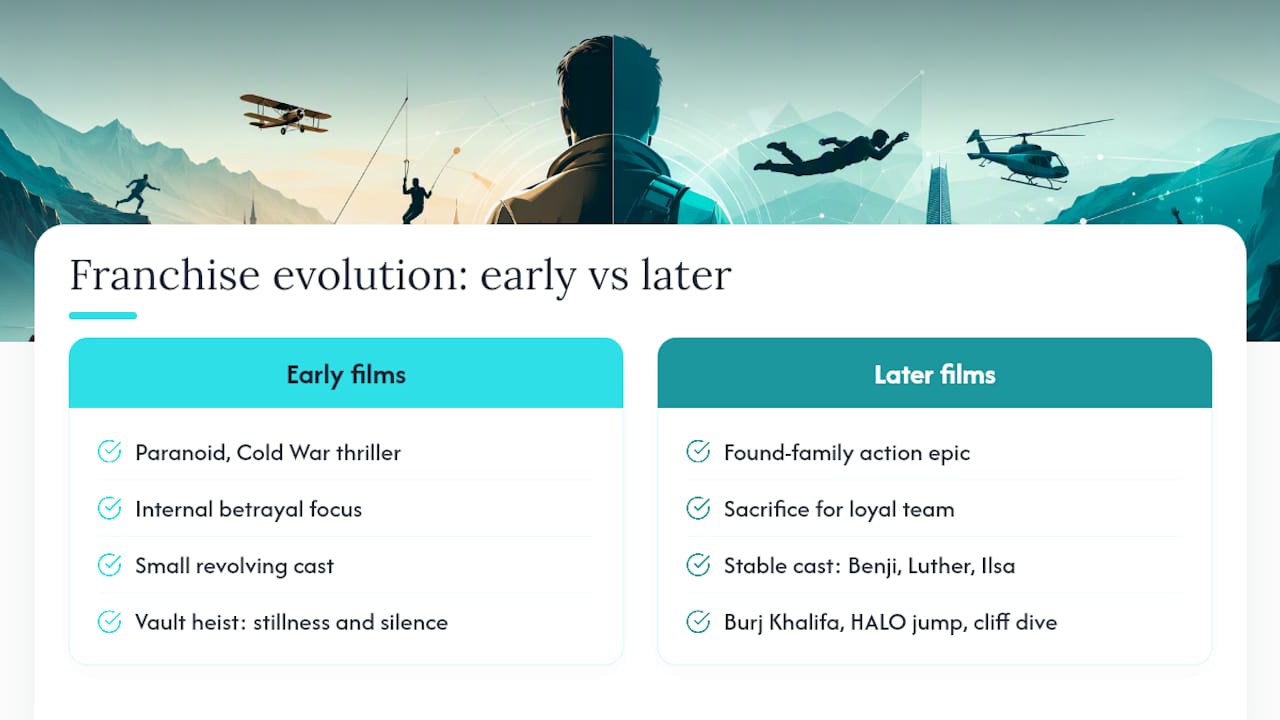
The 1996 original is a paranoid, Cold War-flavored spy thriller built around trust and betrayal inside a small team. By the time you reach The Final Reckoning, the series has shifted toward something closer to a found-family action epic, where the tension comes less from “who’s the mole” and more from “what will Hunt sacrifice for the people who’ve stayed loyal to him.”
That shift tracks almost exactly with the arrival of a consistent supporting cast. Once Benji, Luther, and later Ilsa became fixtures rather than one-off characters, the writers had material to build long-form emotional stakes instead of resetting the relationship dynamics every film. The practical stunt work escalated in parallel: the vault heist in 1996 required stillness and silence, while the Burj Khalifa climb, the HALO jump, and the motorcycle cliff dive in Dead Reckoning required Cruise to physically escalate the risk with each new entry.
Thematically, the franchise moved from institutional distrust (who inside the IMF can you trust?) to something closer to a meditation on loyalty and mortality, especially once the Entity storyline introduces an adversary that isn’t a person at all. That’s a franchise growing up in real time, and it’s part of why watching the films out of order flattens the arc into disconnected action set pieces instead of a story that’s actually going somewhere.
Why release order is the way to watch this franchise
Watching these films as they were released lets you feel the stunts escalate the same way audiences did, film by film, instead of jumping from a 1996 heist straight into a 2025 cliff dive with no sense of how the series got there. It also means the character work lands the way it’s built to. Ilsa’s introduction hits differently when you’ve spent two prior films watching Hunt lose people he trusted.
Thethingsyoumissed exists partly to catch what a straight watch-through misses on a first pass, the repeated props, the callback lines, the visual rhymes between decades of set pieces, and that kind of detail only means something once you’ve already seen the films in the order they were built to be understood.
Frequently Asked Questions
Do I need to watch all eight Mission: Impossible movies to understand the ending? Not all eight equally, but skipping Rogue Nation, Fallout, and Dead Reckoning Part One will leave real gaps in The Final Reckoning, since those films set up the characters and threats the finale resolves.
Is Mission: Impossible 2 skippable? It’s the most standalone entry in the franchise, with the least connective tissue to later films. You can skip it without losing much plot, though you’ll miss some of the mask-and-double-cross flavor the series reuses often.
What’s the difference between release order and chronological order for this franchise? There isn’t one. Unlike franchises with prequels or flashback structures, Mission: Impossible’s internal timeline matches its release order exactly, so there’s no separate “story order” to calculate.
Where can I watch the entire Mission: Impossible series right now? Paramount+ is generally the most complete single option, though availability can shift, so it’s worth checking that hub before renting individual titles elsewhere.
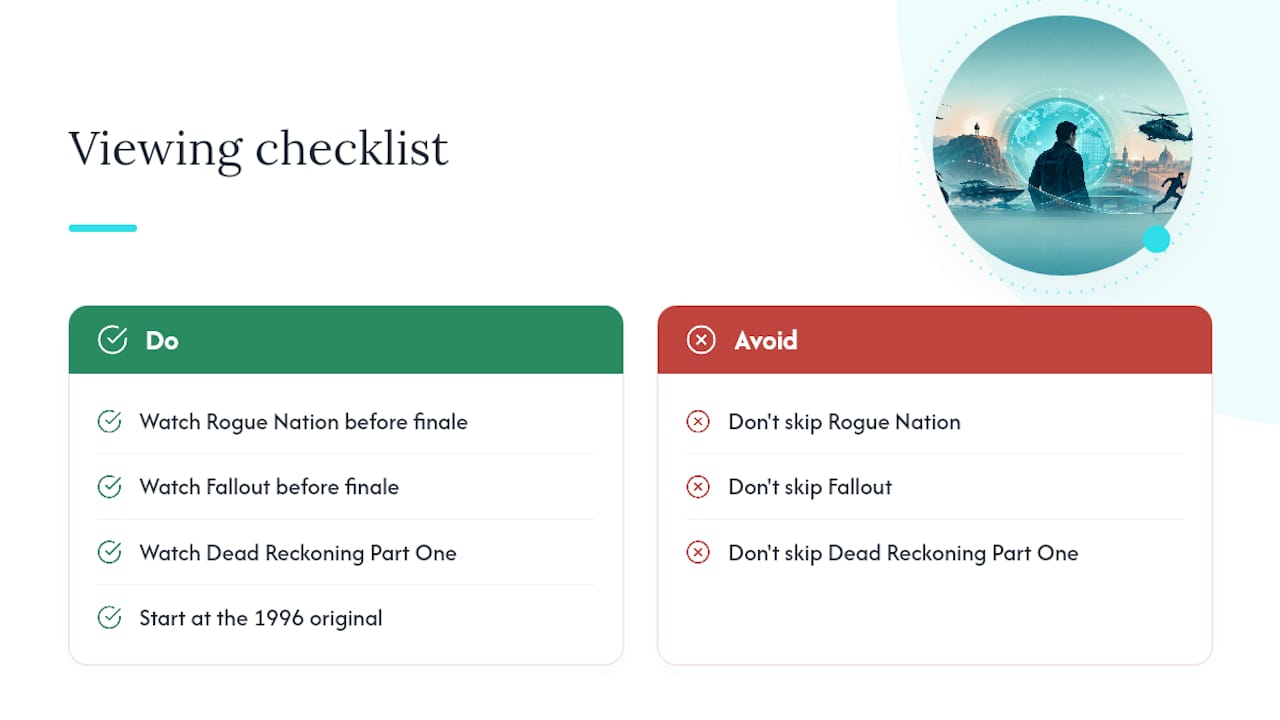
Which Mission: Impossible film should newcomers start with? Start with the 1996 original if you want the full arc and tonal evolution. If you only care about the modern, heavily serialized run, Ghost Protocol is a reasonable entry point since it reboots the team dynamic that carries through to The Final Reckoning.
Sources
- How to watch the Mission: Impossible movies (IGN)
- How to watch Mission: Impossible (CNET)
- Mission: Impossible streaming — how to watch every film (Rolling Stone)
- The Complete Mission: Impossible timeline, explained (CBR)
Recommended
- Easter Eggs by Franchise & Universe — The Things You Missed
- Project Hail Mary Easter Eggs: All 20 Hidden Details & References Explained (2026) — The Things You Missed
- The Fantastic Four: First Steps Easter Eggs: All 20 Hidden Details & References Explained (2025) — The Things You Missed
- Get Out Easter Eggs: All 19 Hidden Details & References Explained (2017) — The Things You Missed