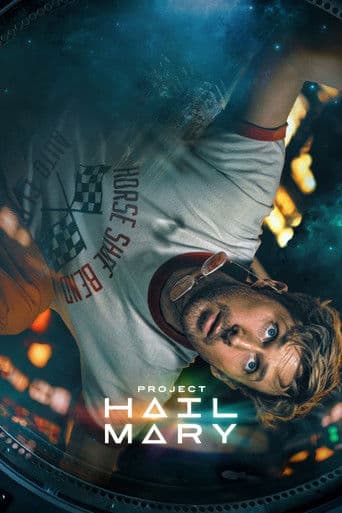
The Things You Missed

Project Hail MaryEaster Eggs & Hidden Details

Five Close Encounters notes tapped through xenonite, a V-with-a-line prison tattoo on Stratt's neck, a mop in a dress named Moppy Ringwald, and Meryl Streep playing a computer.

2026 · Film · 157 min · Phil Lord, Christopher Miller

20 eggs catalogued9 confirmed? 1 theoriesno post-creditsupdated 2026-08-10

The short version

Project Hail Mary (2026) hides 20 catalogued easter eggs and hidden details, 9 of them confirmed by official sources. Standouts include some of gosling's solo scenes are played against a mop in a dress, exactly one gosling–hüller scene was played as written and stratt's neck tattoo is a life sentence without parole. Every entry below includes where to look, a spotting difficulty, and sources.

Every egg on this page

  1. Grace Taps the Close Encounters Motif at Rocky
  2. Stratt's Neck Tattoo Is a Life Sentence Without Parole
  3. A Balloon Dog on the Whiteboard Is a Tribute to Miller's Math Teacher
  4. Meryl Streep Plays a Computer Pretending to Be Meryl Streep
  5. Rocky Comes From the Star System Star Trek Gave to Spock
  6. Grace Quotes Star Trek Twice Under Pressure
  7. "At Least He's Not Growing in Me" Is a Ridley Scott Joke
  8. "Rocky Hate Mark" Is About Gosling's Own Costumer
  9. Some of Gosling's Solo Scenes Are Played Against a Mop in a Dress
  10. A Lab Monitor Shows the Book's Original, Smaller Ship
  11. The Black Debris on the Floor Isn't Soot — It's Rocky Healing
  12. Hexagons Are Hiding in Every Human-Built Surface
  13. The Stars Change Colour as the Ship Accelerates
  14. The Frame Itself Tells You Whether You're in Space or in a Memory
  15. Stratt's Karaoke Number Was Learned Overnight and Cleared the Same Night
  16. Exactly One Gosling–Hüller Scene Was Played as Written
  17. The Ship Has a Room the Directors Named "Don't Go Crazy"
  18. Rocky's Music Is Built From Water Bowls, Woodblocks and a Squeaky Tap
  19. The MGM Lion Roars in Eridian at the Very End
  20. The Broken Antarctic Ice May Be Evidence of the Book's Nuclear Gamble

Ryland Grace, alone in a tunnel bolted between two spacecraft, presses his fingers to a wall of alien plastic and taps out five notes: D-E-C-C-G. It is John Williams' mothership motif from Close Encounters of the Third Kind, and it is the single most-cited hidden detail in Phil Lord and Christopher Miller's adaptation of Andy Weir's novel — a scientist reaching for the only first-contact protocol he has, which is a movie he saw as a kid.

That instinct runs through the whole picture. Drew Goddard's script hands Grace a pop-culture reflex for every crisis: he shouts "Shields up!" at a 2032 shuttle that has no shields, and deflects a panic attack with a Star Trek deflection of his own. But the richest material sits behind the camera. Lord and Miller shot enormous stretches of the film as open improvisation — Ryan Gosling wearing an earwig, puppeteer James Ortiz answering in character as Rocky in real time, takes running as long as forty-five minutes — so a startling amount of what ends up on screen was invented on the day. Gosling's favourite line in the film, "Rocky hate Mark," is a joke about his own costumer standing beside the lens. Meryl Streep is in the movie because Gosling ad-libbed her name and the production refused to fake her voice. Sandra Hüller's karaoke number was chosen overnight and shot the next morning. Only one scene between Gosling and Hüller was played as written.

And then there is the deliberately buried layer. Miller has described his and Lord's method as planting "little secret stories that there's like a little bit of evidence for" — most famously a tattoo on Eva Stratt's neck in the final scene that encodes an entire unfilmed subplot at Weir's own request. The film also changes shape around you: three-quarters of it was shot in native IMAX 1.43:1, with Earth memories squeezed to 2.39:1, so the frame itself tells you where in Grace's head you are. Elsewhere the crew smuggled in things that only readers of the novel will clock — a monitor carrying the ship's discarded original blueprint, black residue on the deck that is not soot — and Daniel Pemberton built a score out of water bowls, woodblocks and a squeaky tap so that even the music would sound handmade rather than symphonic. The Hail Mary itself was a fully practical set with no green screen anywhere in its interior, which is why the reflections and the clutter reward pausing. Everything below is sorted by how solidly it stands up. Confirmed means a director, the composer, a performer or Andy Weir has said it on the record. Community means the finding is widely documented and obvious on screen, but nobody involved has claimed it. Theory means exactly that, and there is one of those here — the ice in the final shot.

The full catalog

Your hunt

Tick off what you spotted

0 / 20 spotted

Tap the circle on a card when you catch one.

Type
Status
Difficulty

Grace Taps the Close Encounters Motif at Rocky

ReferenceMusic Secret Community ConsensusSecond Watch

WHERE TO LOOK · The xenonite tunnel between the Hail Mary and Rocky's ship, during the first communication attempts

Reaching for a way to prove he is intelligent through a barrier he cannot see past, Grace raps out the five-note sequence D-E-C-C-G — John Williams' mothership signal from Steven Spielberg's Close Encounters of the Third Kind (1977). It is the film's most-flagged easter egg, and it works on two levels: as a wink to the audience, and as characterisation. Grace is not a trained diplomat or a linguist; he is a middle-school science teacher, so the only first-contact procedure he has ever been taught is one he absorbed from a movie. Neither director has claimed it on the record, but every major outlet that covered the film independently identified it.

Stratt's Neck Tattoo Is a Life Sentence Without Parole

Hidden DetailBehind the Scenes ConfirmedDeep Cut

WHERE TO LOOK · The final scene back on Earth — Stratt on the boat, visible on her neck

Spoiler:

In the final Earth-set scene, a small mark is just visible on Eva Stratt's neck: a V with a line struck through it. Chris Miller spelled it out — "a V as in life and then the line meaning without parole." It compresses an entire subplot the directors could never fit into the film: after the Hail Mary launched and the climate crisis deepened, governments turned on Stratt, tried her as a criminal and jailed her for life. Phil Lord: "one of the things that we kept trying to cram into the movie and just didn't stick was this idea that after Grace went off to space, people did not cooperate." Andy Weir personally asked for the tattoo so Stratt's arc would close — in his version she then broke out using her contacts and stayed on the run, still working to save the world. Miller's rationale is the whole design philosophy of the film: "The way that you make a movie feel like the world is rich is having like these little secret stories that there's like a little bit of evidence for."

A Balloon Dog on the Whiteboard Is a Tribute to Miller's Math Teacher

Hidden DetailBehind the Scenes ConfirmedDeep Cut

WHERE TO LOOK · Grace's classroom flashback — the whiteboard behind him, amid the equations

Grace's middle-school classroom is dressed to the ceiling — hanging solar-system models, posters, boards crowded with equations — and buried in the algebra is a doodle of a balloon dog. Christopher Miller confirmed he put it there for Tom Rona, a maths teacher from his own school days who wrote "a funny book of math problems starring a character named Balloon Dog." Miller framed it as "a tiny way to honor him and inspiring teachers everywhere," which lands harder given the film's protagonist is himself a teacher who chose a classroom over a lab. You need to pause on the whiteboard to catch it; nothing in the blocking directs your eye there.

Meryl Streep Plays a Computer Pretending to Be Meryl Streep

CameoMetaBehind the Scenes ConfirmedSecond Watch

WHERE TO LOOK · Aboard the Hail Mary, as Grace auditions computer voices for Rocky's translator

While cycling through synthesised voice options to give Rocky's translated speech a sound, Grace lands on one and reacts — and the voice is genuinely Meryl Streep, who recorded a single line for the film. It exists because of the way Lord and Miller shot Gosling: they fed voices into his earwig without telling him which was coming, so his reactions would be real, and he ad-libbed a riff on Streep being able to do anything. Rather than treat it as a throwaway or synthesise her, the production insisted on the real actress. Andy Weir's summary of the layering: "I love how it ended up being Meryl Streep pretending to be a computer that is pretending to be Meryl Streep."

Rocky Comes From the Star System Star Trek Gave to Spock

ReferenceBehind the Scenes Community ConsensusDeep Cut

WHERE TO LOOK · Grace works out Rocky's origin from stellar data during their early exchanges

Rocky's home world, Erid, orbits 40 Eridani A — the same star NASA and Gene Roddenberry's collaborators long identified as the likeliest real-world location of Vulcan, Spock's planet. Weir picked the system for hard-science reasons (it is close, stable and genuinely a plausible host for a rocky world), but the coincidence is too neat for sci-fi audiences to ignore, and the film keeps the detail intact. The joke is how badly the two aliens would get along with the same address: Erid runs at roughly 210°C under an ammonia atmosphere at around double Earth gravity, which would kill a Vulcan considerably faster than it kills a human.

Grace Quotes Star Trek Twice Under Pressure

ReferenceMeta Community ConsensusFreeze Frame

WHERE TO LOOK · Grace's first sighting of Rocky's ship, and a later exchange about being out of his depth

Goddard's script gives Grace a nervous habit of narrating his own crisis in borrowed dialogue, and both of the big ones come from the same franchise. When Rocky's ship first appears, he yells "Shields up!" at a 2032 spacecraft that has no shields and no weapons of any kind — pure reflex, and the line lands as a laugh precisely because it is useless. Later he deflects with "I'm a scientist, not Buck Rogers," a double reference that folds the 1920s pulp spaceman into Dr. McCoy's endlessly recycled "I'm a doctor, not a..." construction from the original series. Together they tell you exactly what Grace's sci-fi diet was, which is the same thing the Close Encounters tap tells you.

"At Least He's Not Growing in Me" Is a Ridley Scott Joke

ReferenceMeta Community ConsensusSecond Watch

WHERE TO LOOK · Grace weighing up the risk of Rocky, early in their acquaintance

Talking himself into trusting Rocky, Grace reassures himself that whatever this creature is, "at least he's not growing in me" — a direct swipe at the reproductive method of the xenomorph in Ridley Scott's Alien (1979), where the facehugger implants an embryo that later exits through the ribcage. It is the film's clearest statement of intent about its own genre: Project Hail Mary is a first-contact story built on the opposite premise to the one that has dominated screen sci-fi since 1979, and Grace naming the alternative out loud is how the script tells you that.

"Rocky Hate Mark" Is About Gosling's Own Costumer

MetaBehind the Scenes ConfirmedFreeze Frame

WHERE TO LOOK · Grace and Rocky's conversation about home and the people they miss

In the quiet scene where Grace and Rocky compare what they left behind, Grace mentions an ex who is now with a man called Mark, and Rocky immediately replies "Rocky hate Mark." None of it was scripted. Gosling explained on Hits Radio: "I work with a guy named Mark and we've worked together for 10 years and he was next to the camera and I was improvising with Rocky about my ex-girlfriend and I just said, 'Oh yeah, but now she's with Mark'. And then James said, 'Rocky hate Mark.'" The Mark in question is Mark Avery, Gosling's costumer of a decade, standing just off-lens; James Ortiz, puppeteering and voicing Rocky live, answered in character without a beat. Gosling has named it his favourite moment in the film.

Some of Gosling's Solo Scenes Are Played Against a Mop in a Dress

Behind the ScenesMeta ConfirmedWhite Whale

WHERE TO LOOK · Grace's early solo sequences aboard the Hail Mary, before Rocky arrives

Long stretches of the first act are Grace alone on a ship with two dead crewmates, and the production found the isolation genuinely hard to shoot. The fix was "Moppy Ringwald" — a floor mop dressed in glasses and a frock, built by the crew to give Gosling a body to talk at and react to. It worked well enough that shots of Gosling playing off the mop reportedly survived into the finished film rather than being replaced. It is the low-tech cousin of the enormous effort spent on Rocky, who was built as a physical puppet by Neal Scanlan's shop and performed on set by a team led by James Ortiz specifically so Gosling would always have something real to act against.

A Lab Monitor Shows the Book's Original, Smaller Ship

Hidden DetailReference Community ConsensusFreeze Frame

WHERE TO LOOK · Laboratory flashback on Earth — background monitor behind the scientists

During a flashback to the project's development, a computer monitor in the background carries a wireframe schematic labelled "Prototype." It is not generic set dressing: it reproduces the smaller original design of the Hail Mary as described in Weir's novel, before the production enlarged the vessel to accommodate the sets, the crew and the IMAX frame. The film effectively shows you its own discarded blueprint and hands it to readers as an apology for the change. Freeze on the monitor rather than the actors to read it.

The Black Debris on the Floor Isn't Soot — It's Rocky Healing

Hidden DetailReference Community ConsensusDeep Cut

WHERE TO LOOK · The Hail Mary's floor after Rocky is brought aboard injured

Spoiler:

After Rocky is recovered in bad shape, dark ash-like material is left smeared across the deck. Readers of the novel will recognise it as Eridian scab: Rocky's biology seals cracks in his shell with a black substance that looks exactly like burnt residue. The book contains a whole sequence in which Grace, trying to help, nearly kills Rocky by scrubbing it away — a near-fatal cross-species misunderstanding that the film cuts entirely. What survives is the debris on the floor, a prop with no scene left to belong to, kept as a nod to anyone who knows what it actually is.

Hexagons Are Hiding in Every Human-Built Surface

Hidden DetailForeshadowing Community ConsensusFreeze Frame

WHERE TO LOOK · Hail Mary lab supports and monitor UI throughout; the xenonite barrier in the tunnel

Once you notice it you cannot stop: hexagonal patterning recurs on Grace's monitor graphics, on the structural supports inside the Hail Mary lab, and most pointedly in the xenonite barrier Rocky builds in the connecting tunnel, which he assembles from hexagonal panels of different compounds so Grace can pick the one he can see through. Rocky's biology is five-fold and his engineering favours hexagonal packing, so the geometry doubles as visual argument: the two species' design instincts were compatible before either of them knew the other existed. It is a production-design through-line rather than a single gag, which is why it takes a second viewing to register.

The Stars Change Colour as the Ship Accelerates

Hidden DetailBehind the Scenes Community ConsensusFreeze Frame

WHERE TO LOOK · The acceleration sequence en route to Tau Ceti — compare forward-facing and rear-facing star views

During the Hail Mary's Astrophage-powered burn toward Tau Ceti, the starfield is not static wallpaper. Stars ahead of the ship shift fractionally toward blue and those behind it toward red — the relativistic Doppler effect, rendered correctly and quietly, with no dialogue drawing attention to it. It is the kind of detail Weir built the novel on and the production preserved: he researched the physics himself and consulted on set to keep the science intact even while the cast improvised around it. Almost nobody clocks it in the cinema; it is obvious once you know to compare the forward and rear views in the same sequence.

The Frame Itself Tells You Whether You're in Space or in a Memory

Hidden DetailMetaBehind the Scenes ConfirmedPlain Sight

WHERE TO LOOK · Every transition between the Hail Mary and Grace's Earth flashbacks

The film switches shape as it switches timeline. Everything in space — roughly three-quarters of the runtime — was shot in native IMAX 1.43:1, filling the tallest frame in commercial cinema; everything on Earth, which is memory, was shot at 2.39:1 and sits as a letterboxed strip. Greig Fraser then built the transition between them rather than cutting: what he nicknamed the "Scooby-Doo Effect" involved re-photographing the memory footage off a monitor onto film with a mis-timed shutter, so the smear of the streaked image carries you between Grace's present and his past. In a 1.43 IMAX presentation the effect is unmissable; in a standard 2.00:1 house the space scenes are cropped and the contrast is much softer.

Stratt's Karaoke Number Was Learned Overnight and Cleared the Same Night

Music SecretBehind the Scenes Community ConsensusFreeze Frame

WHERE TO LOOK · The farewell party on Earth, before the Hail Mary crew departs

At the send-off party before the crew launches, Eva Stratt takes a microphone and sings Harry Styles' "Sign of the Times" — the moment the film cracks her open. None of it was in the script. Sandra Hüller has said the idea landed on her during production and she had to find and learn a song from scratch: "I overcame my fear and tried to find a song overnight, and I found this beautiful Harry Styles song that I adore very much, and I tried to learn it overnight." The music clearance was secured overnight and the scene was shot the following morning. The lyric — a farewell sung by someone who knows the people in front of her are not coming back — is doing an enormous amount of thematic work for a track chosen in a single evening.

Exactly One Gosling–Hüller Scene Was Played as Written

Behind the ScenesMeta ConfirmedWhite Whale

WHERE TO LOOK · The last Grace–Stratt confrontation on Earth, before launch

Spoiler:

Lord and Miller let Gosling and Hüller improvise virtually every exchange their characters have — the directors describe the pairing as "two different spheres of cinema bonking into each other," and the nervousness between the two performers is real and left in. But there is a single exception. Miller: "There's only one scene between them that wasn't loose, and it was their final scene together." That is the scene in which Grace tries to walk away from the mission and Stratt has him put on the ship regardless — and Lord's reasoning for locking it down was Goddard's writing: "We can't mess with this. Just do it three times." Watch it back knowing that and the sudden formality of the dialogue is audible.

The Ship Has a Room the Directors Named "Don't Go Crazy"

Behind the ScenesHidden Detail ConfirmedSecond Watch

WHERE TO LOOK · Aboard the Hail Mary — the Earth-projection chamber

Invented for the film and absent from the novel, the Hail Mary carries an immersive entertainment chamber that projects Earth around Grace — sky, landscape, the world he can never get back to. Lord and Miller referred to it on set as the "Don't Go Crazy" room, which is both the engineering rationale a mission planner would actually write down and a joke about the psychological load of the trip. It exists because the adaptation needed a way to show the scale of the ship and the depth of Grace's isolation visually, where the book could simply narrate his interior monologue.

Rocky's Music Is Built From Water Bowls, Woodblocks and a Squeaky Tap

Music SecretBehind the Scenes ConfirmedDeep Cut

WHERE TO LOOK · Throughout — most audible in Rocky's cues and the first-contact sequence

Daniel Pemberton — reuniting with Lord and Miller after the Spider-Verse films — refused to write a slick orchestral space score. He recorded "a whole host of weird percussion" in a Los Angeles warehouse, tapped his fingers on the studio floor and in bowls of water rather than striking anything with sticks ("I wanted to get a more human touch"), added schoolchildren clapping and stamping, and built an instrument around a squeaky water tap. Rocky's own sound world came from recording vocalists making unusual noises and resampling them into playable instruments — recognisably voice-like, but wrong in a way you cannot place, which is the point. Everything in the palette is wood, metal, glass, water or a human body.

The MGM Lion Roars in Eridian at the Very End

Music SecretMeta Community ConsensusSecond Watch

WHERE TO LOOK · After the final credit card — the production and MGM logo badges

Stay past the final credit card and four badges appear, styled like patches on an astronaut's flight suit: three production companies (PPI, Open Invite Films, Lord Miller Productions) and then the MGM lion. As the lion's head moves, the roar you get is not a roar — it is one of Rocky's musical utterances, dropped over the studio logo. It is the closest thing the film has to a stinger, and the only place in the picture where Rocky's speech goes untranslated with no subtitle to help you. Fans have argued over whether it reads as "goodbye," which is complicated by Rocky explicitly stating earlier that Eridians have no word for it.

The Broken Antarctic Ice May Be Evidence of the Book's Nuclear Gamble

Hidden DetailForeshadowing? TheoryWhite Whale

WHERE TO LOOK · The final Earth scene — Stratt on the boat, the water around her

Spoiler:

In the closing Earth sequence, Stratt's boat pushes through water strewn with shattered glacial ice — odd, given the Sun has been dimming for years and the planet should be freezing solid, not calving. One reading connects it to Project Azrael, the novel's contingency in which 241 nuclear devices are detonated beneath Antarctic ice to loft methane into the atmosphere and buy Earth time. The film never mentions Azrael and never shows it, so this stays speculation — but if the ice is a breadcrumb, it means the worst decision in the book happened off-screen while Grace was asleep between the stars.

Post-credit scenes in Project Hail Mary

No — Project Hail Mary has no post-credit scene. The full answer — what plays, where it falls in the roll and what it sets up — has a page of its own.

Full post-credit breakdown →

Frequently asked

+How many easter eggs are in Project Hail Mary?

We've catalogued 20 easter eggs and hidden details in Project Hail Mary, nine of them confirmed on the record by the filmmakers, the composer or Andy Weir. The standouts: the V-with-a-line tattoo on Eva Stratt's neck, which Weir asked for and which encodes an entire unfilmed subplot about her life sentence; the balloon-dog doodle on Grace's classroom whiteboard, a tribute Chris Miller planted for his own school maths teacher; and Meryl Streep, who really does record the computer voice Grace auditions. The rest are documented community finds and one clearly labelled theory.

+Does Project Hail Mary have a post-credit scene?

No. There is no mid-credits or post-credits scene — Grace and Rocky's story ends inside the film, and nothing is set up for a sequel. There is one small reward for staying, though. After the final credit card, a row of astronaut-style badges appears for the production companies and MGM, and when the lion's head moves you hear one of Rocky's untranslated Eridian phrases instead of the usual roar. It is the only time in the film his speech goes unsubtitled.

+What is Rocky saying at the end of the credits?

Nobody officially knows. The phrase played over the MGM logo is deliberately left untranslated — no subtitle, no explanation from the filmmakers. "Goodbye" is the common assumption, but the film itself undercuts it: Rocky establishes earlier that Eridians have no word for goodbye and instead rub one forearm across the other. The likelier readings are that it is his equivalent of "the end," a thank-you aimed at the audience, or a gag at the expense of everyone who waited through the credits for a stinger.

+How does Project Hail Mary end?

Grace fires the Taumoeba-loaded beetle probes back toward Earth, securing humanity's cure — and then spends his remaining fuel turning around to save Rocky instead of going home, stranding himself permanently. The two of them reach Erid and stop the astrophage there as well. Grace lives out his life on Rocky's world in a purpose-built biodome complete with a beach, teaching science to young Eridians, and Rocky eventually tells him the Sun has returned to full brightness — the confirmation, years late, that Earth survived too.

+What did the Project Hail Mary movie change from Andy Weir's book?

Several things, mostly for pacing and visual scale. Officer Carl is invented for the film; the ship's AI, Mary, takes over dialogue that was Grace's internal monologue on the page; the astrophage and Taumoeba science is trimmed to avoid wall-to-wall exposition, and Stratt no longer drugs Grace. A new Earth-projection chamber the directors called the "Don't Go Crazy" room was added to sell the ship's scale, the Adrian sampling run was expanded into a full set piece, and Stratt's fate is compressed into a single tattoo instead of a subplot.

+Is the science in Project Hail Mary accurate?

Much of it holds up, which is why the film hides physics as easter eggs. During the burn toward Tau Ceti the stars ahead blueshift and those behind redshift, a correctly rendered relativistic Doppler effect that no character comments on. Weir researched the astronomy and biology behind astrophage himself and consulted on set to keep terminology intact even while the cast improvised, and NASA provided consultation during production. Astrophage itself is invention — but microbiologists note that single-celled life surviving vacuum, radiation and extreme temperature is not implausible.

Last updated 2026-08-10 · Spotted something we missed? Tell us.