Stop Missing Hidden TV Details: 10 Easter Eggs to Pause and Verify

An Easter egg in television is a hidden detail (a prop, a number, a line of dialogue, a symbol) planted on purpose for the sliver of the audience sharp enough to catch it, and it turns passive watching into a hunt. Creators use them to reward attention, foreshadow what’s coming, and thicken the world without slowing the plot. Shows like Black Mirror, The Simpsons, and Lost have built entire fan economies around finding them.
TL;DR:
- Visual and audio Easter eggs primarily reward attentive rewatching, with recurring symbols and motifs like Black Mirror’s white bear or its continuous song linking episodes.
- Many Easter eggs, such as Lost’s number sequence or Fringe’s glyph cipher, have been decoded by fans and often hold narrative significance or hidden clues beyond simple background details.
- The rise of high-resolution streaming and pause functions has transformed Easter eggs from accidental jokes into deliberate storytelling tools involving QR codes and social media reveals.
- Finding verified Easter eggs requires techniques like pausing on smooth shots, zooming in on screenshots, checking subtitles, and consulting timestamped, sourced catalogs.
- These hidden details foster strong fan communities that compare discoveries, sometimes influencing future show developments, while emphasizing spoiler etiquette and verified sources to avoid spoilage.
Table of Contents
- What are the main types of TV Easter eggs?
- Ten Easter eggs worth pausing your show to find
- Who actually plants these details, and why
- How to actually find the details creators hid
- A closer look at Black Mirror’s recurring motifs
- How TV Easter eggs evolved from prank to art form
- Why Easter eggs turn viewers into a community
- Easter egg, foreshadowing, or callback: what’s actually the difference?
- A note on why this hunt never gets old
- Find every verified Easter egg without the guesswork
- Sources
- FAQ
What are the main types of TV Easter eggs?
Not every hidden detail works the same way, and knowing the category tells you what to expect from it. Visual eggs live in the background: a prop, a poster, a face in a crowd. Audio eggs hide in a score cue or a recurring song that means nothing the first time and everything the third. Narrative eggs are clues woven into dialogue or plot that only resolve once you know the ending. Running gags are the inside joke a show repeats until it becomes a signature, and interactive eggs, the newest category, push the hunt off-screen entirely through QR codes or coordinated online reveals.
- Visual: a background prop or symbol, like the recurring White Bear symbol threaded through several Black Mirror episodes.
- Audio: a song or motif that resurfaces across unrelated storylines, functioning as connective tissue rather than coincidence.
- Narrative: foreshadowing disguised as throwaway dialogue, the kind Lost built its entire mythology around with recurring numbers.
- Running gag: a repeated bit, like The Simpsons slipping math jokes and the number 1,729 into episodes because writers with mathematics backgrounds keep sneaking it in.
- Interactive: QR codes or ARG-style elements placed in set dressing that lead viewers to real external content.
Each type serves a different goal. Visual and audio eggs mostly reward attentive rewatching. Narrative eggs are foreshadowing wearing a disguise. Running gags build affection and brand identity, and interactive eggs turn the show into a puzzle box that spills past the screen.
Ten Easter eggs worth pausing your show to find
These are the entries that come up again and again when fans compare notes, chosen because each one is well documented and genuinely findable on a rewatch.
- Black Mirror’s recurring song. A track echoes across multiple unconnected episodes, suggesting the anthology’s stories share a universe rather than existing in total isolation. Pause during transition scenes and montages, where music cues sit longest.
- The White Bear symbol. The same triangular symbol turns up in several Black Mirror installments, acting as a quiet brand mark for the show’s darker “punishment” storylines. Watch for it on screens, walls, and clothing in tech-heavy scenes.
- Lost’s number sequence. The numbers 4, 8, 15, 16, 23, and 42 appear on flight manifests, clocks, and dialogue, and their repetition became one of the most cataloged mysteries in TV history. Freeze any scene with a countdown timer or a written list.
- How I Met Your Mother’s “83.” The number 83 recurs across the series as a quiet callback that rewards viewers tracking the show’s tangled timeline. Check license plates, receipts, and background signage.
- Alias’s “47.” The number 47 shows up in addresses, page counts, and dialogue throughout the spy drama, a personal signature from the creator that fans still hunt for episode by episode.
- Fringe’s glyph cipher. Each episode hid a substitution cipher in on-screen symbols that, once decoded, spelled a word tied to that episode’s theme, a code cracked publicly by cipher enthusiasts not long after it aired. Look for the glyphs during scene transitions, usually along the bottom or side of the frame.
- Breaking Bad and Better Call Saul crossovers. Characters and props migrate between the two shows, rewarding viewers who watch both. The Better Call Saul catalog tracks these connections episode by episode for anyone chasing the full picture.
- The Simpsons and 1,729. Writers with math backgrounds have repeatedly embedded the number 1,729 as a recurring in-joke, a nod to a famous mathematical anecdote that only lands for viewers who know the reference.
- The Good Place’s Bad Place clues. Early episodes seed visual and dialogue hints that the show’s premise is not what it first appears, details that only click on a second watch and are compiled in the full breakdown of the show’s hidden details.
- Game of Thrones’s invented languages. Linguist David Peterson built the show’s Dothraki and Valyrian dialogue from scratch, and background text in several scenes uses his constructed languages rather than gibberish, a detail almost no casual viewer catches without subtitles off.
Who actually plants these details, and why
Easter eggs rarely come from one person’s whim. Writers draft the numbers and callbacks, but production designers, prop masters, background artists, and sometimes linguists execute them on set. On Game of Thrones, that meant a dedicated language creator inventing thousands of words so background dialogue would hold up to scrutiny.
Some tactics are purely physical: a freeze-frame gag tucked into a busy shot, a license plate that means something to three people in the audience. Others have gone digital. Modern productions have embedded QR codes directly into set dressing, placed so they look like they belong there, such as a locker in a museum storeroom that happens to link to related content.

The motive behind all of it is consistent: realism that rewards close attention, a small thank-you to obsessive fans, and, increasingly, a built-in reason for people to talk about the episode online before the next one drops.
How to actually find the details creators hid
Spotting eggs is a skill, and it gets easier with the right habits.
- Pause and slow down. Streaming players let you frame-freeze, so stop on any shot that lingers a beat too long on a wall, a sign, or a prop.
- Zoom on your screenshot. A quick screenshot and pinch-zoom reveals text or symbols too small to read at normal playback size.
- Turn on captions. Subtitles occasionally transcribe background dialogue or on-screen text that the main soundtrack buries.
- Check the credits. Some shows bury jokes or clues in cast and crew listings that scroll past in seconds.
- Read crew interviews. Writers and directors often confirm eggs after an episode airs, sometimes on social media within hours.
Etiquette matters here too: mark anything you post as a spoiler, and if you want confirmed answers without risking a plot twist, lean on a spoiler-safe database rather than a random forum thread.
Pro Tip: Trust timestamped, verified entries over comment-section guesses. A hunch is fun, but a sourced timestamp is the difference between “I think I saw that” and knowing you did.
A closer look at Black Mirror’s recurring motifs
Black Mirror is the clearest case of Easter eggs functioning as connective tissue rather than decoration. The same song surfaces across episodes with no shared characters, and the White Bear symbol reappears in multiple installments, quietly suggesting these standalone stories share a technological universe.
- The recurring song creates a mood link between episodes that otherwise share nothing.
- The White Bear symbol marks a loose thread tying several “punishment” storylines together.
- Neither detail affects the plot if you miss it, which is exactly what makes finding it feel earned.
Anyone chasing the full pattern can work through the show’s complete Easter egg catalog for the timestamped version.
How TV Easter eggs evolved from prank to art form
Easter eggs in television started small and mostly accidental: a crew member’s name on a prop, a blooper left in because nobody caught it in time. The term itself traces back to the video game world, where Atari’s Steve Wright coined it around 1980) for hidden surprises programmers snuck past management.
Television caught up gradually. Early sitcoms hid crew jokes in background signage, but the deliberate, franchise-spanning egg didn’t fully arrive until serialized dramas needed ways to reward viewers who watched every week instead of dropping in occasionally. Lost turned recurring numbers into a genuine mystery. The Simpsons made writer in-jokes, including its math references, part of the show’s identity rather than a rare treat.
Streaming changed the pace entirely. High-resolution playback and frame-by-frame pause functions mean a detail that would have flashed by unnoticed on broadcast TV in the 1990s can now be screenshotted, zoomed, and dissected within minutes of an episode dropping. Writers and production designers plan for that. What used to be a private joke between crew members has become a coordinated tactic, sometimes involving QR codes and social-media-ready reveals built for an audience that pauses on purpose.
The trajectory is clear: from accidental oversight, to inside joke, to a deliberate storytelling layer that shows now build around from the pilot episode onward.
Why Easter eggs turn viewers into a community
A hidden detail is a private discovery until someone posts it, and that’s when the real payoff starts. Fans compare screenshots, argue over what a symbol means, and sometimes crack a code faster than the production team expected. Producers on shows like Better Call Saul have watched fan communities decode hints on social media at a pace that surprised even the people who planted them.
That speed changes how creators write the next season. A detail meant to reward the most dedicated ten percent of viewers now reaches a much wider audience within hours, because someone always posts the screenshot. The hunt itself becomes a shared activity, not a solitary one, and community consensus starts to matter almost as much as the official answer.
This is also where the risk lives. A community that races to decode everything can spoil a slower viewer’s discovery in the process, which is part of why spoiler etiquette and verified, dated write-ups matter more as the culture around eggs grows louder. The reward for creators is real, though: engagement that outlasts the episode’s original airing, built entirely on details that never needed to be there at all.
Easter egg, foreshadowing, or callback: what’s actually the difference?
These three get lumped together constantly, but they do different jobs. An Easter egg is a hidden detail placed for observant viewers to find, and the story works fine whether you catch it or not. Foreshadowing is a narrative tool that plants a clue the plot later depends on, meaning it’s doing structural work even if you don’t consciously register it. A callback simply references something earlier in the same show, openly, for viewers who remember it rather than viewers who go hunting.

Lost’s number sequence blurs the line on purpose: it functions as an Easter egg because it rewards close viewers, but it also carries real narrative weight, which tips it into foreshadowing territory once the mythology resolves. A callback, by contrast, doesn’t hide. When a character mentions an earlier season’s running joke directly in dialogue, that’s a callback wearing no disguise at all.
The distinction matters for how you watch. Foreshadowing asks you to remember; an Easter egg asks you to notice; a callback asks nothing of you except having watched the earlier episode. Knowing which one you’re looking at changes whether you should expect it to pay off in the plot or simply reward you for paying attention.
A note on why this hunt never gets old
There’s a specific joy in catching a detail a show never confirms out loud, then finding a timestamped entry that proves you weren’t imagining it. That confirmation is the whole reason a verified catalog matters more than a scattered thread of guesses.
— Christian
Find every verified Easter egg without the guesswork
Scrolling through forum arguments to confirm one hidden detail wastes the exact time you saved by pausing the episode. The Things You Missed catalogs Easter eggs with timestamps, sourced verification, and spoiler-safe browsing, organized by show and by franchise rather than buried in comment threads.
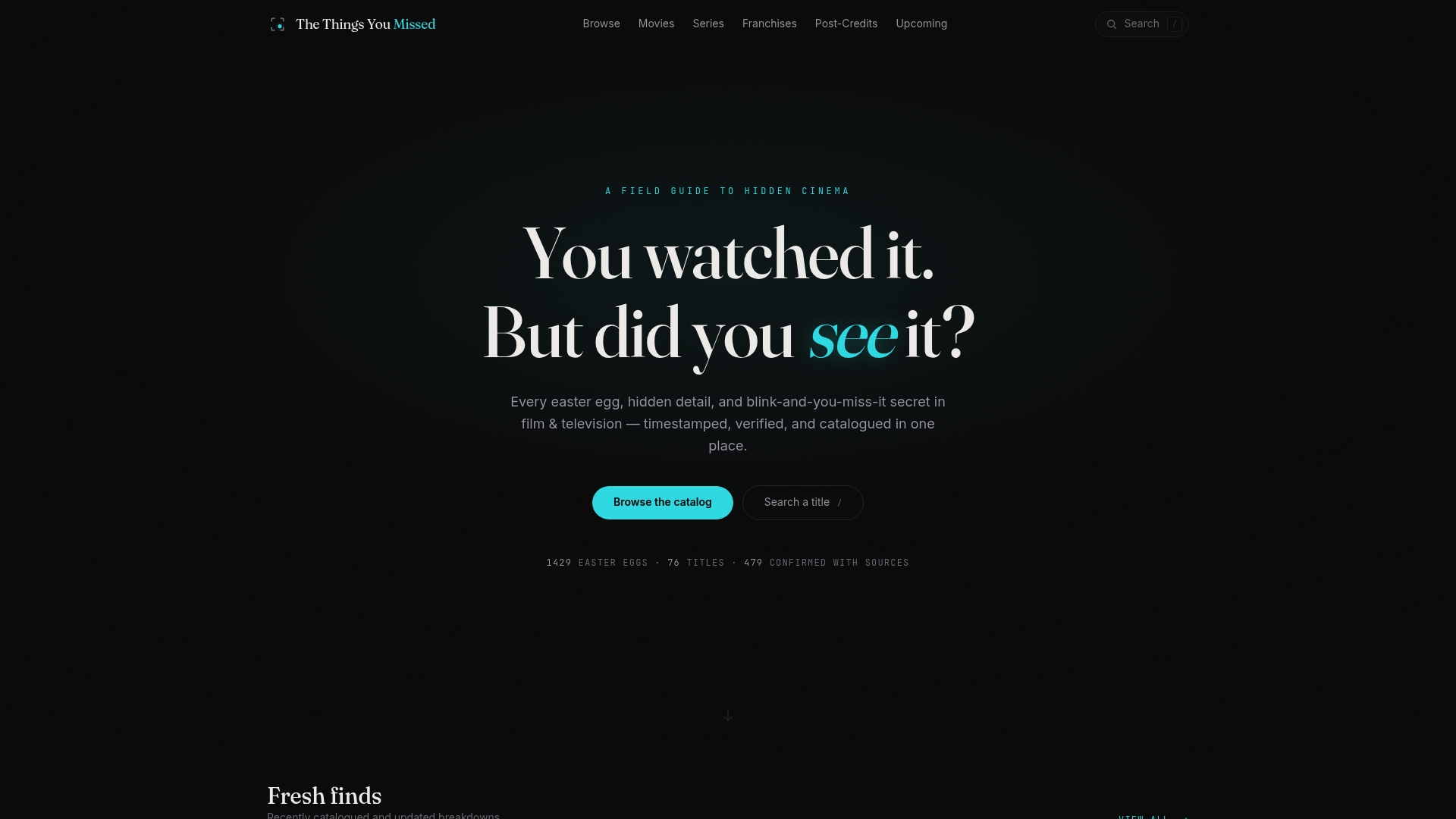
Search a title, jump straight to the timestamp, and skip the eggs tied to plot points you haven’t reached yet. Start with the TV series Easter egg catalog and see what your favorite show has been hiding.
Sources
- Why is the number 1,729 hidden in Futurama episodes? — BBC News
- Variety — coverage of modern Easter-egg tactics (2026)
- Long running TV Easter eggs: Is one really hidden in the background of every episode? — Den of Geek
- 10 Best Easter Eggs in TV History (TV Insider)
FAQ
What do Easter eggs in TV shows mean?
They’re hidden details, props, numbers, symbols, or lines that creators plant on purpose for attentive viewers to find. They usually signal foreshadowing, an inside joke among the crew, or a connection to another part of the same story.
What are some Easter eggs for TV shows on Google?
Searching a specific show plus “Easter eggs” usually surfaces fan-compiled lists, but accuracy varies widely between sources. A timestamped, verified catalog gives more reliable results than a general search, since entries are sourced rather than crowd-guessed.
What are some hidden gems of TV series?
Standouts include Lost’s recurring number sequence, the White Bear symbol across Black Mirror, and the substitution cipher hidden in Fringe’s on-screen glyphs. Each rewards a rewatch rather than a single viewing.
What are some famous Easter eggs in movies?
Film Easter eggs range from studio in-jokes to cross-franchise cameos planted by prop and production teams. Readers looking specifically for film examples can check a movie-focused Easter egg catalog for sourced, timestamped breakdowns by title.