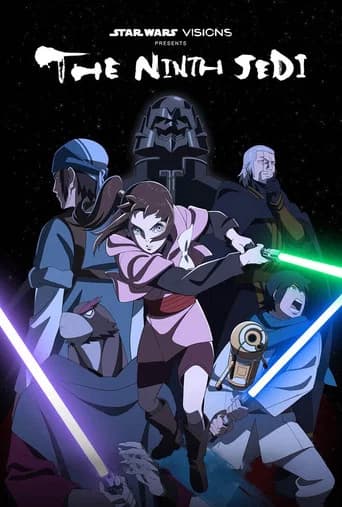
The Things You Missed

Star Wars: Visions Presents - The Ninth Jedi — Easter Eggs & Hidden Details

The show two outlets can't agree on: one counted forty references, one says it cites nothing. What survives the sorting is a Japanese sword-arts term hidden in a blade colour.

2026 · Series · 1 season · Kenji Kamiyama, Shunsuke Tada, Mitsuyasu Sakai

20 eggs catalogued✓ 8 confirmed? 4 theoriesupdated 2026-09-30

Edited by Christian Nielsen

The short version

Star Wars: Visions Presents - The Ninth Jedi (2026) hides 20 catalogued easter eggs and hidden details, 8 of them confirmed by official sources. Standouts include the colour-changing lightsabers exist because kamiyama misremembered the original trilogy, the silver blade is named after a japanese sword-arts idea: mu no kyōchi and the holograms were deliberately designed to look like 1977 technology. Every entry below includes where to look, a spotting difficulty, and sources.

Every egg on this page

  1. The Colour-Changing Lightsabers Exist Because Kamiyama Misremembered the Original Trilogy
  2. The Silver Blade Is Named After a Japanese Sword-Arts Idea: Mu no Kyōchi
  3. The Holograms Were Deliberately Designed to Look Like 1977 Technology
  4. Kara's Floating Droid Was Written Into R2-D2's Bloodline on Purpose
  5. The Warlord Was Built From Anakin and Vader — Then Handed a Blue Lightsaber
  6. Kara's Incompetence Is Engineered — She Is Running Luke's Arc, Not a Master's
  7. The Lightsaber Hilts Were Drawn From Katanas and Spears, Not Star Wars Props
  8. Gramps, the Droid Who Wanted a Hot Drink in 2021, Is Flying the Ship Again
  9. The Tracker That Gives Them Away in Episode 1 Was Planted in the Previous Short
  10. Episode 7 Is Officially Titled "The Jedi Strike Back"
  11. The Series Ends Exactly Where the 2021 Short Began — On Hy Izlan
  12. The Jedi Hunter Kara Spares Is the One Who Kidnapped Her Father
  13. Juro Comes Back as a Force Ghost — the One Original-Trilogy Device the Series Does Use
  14. The Last Shot Is Zhima Forging a Lightsaber for the Prisoner Kara Refused to Kill
  15. The Japanese Narrator Is Akio Ōtsuka — Kamiyama's Batou From Ghost in the Shell
  16. The Score Is by Kamiyama's Own Composing Duo, Imported From Ghost in the Shell: SAC_2045
  17. The Ruined Dome in the Opening Montage — Coruscant's Senate, or Nothing at All
  18. Gennoh's Cyborg Rebuild Puts Him in General Grievous's Shape
  19. The Asteroid Miners of Bibin Read as Dwarves — and Kamiyama Did Direct a Tolkien Film
  20. The Kyber Cannon Is Built on Death Star Grammar, Down to the Reported Dialogue

This is the rare Star Wars page where the honest work is subtraction. Set roughly two centuries after Luke, in a galaxy with no Empire and no Order left to speak of, Kenji Kamiyama's eight-episode Production I.G series was built to owe the films nothing — and reviewers noticed. Ryan Britt's Inverse review puts it flatly: "Not a single planet, starship, or character from the existing Star Wars canon is referenced." ScreenRant, meanwhile, published a list of over forty "easter eggs, references and parallels." Both pieces are describing the same eight episodes.

They can both be partly right, and sorting out how is what this page is for. Almost everything on the long list is a parallel — a droid army that looks like Separatist hardware, a superweapon that behaves like a Death Star, a cyborg general who rhymes with Grievous. Those are structural echoes of a genre the show is working inside, not planted objects, and they live here as clearly labelled theories. Strip them out and what remains is smaller, stranger and much better sourced: the things the filmmakers themselves say they put in.

And those turn out to be the good ones. The colour-changing lightsaber — the whole visual grammar of the series — exists because a twelve-year-old Kamiyama walked out of the original trilogy believing the blades changed colour on their own, and never let the misunderstanding go. Tada asked his designers to give the holograms the look of "low-tech gadgets from the Episode IV era." Kara's floating droid is described by Kamiyama as standing "in the lineage of R2-D2." The silver blade has a name borrowed from Japanese sword arts. Below: 20 entries across all eight episodes — 8 confirmed from Lucasfilm's own outlet and the crew's own interviews, 8 community reads, and 4 theories that include the disputed ruin in the opening montage, with the review that says it isn't there.

The full catalog

Your hunt

Tick off what you spotted

0 / 20 spotted

Tap the circle on a card when you catch one.

Type
Status
Difficulty

The Colour-Changing Lightsabers Exist Because Kamiyama Misremembered the Original Trilogy

S1E1
Behind the ScenesMetaHidden Detail✓ ConfirmedDeep Cut

WHERE TO LOOK · Every blade ignition in the series — the colour reports the wielder's state of mind, not their allegiance

The single idea this whole corner of Star Wars is built on is a mistake that nobody corrected in time. Kenji Kamiyama saw the original trilogy alone in a cinema at twelve and came away believing lightsaber blades changed colour by themselves, according to the wielder. He learned later that they don't — and used it anyway: "I thought maybe it would be interesting for me to use this idea — to make a lightsaber that changed colors based on somebody's connection to the Force." So in this galaxy the blade is not a faction badge, it is a read-out. Kara's runs colourless until the Force answers her and it flares green; Homen's red blade lightens to purple when he breaks the dark side's hold; Nawaam, the warlord, ignites blue. Watch the colour rather than the duel and the series tells you who everyone is before the dialogue does.
The Silver Blade Is Named After a Japanese Sword-Arts Idea: Mu no Kyōchi

Hidden DetailBehind the Scenes✓ ConfirmedDeep Cut

WHERE TO LOOK · Any silver blade, and specifically the red-to-silver transition mid-fight — Tada calls these the series' most difficult shots

The rarest colour in the series has a specific meaning the show never stops to explain. Director Shunsuke Tada told VFX Voice that "the most crucial part was deciding on the light for the silver saber blade, which represents a state of selfless clarity" — mu no kyōchi, the emptied, egoless mind that Japanese sword arts treat as the highest condition a swordsman can fight in. Silver is therefore not a stronger version of green; it is the absence of self. Tada also named the hardest animation in the series: the shots where Kara's blade "turns red out of anger toward the Nawaam forces and then changes to silver as she fights with a clear, selfless mind." Rage and clarity, in one continuous take, on the same blade.

The Holograms Were Deliberately Designed to Look Like 1977 Technology

Hidden DetailReferenceBehind the Scenes✓ ConfirmedFreeze Frame

WHERE TO LOOK · Any holographic transmission or briefing display — note the coarse scan lines and unstable edges against otherwise crisp animation

Here is a genuine, creator-stated reference to the films in a series that supposedly contains none — and it is in the interface design rather than the plot. Asked about the holographic displays, Tada told VFX Voice: "My request for the hologram design was to give them a look reminiscent of low-tech gadgets from the Episode IV era as much as possible!" It is the one place the series lets itself be openly nostalgic. Everything else on screen is two centuries further on from the original trilogy; the holograms are two centuries behind it, coarse and flickering and blue, because that is what a hologram is supposed to look like. Nobody in the show remarks on it, and it is the only design decision in the series explicitly anchored to a specific film.

Kara's Floating Droid Was Written Into R2-D2's Bloodline on Purpose

ReferenceBehind the Scenes✓ ConfirmedSecond Watch

WHERE TO LOOK · 99-99 at Kara's side throughout — watch what the droid does in her worst moments rather than in the action

99-99 — Four Nines, the small yellow droid who hovers at Kara's shoulder and gets hugged when she needs one — is not an accidental resemblance. Kamiyama describes the design brief as giving the droid a "role in the lineage of R2-D2 as a 'cute and clever partner to the protagonist.'" Tada put the same thing a different way: it "fills the sort of role that C-3PO or R2-D2 does in Star Wars, but we made sure to give it a strong, distinctive personality." It is the cleanest example of how this series actually references the films: not by putting an astromech on screen, but by identifying the function an astromech performs in a Star Wars story and rebuilding it from scratch. Worth noting that Tada's own favourite character in the franchise is R2-D2 — "he's been very loyal to his masters... I can't love him more."

The Warlord Was Built From Anakin and Vader — Then Handed a Blue Lightsaber

S1E1
ReferenceForeshadowingBehind the Scenes✓ ConfirmedFreeze Frame

WHERE TO LOOK · Ethan's report from inside Nawaam's mercenary force — the reveal that the warlord is a Jedi

Spoiler:

Ethan's infiltration of Nawaam's mercenary force ends on the reveal that the man conquering the galaxy is a Jedi, and his blade is blue — the colour the series has spent an episode teaching you to read as sincerity. That is deliberate. Kamiyama says Nawaam is "loosely inspired by Anakin Skywalker and Darth Vader" and "pursues his own idea of justice," and elsewhere explains that "even regarding those aspects that appear to be the dark side, he is actually using that power for the sake of others." The point of the borrowing is to ask a different question than the films did: Kamiyama frames Nawaam against Kylo Ren and Vader specifically to ask "what causes that balance to tip to the point where one truly succumbs to the dark side." A fall you can't diagnose by blade colour, in a show where blade colour is the diagnosis.

Kara's Incompetence Is Engineered — She Is Running Luke's Arc, Not a Master's

ReferenceBehind the Scenes✓ ConfirmedFreeze Frame

WHERE TO LOOK · Kara's training beats and every fight she nearly loses — she does not win a duel cleanly until very late

If Kara seems conspicuously bad at this for a title character, that is the design. Tada is explicit about the model: "Luke was also an unknown boy and not talented in the beginning, [and] he gradually becomes a true Jedi. We tried not to make Kara look like a Master from the beginning, but she's gradually growing." Kamiyama's attachment runs deeper — "my favorite character from the Star Wars universe is Luke Skywalker... I felt Luke's story was my story" — and the series deliberately diverges at one point. Where Kamiyama reads Luke's path as closed off and solitary, Kara's is social: "by openly showing her vulnerabilities, she's able to receive good advice and support from those around her." The fellowship structure is the correction, not the decoration.

The Lightsaber Hilts Were Drawn From Katanas and Spears, Not Star Wars Props

S1E2
Behind the ScenesHidden Detail✓ ConfirmedFreeze Frame

WHERE TO LOOK · Juro presenting Kwana with a lightsaber on Bibin — look at the hilt profile rather than the blade

Lah Zhima is the galaxy's only known sabersmith, and the show treats him as a bladesmith rather than an engineer — which is also how the props were designed. Tada describes the process to VFX Voice: the team "consulted with our prop designer and went through a process of trial and error, taking inspiration from traditional Japanese swords [katanas], spears and other weapons." It shows in the silhouettes. The hilt Juro presents to Kwana on Bibin reads as a tsuka — a wrapped sword grip with a guard's worth of flare at the emitter — and several of the eight blades Zhima forges are proportioned like polearms rather than the industrial tube the films settled on. The kyber, not the casing, is the technology here; the casing is joinery.

Gramps, the Droid Who Wanted a Hot Drink in 2021, Is Flying the Ship Again

CallbackCameo✓ ConfirmedSecond Watch

WHERE TO LOOK · Gramps in the cockpit — the same grumbling pilot droid who wanted his hot drink in the 2021 short

The cantankerous old pilot droid grumbling in the cockpit is not a new character built to type. Lucasfilm's own character guide tracks Gramps as one continuous figure: the "skillful and wily pilot droid that agrees to Kara's request to take her to the station orbiting Hy Izlan" in the 2021 short — the same droid who would "rather be relaxing with a hot drink" — and who "later accompanies Kara, Juro, Homen, and Ethan on their mission to rescue Lah Zhima" across this series. Five years of real time, one unbroken grudge about being made to work. He is voiced by Chō in Japanese and J. P. Karliak in English, and he is the strongest thread tying the series back to the fifteen minutes that started it.

The Tracker That Gives Them Away in Episode 1 Was Planted in the Previous Short

S1E1
CallbackForeshadowing◆ Community ConsensusDeep Cut

WHERE TO LOOK · Homen accounting for how Gennoh found them so quickly, during the opening pursuit

Gennoh Ikagi finds the fellowship almost immediately in the premiere, and Homen's explanation is that Nawaam's forces must have put a tracker on the ship during their last run-in. That is not a line of convenient exposition — it is a payoff for something that happened off this series entirely. The Ninth Jedi: Child of Hope, the 2025 Visions short that bridges the gap, shows a tracker being placed on their ship. The premiere never names the short or recaps it; it simply assumes you either saw it or will take Homen's word. A viewer who skipped the shorts reads the moment as hand-waving, and a viewer who didn't gets a closed loop.

Episode 7 Is Officially Titled "The Jedi Strike Back"

S1E7
MetaReference◆ Community ConsensusPlain Sight

WHERE TO LOOK · The episode title card

The one reference in the series that is printed on the title card. Episode 7 — the Hy Izlan interception, where the scattered Jedi finally stop running and meet Nawaam's fleet with a coalition behind them — is called "The Jedi Strike Back." It is the only episode title in the run that borrows its construction from a film, and it borrows the most famous one. The joke also cuts against itself: the episode it names after The Empire Strikes Back is the one where the heroes go on the offensive and still lose the thing they came for, since Nawaam walks away from it with the giant kyber crystal. The structural rhyme with the film is exact, and probably not accidental.

The Series Ends Exactly Where the 2021 Short Began — On Hy Izlan

S1E8
Callback◆ Community ConsensusSecond Watch

WHERE TO LOOK · The founding of the new Jedi Order on Hy Izlan, the world of the 2021 short

Spoiler:

Hy Izlan is the world Kara came from and the world the fifteen-minute short took place on: her father's forge, Juro's temple, the station she talked Gramps into flying her to. The series spends six episodes moving away from it and then turns around. Nawaam wants the giant kyber crystal buried there; the coalition fleet intercepts him above it in episode 7; and after the cannon falls the survivors found their new Jedi Order on the same ground. It is a deliberately small map for a story about a galaxy — the entire war is fought over the planet the first short treated as a backwater, and the new Order is seeded in the soil the old one's last sabersmith was working in.

The Jedi Hunter Kara Spares Is the One Who Kidnapped Her Father

S1E6
CallbackForeshadowing◆ Community ConsensusFreeze Frame

WHERE TO LOOK · Kara's escape from the Jedi Hunters — she kills Eht, spares Bee-Toh, and arms him

Spoiler:

Episode 6 puts Kara in the hands of the Jedi Hunters Eht and Bee-Toh, and when she escapes she kills Eht and spares Bee-Toh — then hands him a blue lightsaber and recruits him. The mercy is pointed, because Lucasfilm's character guide is specific about who Bee-Toh is: he is the hunter who "captured Lah Zhima on Nawaam's orders." The man who started the plot by taking her father becomes the ninth-hour addition to the group trying to get him back. And the blade she gives him lights blue, which in this series is not a gift of trust so much as a verdict delivered by the weapon itself.

Juro Comes Back as a Force Ghost — the One Original-Trilogy Device the Series Does Use

S1E6
CallbackReference◆ Community ConsensusSecond Watch

WHERE TO LOOK · Kara's conversation with Juro while imprisoned by the Jedi Hunters

Spoiler:

For a series that refuses to import anything from the films, episode 6 reaches for the most recognisable piece of Jedi metaphysics there is. Juro, mortally wounded two episodes earlier, appears to Kara while she is a prisoner of the Jedi Hunters and talks her back from the edge — reassuring her against the darkness she had just felt herself fall into. Mechanically it is Obi-Wan on Hoth: a dead master, a cornered student, and advice about trust. The series never uses the phrase "Force ghost" or explains how it works, which is the interesting part — two hundred years after the Order collapsed, the trick survives without the vocabulary.

The Last Shot Is Zhima Forging a Lightsaber for the Prisoner Kara Refused to Kill

S1E8
ForeshadowingCallback◆ Community ConsensusFreeze Frame

WHERE TO LOOK · The closing scenes after the new Order is founded — Zhima at the forge, working for the prisoner

Spoiler:

Kara beats Nawaam, runs him through, and pulls the blade back with the Force at the last possible instant — then tells him that a leader without compassion is doomed and that the nothingness he worships is a lie. What the finale does with him afterwards is the sharper choice: Nawaam is imprisoned, and Lah Zhima builds him a lightsaber. In a galaxy where a blade reports its wielder's heart in real time, that is simultaneously a mercy, a sentence and an experiment. Nobody in the scene has to say what colour it will light; the series has spent eight episodes making the audience ask the question for itself. It is also the most obvious thread left hanging for whatever Visions Presents does next.

The Japanese Narrator Is Akio Ōtsuka — Kamiyama's Batou From Ghost in the Shell

S1E1
CameoBehind the ScenesMeta◆ Community ConsensusDeep Cut

WHERE TO LOOK · The opening narration of the Japanese-language audio track

The gravel-voiced narrator who opens the Japanese-language version is Akio Ōtsuka, and the casting is a twenty-year reunion rather than a coincidence. Ōtsuka voiced Batou across Ghost in the Shell: Stand Alone Complex, the series Kamiyama directed and wrote that made his name, and he is the Japanese voice of Solid Snake besides. Handing him the prologue is Kamiyama stamping the series with his own house voice before a single character speaks — and because it is a dub-only detail, English-language viewers have no way to hear it. Ōtsuka is not credited in the English version at all.

The Score Is by Kamiyama's Own Composing Duo, Imported From Ghost in the Shell: SAC_2045

S1E1
Music SecretBehind the Scenes◆ Community ConsensusDeep Cut

WHERE TO LOOK · The end-credit composer cards on any episode, then the Hy Izlan battle music

Nobuko Toda and Kazuma Jinnouchi write the music, and they are not generalists hired for a Star Wars job — they are Kamiyama's regular collaborators. The pair scored Ghost in the Shell: SAC_2045 for him and Shinji Aramaki, and worked on Ultraman, which Kamiyama co-directed; between them they also carry the Metal Gear Solid series and Halo 5: Guardians. The result is a Star Wars series whose sound comes out of Japanese game and anime scoring rather than the symphonic-Hollywood tradition, which is much of why the show's fights read as anime action rather than as a lightsaber duel in the films' idiom. Same director, same composers, different galaxy.

The Ruined Dome in the Opening Montage — Coruscant's Senate, or Nothing at All

S1E1
Hidden DetailReference? TheoryWhite Whale

WHERE TO LOOK · The montage of past wars under the opening narration — the collapsed domed structure

This is the entry the site's own sourcing rules force us to leave unresolved, and it is worth reading as a warning about the rest of the internet's lists. Under the opening narration the series runs a montage of wars past, and ScreenRant identifies one shot as a collapsed structure resembling the Galactic Senate Building on Coruscant — which would be the series' one and only direct link to the films' map. Ryan Britt's Inverse review, filed the day the show dropped, rules it out flatly: "Not a single planet, starship, or character from the existing Star Wars canon is referenced." No creator interview mentions the shot, no official Lucasfilm material identifies it, and a domed ruin in a montage of collapsed civilisations is exactly the kind of image a viewer completes from memory. Theory, and probably a projection — but a fun one to freeze-frame and argue about.

Gennoh's Cyborg Rebuild Puts Him in General Grievous's Shape

S1E5
Reference? TheoryFreeze Frame

WHERE TO LOOK · Gennoh receiving his cyborg body

Spoiler:

Episode 5 takes the masked warrior who has been chasing the fellowship since the premiere and rebuilds him: Gennoh Ikagi is given a cyborg body, and two episodes later he duels Lah Zhima at full power. Readers of ScreenRant's list place him as this galaxy's General Grievous — a dark-side duellist upgraded from flesh into machinery, escalating with every engagement. The rhyme is real and the show does nothing to hide it, but nothing in the series or in any creator interview ties the design to Grievous specifically, and the villain-becomes-machine beat is franchise-wide furniture rather than a planted object. Filed as a parallel, which is what it is.

The Asteroid Miners of Bibin Read as Dwarves — and Kamiyama Did Direct a Tolkien Film

S1E2
Reference? TheoryDeep Cut

WHERE TO LOOK · The recruitment of the miners on Bibin

Episode 2 takes the fellowship to Bibin, the mining world where Juro and Zhima trained, to recruit its miners into the war. ScreenRant reads the miners as patterned on Tolkien's dwarves, and the biographical circumstance makes that tempting: Kamiyama's previous project was The Lord of the Rings: The War of the Rohirrim in 2024, so he came to this series directly off Middle-earth. Against it, Kamiyama's own account of the world is strictly functional — the asteroid vessels, he says, "came out of exploring what kind of starship would fit a mining planet and how we could give it a strong sense of uniqueness," with no homage mentioned. Subterranean miners who love their rock are their own archetype. Theory, flagged because the timing is suggestive rather than because the evidence is.

The Kyber Cannon Is Built on Death Star Grammar, Down to the Reported Dialogue

S1E2
Reference? TheorySecond Watch

WHERE TO LOOK · Nawaam revealing the superweapon and firing on Bibin

Spoiler:

Nawaam's superweapon is revealed in episode 2 and immediately fired at Bibin, missing narrowly; by the finale it is drawing on the giant kyber crystal from Hy Izlan and a boarding party is sabotaging it while a fleet disables the engines. Every structural beat is the Death Star's, and ScreenRant goes further, reporting Death Star vocabulary in the dialogue — a "fully operational" line, and a wing shape it likens to a TIE fighter's. Those specific quotations rest on a single outlet, and Inverse's review insists the series references nothing from canon at all, so the dialogue claims stay unverified here. The shape of the thing, though, is undeniable: a planet-killer powered by a sacred crystal, with a vent to find. Kyber weaponry is the series' own idea; the staging is borrowed.

Frequently asked

+How many easter eggs are in Star Wars: Visions Presents - The Ninth Jedi?

We catalogue 20 entries across all eight episodes: 8 confirmed by Lucasfilm's own outlet or by the filmmakers in interviews, 8 community reads, and 4 theories. That number is deliberately far below the "over 40" other outlets have published, because most of those items are thematic parallels rather than planted references — and this series was built to contain very few of the latter.

+Does The Ninth Jedi reference the main Star Wars films?

Barely, and that is the point. Inverse's review states that not a single planet, starship or character from existing canon appears. What the filmmakers do confirm is a handful of deliberate design homages: the holograms were drawn to look like "low-tech gadgets from the Episode IV era," Kara's droid 99-99 was written into "the lineage of R2-D2," the villain Nawaam is "loosely inspired by Anakin Skywalker and Darth Vader," and Kara's arc was consciously modelled on Luke's. Everything else circulating as an easter egg — Death Star echoes, a Grievous-shaped cyborg, droideka lookalikes — is a structural parallel, and we label those as theories.

+Do I need to watch the Star Wars: Visions shorts before the series?

It helps more than the series admits. "The Ninth Jedi" (Volume 1, 2021) establishes Kara, her sabersmith father, Margrave Juro, the colour-changing blades and the droid Gramps; "The Ninth Jedi: Child of Hope" (Volume 3, 2025) bridges to the series and, among other things, shows the tracker that gets the fellowship found in episode 1. The series never recaps either. You can follow the plot cold, but several beats land as coincidence instead of payoff.

+What do the lightsaber colours mean in The Ninth Jedi?

Not allegiance — state of mind. Lah Zhima tempers kyber so the blade reports the wielder's relationship with the Force in real time: Kara's runs colourless until it flares green, Homen's red lightens to purple once he breaks the dark side's hold, and General Nawaam ignites blue despite conquering the galaxy. Silver is the rarest and means the most: director Shunsuke Tada says it represents "a state of selfless clarity" — mu no kyōchi, the emptied mind of Japanese sword arts.

+Is Star Wars: Visions Presents - The Ninth Jedi canon?

No. Visions sits outside the canon timeline by design, which is precisely why this series can set itself roughly two hundred years after Luke in a galaxy with no Empire, rewrite how kyber crystals work, and reference nothing. It is the first limited series under the Visions Presents banner, a Lucasfilm initiative to expand the most popular anthology shorts into longer form.

+Where did the colour-changing lightsabers come from?

A misunderstanding that nobody corrected in time. Kenji Kamiyama saw the original trilogy alone in a cinema at twelve and came away believing lightsaber blades changed colour on their own; he learned otherwise later and kept the idea anyway. "I thought maybe it would be interesting for me to use this idea — to make a lightsaber that changed colors based on somebody's connection to the Force." The entire visual grammar of The Ninth Jedi grows out of that error.

Recurring motifs in this title

These devices show up across the catalogue, not just here. Each one opens the full list of everywhere we have catalogued it.

Last updated 2026-09-30 · Spotted something we missed? Tell us.