Six Montage Examples Film Students Should Study Shot by Shot
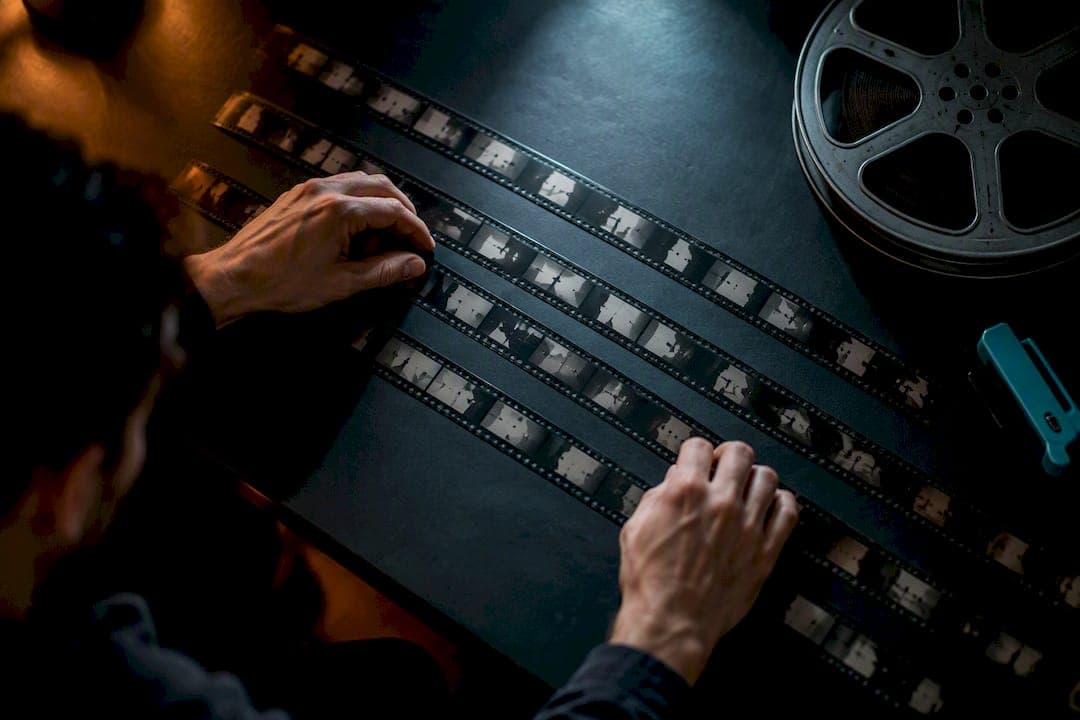
A montage is an edited sequence of shots that creates meaning by compressing time, juxtaposing images, or condensing information the audience would otherwise have to sit through in real time. Its three main jobs are compressing progress (Rocky’s training runs), showing repetition or learning, and building ideological or emotional juxtaposition (the Odessa Steps). The canonical examples below, from Eisenstein’s Soviet cinema to Parasite’s peach, map directly onto a repeatable writing and editing process.
TL;DR:
- Most effective montages combine at least two of Eisenstein’s methods, such as metric and intellectual, to deepen emotional and conceptual impact.
- To craft a montage, define its dramatic purpose first, then include only shots that build on that goal without unnecessary repetition.
- Rhythm, sound, and motif repetition are key tools for manipulating viewer engagement, making sequences feel more dynamic or emotionally charged.
- Montages often blend with cross-cutting techniques, so consider whether the sequence advances through time or parallel action to choose the appropriate method.
- Studying specific sequences with timestamped shot maps reveals patterns that explain why some montages resonate and others fall flat.
Table of Contents
- What Counts as a Montage, and What Kind Is It?
- Six Montages Every Film Student Should Study Shot by Shot
- How to Write a Montage in a Screenplay
- Building the Cut: Rhythm, Music, and Motif
- Montage vs. Cross-Cutting: Choosing the Right Tool
- Mapping a Montage: A Study Method for Students
- Montage After Eisenstein: How the Technique Evolved
- Why Montage Hits Different: The Psychology of the Cut
- Montage Around the World and Across Genres
- Montage Beyond Film: Advertising and Music Videos
- Common Montage Pitfalls (and How to Dodge Them)
- Study Every Sequence You Just Read About, Shot by Shot
- Sources
- FAQ
What Counts as a Montage, and What Kind Is It?
Britannica defines montage as an editing technique that assembles separate, thematically related shots so their arrangement creates meaning, compresses time or space, condenses information, or interweaves storylines. Sound can do this work too, Britannica notes, which is why a needle drop can carry as much montage logic as a cut. That’s the crucial distinction from continuity editing: continuity hides the cut so time feels continuous; montage foregrounds the cut so the collision between shots becomes the point.
Sergei Eisenstein, the Soviet theorist whose Battleship Potemkin still anchors film-school syllabi, broke montage into five methods that StudioBinder catalogs as the field’s working vocabulary:
- Metric montage cuts on a fixed measure of length regardless of content, producing a mechanical, almost musical pulse.
- Rhythmic montage cuts to visual rhythm inside the frame, letting movement (not a stopwatch) dictate the pace.
- Tonal montage cuts around the emotional mood of a shot, so grief, dread, or elation carries the transition.
- Overtonal montage layers metric, rhythmic, and tonal cutting simultaneously, producing a denser emotional chord than any single method alone.
- Intellectual montage juxtaposes unrelated images so their collision produces an idea, the mental leap that made Eisenstein’s Odessa Steps a political argument rather than a scene.
These categories describe how a sequence works, not a recipe you follow in order. Most real montages blend two or three at once. Georgetown’s gnovis journal frames Eisenstein’s core insight well: a shot’s meaning is relational, meaning shot B changes how you read shot A. When you’re trying to classify a sequence, ask which relationship dominates. If the cuts land on a metronome, it’s metric. If they land on an idea, it’s intellectual.
Six Montages Every Film Student Should Study Shot by Shot
1. Rocky’s Training Montage
Rocky’s 1976 training sequence set the template every sports movie has copied since: failure, then a regimen, then visible evidence of progress, then a payoff that proves the work mattered. The famous stair sprint at the end isn’t decoration. It’s the montage’s thesis, delivered in one image, that Rocky has closed the gap between where he started and where he needs to be.
2. Battleship Potemkin’s Odessa Steps
Eisenstein’s 1925 sequence remains the field’s founding case study in montage as political argument. By cutting between fleeing civilians, a mother’s dead child, and the mechanized advance of Cossack soldiers, Eisenstein builds outrage through juxtaposition rather than narration. Douglas Kellner’s analysis for UCLA describes how the sequence uses montage to indict state violence by making the viewer assemble the moral conclusion themselves, cut by cut. A century later, the sequence still teaches the same lesson: intellectual montage works because the audience does the arguing, not the filmmaker.
3. The Godfather’s Baptism and Assassinations
Francis Ford Coppola’s 1972 sequence cross-cuts Michael Corleone standing as a baptismal godparent with the coordinated murders he’s ordered across the city. The sacred and the murderous share the same rhythm, the same organ score, and that overlap is the entire point. It’s intellectual montage doing moral critique: Michael’s institutional piety and his violence are shown to be the same machine. If you want a companion read on how the Corleone family encodes menace into recurring visual detail, the trilogy’s orange symbolism works the same territory from a different angle.
4. Goodfellas’ “Layla” Aftermath
Martin Scorsese’s 1990 sequence surveys a string of murders tied to the Lufthansa heist, scored to the piano coda of Derek and the Dominos’ “Layla.” The music doesn’t match the violence; it contradicts it, gliding and melancholic while bodies turn up in a car, a dumpster, a meat truck. That mismatch is the subtext. Scorsese edits to music with surgical precision, and Britannica’s editing overview treats his song choices as structural, not decorative, a sound mixer’s note confirmed by Tom Fleischman’s account of how the score interacts with on-screen sound rather than simply riding the beat.
5. Parasite’s Peach Sequence
Bong Joon Ho’s 2019 peach sequence runs about five minutes and uses a high number of shots according to No Film School’s analysis, turning a single allergen into a plot weapon.
The peach fuzz that triggers the housekeeper’s allergy isn’t introduced as a threat. It becomes one through repetition, each glance at the fruit accumulating dread the audience can’t yet name. That’s motif-driven montage at its sharpest: an ordinary object, weaponized through repeated attention, and No Film School’s own read notes that Bong keeps a controlled visual continuity, consistent framing and camera movement, beneath the fragmentation, which is why the sequence feels tense rather than chaotic.
6. Up’s “Married Life”
Pixar’s 2009 opening compresses an entire marriage, courtship through widowhood, into roughly four wordless minutes. Animation gives this montage an advantage live action rarely has: color grading and character design can age Carl and Ellie gradually across the same shot setups, so the audience registers decades passing through visual erosion rather than title cards. It’s the clearest demonstration in the medium that montage’s real currency isn’t screen time. It’s compression of felt time.
How to Write a Montage in a Screenplay
Screenwriting format treats montage as a container, not a scene. The standard slug line reads MONTAGE or MONTAGE - VARIOUS LOCATIONS, followed by a short run of single-line visual beats, and closes with END MONTAGE if the script returns to a specific location afterward. Final Draft’s own guidance is blunt on length: a montage that runs past a page risks losing the reader’s patience, because the format rewards brevity over exhaustive coverage.
Before you write a single beat, write one sentence stating the montage’s dramatic function. What does the audience know or feel differently by the end that they didn’t at the start? Every beat you draft afterward gets tested against that sentence, and anything that doesn’t serve it gets cut.
- Each beat must add new plot or character information, not just repeat the previous one in a different location.
- Note location changes explicitly. A montage jumping between five sets is a scheduling problem for production, not just a writing choice.
- Flag any beat that needs dialogue or performance coverage. If a beat needs an actor to react, it may function better as a short scene than a montage image.
- Keep beats visual and active. “He gets better at boxing” is a summary. “He lands three clean jabs where he missed before” is a beat.
Pro Tip: If a single beat in your montage needs more than one sentence to describe, it’s asking to be its own scene. Montage beats should read like captions, not paragraphs.
Building the Cut: Rhythm, Music, and Motif
Speed and rhythm aren’t the same tool. Speed is how fast the cuts come. Rhythm is the pattern those cuts fall into, and a montage can be fast but arrhythmic (chaotic) or slow but tightly rhythmic (hypnotic). Editors control urgency by combining shot length, camera movement, and audio density, not by simply cutting faster.
- Shorten shot duration as a sequence builds, but vary the rate of shortening so the pattern doesn’t feel mechanical.
- Choose music for what it contradicts or confirms emotionally, the way Scorsese uses “Layla” as ironic counterpoint rather than mood matching.
- Use a repeated object or gesture as a visual anchor, the way Parasite’s recurring motifs turn an ordinary detail into a narrative engine.
- Bridge cuts with sound, letting one scene’s audio spill into the next shot, so the ear smooths over jumps the eye would otherwise flag as jarring.
Montage vs. Cross-Cutting: Choosing the Right Tool
Montage and cross-cutting solve different problems, and confusing them produces sequences that feel busy without feeling purposeful. Montage compresses or leaps through time to build meaning through juxtaposition; cross-cutting alternates between simultaneous actions happening at the same time in different places, the way The Godfather’s baptism intercuts with murders occurring at that exact hour. StudioBinder’s breakdown draws that line clearly: one bends time, the other holds it steady across parallel threads.
Many strong sequences hybridize both, using montage’s compression within a cross-cut structure, exactly what makes the Godfather sequence so dense. Ask three questions before you commit to a structure:
- Is time passing, or are these events simultaneous? Passing time points to montage; simultaneity points to cross-cutting.
- Does the meaning come from accumulation or from tension between parallel threads? Accumulation favors montage; suspense favors cross-cutting.
- Would cutting away and back read as urgency or as summary? Urgency wants cross-cutting’s alternation; summary wants montage’s compression.
Mapping a Montage: A Study Method for Students
Vague praise (“great editing”) teaches you nothing you can reuse. A shot map does. Build five columns: shot or sound event, duration, visual subject, relation to the preceding shot, and what changes in the story because of that shot. gnovis’s framework for reading montage relationally works because it forces you to name the relationship between cuts instead of just describing the images.
Pick a 30 to 90 second sequence, Rocky’s stairs or Parasite’s peach both work well, and fill in every row. Patterns emerge fast: a metric montage shows near-identical durations across rows; an intellectual montage shows wild subject swings with tight thematic links in the “story change” column.
- Time the sequence with a stopwatch or a video editor’s timeline, not a guess.
- Note whether duration shortens, lengthens, or stays flat as the sequence builds.
- Flag any shot that repeats a prior image; that’s usually your motif.
Pro Tip: Run the same shot map on a montage you dislike. The gaps in the “story change” column usually explain exactly why it felt hollow. For timestamped versions of several sequences discussed here, Thethingsyoumissed’s movie archive breaks specific scenes down beat by beat.
Montage After Eisenstein: How the Technique Evolved
Eisenstein built his theory around Soviet propaganda cinema, but montage’s toolkit expanded fast once other national cinemas adopted it. French New Wave editors in the 1960s used jump cuts and mismatched continuity to create a rougher, more self-aware montage style, one that called attention to its own construction rather than smoothing it over. Hollywood absorbed montage into commercial genre formulas across the 1970s and 1980s, most visibly in the sports and training sequences that Rocky popularized, where montage became less about ideological argument and more about audience efficiency: get from point A to point B without losing momentum.
Music-driven montage matured alongside the music video format in the 1980s, and editors like Scorsese carried that sensibility back into narrative feature work, using entire songs as structural spines rather than background texture. Digital nonlinear editing systems, arriving through the 1990s, made rapid experimentation with shot order and rhythm dramatically cheaper, which pushed montage from a specialized theoretical tool into something editors could iterate on dozens of times in an afternoon. Contemporary filmmakers now treat montage as a flexible register they can dial up or down within a single scene rather than a discrete “montage sequence” set apart from the rest of the film, visible in how directors blend montage logic into otherwise continuous scenes without ever cutting to a formal slug line, as seen in Christopher Nolan’s The Odyssey which showcases modern uses of montage in big-budget filmmaking.
Why Montage Hits Different: The Psychology of the Cut
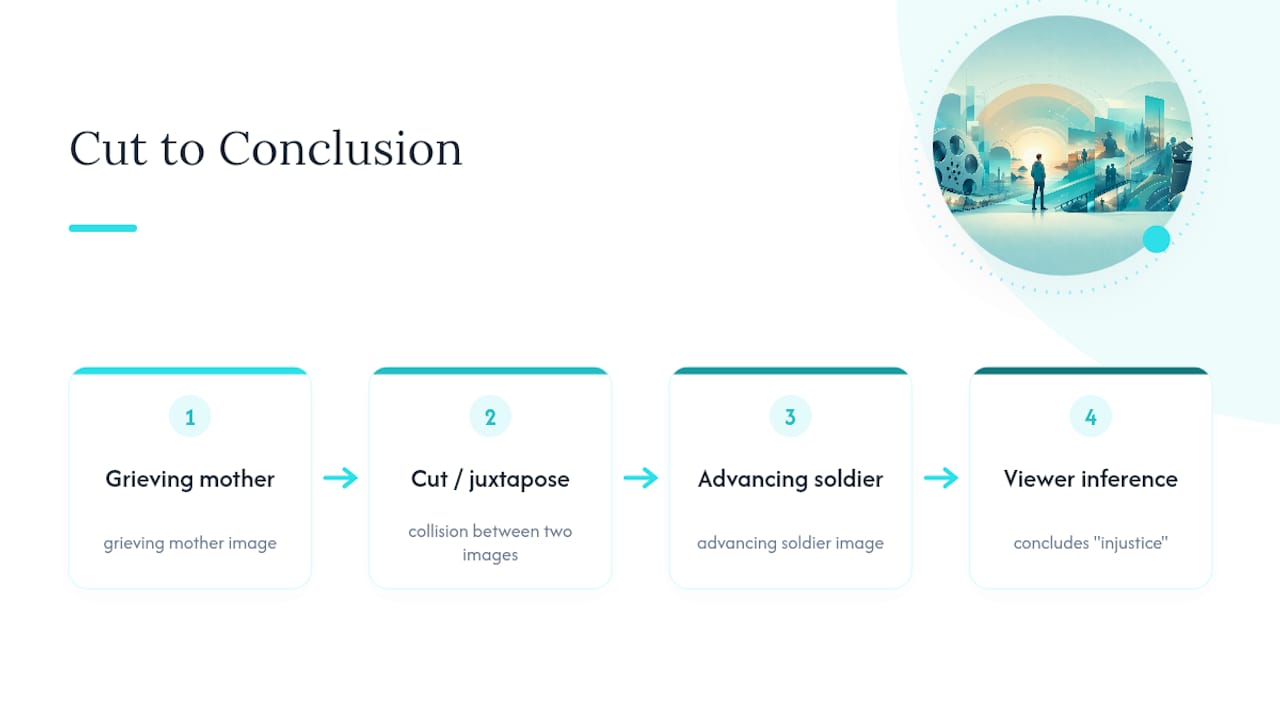
Montage works on audiences because it exploits how people naturally fill gaps. When Eisenstein cuts between a grieving mother and an advancing soldier, no line of dialogue states “this is unjust,” yet audiences arrive at that conclusion themselves because the mind resolves the collision between two images into a single idea. That’s the mechanism behind intellectual montage’s power: conclusions the viewer generates land harder than conclusions the film hands them.
Rhythm manipulates emotional pace directly. A montage that accelerates its cutting rate mimics the physiological signature of excitement, quickened breathing, a racing pulse, and audiences respond to that rhythm almost independently of the images themselves. That’s why a poorly chosen montage can feel exciting even when the content is thin, and why a well-chosen one, like Up’s slow, held shots in “Married Life,” can feel devastating precisely because it refuses to rush.
Motif-driven montage adds a third psychological lever: repetition trains attention. A repeated motif in a montage can become threatening through repeated attention, teaching the audience to treat it as significant before the plot confirms why. Removing the repetition would make the payoff feel like a random detail rather than an expected event.
Montage Around the World and Across Genres
Montage’s ideological roots in Soviet cinema didn’t confine it to political filmmaking. Bong Joon Ho’s use of motif montage in Parasite descends from a very different tradition than Eisenstein’s, closer to observational character work than argument, while still relying on the same juxtaposition logic that made the Odessa Steps land. South Korean cinema more broadly has leaned on tonal montage to shift genre registers mid-film, letting a sequence swing from comedy to horror through cutting alone rather than a hard scene break.
Genre conventions shape how montage gets used almost as much as national film culture does. Sports films lean on the Rocky template because physical training visualizes progress cleanly. Crime and gangster films, Goodfellas chief among them, favor music-driven montage because it lets a director cover a lot of violent plot without lingering on any single act. Animated films, as Up demonstrates, get access to montage tools live action can’t easily match: gradual character redesign, color shifts, and background changes that compress years without a single line of dialogue.
International art cinema has pushed montage furthest from its Soviet origins, often stripping out narrative urgency altogether and using juxtaposition purely for tonal or philosophical effect. The technique that started as a weapon for political argument now shows up anywhere a filmmaker needs to compress, contrast, or accelerate, regardless of genre or national tradition, which is part of why it remains one of editing’s most durable tools.
Montage Beyond Film: Advertising and Music Videos
Advertising borrowed montage almost as soon as television made rapid-fire cutting technically viable, and a 30-second commercial is often structured exactly like a training montage: problem, product, transformation, payoff, compressed into a fraction of Rocky’s runtime. The compression logic is identical even though the goal (selling a product rather than building character) is completely different.
Music videos took montage in the opposite direction from advertising’s tight causality. Where a commercial’s montage builds toward a single persuasive point, a music video montage often abandons narrative logic entirely and cuts purely for tonal or rhythmic effect, matching image to beat the way Eisenstein’s metric montage matches image to a fixed measure. The difference is intent: film montage almost always serves character or plot, even at its most abstract, while a music video’s montage can serve pure sensation without owing the viewer any throughline at all. Understanding that distinction matters if you’re translating montage technique across mediums. What reads as thrillingly disjointed in a three-minute music video would read as incoherent in a feature film asking an audience to track character motivation for two hours.
Common Montage Pitfalls (and How to Dodge Them)
Most bad training montages fail for the same reason: they copy Rocky’s shape without earning it, so the audience clocks the formula and checks out. The fix isn’t abandoning montage. It’s making sure the payoff reveals cost, not just triumph. What did this progress take from the character? Favor a motif or character detail over a generic time-lapse of calendar pages and rain-soaked windows. Parasite’s peach works because it’s specific to that story. A generic clock-wipe works for nothing in particular.
— Christian
Study Every Sequence You Just Read About, Shot by Shot
Reading a montage breakdown is useful. Watching the exact frame where a motif first appears, with a timestamp instead of a rough guess, teaches faster. Some platforms catalog verified, timestamped entries for sequences discussed here, with spoiler-safe browsing so viewers can research a film without ruining the ending.
If you want to study the baptism sequence’s cross-cutting rhythm shot by shot, or trace how Parasite’s peach motif recurs across the runtime, search the movie catalog for the specific title and jump straight to the annotated moment. Working on a TV thesis instead? The series catalog breaks down montage sequences episode by episode with the same verified, sourced approach. Pull up the title you’re studying and start timestamping your own shot map against ours.
Sources
- Montage | Film Editing, Visual Storytelling & Editing Techniques | Britannica
- What is a Montage? Definition, Examples & 6 Ways to Use Them | StudioBinder
- How to write an effective montage | Final Draft
- Douglas Kellner - ‘One Eisenstein’s Potemkin’ essay (UCLA)
FAQ
What Are the Five Types of Montage?
Sergei Eisenstein defined metric, rhythmic, tonal, overtonal, and intellectual montage as the five core methods, each governing how shots relate to each other, whether by fixed length, internal movement, mood, layered combination, or conceptual collision, as StudioBinder outlines. These are analytical lenses rather than strict production categories, and most real sequences blend two or more.
How Do You Write a Montage in a Screenplay?
Use the slug line MONTAGE or MONTAGE - VARIOUS, list short single-line visual beats, and close with END MONTAGE if the story returns to a specific setting. Final Draft recommends keeping the whole sequence under a page, since longer montages tend to lose reader momentum.
How Do You Create a Montage in Editing?
Start by defining the before-and-after change the sequence needs to show, then choose one visual rule or motif to carry it, per StudioBinder’s workflow. List only beats that add new information, vary shot scale and pacing, cut for rhythm and sound, and end on a payoff that changes what happens in the next scene.
What Is a Short Montage?
A short montage compresses a small window of time or a single idea into a handful of shots, often ten seconds to under a minute, rather than the multi-minute sequences seen in Rocky or Up. The same principles apply at that scale: every shot still needs to earn its place against the sequence’s one-sentence dramatic purpose.
How Do I Study a Montage for a Film Class Assignment?
Build a shot map with columns for duration, visual subject, relation to the prior shot, and story change, then fill it in for a 30 to 90 second sequence. Thethingsyoumissed’s motif entries and timestamped movie breakdowns give you a verified reference point to check your own shot map against.