Verify Nope Easter Eggs With Timestamped, Sourced Evidence

The three eggs that matter most in Nope are the Muybridge horse footage bookending the film, the Gordy’s Home flashback with its bloody balloons and lone standing shoe, and Jean Jacket’s slow reveal as a predator built entirely around the act of looking. Every one of them serves Jordan Peele’s real subject: spectacle, who profits from it, and who gets erased in the process. What follows is a timestamped, sourced breakdown of the details, the production choices behind them, and what they add up to.
TL;DR:
- Most of the film’s detailed Easter eggs, such as the Muybridge footage, the shoe, and the timestamp 6:13, are intentionally designed to reinforce the theme of spectacle and erasure.
- The film emphasizes that both historical and fictional representations of animals and beings are ultimately about consumption and exploitation, with visual cues like the cloud disguise and Apollo’s imagery supporting this idea.
- Technical choices, including digital sky effects and infrared night filming, enhance the surreal atmosphere and underline the creature’s ability to short out electronic systems.
- Repeated viewings reveal hidden details, such as electrical interference cues and background props, which deepen understanding of character arcs and the film’s core message.
- Each detail, from wardrobe choices to visual effects, ties back to the overarching theme that observing or documenting danger can heighten its threat and erase the real subjects involved.
Table of Contents
- Where to Find the Best Nope Easter Eggs, Minute by Minute
- What Nope’s Symbolism Says About Spectacle and the Gaze
- The Film-History Nods Nope Pays Homage To
- What Small Props and Wardrobe Reveal About Nope’s Characters
- The Visual Tricks That Reinforce Nope’s Whole Argument
- The Production Choices Behind Nope’s Most Talked About Eggs
- How The Things You Missed Verifies Every Nope Detail
- What Nope’s Hidden Messages Actually Mean
- The Sound Design Choices Hiding in Nope
- How Nope’s Easter Eggs Track Character Growth
- How Fans and Critics Have Responded to Nope’s Hidden Details
- How Nope’s Easter Eggs Compare to Get Out and Us
- What Repeat Viewings of Nope Actually Reward
- Confirm Every Nope Detail With Timestamped, Sourced Entries
- Sources
- FAQ
Where to Find the Best Nope Easter Eggs, Minute by Minute
Hunting for nope easter eggs works best when you know roughly where to look, because Peele buries most of his best material in wide shots and background production design rather than jump scares. Below is a working catalog of the eggs viewers and critics flag most often, cross checked against production interviews and film analysis rather than crowd sourced guesswork.
- Opening title card (chapter “Ghost”): A Bible verse, Nahum 3:6, flashes before anything else happens. It sets up the film’s obsession with being watched and cast down, a thesis statement disguised as scripture.
- Muybridge horse reel: The Haywood family’s origin story is illustrated with Eadweard Muybridge’s 1878 stop motion horse photographs, the same images credited as the birth of cinema. Peele frames this as the moment film history erased the Black jockey who actually rode the horse.
- 6:13 timestamp obsession: Several clocks and digital displays across the film land on 6:13, tied to the Bible verse and functioning as a recurring dread cue every time it appears onscreen.
- Gordy’s Home set dressing: Pastel sitcom furniture, a birthday banner, and scattered balloons dress the flashback that reveals what happened to the chimpanzee actor and his young costars.
- The single standing shoe: Balanced upright on its heel in the aftermath of the Gordy attack, this prop became one of the most discussed images in the film. Peele has described it as a “bad miracle,” the exact moment young Jupe checks out and dissociates from the trauma unfolding around him, according to his interview with The Independent.
- Jupiter’s Claim marquee and gift shop: Jupe’s theme park is dressed with old west kitsch that doubles as a shrine to his own survival, including memorabilia that edges uncomfortably close to merchandising his own trauma.
- Jean Jacket’s first “sighting” as weather: The creature initially reads onscreen as a cloud that never moves, a visual trick that rewards a second viewing once you know what you’re looking at.
- The inflatable Star Lasso Experience figures: Bouncing, faceless mascots get consumed onscreen in a moment that plays as both dark comedy and a preview of what happens to anyone who looks up.
- Straight Shooters Grand Prix carousel horses: Modeled on Muybridge’s photographic subject, the horses on Jupe’s carousel visually rhyme with the film’s opening images.
- The UFO documentary posters in the Haywood barn: Set dressing nods to decades of low budget alien encounter films, hinting at how thin the line is between the Haywoods’ ranch and pure showbiz.
- Antlers Holst’s IMAX camera crank: A hand cranked film camera that requires no electricity becomes the film’s answer to Jean Jacket’s ability to short out anything powered.
- The “Us” callback in Emerald’s hoodie: Sharp eyed viewers have connected wardrobe choices to Peele’s earlier film, though this one sits more in fan theory territory than confirmed production detail.
- Fry’s Electronics parking lot showdown: The retail chain’s actual branding and layout were used, grounding the alien finale in aggressively mundane Americana.
Pro Tip: Watch the opening Muybridge sequence a second time after finishing the film. Peele recontextualizes it as the emotional bookend to Emerald’s final photograph, and the repetition only lands once you’ve seen where the story ends up.
Roughly a third of these details recur across multiple film analysis outlets independently, which is a strong signal they were intentional rather than incidental. The Things You Missed maintains timestamped entries for the Muybridge framing, the shoe, and Jean Jacket’s early cloud disguise, each graded for visibility so you can tell the blink and you’ll miss it eggs from the ones hiding in plain sight.
What Nope’s Symbolism Says About Spectacle and the Gaze

Peele has said publicly that Nope is a movie about the desire to document spectacle, not just witness it, a framing he laid out directly in his interview with the Associated Press. The Muybridge opening isn’t decoration. Academic analysis argues that by recreating those 1878 horse photographs and tying them to the Haywood family lineage, Peele is directly confronting how film history commemorated the invention of cinema while erasing the unnamed Black jockey who made the images possible in the first place, a reading detailed in this nonhuman cinema historiography analysis.
Gordy and Jean Jacket function as mirrored case studies in the same argument. Both are living beings turned into content. Gordy is a trained performer whose violence gets explained away as an anomaly rather than a predictable result of exploitation, and Jean Jacket is a predator whose feeding behavior depends entirely on being watched and photographed.
The film links horses, chimpanzees, and an alien predator into one continuous argument: spectacle consumes whoever it depends on, and history tends to remember the image rather than the body that made it possible.
Pro Tip: If you want the fastest way to see this theme click into place, watch the Muybridge footage and the Gordy flashback back to back. Peele shot both with the same clinical distance, as if the camera itself refuses to look away even when the audience wants it to.
The Film-History Nods Nope Pays Homage To
Nope’s references aren’t trivia for trivia’s sake. Each one supports the film’s argument about spectacle, withholding, or consumption.
- Akira’s motorcycle slide: OJ’s dirt bike drift echoes the anime’s iconic stunt almost frame for frame, a connection confirmed by production commentary as an intentional homage rather than coincidence.
- Spielberg and Jaws: The slow reveal strategy, where the threat stays offscreen or disguised for most of the runtime, borrows directly from Spielberg’s withholding technique, reworked here to comment on the danger of looking rather than the danger of the shark itself.
- Close Encounters of the Third Kind: The climactic sky imagery and the family’s fixation on documenting the unexplainable draw a direct line to Spielberg’s alien contact film, though Nope inverts the wonder into dread.
- Evangelion’s angel designs: Jean Jacket’s final silhouette pulls from the anime’s angel antagonists, a connection Peele and his visual effects team confirmed in SlashFilm’s design breakdown.
- The Wizard of Oz and King Kong: Both films get visual and thematic nods tied to spectacle, captivity, and the exploitation of a performer treated as an attraction rather than a being.
What Small Props and Wardrobe Reveal About Nope’s Characters
The film’s smallest visual choices carry its clearest character information, often more efficiently than dialogue does.
- Jupe’s memorabilia room: A private museum of Gordy’s Home artifacts shows a man who never processed his trauma, instead converting it into inventory. His instinct to monetize the memory through Jupiter’s Claim is the same impulse that got him killed.
- Emerald’s camera work: Her insistence on capturing usable footage, even at real risk, reframes her as the character actually trying to reclaim ownership over the family’s story rather than simply survive it.
- OJ’s quiet caution around animals: His hesitation and respect for horse behavior throughout the film reads as earned expertise, the opposite of Jupe’s showmanship, and it’s the reason he survives longer than almost anyone else onscreen.
- Antlers Holst’s analog gear: His hand cranked IMAX camera, immune to Jean Jacket’s electrical interference, positions him as the film’s argument for patient, mechanical, non digital image capture, right up until spectacle claims him too.
The Visual Tricks That Reinforce Nope’s Whole Argument
Jean Jacket’s true form is eventually revealed as something closer to a camera aperture than a mouth, a design choice that turns the predator into a literal instrument of vision. Every time it feeds, the sequence plays like a shutter opening.
Electrical outages recur throughout the film whenever Jean Jacket is near, and a small bug crawling across a battery powered camera becomes a recurring visual joke about how fragile the crew’s ability to document anything really is. The film’s “don’t look up” rule works as both a survival mechanic and a rebuke of the audience’s own instinct to stare. Chapter title cards named after animals reinforce the same idea in silent era fashion, forcing viewers into active rather than passive spectatorship, a structural echo detailed in analysis of the film’s silent era techniques.
The Production Choices Behind Nope’s Most Talked About Eggs
Jean Jacket’s final look blended Evangelion’s angel imagery with biblical references, a combination Peele’s team confirmed while deliberately avoiding calling the creature an angel outright, preserving ambiguity about its true nature according to SlashFilm’s design reporting.
Most of the sky in Nope is entirely digital, and the crew used infrared and mixed camera rigs to shoot night sequences during the day, a technical workaround confirmed in production notes on the film’s visual effects. Gordy himself was performed by Terry Notary on scaled sets built to sitcom proportions, combining practical staging with motion capture to make the chimpanzee’s violence feel physically real rather than animated.
How The Things You Missed Verifies Every Nope Detail
Every entry in the catalog follows the same format: a timestamp, a plain description of what’s onscreen, and a linked source confirming the detail is intentional rather than fan speculation. That structure exists specifically so you can browse spoiler-safe and stop exactly where you want.

The movies landing page organizes entries by franchise and film, and the site grades each egg by how visible and how difficult it is to spot on a first watch, similar to the format used in the Get Out catalog for Peele’s earlier work.
What Nope’s Hidden Messages Actually Mean
Nope’s hidden messages consistently point back to one idea: looking is never neutral. The Bible verse in the opening title card, Nahum 3:6, threatens to make its subject “vile” and put them on display, a fate the film assigns almost literally to Gordy, Jupe, and eventually anyone who tries to film Jean Jacket for profit.
The recurring 6:13 timestamp works the same way, a quiet reminder planted in clocks and displays that dread is always on a schedule in this story. Insight from film critics ties this back to Peele’s broader use of animals as a lens for exploitation, noting that the creature’s behavior mirrors how spectacle itself feeds on attention, per analysis from Collider on Nope’s animal motif. None of these messages exist purely for decoration. Each one reinforces that the real threat in Nope isn’t the alien. It’s the impulse to keep watching something dangerous because it might make a good photograph.
The Sound Design Choices Hiding in Nope
Jean Jacket’s feeding sequences use an unsettling vacuum like inhale, a sound cue that plays almost identically every time the creature consumes something, training the audience to brace before the visual even confirms what’s happening. The absence of a musical score during several key horse handling scenes is deliberate, letting ambient ranch sound carry the tension instead of a swelling soundtrack.
Electrical interference produces a distinct crackle and hum whenever Jean Jacket approaches, functioning as an audio warning system separate from anything visual. That same interference disrupts dialogue and radio communication at key moments, reinforcing how the creature’s presence breaks every system the humans rely on, including the ones they can’t see failing. Listen for the moment sound drops out entirely just before a major reveal. Peele uses total silence more aggressively than most horror directors, and it’s one of the more effective, least discussed tools in the film.
How Nope’s Easter Eggs Track Character Growth
The eggs in Nope aren’t static trivia. Most of them mark a turning point for whoever they’re attached to. Jupe’s shoe marks the exact moment his personality splits between the boy who survived Gordy and the man who later tries to sell that survival as entertainment.
Emerald’s arc tracks through her camera work, moving from someone chasing a paycheck to someone actively documenting the ranch’s history on her own terms. OJ’s growing willingness to trust his sister and abandon strict animal handling logic when the situation demands it shows up in small behavioral shifts rather than dialogue. Antlers Holst’s analog camera becomes his defining trait and, ultimately, his undoing, a detail that only pays off once you’ve tracked his obsession with mechanical process across the entire runtime.
How Fans and Critics Have Responded to Nope’s Hidden Details
Reception around Nope’s Easter eggs split into two camps almost immediately after release. One group focused on the historical and academic reading, treating the Muybridge framing as the clear thesis of the film, a position reinforced repeatedly in film studies circles. The other camp focused on decoding smaller details like the 6:13 timestamp and the shoe, often independent of the film’s larger argument about spectacle.
Fan theories about Jupe knowing more than he let on remain some of the most debated territory. The film never confirms Jupe understood Jean Jacket was intelligent before his fatal show, but his instinct to feed and display it, the same impulse that got him hurt as a child, suggests a man repeating a pattern rather than a man in control of a secret. Most serious analysis lands closer to that reading than to any theory involving deliberate collusion.
How Nope’s Easter Eggs Compare to Get Out and Us
Get Out buried its eggs mostly in dialogue and background production design, small verbal tells and framed photographs that rewarded attentive listening more than visual scanning. Nope shifts that strategy toward spectacle itself, hiding meaning in things designed to be looked at, which fits a film explicitly about the danger of looking.
Us leaned on doubling and mirrored imagery, using visual repetition to build its twin based mythology. Nope borrows a version of that repetition through the Muybridge bookend, but applies it to film history broadly rather than to a single family’s secret. Across all three films, Peele’s consistent move is burying thematic argument inside visual detail rather than treating eggs as isolated trivia, which is exactly why the Get Out catalog reads as a companion piece to this one rather than a separate exercise.
What Repeat Viewings of Nope Actually Reward
Nope rewards a second watch more than almost anything else Peele has made, because the Muybridge opening only means something once you know how the story ends. Background posters, the recurring 6:13 timestamp, and Jupe’s gift shop inventory tend to slip by on a first viewing entirely.
If you’re building out your own easter egg hunt ideas for a rewatch, track the electrical interference cues specifically. They telegraph Jean Jacket’s presence well before the plot confirms it. The catalog expands based on reader requests, so if there’s a detail you spot that isn’t documented yet, you can submit it through a request mechanism.
— Christian
Confirm Every Nope Detail With Timestamped, Sourced Entries
This site offers entries that carry timestamps, sourced references, and visibility grades instead of guesses. If you’ve read this far, you already know how many of Nope’s best details hide in plain sight behind ordinary looking props and background frames.
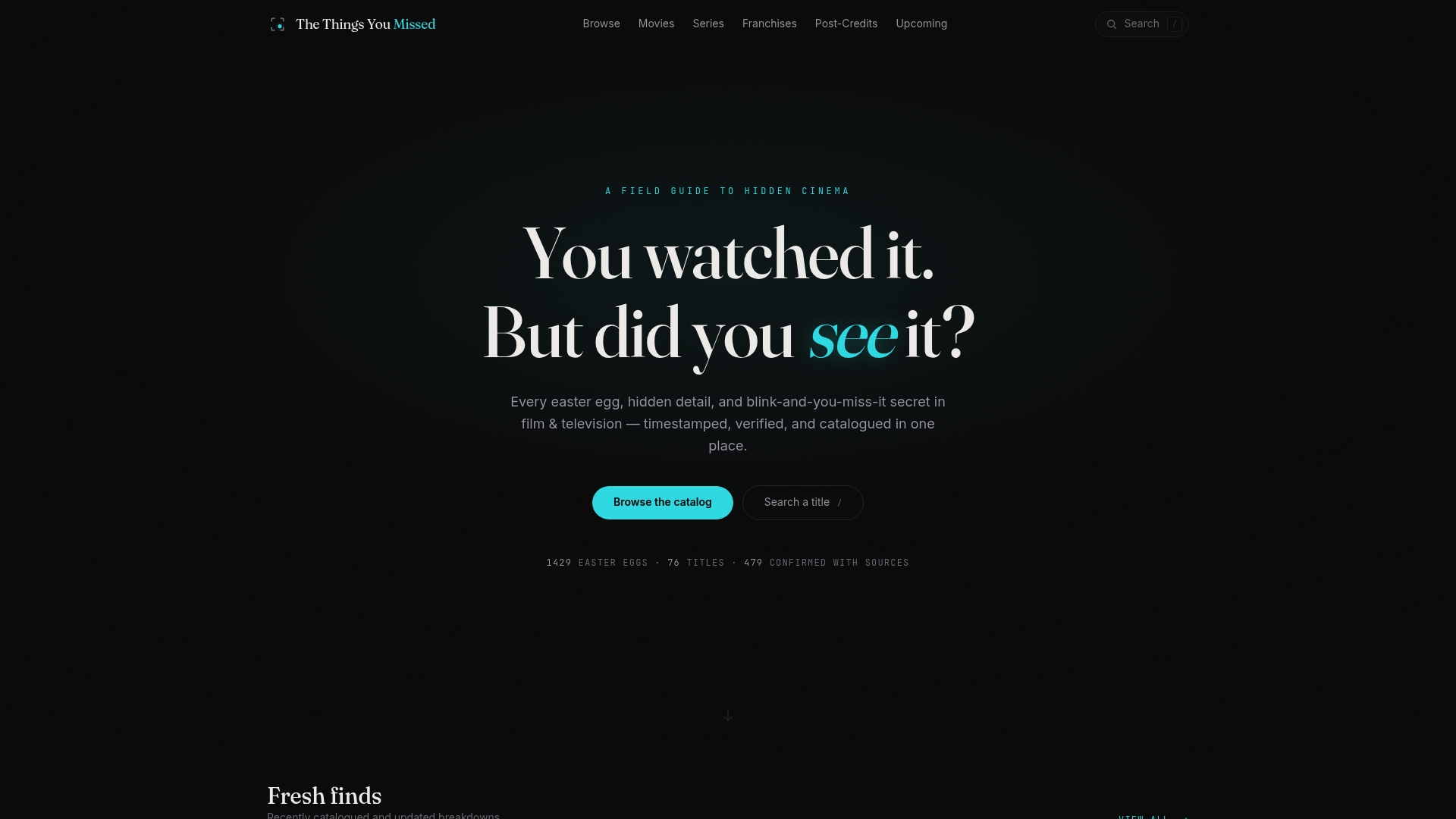
The movies landing page organizes catalogs by title and franchise, and the Nope entries sit alongside detailed breakdowns for films like 28 Years Later, built with the same timestamp and source method described throughout this guide. Browsing is spoiler-safe by design, letting users stop when they’ve found what they want. New details can be submitted through a request mechanism, and a weekly newsletter provides updates.
Sources
- Zoopraxiscope to Nope: A Case for Nonhuman Cinema Historiography
- This influential anime inspired the final alien design in Nope
- Nope calls back Akira motorcycle slide and other pop-culture references
- Nope visual effects and Gordy scene production notes
- Q&A: Jordan Peele on the dreams and nightmares of ‘Nope’
FAQ
What Are Some of the Hidden Meanings in Nope?
The film’s central hidden meaning ties spectacle to exploitation, using the Muybridge horse footage, Gordy’s Home, and Jean Jacket to argue that documenting danger is its own form of danger. Recurring cues like the 6:13 timestamp and the opening Bible verse reinforce that theme throughout, as detailed in the Themes and symbolism section above.
What Is the Scariest Part of Nope?
Most viewers and critics point to the Gordy’s Home flashback as the film’s most disturbing sequence, largely because of how restrained and clinical the violence looks onscreen. The single standing shoe afterward, which Peele has described as a “bad miracle”, tends to stick with audiences longer than the alien attacks that follow.
Did Jupe Know About the Alien?
The film never confirms that Jupe fully understood Jean Jacket’s intelligence before his fatal show, but his instinct to feed and display the creature echoes the same pattern that led to the Gordy attack in his childhood. Most analysis reads this as repeated trauma driving bad judgment rather than deliberate secrecy.
What Did the Monkey Mean in Nope?
Gordy functions as the film’s first case study in spectacle turning a living performer into a liability once the audience stops seeing him as dangerous. His attack, and the shoe left behind afterward, sets up the same exploitation pattern the film later applies to Jean Jacket on a much larger scale.