Students: 5 Steps to Prove Film Symbolism With TEE & Timestamps

Film symbolism is the practice of loading a concrete image, object, sound, or repeated visual choice with extra meaning so it carries theme or emotional subtext without a single line of dialogue. It works because directors use it to smuggle interiority past the audience’s conscious guard, letting a stone, a spinning top, or a red rose say what a script never states outright. The examples ahead, and a repeatable method for arguing them, come next.
TL;DR:
- Repetition across scenes and pivotal moments is essential for a symbol to develop clear meaning and support multiple valid interpretations.
- Color, object, character, setting, sound, and framing choices each offer different evidence types and require specific tracking methods for accurate analysis.
- Symbols often follow a payoff that clarifies or transforms their initial meaning, with ambiguity remaining normal and acceptable.
- Cultural context influences symbol interpretation, so understanding the film’s cultural background is crucial to avoid misreading universal images.
- Genre shapes how symbols are used and viewed, with horror emphasizing early, obvious symbols and dramas favoring subtle, deferred meanings.
Table of Contents
- What Is Symbolism in Film and How Does It Work?
- The Main Types of Cinematic Symbolism
- How to Analyze Symbolism in Film Step by Step
- Classic Film Symbolism Examples Explained
- Motif vs Symbol: What’s the Real Difference?
- How Film Symbolism Has Evolved Over Time
- Cultural Variations in Symbolism Interpretation
- Common Symbolic Archetypes in Cinema
- How a Director’s Style Shapes Symbolic Choices
- Symbolism and Genre: Why the Rules Shift by Category
- Reading Symbols Without Fooling Yourself
- Find the Scene-Level Evidence for Your Next Symbol Argument
- Sources
- FAQ
What Is Symbolism in Film and How Does It Work?
Symbolism in film analysis is the act of attaching meaning beyond an object’s literal function. A rose is a flower until a director frames it, lights it, and returns to it three times. Then it is desire, decay, or a lie the characters tell themselves. The mechanics rely on three things working together: an image or sound that exists at the story level, a directorial choice that isolates it (a held shot, a swelling cue, a deliberate cut), and enough context for the audience to sense that isolation means something.
Repetition is what separates a passing detail from a deliberate one. When the same object recurs across different emotional beats, viewers start reading it as a marker rather than a prop. Framing does similar work in a single instance. A tight close-up on an object the plot barely mentions tells you to pay attention even when nobody says why.
Good symbol readings tie back to what actually happens on screen, not a generic symbol dictionary imported from outside the film. Three markers make a reading persuasive:
- Repetition: the element reappears across scenes, not just once.
- Timing: it shows up at pivotal emotional or plot moments.
- Payoff: its final appearance changes or resolves what it meant earlier.
Even with all three, ambiguity is normal since film scholars generally accept that a strong symbol supports more than one valid interpretation, provided each reading is grounded in what the film actually shows.
The Main Types of Cinematic Symbolism
Screenwriting and film-study resources group cinematic symbolism into a handful of recurring categories, each doing a different kind of narrative work.
- Color symbolism uses palette as emotional shorthand. A film that shifts from warm ambers to cold blues is often telling you a character’s world has curdled before the plot admits it.
- Object symbolism splits into two flavors: recurring props that accumulate meaning over multiple scenes, and single-significance items that carry weight in one pivotal moment and never return.
- Character as symbol happens when a person functions less as an individual and more as an embodiment of an idea, class, or fear, an allegorical stand in rather than a fully psychologized figure.
- Setting and weather work as mood and theme shorthand. A storm rolling in rarely happens for meteorological reasons; it usually mirrors internal collapse.
- Music and sound editing can symbolize memory, threat, or denial, especially when a motif attaches to a specific character or trauma and reappears distorted.
- Camera and framing choices are symbolism too. A shrinking aspect ratio, a Dutch tilt, or a character consistently framed behind bars-like objects all argue something visually that the script may never say aloud.
That last category gets overlooked by viewers who focus only on objects and colors, but framing decisions are often where a director’s intent is clearest. A closer look at how aspect ratio shifts communicate subtext shows how purely visual grammar can carry as much symbolic weight as a recurring prop. Each type demands slightly different evidence: color asks you to track palette shifts, object symbolism asks you to count appearances, and character symbolism asks whether a figure behaves more like an idea than a person.
How to Analyze Symbolism in Film Step by Step
Reading symbolism well is a discipline, not a hunch. Film-study resources recommend building the case the same way a lawyer builds an argument: with evidence, not assertion.
- Spot repetition and moments of emphasis. Track any image, object, or sound that shows up more than once, especially if its reappearance coincides with a turning point.
- Note the craft choices around it. Watch for camera framing, lighting, music cues, or edits that isolate the element, since directors rarely linger on something accidentally.
- Connect the image to theme or character arc. Ask what idea the object clarifies that dialogue does not already state directly.
- Test the reading against payoff and alternatives. A symbol earns its meaning at its final or most transformed appearance. If a rival interpretation fits the evidence equally well, say so rather than forcing a single answer.
- Structure the argument using the TEE formula. Technique, Example, Effect is the standard structure for turning an observation into a paragraph: name the technique, cite the specific example, then explain the effect and how it supports your broader argument about the film.
Pro Tip: Keep a running list on a rewatch: object, timestamp, what’s happening around it, and what changed by its last appearance. Patterns that feel vague on a first viewing often become obvious once you can see all four columns side by side.
Before you commit to a reading, run a quick checklist: Does it appear more than once? Does its context or appearance change over time? Does removing it weaken the story’s emotional logic? If you can answer yes to at least two, you likely have a symbol worth writing about instead of a coincidence.
Classic Film Symbolism Examples Explained
Theory is only useful once you see it applied. These are among the most frequently cited symbols in modern cinema, each holding up under the repetition, timing, and payoff test.
- The scholar’s stone in Parasite: it enters the story as a gift symbolizing hope for wealth, reappears at moments the Kim family’s fortunes rise and fall, and pays off violently by the film’s end, converting a symbol of aspiration into one of delusion.
- The spinning top in Inception: functions as a literal reality check within the plot and a symbolic one for the audience. Its final, ambiguous spin refuses to resolve, forcing viewers to sit with uncertainty rather than a clean answer.
- Red roses in American Beauty: recur in fantasy sequences tied to desire and repression, framed with theatrical lighting that separates them from the film’s otherwise flat suburban palette. The artifice of the framing is the point.
- The deer in Get Out: introduced early as a throwaway warning, then returns as a foreshadowing trigger that pays off in the film’s climax, tying a rural hunting image to the story’s true predator. The full breakdown of the film’s hidden details traces exactly where that setup lands.
- The coin toss in No Country for Old Men: repeated across encounters with Anton Chigurh, transforming an ordinary coin into a stand in for fate and moral randomness with no author behind it.
- Water and mirrors show up across decades of cinema as broader symbolic categories rather than single-film inventions. Water tends to signal rebirth or drowning dread depending on context, while mirrors typically externalize a character’s split or hidden self.
Motif vs Symbol: What’s the Real Difference?
A motif is simply a recurring element, a color, phrase, or object that shows up more than once. Not every motif becomes a symbol. The upgrade happens when repetition brings semantic change: the object shows up in a new emotional context each time, accumulating meaning it didn’t carry on its first appearance.
- Motif: repeats, but its meaning stays flat across appearances.
- Symbol: repeats, transforms, and pays off, carrying an argument the film wants you to notice.
Think of it as the difference between a visual habit and a visual argument. Cataloged recurring motifs across franchises show plenty of repeated details that never escalate into symbols, and plenty that do the moment a filmmaker changes their context on a second or third appearance.
How Film Symbolism Has Evolved Over Time
Early silent cinema leaned on symbolism out of necessity. Without synchronized dialogue, filmmakers like the German Expressionists used shadow, distorted architecture, and exaggerated framing to convey psychological states that intertitles could never fully carry. Symbolism wasn’t a flourish; it was often the primary language of the medium.
The studio era refined this into genre shorthand. Film noir cemented visual codes, venetian blind shadows for entrapment, cigarette smoke for moral ambiguity, that audiences learned to read almost instinctively. By the 1960s and 1970s, directors like Stanley Kubrick and Ingmar Bergman pushed symbolism toward deliberate ambiguity, trusting audiences to sit with unresolved meaning rather than handing them a decoder ring.
Contemporary cinema has layered a new expectation on top of all this: audiences now actively hunt for symbolic detail, partly because home viewing and streaming make frame-by-frame rewatching trivial in a way theatrical audiences never had. A director in 2026 knows a paused frame will circulate online within hours of release, which changes how deliberately some symbolic choices get planted. The core mechanics haven’t changed, repetition, framing, payoff, but the audience’s tools for catching them have gotten dramatically sharper.
Cultural Variations in Symbolism Interpretation
A symbol rarely means the same thing to every audience. Color is the clearest example: white signals purity and weddings in many Western films, but funerals and mourning in several East Asian cinematic traditions. A director working within one cultural frame may not intend the reading a foreign audience brings to the same image.
Animals carry similar variance. An owl might read as wisdom in one tradition and as an omen of death in another. Even water, one of cinema’s most universal symbols, splits along cultural lines between purification in some religious contexts and danger or chaos in others rooted in flood mythology.
This is why film scholarship treats symbols as culturally embedded rather than universally coded. A symbol functions as a bridge between aesthetic experience and cognition, but that bridge only connects if the viewer shares enough cultural context with the filmmaker to recognize the crossing. Reading a symbol from another cultural tradition without acknowledging that gap risks flattening a deliberate choice into a generic one.
The practical takeaway for close analysis: when a film draws from a specific cultural or religious tradition, it’s worth researching that tradition’s own symbolic vocabulary before assuming a Western reading applies. A red door might mean something entirely different in a film rooted in Chinese folklore than it does in an American horror movie, and treating both the same way flattens what the director actually built.
Common Symbolic Archetypes in Cinema
Certain symbolic patterns recur so often across unrelated films that they function as a shared cinematic vocabulary. Recognizing them speeds up analysis, even if each film still deserves its own specific reading.
The threshold (doors, windows, staircases) marks a character’s transition between psychological states or worlds. The mirror externalizes duality, self-deception, or a fractured identity, often used right before a character’s true nature surfaces. Water swings between rebirth and drowning depending on framing and pacing, calm water suggesting cleansing, turbulent water suggesting loss of control. Fire typically signals destruction paired with transformation, rarely one without the other. The journey or road stands in for personal growth or moral reckoning, especially in genre films where the literal trip mirrors an internal one. Masks and disguises externalize the gap between a character’s public performance and private truth.
None of these archetypes guarantee meaning on their own. A mirror in one film might be pure set dressing; in another, it’s load-bearing. The archetype only becomes a working symbol once a specific film applies the repetition, timing, and payoff test outlined earlier. Treating these patterns as a checklist to spot, rather than a dictionary to apply blindly, keeps analysis honest.
How a Director’s Style Shapes Symbolic Choices
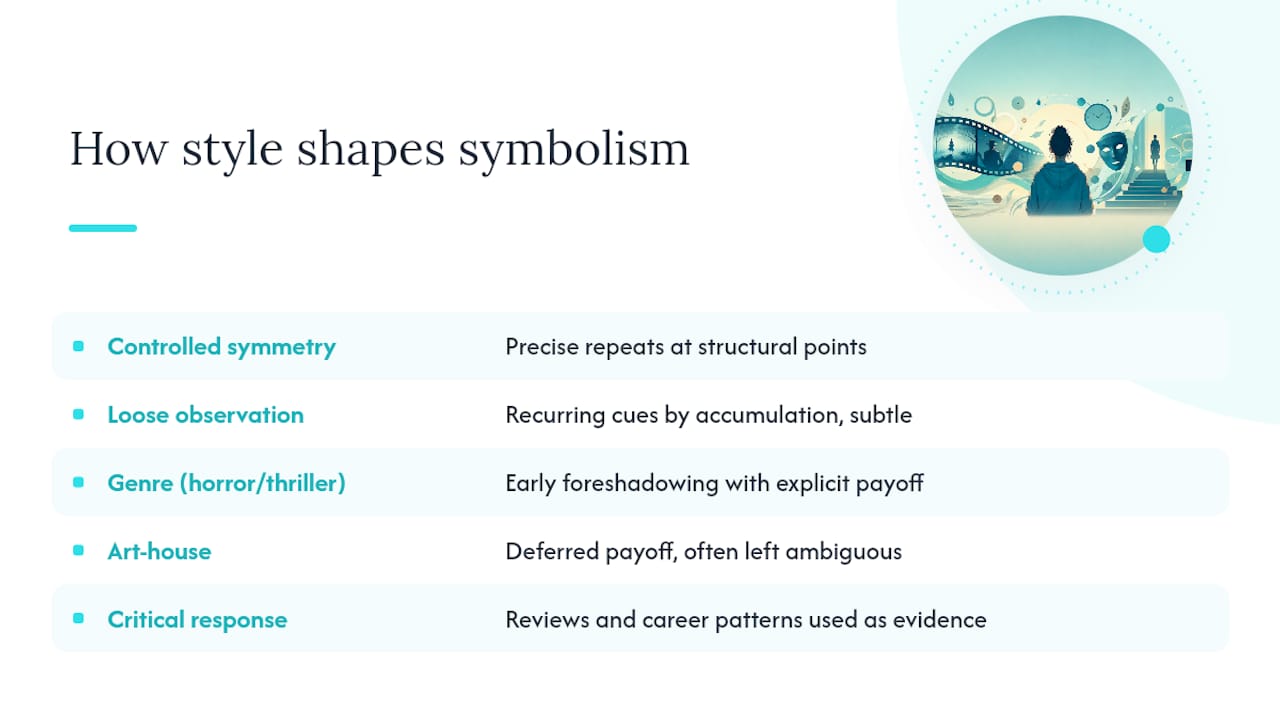
Symbolism isn’t a universal tool applied the same way by every filmmaker; a director’s visual signature dictates how symbols get built and how hard they’re meant to be spotted. Directors working in a highly controlled, symmetrical style tend to plant symbols with mathematical precision, repeating specific colors or objects at exact structural points so viewers can map them almost architecturally.
Other directors favor a looser, more observational style where symbolism emerges through accumulation rather than design, a color or gesture that recurs without ever being emphasized by the camera, letting attentive viewers assemble the pattern themselves. Genre filmmakers working in horror or thriller often front-load symbolic foreshadowing early and pay it off explicitly, since the genre rewards audiences catching the setup on a first watch. Directors working in slower, art-house registers tend to defer payoff, sometimes never resolving a symbol’s meaning at all, trusting ambiguity over closure.
This is also where critical response becomes useful evidence. Reviews of major releases often unpack how a filmmaker’s stated ambitions translate into specific visual choices, and a review that traces mythic ambition against actual craft shows how critics separate intended symbolism from the execution that lands on screen. Reading a director’s broader body of work matters here too: a symbol that seems isolated in one film often turns out to be a signature the director has reused, refined, or inverted across a career.
Symbolism and Genre: Why the Rules Shift by Category
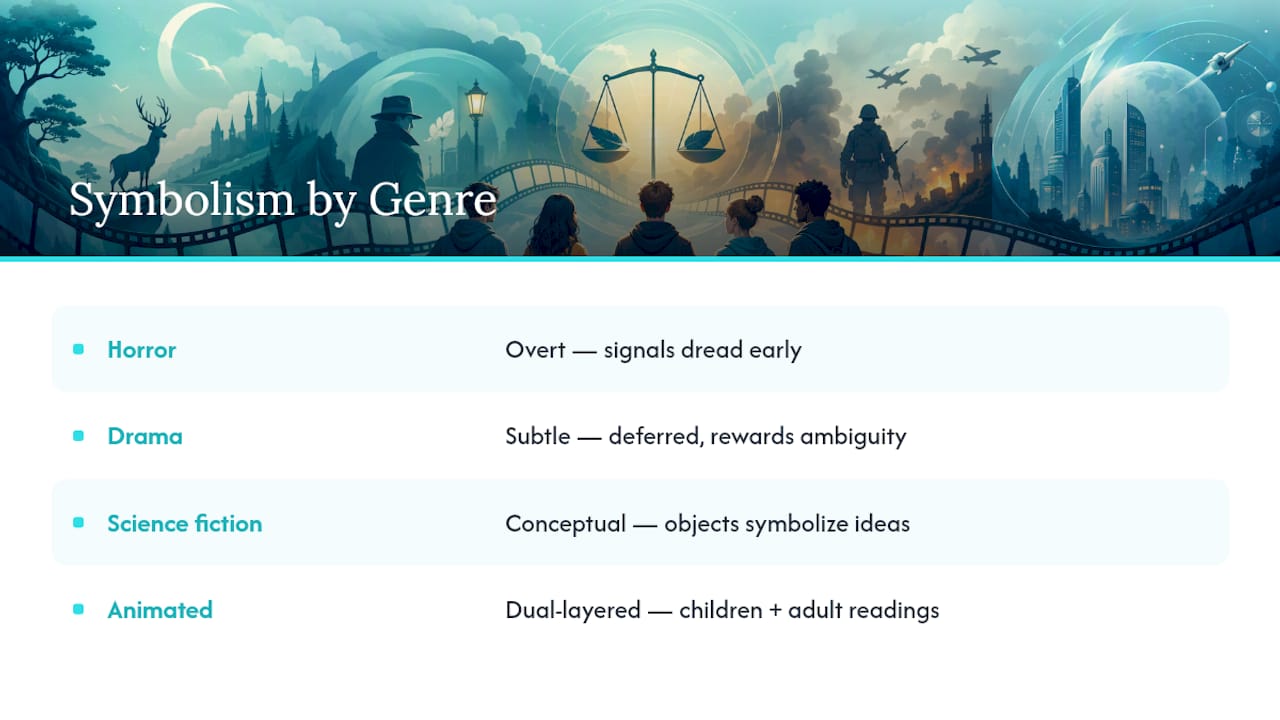
Symbolism doesn’t behave the same way across genres, because each genre trains its audience to expect a different relationship between image and meaning. Horror leans on symbolism that’s meant to be caught, at least partially, on a first viewing: a recurring animal, color, or object usually signals dread before the plot confirms it, because the genre’s pleasure depends on audiences sensing danger ahead of the characters.
Drama and literary adaptations tend toward subtler, more deferred symbolism, often resistant to a single clean reading, since the genre rewards ambiguity and repeat engagement over jump-scare clarity. Science fiction frequently uses symbolism at the conceptual level, an object or technology standing in for a broader anxiety about identity or control, where the spinning top in Inception functions less like a horror omen and more like a philosophical instrument. Animated films, family features especially, often carry symbolism aimed at two audiences simultaneously: a surface reading children can absorb and a layered one adult are meant to catch, which is part of why franchises built around animated features attract such dense symbolic analysis.
Genre expectations also shape how visible a symbol is allowed to be before it feels heavy handed. What reads as bold, deliberate patterning in a horror film might feel like overreach in a naturalistic drama, and what feels appropriately restrained in an art house piece would likely confuse a mainstream genre audience expecting clearer signals.
Reading Symbols Without Fooling Yourself
Symbol-hunting is genuinely fun, and that’s exactly why it invites bad habits. The biggest one is confirmation bias: deciding on a theme first, then cherry-picking whichever detail seems to fit, while ignoring everything that contradicts it. A single red object doesn’t prove a color motif. A single close-up doesn’t prove intentional framing. The checklist matters precisely because it forces you to check for repetition and payoff before you commit to a claim in writing.
The healthiest approach treats a first instinct as a hypothesis, not a conclusion. Rewatch with the specific object or image in mind, track every appearance, and be willing to abandon a reading that the evidence doesn’t actually support. Evidence-based interpretation, backed by verified, scene-level sourcing, produces better essays and better fan discussions than a clever guess dressed up as certainty.
— Christian
Find the Scene-Level Evidence for Your Next Symbol Argument
Making a symbol argument stick means pointing to the exact scene, not a vague memory of “somewhere in the second act.” Thethingsyoumissed catalogs entries with timestamps and verified sourcing rather than crowd-sourced guesses, which matters when you’re citing evidence in an essay or backing up a claim in a discussion thread.
Use it to pull the exact moment a recurring object first appears, track every return, and confirm the framing choice a director made at the payoff. It works for essay citations, class prep, or simply rewatching with a checklist instead of a hunch. Start with the full catalog of movie breakdowns and search by title to find the scene-level detail your argument actually needs.
Sources
For deeper study, StudioBinder’s breakdown of symbolism types covers the object, color, and character categories in more depth. The ERIC research paper on symbolism in feature film offers the academic grounding behind the cognition and context arguments made throughout this piece. For a checklist-style approach to spotting symbols on a rewatch, Matrix Education’s film symbolism guide walks through the TEE formula in classroom detail.
FAQ
What is symbolism in a film?
Film symbolism is the practice of attaching extra meaning to an image, object, sound, or repeated visual choice so it carries theme or emotional subtext beyond its literal function.
Can you give examples of symbolism in movies?
Widely cited examples include some recurring objects like the scholar’s stone in Parasite, the spinning top in Inception, red roses in American Beauty, the deer in Get Out, the coin toss in No Country for Old Men, and water and mirror imagery appearing symbolically in many films.
What are the most famous examples of symbolism in movies?
Beyond the classics above, object symbolism tends to get the most attention because it’s visually trackable across a rewatch. Thethingsyoumissed catalogs many of these franchise by franchise, including recurring motif entries that show how objects gain meaning across an entire series.
What are the best symbolic movies to study?
Films frequently used in film-study courses for their symbolism include Parasite, Get Out, No Country for Old Men, and American Beauty, largely because each ties its central symbol to a clear payoff that’s easy to argue in an essay.
How is a symbol different from a motif?
A motif is any recurring element, while a symbol is a motif that gains additional, argument-supporting meaning through repetition, transformation, and a clear payoff by the film’s end.