11 Movie Easter Eggs Verified With Timestamps
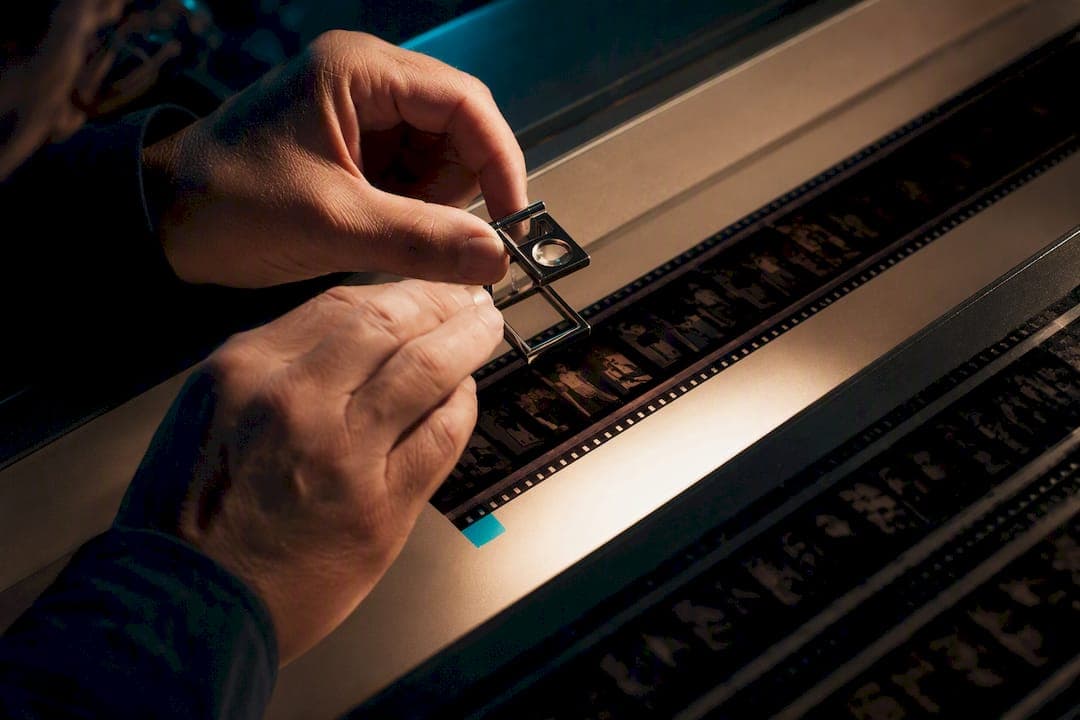
Movie Easter eggs are intentional hidden details, references, or in-jokes that filmmakers plant for attentive viewers to discover, often on a second or third watch. This guide rounds up the most famous examples across animation and live action, explains why directors keep hiding them, and gives you real methods to spot the ones you have already missed. Thethingsyoumissed catalogs these with timestamps so you never have to guess where to look.
TL;DR:
- Most well-known Easter eggs, like the Pizza Planet truck and A113, require precise pausing at specific frames to spot easily.
- Confirmed Easter eggs often involve subtle props, digital effects, or background cameo appearances that are intentionally hidden during filming or editing.
- Tools like slow playback, captions, reverse image searches, commentary tracks, and verified databases help distinguish deliberate references from coincidences or errors.
- Fan communities and frame-by-frame analysis have made many Easter eggs, such as the Fight Club splice or The Shining numerology, visible years or decades after release.
- Studios embed these details to enhance continuity and franchise lore but face criticism when Easter eggs distract or create exclusivity for dedicated fans.
Table of Contents
- What Are Movie Easter Eggs, and Where Did the Term Come From?
- The Most Famous Movie Easter Eggs Worth Rewatching For
- The Recurring Types of Easter Eggs You’ll Keep Running Into
- How to Spot and Verify a Hidden Detail Yourself
- How Thethingsyoumissed Verifies Every Hidden Detail
- The Easter Eggs Nobody Noticed Until Years Later
- Why Easter Eggs Reshape Fan Theories and Franchise Lore
- How Filmmakers Actually Hide These Details on Set and in Post
- When Easter Eggs Go Too Far
- A Quick Note From the Person Cataloging These
- Find Every Verified Easter Egg Without the Guesswork
- Sources
What Are Movie Easter Eggs, and Where Did the Term Come From?
The phrase “Easter egg” jumped into pop culture from video games, not film. It traces back to around 1979 and 1980, when programmer Warren Robinett hid his name inside the Atari game Adventure), a secret message players stumbled onto years after release. Atari’s leadership hadn’t approved a credit for him, so he buried one where the suits wouldn’t notice.
That practice existed in earlier computing circles too, tucked into debug menus and arcade cabinets before Robinett’s name-drop turned it into a cultural phenomenon. Once “Easter egg” caught on as a term, it migrated fast:
- Film directors started planting visual callbacks and in-jokes for attentive audiences.
- Home video and DVD releases added literal hidden menus and bonus scenes, cementing the term in movie culture.
- Fan communities began building shared databases to track what they’d found, turning solo discovery into a collective sport.
That last shift matters more than people realize. A hidden detail that once lived and died in one person’s memory now gets screenshotted, timestamped, and cross-checked by thousands of rewatchers within days of a release.
The Most Famous Movie Easter Eggs Worth Rewatching For
Here’s the thing about a great Easter egg: it rewards patience, not luck. These are the examples that keep coming up in fan discussions because they’re verifiable, visually specific, and often connect to something bigger than the scene they’re hiding in.
Pro Tip: Before you go hunting, know your target frame. A vague “somewhere in the background” tip wastes your rewatch. Every entry below tells you exactly where to pause.
- The Pizza Planet truck (Pixar’s shared universe). That battered red-and-yellow delivery truck from Toy Story has appeared in nearly every Pixar film since, usually parked in a background shot or driving past a street scene. Check the driveway scenes and street crossings; it’s become one of the studio’s signature Easter eggs in Disney and Pixar films. The full Pizza Planet trail across Pixar’s catalog is longer than most fans expect.
- A113. This classroom number from the California Institute of the Arts animation program shows up on license plates, apartment doors, and equipment labels across Pixar and Disney films. It’s a tribute from alumni who studied there before joining the studio, and once you know to look for it, you’ll spot it constantly.
- The Wilhelm Scream. This recycled scream sound effect has echoed through hundreds of productions since the 1950s, functioning as an inside joke among sound editors. Listen for it during any death or fall scene in a Star Wars, Indiana Jones, or Lord of the Rings film; it’s almost guaranteed to show up somewhere.
- E.T. spots a Star Wars character. In E.T. the Extra-Terrestrial, E.T. reacts with recognition to a child dressed as Yoda on Halloween, a wink George Lucas and Steven Spielberg arranged between friends. BBC Bitesize catalogs this crossover as one of the clearest examples of directors trading favors on camera.
- The hieroglyphic droids in Indiana Jones. Raiders of the Lost Ark hides carvings of C-3PO and R2-D2 among Egyptian wall art, a direct callback confirming the Lucas and Spielberg friendship extended well past one film.
- Alfred Hitchcock’s cameos. Hitchcock appeared briefly in nearly every one of his own films, often boarding a bus or walking past a window early in the runtime. He treated it as a signature, and audiences started watching the opening minutes specifically to catch him.
- Fight Club’s pre-narrative flickers. Single frames of Tyler Durden appear spliced into the film before his character is formally introduced, visible only through frame-by-frame playback. It’s one of the earliest examples of a film daring viewers to pause and rewind.
- Captain America’s shield in Tony Stark’s workshop. Iron Man (2008) hides an unfinished prototype of Cap’s shield on a shelf, years before Steve Rogers appeared on screen. It’s one of the first breadcrumbs of what became the interconnected Marvel Cinematic Universe.
- The Shining’s hidden numerology. Stanley Kubrick scattered the number 42 and contradictory room layouts throughout the Overlook Hotel, details still debated by fans decades later. Some read intention into every choice; others argue Kubrick simply liked precision.
- Toy Story’s Luxo lamp. Pixar’s own mascot, the hopping desk lamp from its earliest short film, appears as a toy or decoration in the background of multiple films, a quiet signature stamped across the studio’s filmography.
- Get Out’s title-card foreshadowing. Jordan Peele plants visual and dialogue clues early in Get Out that only make sense once you know the ending, a pattern horror fans have mapped in detail on sites like Thethingsyoumissed’s Get Out breakdown.
Most of these took real digging to confirm. That’s not accidental: filmmakers and studios rarely announce Easter eggs at release, which is exactly why timestamped, verified entries matter more than a scattered forum thread.
The Recurring Types of Easter Eggs You’ll Keep Running Into
Once you’ve spotted a handful of these, patterns start jumping out. Filmmakers tend to reuse the same handful of tricks, just dressed differently for each story.
- Recurring props: objects like the Pizza Planet truck or Luxo lamp that migrate between unrelated films from the same studio.
- In-jokes among crew: references only cast, crew, or die-hard fans would catch, like Hitchcock’s cameos or a director slipping their own name onto a background sign.
- Audio cues: sound effects like the Wilhelm Scream, reused specifically because sound editors know other sound editors will notice.
- Hidden text or numbers: license plates, room numbers, and background signage carrying a code or callback, as with A113.
- Background cameos: actors or characters from other productions appearing briefly, unbilled, in a crowd scene.
- Cross-universe props: items connecting separate franchises, like Cap’s shield showing up before the Avengers existed as a team.
Studio motifs like A113 and Pizza Planet do double duty. They work as one-off jokes for anyone who catches them, but they also function as quiet brand continuity, a signature stitched across decades of releases without ever needing a marketing push.
Pro Tip: Not every “hidden” detail was planted on purpose. Continuity errors and coincidental background objects sometimes get mistaken for Easter eggs after the fact. If a studio or filmmaker never confirmed intent, treat the find as a fan theory rather than a verified egg.
How to Spot and Verify a Hidden Detail Yourself
Finding your first real Easter egg feels great. Confirming it’s real, and not just a coincidence your brain is dressing up, takes a slightly different skill set.
- Slow the playback to half speed or use frame-by-frame stepping on any streaming platform or media player that supports it.
- Turn on captions and subtitles; some audio-based references, like a character muttering a callback line, are easy to miss at full volume.
- Run a reverse image search on a suspicious prop or background poster if you can grab a clean screenshot.
- Cross-check the detail against director or cast commentary tracks, where filmmakers often confirm intentional references directly.
- Search a verified database, like Thethingsyoumissed, before assuming a coincidence is a confirmed reference.
| Step | What it solves |
|---|---|
| Slow playback | Catches single-frame or blink-and-you-miss-it visuals |
| Captions on | Surfaces audio references buried in dialogue or ambient sound |
| Reverse image search | Identifies unfamiliar props, posters, or background text |
| Commentary tracks | Confirms filmmaker intent instead of guessing |
| Verified database check | Avoids spreading an unconfirmed fan theory as fact |
Skipping that last step is how false Easter eggs spread. A pattern someone noticed on a rewatch gets repeated as fact across forums within days, long before anyone confirms whether the filmmaker actually intended it.
How Thethingsyoumissed Verifies Every Hidden Detail
Every entry in the Thethingsyoumissed database gets a timestamp, a source link, and an editorial pass before publication, the same discipline you’d want from any reference resource you’re citing in an argument with friends. That process separates a confirmed reference from a rumor that gained traction on social media.
- Timestamped scene markers, so you know the exact minute to pause.
- Source links back to commentary tracks, interviews, or official studio confirmation where available.
- Editorial review before an entry goes live, cutting down on unverified fan speculation.
- Dedicated collections for franchises with dense cross-reference histories, including Pixar’s recurring motifs and the Disney animation catalog.
- A request system for readers to flag a title that hasn’t been cataloged yet.
The Easter Eggs Nobody Noticed Until Years Later
Some of the best finds in film history sat undiscovered for years, sometimes decades, before anyone caught them. That delay isn’t a failure of attention; it’s a byproduct of how slowly frame-by-frame culture used to spread.
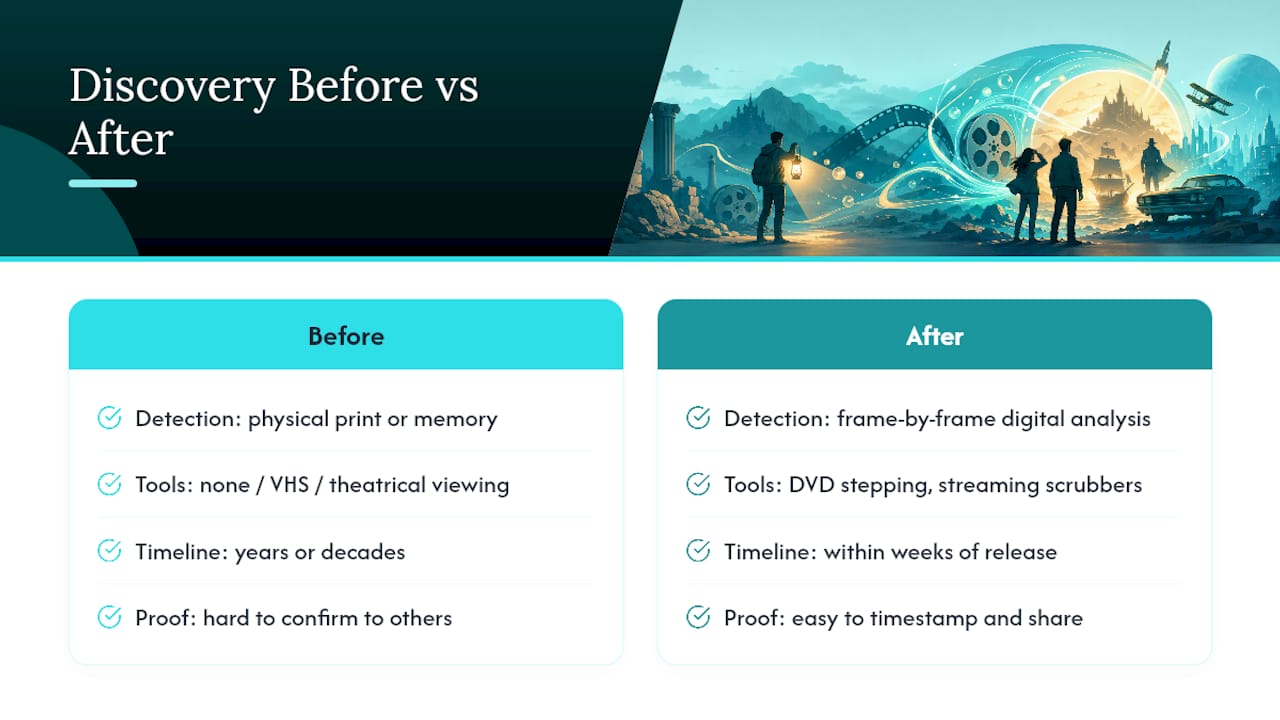
Before digital rewatching became normal, catching a single-frame flash or a background detail required either owning a physical print or having freakishly sharp memory. Fan communities using frame-by-frame digital analysis changed that timeline dramatically. A detail that might have stayed buried for a generation now surfaces within weeks of a streaming release, because thousands of viewers are pausing the same scene simultaneously and comparing notes online.
The Fight Club splice frames are a textbook case. Viewers who caught Tyler Durden’s flickering appearances on VHS or in theaters had no easy way to confirm what they saw, let alone prove it to skeptical friends. DVD releases with frame-stepping features, followed by digital streaming with scrubber bars, gave fans the tools to finally pin down and timestamp exactly which frames carried the reference.
The Shining’s numerology debates followed a similar arc, fueled less by new discovery and more by obsessive frame-counting once home video made pausing effortless. Kubrick reportedly never confirmed most of the theories fans built around his film, which means some of these “Easter eggs” occupy a gray zone between intentional design and pattern-matching by devoted audiences.
This retrospective discovery pattern also explains why older films sometimes generate more Easter egg chatter decades after release than they did on opening weekend. The tools caught up to the craft.
Why Easter Eggs Reshape Fan Theories and Franchise Lore
A single hidden shield in a workshop scene did more than reward attentive viewers. Cap’s shield appearing in Iron Man years before The Avengers became one of the earliest signals that Marvel Studios was building something interconnected, and it trained an entire generation of moviegoers to treat background details as potential lore rather than set dressing.
That shift changed viewing behavior industry-wide. Once audiences learned that a prop in frame six could matter three films later, they started scrutinizing everything: cast lists, production notes, even shipping manifests referenced in dialogue. Research on fan behavior backs this up directly: finding Easter eggs in entertainment measurably boosts enjoyment and fan engagement, turning passive viewing into an active hunt.
The effect on franchise lore runs both directions. Sometimes a planted detail confirms a theory fans had already built from dialogue and character behavior, giving that theory sudden legitimacy. Other times, a detail gets discovered first, and fans build the theory backward from it, filling gaps a studio never intended to leave open. Either way, Easter eggs function as connective tissue between films that otherwise have no formal link, letting audiences build their own map of a universe’s internal logic.
Studios have leaned into this deliberately. A recurring prop or number isn’t just a treat for observant fans anymore; it’s a low-cost way to suggest scale and continuity without writing a single line of dialogue confirming it.
How Filmmakers Actually Hide These Details on Set and in Post
Planting an Easter egg that survives editing, color grading, and a dozen studio notes takes more coordination than most viewers assume. Three techniques show up again and again.

Set design and props. The simplest method is physical: a production designer places an object, like a specific book, poster, or toy, somewhere in frame during principal photography. This is how most background cameos and recurring props like the Pizza Planet truck get inserted, since animators and set decorators can slip a callback into a scene without altering dialogue or plot.
Digital effects and compositing. Visual effects teams sometimes add a reference in post-production, layering a detail into a shot after filming wraps. This method gives filmmakers more control and lower risk, since a digital insert can be added or removed without reshooting, and it explains why some Easter eggs feel suspiciously well-placed within a busy frame.
Editing and frame splicing. The riskiest and most deliberate method involves editing single frames of footage into a sequence where they don’t belong, exactly what happened with Fight Club’s Tyler Durden flashes. This technique only works because editors control exactly which frames survive the final cut, and it’s the method most likely to require frame-by-frame playback to even notice.
Sound design adds a fourth layer entirely separate from the visual tricks above. A recycled effect like the Wilhelm Scream gets dropped into the final audio mix, sometimes by a sound editor with zero involvement in the visual production, which is part of why that particular Easter egg has survived across so many decades and studios.
When Easter Eggs Go Too Far
Not every viewer loves the hunt. Easter eggs draw real criticism, and some of it holds up.
The most common complaint is distraction. A movie asking you to scan every background shelf for a hidden reference risks pulling attention away from the story itself, especially in dense franchise films where every frame might be doing double duty as a marketing teaser for something unreleased. Critics have pointed out that some recent blockbusters lean on cross-references so heavily that the connective tissue starts to feel like the actual plot, rather than a bonus layered on top of one.
There’s also a fair complaint about exclusivity. An Easter egg rewards insiders, people who’ve seen every prior film in a franchise, who follow cast interviews, or who have the patience to pause and rewind. Casual viewers can walk away from a packed theatrical release having missed half its emotional weight simply because they didn’t catch a callback that recontextualizes an earlier scene. That creates a two-tier viewing experience where the “full” version of a film is only available to people willing to do homework.
A subtler criticism concerns manufactured hype. When studios start treating Easter eggs as a marketing tool rather than a genuine creative flourish, audiences can sense the difference. A reference that exists because a director loved a scene reads differently than one seeded specifically to trend on social media the morning after release. Fans have grown sharper at telling the two apart, and the backlash against egg-hunting for its own sake has grown right alongside the trend.
A Quick Note From the Person Cataloging These
The Fight Club splice frames were the discovery that hooked me. Once I confirmed one, I couldn’t stop hunting for the next. That’s the whole reason this catalog exists: to save you the guesswork and let you skip straight to the good part. Spotted something we haven’t logged yet? Send it our way.
— Christian
Find Every Verified Easter Egg Without the Guesswork
Rewatching a two-hour film frame by frame just to confirm one background prop isn’t realistic for most people, and forum threads full of unverified claims aren’t much better. Thethingsyoumissed solves that gap directly: every entry carries a timestamp, a source, and an editorial check, so you get the confirmed detail without doing the detective work yourself.
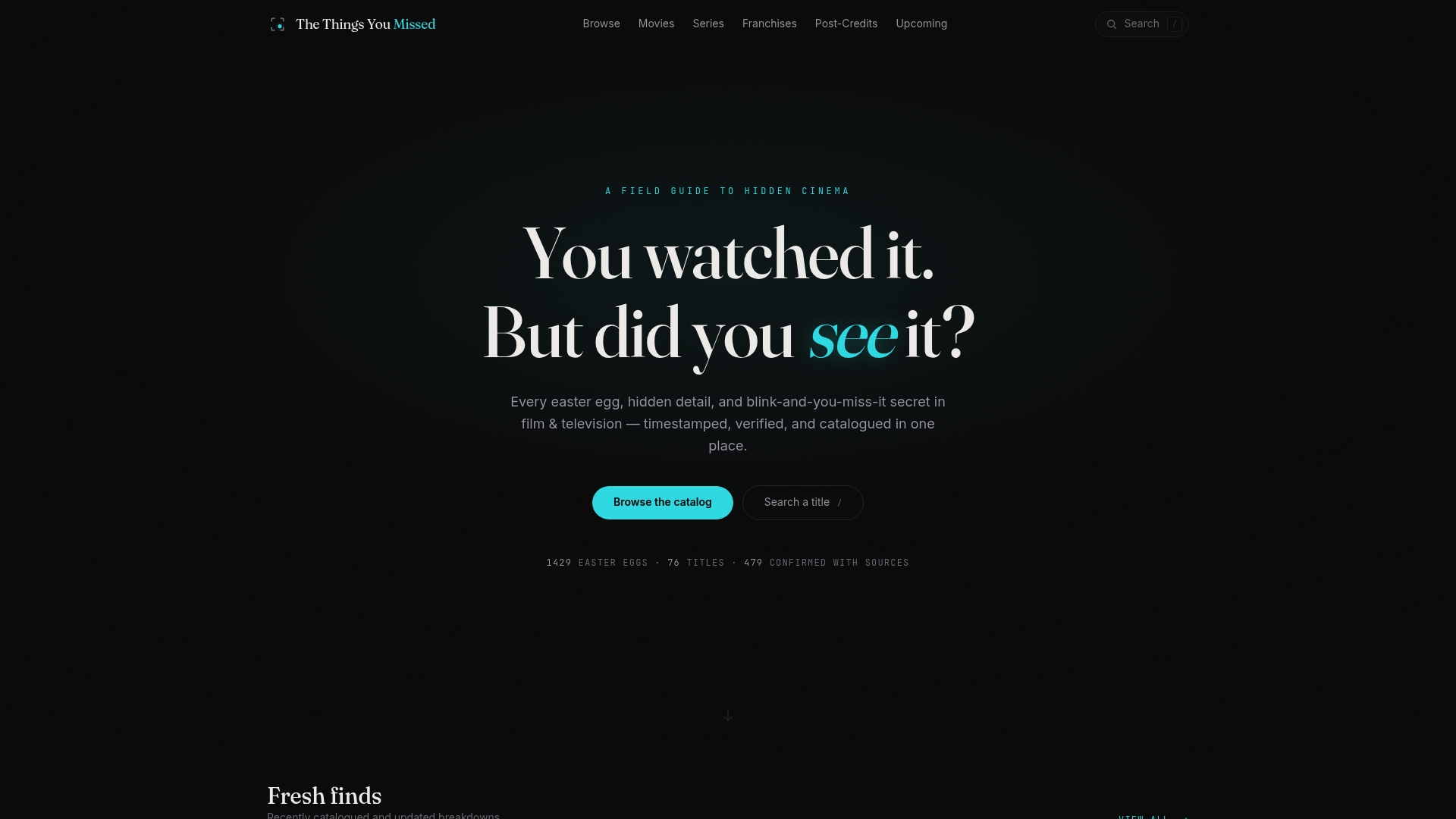
The movie Easter egg hub covers titles frame by frame, while the franchise collections group connected references across entire universes, from Star Wars to Disney animation. If you’re planning a rewatch this weekend, pull up the entry for that film first and browse the confirmed timestamps before you press play. It turns a passive rewatch into a genuine hunt, minus the wasted pauses.
Sources
- Unveiling some of the best Easter eggs in Disney and Pixar films | Mused
- 15 Movie Easter Eggs Hidden in Plain Sight | Den of Geek
- Top 20 movie Easter eggs that took years to find — WatchMojo
- Famous Easter eggs in games and films - BBC Bitesize