Movie Continuity Errors: Famous Examples and Why They Happen

A continuity error is a shot that contradicts the shot beside it: a cigarette that grows back, a shoe that changes color, a wound that hops to the other cheek. They slip through because films are shot out of order, over days or months, and stitched together later. Some are accidents, a few are secretly deliberate, and all of them reward a second look. Below you’ll find what actually counts, the famous cases worth freeze-framing, how they happen, and how to tell a blunder from a choice.
TL;DR
- A continuity error is a mismatch between shots or scenes (props, costumes, food, wounds, lighting). A plot hole is a gap in the story’s logic. They are different things.
- Classic cases include Dorothy’s shoes in The Wizard of Oz, Paulie’s cigar in Goodfellas and Samuel L. Jackson’s cigarette in Jurassic Park.
- Errors survive because reshoots and digital fixes cost money, and filmmakers often protect the best performance over a perfect match.
- Some apparent errors may be intentional, like the shifting Overlook Hotel in The Shining. Treat that as interpretation unless the filmmakers confirm it.
- Repeat viewings are the best detector, and a timestamp turns a hunch into a verifiable find.
Table of Contents
- What actually counts as a continuity error
- Famous movie continuity errors worth a freeze-frame
- How continuity errors happen during filming and editing
- Why mistakes stay in the finished film
- Slip, joke or secret signal? Telling accidents from intent
- How to spot continuity errors on your own
- Our take: a mistake is a clue, not a punchline
- Keep hunting with a catalog built for it
- FAQ
- Sources
What actually counts as a continuity error
Researchers at Oxford’s Visual Geometry Group describe a continuity error as a lapse in the self-consistency of a scene or story. Their examples are props that move inconsistently, shadows that change, and drinks that empty and refill without anyone touching them. IndieWire’s 2025 roundup of the best movie mistakes draws the same line fans argue about constantly: continuity errors, where the logic of one shot doesn’t line up with another, count. Plot holes do not.
That distinction saves a lot of comment-section fights.
| Continuity error | Plot hole | |
|---|---|---|
| Where it lives | Between shots or scenes | In the story’s own logic |
| Typical example | A tie changes from red to blue mid-conversation | A character knows something they never could have learned |
| Caused by | Production and editing | Writing |
| Can you see it on a freeze-frame? | Usually yes | Rarely |
A third bucket sits nearby: production intrusions such as a crew member’s reflection, a visible microphone or a modern car in a period landscape. Fans often file these under “movie mistakes” and lump them in with continuity. For hunting purposes, the useful question is simple: does something in this frame disagree with the frame before it, or with what the film has established?
Famous movie continuity errors worth a freeze-frame
These are the cases the research keeps returning to, each with exactly what to look for.
| Film | What to watch for | Source |
|---|---|---|
| The Wizard of Oz | Dorothy’s ruby slippers turn into black shoes in the apple-tree sequence | Videomaker |
| Jurassic Park | A cigarette goes from full to half-full and back without a new one being lit | The Guardian |
| Pretty Woman | Vivian bites a croissant, then the next shot shows her eating a pancake | The Independent |
| The Avengers | The helicarrier’s displays show 15,000 feet, then 18,000 feet, while the ship is losing altitude | ScreenRant |
| The Return of the King | Frodo’s cheek wound switches sides | Videomaker |
| Goodfellas | Paulie’s cigar disappears between shots | Collider |
The costume and props classics
Dorothy’s footwear is the textbook case. Videomaker explains that comfortable shoes were used when Judy Garland’s feet weren’t expected to be visible, which is a very human reason for a very visible slip. Spider-Man’s broken windows becoming intact again is another staple from the same Videomaker piece, and it shows how destruction scenes are especially hard to track across takes.
The food and smoke offenders
Breakfast is a repeat offender. Food gets eaten, moved and replaced between takes, so a croissant can become a pancake in a cut. Cigarettes burn down at a fixed speed, which is why the Jurassic Park cigarette (it reverses itself without a relight) is so easy to catch once you know to look at the hand.
The big-budget numbers game
Not every slip is a prop. In The Avengers, the altitude readouts disagree with each other while the helicarrier is visibly dropping. It’s a data-display mismatch rather than a costume error, which makes it a good reminder that screens and graphics need continuity checks as well.
Location intrusions
A white car is visible in the background of a Middle-earth field shot in the original cut of The Fellowship of the Ring, according to a script-supervision write-up, which also notes a gas cylinder on a chariot and a reported wristwatch in Gladiator. Big action scenes with hundreds of extras are where these checks break down.
If you like spotting this kind of thing in a franchise, our Lord of the Rings easter eggs breakdown is a good companion hunt: same trilogy, different kind of hidden detail.
How continuity errors happen during filming and editing
Films are almost never shot in story order. According to Slashfilm’s explainer on why every movie has them, scenes are shot in different ways over hours, days or even months, so actors, costumes, props, blocking, food, lighting and backgrounds may not match from one setup to the next. Shooting more coverage gives editors more options, but it also multiplies the chances that two options don’t match.
The same piece lists how much a continuity checklist has to cover:
- Actor placement, distance and eyelines
- Costume, makeup, hair, facial hair and tattoos
- Movement and emotion
- Clocks, food and fake blood
- Lighting and shadows
The script supervisor’s job
The defense against all this is paperwork. Videomaker says continuity reports capture camera settings, weather, acting, audio and picture quality, and action details, along with photographs of costumes, hair, makeup, set dressing, actor positions and props. Blocking notes and storyboards help too. The logic is simple: it’s far cheaper to photograph a cigarette’s length on set than to discover the mismatch in the edit suite.
Camera geometry counts too
Continuity isn’t only objects. The 180-degree rule keeps the camera on one side of an imaginary line so that screen direction and eyelines stay consistent. A University of Huddersfield study on violating the 180-degree rule found that crossing the line can cause some confusion or disorientation, though it did not reduce viewers’ liking of the video. So spatial slips are felt even when they aren’t consciously named.
Editors play with this deliberately all the time. Our guide to match cut examples shows how cuts can bend time and space on purpose, which is the opposite of an accident.
Why mistakes stay in the finished film
Two reasons dominate. First, repair is expensive. Slashfilm notes that a correction may need a reshoot or a digital touch-up, and minor errors may not justify the expense if most moviegoers are unlikely to notice. Perfect continuity would also demand a disproportionate amount of time and labor. Viewers often miss errors on a first theatrical viewing, and repeat viewings make more details visible.
Second, performance wins arguments. Collider reports that Goodfellas editor Thelma Schoonmaker said the team prioritized the strongest performance over matching the cigar, and accepted continuity slips rather than sacrifice it. That’s a useful lens: a visible mismatch can survive because dramatic rhythm, safety or meaning outweighs a perfect match.

Slip, joke or secret signal? Telling accidents from intent
Here’s where continuity hunting gets fun. Sometimes a mistake is quietly adopted.
The stormtrooper bump
In Star Wars: A New Hope, a stormtrooper clonks his helmet on a doorway. The 1997 remaster added a sound effect, turning the blunder into a deliberate joke. That’s an accident that was later promoted to a gag.
The Overlook problem
The Shining is the favorite case for the intent argument. Furniture, rug patterns, hand positions and the hotel’s architecture change or fail to line up between shots. ScreenRant reports the interpretation that Kubrick used these inconsistencies on purpose to make the Overlook feel surreal and unstable. It’s a reading, not a confession, but it gives you a handy test: if the oddities consistently reinforce the film’s spatial, psychological or thematic effect, intent becomes plausible.
The Pulp Fiction bullet holes
Bullet holes appear behind Jules and Vincent before the shooting. Far Out reports that viewers debate whether it was accidental or deliberate. Without a stronger primary source, the honest label is “disputed,” and that’s how we’d catalog it.
A quick intent test
- Does the oddity repeat, or is it a one-off?
- Does it serve the mood, theme or space of the scene?
- Has a filmmaker, editor or official release addressed it?
- Is there a mundane production reason, like a quick shoot or a stand-in?
Three or four yeses suggest intent. One yes suggests a fun theory.
Writers wrestle with the same tension between strict accuracy and what audiences find believable, a topic explored in the accuracy versus relatability trade-off.
How to spot continuity errors on your own
You don’t need special software. You need patience and a habit.
- Pick a scene with a prop in hand. Drinks, food, cigarettes and phones change fastest.
- Watch hands, not faces. Hand positions and held objects drift when takes are intercut.
- Track wounds, hair and costume. Makeup and fake blood are classic slips.
- Check the background. Clocks, signs, extras and vehicles shift or intrude.
- Cut-to-cut comparison. Pause on the last frame before a cut and the first after it.
- Note the timestamp. A find without a timestamp is a rumor.
- Rewatch. The second pass is where most finds happen.
For a gentler on-ramp, seven hidden movie details casual fans can spot are timestamped and spoiler-safe. And if you want to hunt for the deliberate stuff instead, hidden cameos are the most satisfying category of intentional blink-and-you’ll-miss-it moments.
Our take: a mistake is a clue, not a punchline
Most lists of movie mistakes stop at “gotcha.” We think that’s where the interesting part starts.
A continuity slip tells you how a scene was made: which take won, what the editor protected, where the schedule got tight. And when a mismatch turns out to be deliberate, it tells you what the director wanted you to feel. That’s why we log every find with a timestamp and a sourced reference, rather than leaving it as crowd-sourced trivia.
We also grade entries by visibility and difficulty, so a once-in-a-blue-moon freeze-frame find isn’t presented as if everyone would catch it. And we keep our browsing spoiler-safe, so your hunt doesn’t cost you a plot twist.
The community consensus matters, but a verified source matters more. If a find is disputed, we’d rather say so than crown it.
Christian
Keep hunting with a catalog built for it
Continuity errors are one layer of hidden detail. Our catalog lists easter eggs, secret scenes and storytelling motifs, each timestamped and sourced, with spoiler-safe browsing so you can look up a film before or after you watch it.
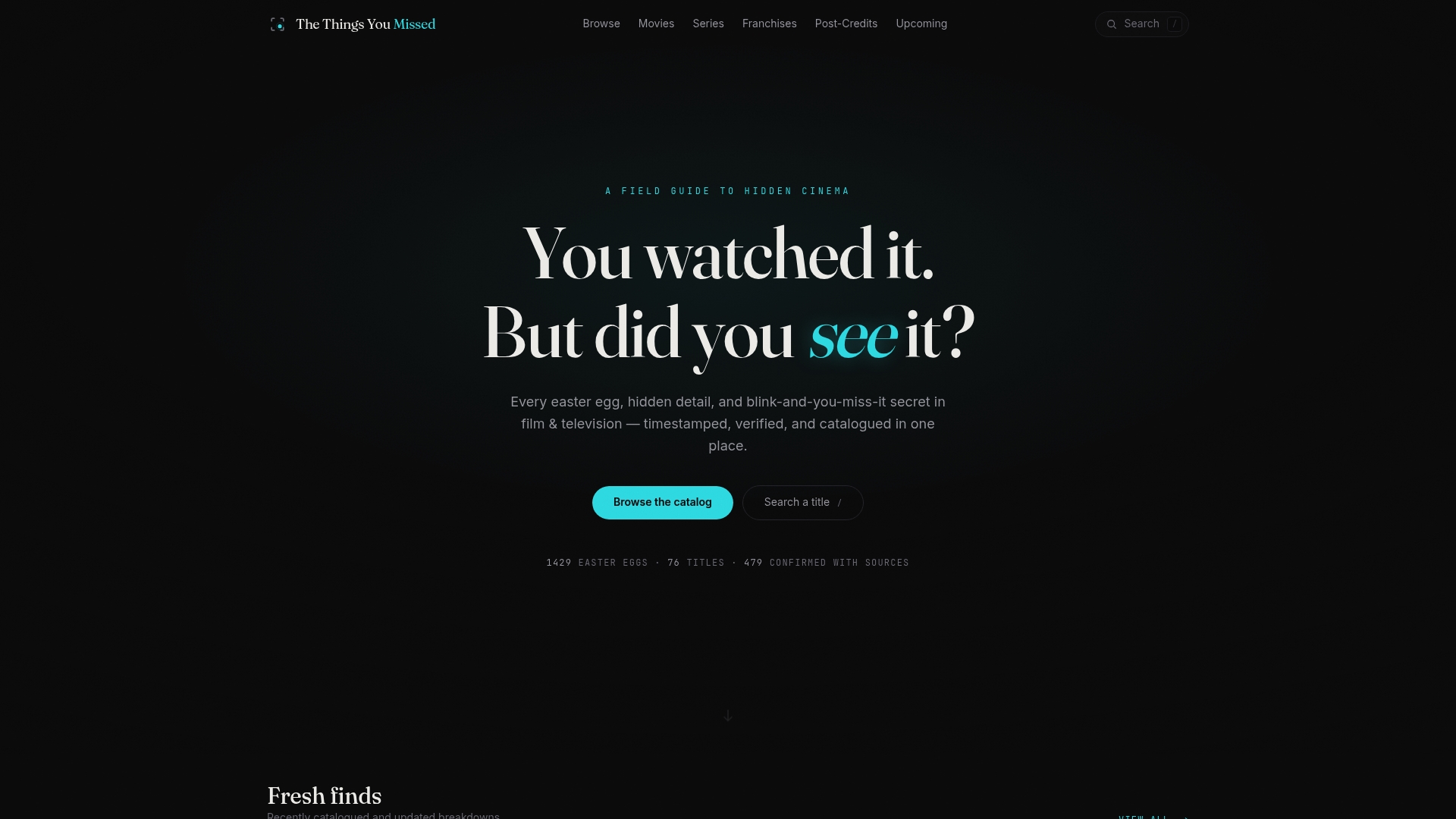
Browse the movie easter egg catalog, jump into the TV series entries, or see what’s recently added and updated. Want a film covered? Use the request mechanism and join the weekly email newsletter.
FAQ
What’s the difference between a continuity error and a plot hole?
A continuity error is a visual or logistical mismatch between shots or scenes, such as a prop that changes or a drink that refills. A plot hole is a contradiction in the story’s logic. IndieWire’s movie-mistakes list counts the former and leaves out plot holes.
What are the most famous continuity errors in movies?
Commonly cited cases include Dorothy’s black shoes in The Wizard of Oz, the changing cigarette in Jurassic Park, the croissant-to-pancake swap in Pretty Woman and the disappearing cigar in Goodfellas. Each is easy to find once you know which object to watch.
Why don’t filmmakers just fix them?
Fixing means a reshoot or digital work, and filmmakers may judge a minor slip unlikely to bother most viewers. Sometimes the take with the best performance is the one with the mismatch, and that take wins, as the Goodfellas cigar shows.
Can a continuity error be intentional?
Sometimes, and the clearest case is a mistake adopted afterward: the stormtrooper’s helmet bump in A New Hope got a sound effect in the 1997 remaster. Other cases, like The Shining, are interpretations that critics argue for rather than confirmed intent.
How can I tell if a movie mistake is real?
Find the exact frames on both sides of the cut and note timestamps. Then check whether a credible source documents it. If you can only see it on one pass or one screen, treat it as unconfirmed.
Sources
- Visual Geometry Group, University of Oxford: continuity research
- IndieWire: The 65 Best Movie Mistakes
- Videomaker: Maintaining Continuity
- The Guardian: A Titanic mistake, a Jurassic error and other great movie goofs
- The Independent: The 29 worst mistakes in famous movies
- ScreenRant: 10 Continuity Fails in Popular Movies
- Script supervision blog: 15 famous continuity errors
- Slashfilm: Why Every Movie Has Continuity Errors
- University of Huddersfield: Exploring the Effects of Violating the 180-Degree Rule
- Collider: Martin Scorsese Knows About That Continuity Error in Goodfellas
- ScreenRant: The Shining’s Continuity Error Trick
- Far Out: The on-set mistake left in Pulp Fiction