Nonlinear Storytelling in Film: How It Works and Where to Spot It

Nonlinear storytelling is any story that does not hand you events in the order they happened. It might jump between past and future, braid several timelines together, run backward, or loop back on itself. The point is rarely to confuse you. The point is to make you assemble the story, and to feel something the straight version could not give you.
This guide covers how nonlinear structure works, the techniques directors reach for, how famous films use them, how an unreliable narrator differs from a scrambled timeline, and how to keep your bearings on a first watch. Then, once you know the machinery, you can start hunting for the details hidden inside it.
TL;DR
- A linear story shows events as they occur in time. A nonlinear one breaks those rules of space and time and may present events out of order.
- The common tools are flashbacks, flash-forwards, converging timelines, circular structures and reverse chronology.
- A scrambled timeline and an unreliable narrator are different tricks. One reorders events, the other makes the account itself untrustworthy. Some films use both.
- To follow an out-of-order film, track recurring images and objects that signal a jump in time or place.
- On a rewatch, the structure itself becomes a map of hidden details.
Table of Contents
- What nonlinear storytelling actually is
- The techniques directors use to rearrange time
- Nonlinear movies and how each one plays the trick
- Nonlinear timeline vs. unreliable narrator
- How to follow a story told out of order
- Our take: structure is where the best easter eggs live
- Hunt the details in your next watch
- FAQ
- Sources
What nonlinear storytelling actually is
Start with the baseline. A linear narrative reveals details as they happen in space and time: this, then this, then this. A nonlinear narrative, as one LitReactor discussion of narrative structure puts it, does not follow those rules and may present events out of order.
That definition is deliberately wide. It covers a single flashback in an otherwise chronological drama, and it covers a film that is nothing but fragments. So it helps to think of nonlinearity as a dial, not a switch:
- Light touch: a cold open that flashes forward, then returns to the beginning. The bulk of the film runs straight.
- Medium: two or three timelines that alternate, with the audience knowing which is which.
- Heavy: the order of scenes is the puzzle, and the final scene you see may be the first thing that happened (or the last).
Why do filmmakers bother? Because order controls information, and information controls emotion. Show the consequence before the cause and the audience watches the cause with dread. Withhold a single fact until the final act and everything you watched earlier changes meaning. That is the whole thesis of the technique, and every example below is a variation on it.
The techniques directors use to rearrange time
Academic writing on film time, such as this 2026 piece in The Conversation, lists the recurring tools: flashbacks and flash-forwards, converging timelines and circular structures. The same article names the more technical terms too. Here is the toolkit in plain words.
| Technique | What it does | What it does to you |
|---|---|---|
| Flashback (analepsis) | Shows past events | Explains motive, reveals a secret, deepens a character |
| Flash-forward (prolepsis) | Shows a future peak or outcome | Builds dread or curiosity: how do we get there? |
| Interweaving timelines | Alternates two or more time strands | Lets parallel stories echo or collide |
| Converging timelines | Strands move toward a shared moment | Creates a payoff when they finally meet |
| Reverse chronology | Tells the story backward | Effects arrive before causes, so you hunt for the why |
| Circular structure | Ends where it began | Suggests fate, repetition or a trap |
A few notes from the hunting side of the fence.
Flashbacks are the gateway drug. Almost every viewer has seen one, so they feel natural. The craft is in the trigger: a smell, a photograph, a line of dialogue that tips the film into the past. Spot the trigger and you spot the director’s thinking.
Flash-forwards are the cheat code for tension. A single glimpse of the aftermath changes how you read every scene before it. Watch what object or location shows up in that glimpse. It will almost always return.
Circular structures reward rewatching. When the last image rhymes with the first, go back and compare framing, sound and costume. Directors love to plant the ending in the opening.
Nonlinear movies and how each one plays the trick
Searchers who type “nonlinear narrative films” want names, so here are the headline cases and what each one is actually doing.
Memento: the structure is the character
Memento (2000) tells Leonard’s story through two strands: black-and-white scenes moving forward chronologically and colour scenes moving backward. The same source observes that this structure lets viewers experience something analogous to his memory disorder. You know only what Leonard knows, and you arrive in every colour scene without the cause, just as he does.
That is why Memento is the textbook example. The form is not decoration on top of the story. It is the story’s engine. Rewatching it, track the transitions between the strands, because the seams are where the film does its most careful work.

Pulp Fiction: three stories, shuffled
Pulp Fiction scrambles the chronology of three interlocking stories. The result is a film where a character can be dead in one chapter and chatting in the next. The shuffle gives the movie its rhythm: each segment is self-contained enough to enjoy alone, and the order produces ironies the straight sequence never could.
It is also a film full of recurring visual signatures. If you enjoy those, our breakdown of Tarantino trunk shots with verified timestamps shows how one director’s habits repeat across a filmography.
Inception: nonlinearity as suspense
The same article notes that Inception uses non-linearity to create suspense and keep the audience engaged. Nested dream layers stretch and compress time, so you are constantly asking where in the structure you are. If you want to go deeper on the ending in particular, we laid out three defensible readings of Inception’s ending backed by Nolan.
The Usual Suspects: when the order is a lie
The Usual Suspects (1995) sits on the border between two ideas. Its narrator, Verbal Kint, uses his interrogation to fabricate a story, and in the final moments both the police and the audience realize his testimony misled them. The film is told in flashback, but the real twist is not about time. It is about trust. Which brings us to the next distinction.
Nonlinear timeline vs. unreliable narrator
People search “unreliable narrator movies” right alongside “nonlinear narrative films,” and the overlap is real. But they are separate tools.
- Nonlinear storytelling changes when you see events.
- An unreliable narrator changes whether you can believe what you are told.
The broad definition is simple: an unreliable narrator is one whose credibility is compromised, so the audience cannot fully trust the account. Screenwriting commentary adds a useful nuance: such a narrator is not necessarily lying. They may be telling a fractured, coloured version of events that is not entirely accurate. Think of it as perspective, not just deception.
Film adds a wrinkle that prose does not have. Scholars of cinematic narration note that film presents seemingly “objective” images alongside a subjective voice-over, which creates a tension between what the camera shows and what the narrator claims. In a novel, the narrator’s words are all you have. In a movie, you can catch the picture contradicting the voice. If you like seeing how this plays out on the page, there is a good read on unreliable narrators in domestic thrillers that explores the same tension between telling and showing.
A quick way to sort a film in your head:
- Are the scenes out of order? That is a nonlinear structure.
- Does the person telling the story have a reason, a flaw or a gap that bends the account? That is an unreliable narrator.
- Both? You are probably watching one of the films people argue about for years.
How to follow a story told out of order
If you have ever paused a movie to ask “wait, when is this?”, you are in good company. Out-of-order films are built to make you work, but they also give you handholds.
Screenwriting craft guidance describes anchors and triggers: elements that help viewers reassemble chronology and find their bearings. Recurring images and objects act as signals for transitions in time and place. Here is how to use that on a first watch.
- Pick your anchors early. In the first fifteen minutes, note any object, costume or location that shows up more than once. A watch, a scar, a haircut, a car.
- Watch the visual language. Directors often assign different looks to different timelines. In Memento, color and black-and-white do that job.
- Notice the trigger before the jump. A line of dialogue, a sound or a match cut often launches the transition. Once you spot the trigger pattern, the jumps stop feeling random.
- Do not try to solve it live. Let the film hand you pieces. Most nonlinear movies expect you to assemble the whole picture at the end, not in the middle.
- Rewatch with the order in your head. Second viewings are where the design becomes visible.
When the narrator is also unreliable, add one more habit: compare what you are shown with what you are told. Any mismatch between the image and the voice-over is a clue. That tension is the film’s own invitation to doubt.
Rewatch checklist for hidden details
Structure-heavy films are packed with small signals that reward a second pass:
- Background signage and props that fix a scene in a particular timeline (our catalog of blink-and-miss signage shows how often these hide in plain sight)
- Musical motifs that return when a timeline resurfaces, which is the territory of the music cue callback motif
- Shifts in aspect ratio or framing that mark a different time or mental state, as in our piece on aspect ratio changes
- Moments where a character seems to address the audience, which we track under fourth wall breaks
Our take: structure is where the best easter eggs live
We think nonlinear films are the richest hunting ground there is. A straight story gives you one pass. A story told out of order gives you two: the order it shows you, and the order it happened. Every gap between those two is a place to hide something.
That is why we timestamp what we catalog. When a film jumps, a detail’s meaning depends on where it sits in the timeline, and a loose note like “somewhere in the middle” is useless to a rewatcher. We grade entries by how visible and how difficult they are to catch, and we tie them to sourced references, because a good hidden detail should survive an argument.
We also built the site to be spoiler-safe. Nonlinear films often live or die on one reveal, and you should decide when you meet it. Browse by title, franchise or motif, take what you need for tonight’s watch, and leave the rest for the rewatch.
Call it a revival of how to watch: pause, rewind, and treat the structure itself as a clue.
Christian
Hunt the details in your next watch
Once you know a film plays with time, the best next step is to see what other viewers have already caught. Our catalog collects timestamped, sourced details for movies and TV series, with spoiler-safe browsing so you can look up a title without losing the twist. You can also check what is recently added or updated, or request a film you want covered. A weekly newsletter keeps the new entries coming.
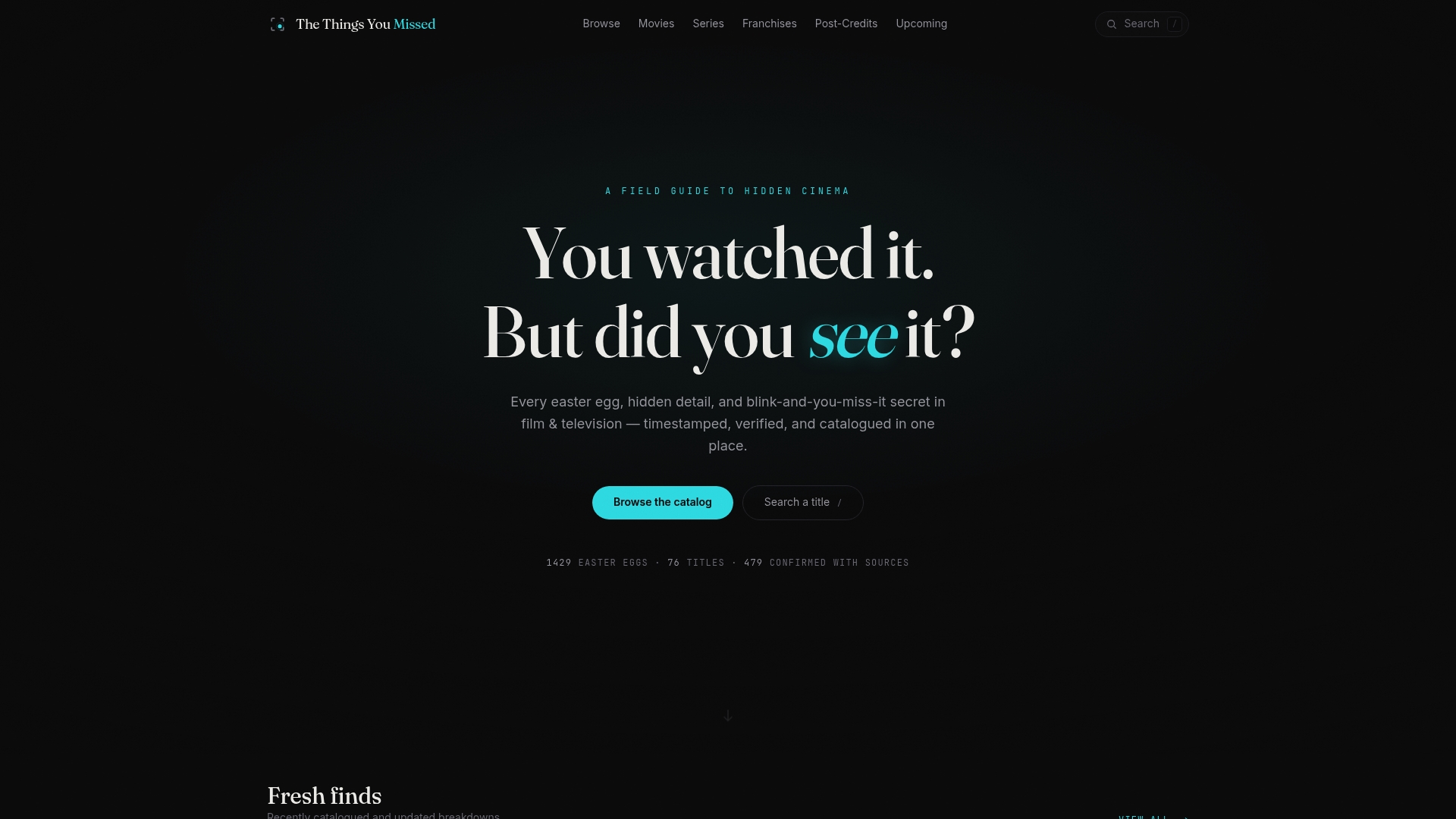
If you are not sure where to begin, start with the most confirmed easter eggs and work backward to the structure behind them.
FAQ
What is a non-linear storyline?
It is a plot that does not present events in the order they occurred. It can use flashbacks, flash-forwards, multiple timelines, reverse order or a looping structure. The audience pieces the chronology together, and that effort is often the source of the story’s tension.
What is the difference between nonlinear storytelling and an unreliable narrator?
Nonlinear storytelling rearranges when events appear. An unreliable narrator is a storyteller whose account cannot be fully trusted, so you question what you are told. A film can use one, the other or both. Memento leans on structure, while The Usual Suspects leans on a fabricated account.
Which movies are good examples of nonlinear storytelling?
Memento runs color scenes backward and black-and-white scenes forward. Pulp Fiction scrambles the chronology of three interlocking stories. Inception uses non-linearity to create suspense. All three are easy to find and rewarding to rewatch with the structure in mind.
How do I keep track of a movie told out of order?
Look for recurring images and objects that mark a change of time or place, and note any visual rule the film sets, like a color scheme. Resist solving the puzzle mid-film. A second viewing, with the real order in your head, is where most of the design becomes clear.
Sources
- Out of Order: A Discussion of Nonlinear Narrative Structure (LitReactor)
- Loops, flashbacks and fractured narratives: why filmmakers love to play with time (The Conversation)
- Visual Mindscape: Anchors, Triggers and Writing Flashbacks (Script Magazine)
- The Power of Unreliable Narrators: Crafting Suspense in Film and TV (Creative Screenwriting)
- “He lies like an eyewitness”: Unreliable Narration (Heteroglossia, 2024)